Species · Flowering plants
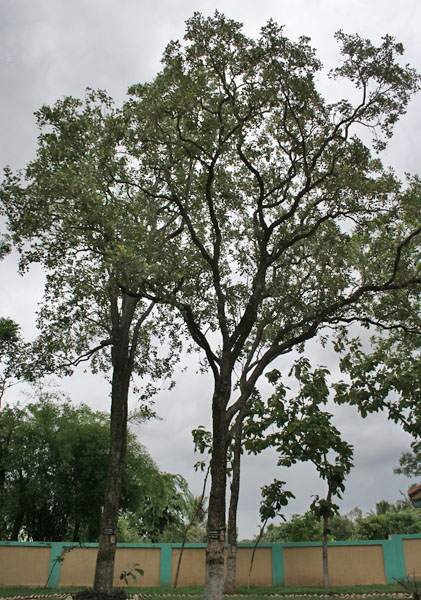
Bloodwood Pterocarpus officinalis
The scientific name of the Bloodwood is Pterocarpus officinalis. It is a species of flowering plant in the family Fabaceae (bean), order Fabales.
- Scientific name
- Pterocarpus officinalis Jacq.
- Common name
- Bloodwood
- Genus
- Pterocarpus
- Family
- Fabaceae (Bean)
- Order
- Fabales
- Class
- Magnoliopsida
- Red List category
- NT Near Threatened
- Recorded in
- 26 countries
- Name status
- accepted in the Catalogue of Life

Overview
Bloodwood is a flowering plant in the Fabaceae family. It is native to southern Mexico, Central America, the Caribbean, and northern South America. It is a dominant plant of oligotrophic wetlands.
Written 26 November 2026 from the sources listed below. Each statement was checked against the passage it cites; statements that could not be supported were removed.
Habitat
Bloodwood typically grows in coastal freshwater or slightly brackish habitats. It occurs alongside mangroves that occupy more saline habitats.[1][2]
Bloodwood is identified as a dominant plant of oligotrophic wetlands.[3]
Conservation
The forested habitats of Bloodwood in Puerto Rico are described as rare.[4]
Uses
The timber of Bloodwood is commercially traded.[5]
Classification of the Bloodwood
| Kingdom | Plantae |
|---|---|
| Subkingdom | Pteridobiotina |
| Phylum | Tracheophyta |
| Class | Magnoliopsida |
| Order | Fabales |
| Family | Fabaceae (Bean) |
| Genus | Pterocarpus |
| Species | Pterocarpus officinalis Jacq. |
Where the Bloodwood is found
Checklists and occurrence records place Pterocarpus officinalis in 26 countries across North America and South America. GBIF holds 33,840 georeferenced records of it.
Countries
- Belize 72
- Brazil 238
- Colombia 32,379
- Costa Rica 154
- Cuba 2
- Dominica 46
- Dominican Republic 15
- Ecuador 56
- French Guiana 115
- Guadeloupe 58
- Guatemala 33
- Guyana 46
- Haiti 1
- Honduras 19
- Jamaica 13
- Martinique 8
- Mexico 67
- Nicaragua 48
- Panama 101
- Peru 3
- Puerto Rico 180
- Saint Lucia 8
- Suriname 81
- Trinidad and Tobago 10
- United States 16
- Venezuela 71
Regions and cities with the most records
- Sucre Department, Colombia 26,346
- Bolívar, Colombia 3,751
- Antioquia, Colombia 1,051
- Ituango, Colombia 890
- Valle del Cauca Department, Colombia 617
- Humacao, Puerto Rico 86
- Limón Province, Costa Rica 77
- Humacao, Puerto Rico 74
- Amazonas, Brazil 63
- Chocó, Colombia 54
- Fajardo, Puerto Rico 49
- Baie-Mahault, Guadeloupe 47
- Pointe-à-Pitre, Guadeloupe 44
- San Jacinto, Colombia 44
- San Juan Nepomuceno, Colombia 44
- Cesar Department, Colombia 43
- Petit-Bourg, Guadeloupe 40
- Les Abymes, Guadeloupe 38
- Puntarenas Province, Costa Rica 38
- Sainte-Rose, Guadeloupe 36
- Le Gosier, Guadeloupe 35
- Veracruz, Mexico 35
- Esmeraldas, Ecuador 33
- Amazonas Department, Colombia 29
- Cauca Department, Colombia 28
- Santander Department, Colombia 28
- Amapá, Brazil 26
- El Carmen de Bolívar, Colombia 25
- Carolina, Puerto Rico 24
- Matoury, French Guiana 23
- Capesterre-Belle-Eau, Guadeloupe 22
- Luquillo, Puerto Rico 21
- Río Grande, Puerto Rico 19
- Cayenne, French Guiana 18
- Heredia Province, Costa Rica 18
- Pará, Brazil 18
A number beside a place is its count of GBIF occurrence records. A place without a number comes from a checklist alone. Records show where a species has been observed or collected, which can include escapes and vagrants.
Common names
English
- Bloodwood
- Dragon Blood Tree
- Dragonsblood Tree
Names in 5 other languages
- Czech
- křídlok lékařský
- French
- mangle médaille
- German
- Amerikanischer Drachenbaum, Drachenblutbaum, Westindischer Drachenbaum
- Slovak
- santalovec lekársky
- Spanish
- Sangre de drago, Sangrillo, bollo blanco, drago, lagunero, sangre
Synonyms
12 other scientific names have been used for this species and are now treated as synonyms of Pterocarpus officinalis.
- Lingoum officinale (Jacq.) Kuntze
- Moutouchi crispata (DC.) Benth.
- Moutouchi draco (L.) Benth.
- Moutouchi suberosa Aubl.
- Pterocarpus belizensis Standl.
- Pterocarpus crispatus DC.
- Pterocarpus draco L.
- Pterocarpus hemipterus Gaertn.
- Pterocarpus moutouchi Lam.
- Pterocarpus officinalis subsp. officinalis
- Pterocarpus sanguis-draconis Crantz
- Pterocarpus suberosus (Aubl.) Pers.
Related species
-
 Red SandalwoodPterocarpus santalinus
-
 Amboyna WoodPterocarpus indicus
-
 Malabar KinoPterocarpus marsupium
-
 Wild TeakPterocarpus angolensis
-
 African PadaukPterocarpus soyauxii
-
 Burma PadaukPterocarpus macrocarpus
-
 Andaman PadaukPterocarpus dalbergioides
-
 African RosewoodPterocarpus erinaceus
Compare
Questions and answers
What is the scientific name of the Bloodwood?
The scientific name of the Bloodwood is Pterocarpus officinalis. Written with its author, the full name is Pterocarpus officinalis Jacq..
Which family does the Bloodwood belong to?
Pterocarpus officinalis belongs to the family Fabaceae, in the order Fabales and the class Magnoliopsida.
Where is the Bloodwood found?
Checklists and occurrence records place Pterocarpus officinalis in 26 countries, including Colombia, Brazil, Puerto Rico, Costa Rica, French Guiana and Panama.
What is the conservation status of the Bloodwood?
The IUCN Red List category recorded for Pterocarpus officinalis is Near Threatened (NT).
What other names does the Bloodwood have?
Pterocarpus officinalis is also known in English as Dragon Blood Tree and Dragonsblood Tree.
How rare is bloodwood?
Its forested habitats in Puerto Rico are described as rare. Forests dominated by Bloodwood cover 261 hectares across 15 locations in Puerto Rico.[6][4]
What is bloodwood good for?
Its timber is commercially traded.[5]
What is the biological source and family of the Pterocarpus plant?
Pterocarpus officinalis Jacq. is a flowering plant belonging to the Fabaceae family.[7]
What are some native trees in Puerto Rico?
Bloodwood is represented by forests covering 261 hectares across 15 locations in Puerto Rico.[6]
Sources
Passages the profile rests on
- The species typically grows in coastal freshwater or slightly brackish habitats. Source passage: “typically found in coastal freshwater or slightly brackish habitats” — English Wikipedia
- The species occurs alongside mangroves that occupy more saline habitats. Source passage: “in association with mangroves that occupy the more saline areas.” — English Wikipedia
- The species is identified as a dominant plant of oligotrophic wetlands. Source passage: “Dominants of oligotrophic wetlands (Pterocarpus officinalis and. Prestoea montana) were displaced.” — repository.upenn.edu
- The forested habitats of this species in Puerto Rico are described as rare. Source passage: “highlighting their rarity.” — academia.edu
- The timber of this species is commercially traded. Source passage: “Its timber is commercially traded.” — English Wikipedia
- Forests dominated by this species cover 261 hectares across 15 locations in Puerto Rico. Source passage: “Pterocarpus officinalis forests in Puerto Rico cover only 261 ha across 15 locations” — academia.edu
- The species is a flowering plant belonging to the Fabaceae family. Source passage: “is a species of flowering plant in the family Fabaceae” — English Wikipedia
Data
- Catalogue of Life, 2026-10-16 XR cc by
- Global Biodiversity Information Facility CC BY 4.0
- Wikidata CC0
- GeoNames CC BY 4.0
- Wikimedia Commons per image; credit shown with each image
- Within the Catalogue of Life, this name comes from The World Checklist of Vascular Plants (WCVP): Fabaceae cc by
References
- Select. Stirp. Amer. Hist.: 283 (1763) where the name was published
This species in other databases
- Catalogue of Life 4PVJR
- Wikidata Q3410267
- iNaturalist 292108
- World Flora Online wfo-0000194876
- GRIN 30291
Page built on 26 November 2026. See how the catalog is made and all sources and licences.
Cite this page
ScientificNames.org. (2026). Pterocarpus officinalis (Bloodwood). Retrieved November 26, 2026, from https://scientificnames.org/species/pterocarpus-officinalis
“Pterocarpus officinalis (Bloodwood).” ScientificNames.org, 2026, scientificnames.org/species/pterocarpus-officinalis. Accessed 26 Nov. 2026.
ScientificNames.org. “Pterocarpus officinalis (Bloodwood).” Accessed November 26, 2026. https://scientificnames.org/species/pterocarpus-officinalis.
@misc{scientificnames_pterocarpus_officinalis_bloodwood,
  author = {{ScientificNames.org}},
  title = {Pterocarpus officinalis (Bloodwood)},
  year = {2026},
  url = {https://scientificnames.org/species/pterocarpus-officinalis},
  note = {Accessed 2026-11-26}
}