Species · Flowering plants
Malabar Kino Pterocarpus marsupium
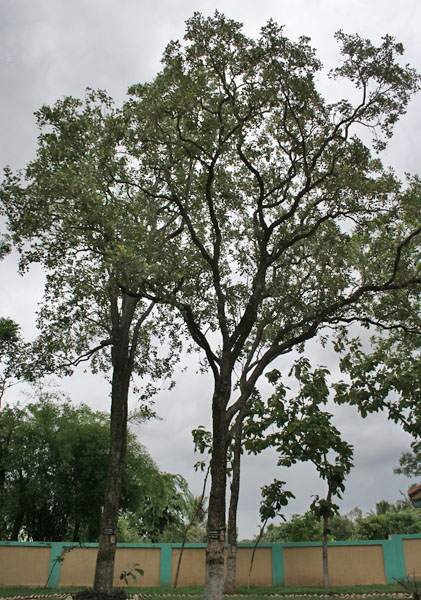
The scientific name of the Malabar Kino is Pterocarpus marsupium. It is a species of flowering plant in the family Fabaceae (bean), order Fabales.
- Scientific name
- Pterocarpus marsupium Roxb.
- Common name
- Malabar Kino
- Genus
- Pterocarpus
- Family
- Fabaceae (Bean)
- Order
- Fabales
- Class
- Magnoliopsida
- Red List category
- NT Near Threatened
- Recorded in
- 7 countries
- Name status
- accepted in the Catalogue of Life

Overview
Pterocarpus marsupium is native to India, Nepal, and Sri Lanka. It contains the chemical compound 2,3,6-trimethyl-1,4-naphthoquinone, which may cause skin, eye, and respiratory irritation.
Written 26 November 2026 from the sources listed below. Each statement was checked against the passage it cites; statements that could not be supported were removed.
Appearance
Malabar kino is a deciduous tree. It can grow up to 31 metres tall and can reach a height of 30 metres.[1][2][3]
Habitat
Malabar kino is native to India, Nepal, and Sri Lanka. In India, it occurs in parts of the Western Ghats in the Karnataka-Kerala region and in the forests of Central India.[4][5]
Uses
Malabar kino contains the chemical compound 2,3,6-trimethyl-1,4-naphthoquinone. This compound may cause skin, eye, and respiratory irritation.[6][7]
Classification of the Malabar Kino
| Kingdom | Plantae |
|---|---|
| Subkingdom | Pteridobiotina |
| Phylum | Tracheophyta |
| Class | Magnoliopsida |
| Order | Fabales |
| Family | Fabaceae (Bean) |
| Genus | Pterocarpus |
| Species | Pterocarpus marsupium Roxb. |
Where the Malabar Kino is found
Checklists and occurrence records place Pterocarpus marsupium in 7 countries across Africa, Asia and North America. GBIF holds 994 georeferenced records of it.
Countries where it is native or its origin is not stated
Countries where it has been introduced
Regions and cities with the most records
- Kerala, India 442
- Māvelikara, India 155
- Chengannūr, India 154
- Cheppad, India 154
- Karthikappally, India 154
- Bharanikāvu Tekku, India 153
- Kattanam, India 153
- Adūr, India 140
- Ayanavelikulangara Vadakku, India 138
- Kalleribhāgam, India 138
- Karungappalli, India 137
- Kulasēkarapuram, India 137
- Muthukulam, India 137
- Thodiyoor, India 137
- Ādanāttutekkumuri Kizhakku, India 137
- Kayamkulam, India 136
- Krishnāpuram, India 136
- Ochira, India 136
- Pattiyūrgrāmam, India 136
- Kandalloor, India 135
- Ambikāpuram, India 111
- Puthuppariyāram, India 111
- Chirakkal, India 108
- Marutharōd, India 107
- Ancharakandy, India 106
- Chelora, India 106
- Chālakilakākara, India 106
- Elayavur, India 106
- Irivēri, India 106
- Kadachira, India 106
- Kanhirode, India 106
- Kannur, India 106
- Keevallur, India 106
- Kudali, India 106
- Mattanur, India 106
- Munderi, India 106
2 more countries have a few records outside this range
These countries hold a few records of Pterocarpus marsupium but lie outside the range the checklists give for it. Such records are often zoo or garden specimens, museum material or vagrants, so the species is not counted as occurring there.
A number beside a place is its count of GBIF occurrence records. A place without a number comes from a checklist alone. Records show where a species has been observed or collected, which can include escapes and vagrants.
Common names
English
- Malabar Kino
- East Indian Kino
- East Indian/Malabar Kino
- Indian Kino
- Indian Kinotree
Names in 6 other languages
- Chinese
- 襄状紫檀, 马拉巴紫檀
- Czech
- křídlok vakovitý
- Hindi
- bijasal, विजयसार
- Marathi
- बिबला, बीजा
- Slovak
- santalovec vakovitý
- Tamil
- வேங்கை
Synonyms
2 other scientific names have been used for this species and are now treated as synonyms of Pterocarpus marsupium.
- Lingoum marsupium (Roxb.) Kuntze
- Pterocarpos marsupius (Roxb.) St.-Lag.
Subspecies and varieties
- Pterocarpus marsupium subsp. acuminatus subspecies
- Pterocarpus marsupium subsp. marsupium subspecies
Related species
-
 Red SandalwoodPterocarpus santalinus
-
 Amboyna WoodPterocarpus indicus
-
 MukwaPterocarpus angolensis
-
 MuengePterocarpus soyauxii
-
 Burma PadaukPterocarpus macrocarpus
-
 NarraPterocarpus dalbergioides
-
 KenoPterocarpus erinaceus
-
 BloodwoodPterocarpus officinalis
Compare
Questions and answers
What is the scientific name of the Malabar Kino?
The scientific name of the Malabar Kino is Pterocarpus marsupium. Written with its author, the full name is Pterocarpus marsupium Roxb..
Which family does the Malabar Kino belong to?
Pterocarpus marsupium belongs to the family Fabaceae, in the order Fabales and the class Magnoliopsida.
Where is the Malabar Kino found?
Checklists and occurrence records place Pterocarpus marsupium in 7 countries, including India, Sri Lanka, Nepal, Taiwan and Bangladesh.
What is the conservation status of the Malabar Kino?
The IUCN Red List category recorded for Pterocarpus marsupium is Near Threatened (NT).
What other names does the Malabar Kino have?
Pterocarpus marsupium is also known in English as East Indian Kino, East Indian/Malabar Kino, Indian Kino and Indian Kinotree.
What are the potential side effects of Vijaysar wood?
Malabar kino contains 2,3,6-trimethyl-1,4-naphthoquinone, which may cause skin, eye, and respiratory irritation.[6][7]
What is the Indian kino tree?
Malabar kino (Pterocarpus marsupium Roxb.) is a deciduous flowering tree in the family Fabaceae.[1]
Sources
Passages the profile rests on
- Pterocarpus marsupium is a deciduous tree. Source passage: “is a medium-to-large, deciduous tree” — English Wikipedia
- Pterocarpus marsupium can grow up to 31 metres tall. Source passage: “can grow up to 31 m (102 ft) tall.” — English Wikipedia
- Pterocarpus marsupium can reach a height of 30 metres. Source passage: “is a medium to large, deciduous tree that can grow up to 30 metres (98 ft)” — inaturalist.org
- Pterocarpus marsupium is native to India, Nepal, and Sri Lanka. Source passage: “It is native to India (where it occurs in parts of the Western Ghats in the Karnataka-Kerala region and in the forests of Central India), Nepal, and Sri Lanka.” — English Wikipedia
- In India, Pterocarpus marsupium occurs in parts of the Western Ghats in the Karnataka-Kerala region and in the forests of Central India. Source passage: “parts of the Western Ghats in the Karnataka-Kerala region and in the forests of Central India” — English Wikipedia
- Pterocarpus marsupium contains the chemical compound 2,3,6-trimethyl-1,4-naphthoquinone. Source passage: “Pterocarpus marsupium contains 2,3,6-trimethyl-1,4-naphthoquinone” — English Wikipedia
- The compound 2,3,6-trimethyl-1,4-naphthoquinone in Pterocarpus marsupium may cause skin, eye, and respiratory irritation. Source passage: “may cause skin, eye and respiratory irritation.” — English Wikipedia
Data
- Catalogue of Life, 2026-10-16 XR cc by
- Global Biodiversity Information Facility CC BY 4.0
- Wikidata CC0
- GeoNames CC BY 4.0
- Wikimedia Commons per image; credit shown with each image
- Within the Catalogue of Life, this name comes from The World Checklist of Vascular Plants (WCVP): Fabaceae cc by
References
- Pl. Coromandel 2: 9 (1799) where the name was published
This species in other databases
- Catalogue of Life 4PVJF
- Wikidata Q2385259
- iNaturalist 68659
- World Flora Online wfo-0000185089
- GRIN 30289
Page built on 26 November 2026. See how the catalog is made and all sources and licences.
Cite this page
ScientificNames.org. (2026). Pterocarpus marsupium (Malabar Kino). Retrieved November 26, 2026, from https://scientificnames.org/species/pterocarpus-marsupium
“Pterocarpus marsupium (Malabar Kino).” ScientificNames.org, 2026, scientificnames.org/species/pterocarpus-marsupium. Accessed 26 Nov. 2026.
ScientificNames.org. “Pterocarpus marsupium (Malabar Kino).” Accessed November 26, 2026. https://scientificnames.org/species/pterocarpus-marsupium.
@misc{scientificnames_pterocarpus_marsupium_malabar_kino,
  author = {{ScientificNames.org}},
  title = {Pterocarpus marsupium (Malabar Kino)},
  year = {2026},
  url = {https://scientificnames.org/species/pterocarpus-marsupium},
  note = {Accessed 2026-11-26}
}