Species · Flowering plants
African Padauk Pterocarpus soyauxii
The scientific name of the African Padauk is Pterocarpus soyauxii. It is a species of flowering plant in the family Fabaceae (bean), order Fabales.
- Scientific name
- Pterocarpus soyauxii Taub.
- Common name
- African Padauk
- Genus
- Pterocarpus
- Family
- Fabaceae (Bean)
- Order
- Fabales
- Class
- Magnoliopsida
- Recorded in
- 9 countries
- Name status
- accepted in the Catalogue of Life

Overview
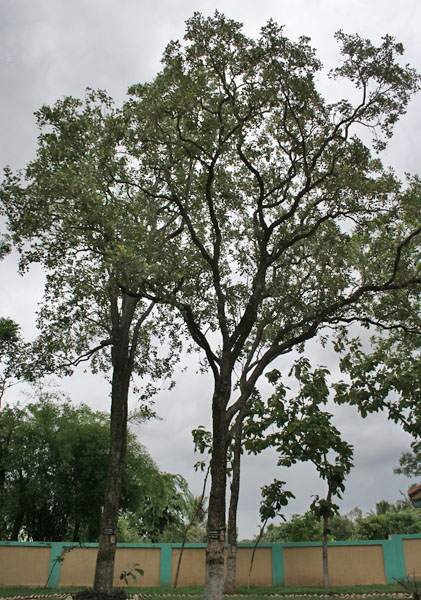
The species is native to central and tropical west Africa, ranging from Nigeria eastward to Congo-Kinshasa and southward to Angola. It is a tree with reddish-grey bark, pinnate leaves and thorny fruits, and its durable wood is used to manufacture musical instruments.
Written 26 November 2026 from the sources listed below. Each statement was checked against the passage it cites; statements that could not be supported were removed.
Habitat
African padauk is native to central and tropical west Africa. Its range extends from Nigeria eastward to Congo-Kinshasa and southward to Angola.[1]
Appearance
The tree reaches a height of 27–34 m, and its trunk can reach 1 m in diameter. The trunk has flaky reddish-grey bark.[2][3][4]
The leaves are pinnate and contain 11–13 leaflets. The flowers are arranged in panicles.[5][6]
The wood is initially red and changes to purplish-brown when exposed to light. Its density is 0.79 g/cm3.[7][8]
Diet
The leaves are consumed as a vegetable and contain large amounts of vitamin C.[9][10]
Reproduction and life cycle
The species produces thorny fruits measuring 6–9 cm in length. The mature fruit does not split open.[11][12]
Uses
Bark extracts are used in herbal medicine to treat skin parasites and fungal infections.[13]
The wood is valued for its durability and tonal properties. It is resistant to termite damage.[14][15]
The wood is used to manufacture drums in Africa because of its tonal resonance. It is also used in acoustic and electric guitars because of its tonal attributes and durability.[16][17]
Dust generated during wood processing can cause dermatitis in some people.[18]
Classification of the African Padauk
| Kingdom | Plantae |
|---|---|
| Subkingdom | Pteridobiotina |
| Phylum | Tracheophyta |
| Class | Magnoliopsida |
| Order | Fabales |
| Family | Fabaceae (Bean) |
| Genus | Pterocarpus |
| Species | Pterocarpus soyauxii Taub. |
Where the African Padauk is found
Checklists and occurrence records place Pterocarpus soyauxii in 9 countries across Africa. GBIF holds 1,273 georeferenced records of it.
Countries
- Angola 38
- Cameroon 215
- Central African Republic 33
- Democratic Republic of the Congo 235
- Equatorial Guinea 25
- Gabon 658
- Nigeria 11
- Republic of the Congo 55
- Sierra Leone 3
Regions and cities with the most records
- Ogooué-Ivindo, Gabon 151
- Estuaire, Gabon 120
- Tshopo, Democratic Republic of the Congo 111
- Ogooué-Lolo, Gabon 91
- Yangambi, Democratic Republic of the Congo 80
- Woleu-Ntem, Gabon 58
- South, Cameroon 55
- Haut-Ogooué, Gabon 27
- South-West, Cameroon 27
- East, Cameroon 25
- Moyen-Ogooué, Gabon 25
- Littoral, Cameroon 22
- North-West, Cameroon 20
- Libreville, Gabon 19
- Kisangani, Democratic Republic of the Congo 17
- Bas-Uele, Democratic Republic of the Congo 16
- Makokou, Gabon 16
- Owendo, Gabon 16
- Nkongsamba, Cameroon 15
- Sangha, Republic of the Congo 14
- Likouala, Republic of the Congo 13
- Mouila, Gabon 13
- Nyanga, Gabon 12
- Kribi, Cameroon 10
- Oyam, Gabon 10
- Tshuapa, Democratic Republic of the Congo 10
- Équateur, Democratic Republic of the Congo 10
- Lobaye, Central African Republic 9
- Mbaïki, Central African Republic 9
- Sangha-Mbaéré, Central African Republic 9
- Centre, Cameroon 7
- Mbanga, Cameroon 7
- Ntoum, Gabon 7
- Akanda, Gabon 6
- Bolenge, Democratic Republic of the Congo 6
- Kumba, Cameroon 6
A number beside a place is its count of GBIF occurrence records. A place without a number comes from a checklist alone. Records show where a species has been observed or collected, which can include escapes and vagrants.
Common names
English
- African Padauk
- African Coralwood
- Gabon Padauk
- Barwood
- Muenge
- Redwood
Names in 4 other languages
- Finnish
- punaveripihkapuu
- French
- bois rouge
- Slovak
- santalovec africký
- Swedish
- afrikansk padauk
Related species
-
 Red SandalwoodPterocarpus santalinus
-
 Amboyna WoodPterocarpus indicus
-
 Malabar KinoPterocarpus marsupium
-
 Wild TeakPterocarpus angolensis
-
 Burma PadaukPterocarpus macrocarpus
-
 Andaman PadaukPterocarpus dalbergioides
-
 African RosewoodPterocarpus erinaceus
-
 BloodwoodPterocarpus officinalis
Compare
Questions and answers
What is the scientific name of the African Padauk?
The scientific name of the African Padauk is Pterocarpus soyauxii. Written with its author, the full name is Pterocarpus soyauxii Taub..
Which family does the African Padauk belong to?
Pterocarpus soyauxii belongs to the family Fabaceae, in the order Fabales and the class Magnoliopsida.
Where is the African Padauk found?
Checklists and occurrence records place Pterocarpus soyauxii in 9 countries, including Gabon, Democratic Republic of the Congo, Cameroon, Republic of the Congo, Angola and Central African Republic.
What other names does the African Padauk have?
Pterocarpus soyauxii is also known in English as African Coralwood, Gabon Padauk, Barwood, Muenge and Redwood.
Sources
Passages the profile rests on
- The species is native to central and tropical west Africa, ranging from Nigeria eastward to Congo-Kinshasa and southward to Angola. Source passage: “native to central and tropical west Africa, from Nigeria east to Congo-Kinshasa and south to Angola.” — English Wikipedia
- The tree reaches a height of 27–34 m. Source passage: “It is a tree growing to 27–34 m tall” — English Wikipedia
- The trunk can reach 1 m in diameter. Source passage: “with a trunk diameter up to 1 m” — English Wikipedia
- The trunk has flaky reddish-grey bark. Source passage: “with flaky reddish-grey bark.” — English Wikipedia
- The leaves are pinnate and contain 11–13 leaflets. Source passage: “The leaves are pinnate, with 11–13 leaflets.” — English Wikipedia
- The flowers are arranged in panicles. Source passage: “The flowers are produced in panicles.” — English Wikipedia
- The wood is initially red and changes to purplish-brown when exposed to light. Source passage: “red at first, becoming purplish-brown on exposure to light” — English Wikipedia
- The wood has a density of 0.79 g/cm3. Source passage: “with a density of 0.79 g/cm3.” — English Wikipedia
- The leaves are consumed as a vegetable. Source passage: “they are eaten as a leaf vegetable.” — English Wikipedia
- The leaves contain large amounts of vitamin C. Source passage: “The leaves are edible, and contain large amounts of vitamin C” — English Wikipedia
- The species produces thorny fruits measuring 6–9 cm in length. Source passage: “The fruit is a thorny pod 6–9 cm long” — English Wikipedia
- The mature fruit does not split open. Source passage: “which does not split open at maturity.” — English Wikipedia
- Bark extracts are used in herbal medicine to treat skin parasites and fungal infections. Source passage: “Bark extracts are used in herbal medicine to treat skin parasites and fungal infections.” — English Wikipedia
- The wood is valued for its durability and tonal properties. Source passage: “The wood is valuable; it is very durable” — English Wikipedia
- The wood is resistant to termite damage. Source passage: “It is resistant to termites.” — English Wikipedia
- The wood is used to manufacture drums in Africa because of its tonal resonance. Source passage: “It is valued for making drums in Africa due to its tonal resonance.” — English Wikipedia
- The wood is used in acoustic and electric guitars because of its tonal attributes and durability. Source passage: “The wood is also favored for its use in stringed instruments (namely acoustic and electric guitars) for its tonal attributes and durability.” — English Wikipedia
- Dust generated during wood processing can cause dermatitis in some people. Source passage: “Dust from the wood produced during wood processing can cause dermatitis in some people.” — English Wikipedia
Data
- Catalogue of Life, 2026-10-16 XR cc by
- Global Biodiversity Information Facility CC BY 4.0
- Wikidata CC0
- GeoNames CC BY 4.0
- Wikimedia Commons per image; credit shown with each image
- Within the Catalogue of Life, this name comes from The World Checklist of Vascular Plants (WCVP): Fabaceae cc by
References
- Hooker's Icon. Pl. 24: t. 2369 (1895) where the name was published
This species in other databases
- Catalogue of Life 4PVKG
- Wikidata Q2312121
- iNaturalist 1497635
- World Flora Online wfo-0000172858
- GRIN 312067
Page built on 29 November 2026. See how the catalog is made and all sources and licences.
Cite this page
ScientificNames.org. (2026). Pterocarpus soyauxii (African Padauk). Retrieved November 29, 2026, from https://scientificnames.org/species/pterocarpus-soyauxii
“Pterocarpus soyauxii (African Padauk).” ScientificNames.org, 2026, scientificnames.org/species/pterocarpus-soyauxii. Accessed 29 Nov. 2026.
ScientificNames.org. “Pterocarpus soyauxii (African Padauk).” Accessed November 29, 2026. https://scientificnames.org/species/pterocarpus-soyauxii.
@misc{scientificnames_pterocarpus_soyauxii_african_padauk,
  author = {{ScientificNames.org}},
  title = {Pterocarpus soyauxii (African Padauk)},
  year = {2026},
  url = {https://scientificnames.org/species/pterocarpus-soyauxii},
  note = {Accessed 2026-11-29}
}