Species · Flowering plants
White Padouk Pterocarpus mildbraedii
The scientific name of the White Padouk is Pterocarpus mildbraedii. It is a species of flowering plant in the family Fabaceae (bean), order Fabales.
- Scientific name
- Pterocarpus mildbraedii Harms
- Common name
- White Padouk
- Genus
- Pterocarpus
- Family
- Fabaceae (Bean)
- Order
- Fabales
- Class
- Magnoliopsida
- Red List category
- LC Least Concern
- Recorded in
- 14 countries
- Name status
- accepted in the Catalogue of Life
Overview
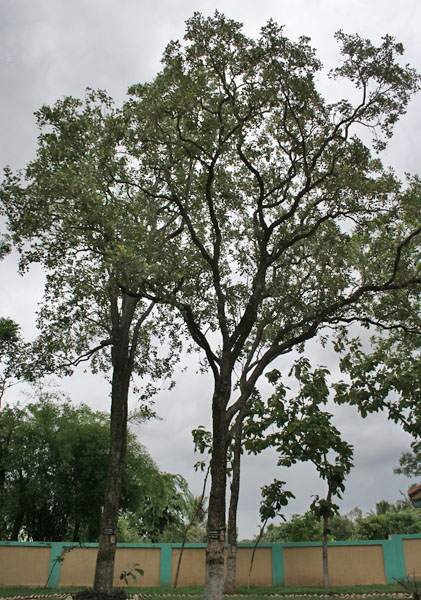
White Padouk (Pterocarpus mildbraedii Harms) is a semi-deciduous tree with a non-climbing growth habit. The species occurs in West and Central Africa, extending from Guinea to the Democratic Republic of Congo, and is also found in Tanzania's Usambara Mountains. It has golden yellow flowers and produces large, obovate, semi-transparent fruit pods.
Written 26 November 2026 from the sources listed below. Each statement was checked against the passage it cites; statements that could not be supported were removed.
Appearance
White Padouk is a semi-deciduous tree with a non-climbing growth habit. The West African type subspecies has a small, rounded crown.[1][2][3]
The bark is greyish to pale brown and may have longitudinal cracks. The leaves are alternate and imparipinnately compound.[4][5]
Young leaves are light green and become darker green when mature. The leaflets are ovate to elliptical, with acuminate tips and rounded bases.[6][7]
The flowers are golden yellow. The fruit is a large, obovate, semi-transparent pod.[8][9]
The West African type subspecies can reach 25 metres in height, while the East African subspecies P. m. subsp. usumbarensis can grow up to 75 metres tall.[10][11]
The leaflets can reach 14 centimetres in length and 7 centimetres in width. The fruit pod can reach 12 centimetres in length.[12][13][14]
Habitat
White Padouk occurs in West and Central Africa, extending from Guinea to the Democratic Republic of Congo. It is also found in Tanzania's Usambara Mountains.[15][16]
The type subspecies is native to West Africa. The subspecies P. m. subsp. usumbarensis is endemic to the mountains of East Africa.[17][18]
Uses
The leaves are used as an ingredient in Nigerian oha soup. The species is known as Oha in Southeastern Nigeria.[19][20]
Leaf extracts are used in traditional medicine for pain management.[21]
White Padouk is considered suitable for use as a shade tree in Ghanaian cocoa plantations.[22]
The species is known as Aguaya in Ivory Coast. Its leaves have been reported to contain high levels of hydrogen cyanide and oxalate.[23][24]
Conservation
White Padouk was assessed for the IUCN Red List in 2011.[25]
Classification of the White Padouk
| Kingdom | Plantae |
|---|---|
| Subkingdom | Pteridobiotina |
| Phylum | Tracheophyta |
| Class | Magnoliopsida |
| Order | Fabales |
| Family | Fabaceae (Bean) |
| Genus | Pterocarpus |
| Species | Pterocarpus mildbraedii Harms |
Where the White Padouk is found
Checklists and occurrence records place Pterocarpus mildbraedii in 14 countries across Africa. GBIF holds 339 georeferenced records of it.
Countries
- Benin 12
- Cameroon 92
- Central African Republic
- Equatorial Guinea 16
- Gabon 11
- Ghana 5
- Guinea 3
- Ivory Coast 22
- Liberia 10
- Nigeria 120
- Republic of the Congo
- Sierra Leone 2
- Tanzania 32
- Togo 14
Regions and cities with the most records
- Littoral, Cameroon 50
- Delta, Nigeria 47
- Nkongsamba, Cameroon 42
- Ughelli, Nigeria 23
- Centre, Cameroon 18
- Edo State, Nigeria 12
- Ekpoma, Nigeria 12
- Uromi, Nigeria 12
- Ondo State, Nigeria 11
- Lagos, Nigeria 10
- Okoa, Cameroon 10
- Plateaux, Togo 10
- South-West, Cameroon 10
- Warri, Nigeria 10
- Yaoundé, Cameroon 10
- Ajegunle, Nigeria 9
- Aliayabiagba, Nigeria 9
- Montserrado County, Liberia 9
- Rivers State, Nigeria 9
- Domaa-Ahenkro, Ghana 8
- Maramba, Tanzania 8
- Mushin, Nigeria 8
- Oshodi, Nigeria 8
- Surulere, Nigeria 8
- Tanga, Tanzania 8
- Zanzan District, Ivory Coast 8
- Alimosho, Nigeria 7
- Ikare, Nigeria 7
- Lagos, Nigeria 7
- Muheza, Tanzania 7
- Shomolu, Nigeria 7
- Ubiaja, Nigeria 7
- Agege, Nigeria 6
- Akowonjo, Nigeria 6
- Cové, Benin 6
- Cross River State, Nigeria 6
A number beside a place is its count of GBIF occurrence records. A place without a number comes from a checklist alone. Records show where a species has been observed or collected, which can include escapes and vagrants.
Common names
English
- White Padouk
- Oha Leaf
Names in 4 other languages
- French
- padouk blanc
- Slovak
- santalovec Mildbraedov
- Swahili
- mkula
- ibo
- oha ojii
Synonyms
3 other scientific names have been used for this species and are now treated as synonyms of Pterocarpus mildbraedii.
- Pterocarpus mildbraedii subsp. mildbraedii
- Pterocarpus mildbraedii subsp. usambarensis (Verdc.) Polhill
- Pterocarpus usambarensis Verdc.
Related species
-
 Red SandalwoodPterocarpus santalinus
-
 Amboyna WoodPterocarpus indicus
-
 Malabar KinoPterocarpus marsupium
-
 Wild TeakPterocarpus angolensis
-
 African PadaukPterocarpus soyauxii
-
 Burma PadaukPterocarpus macrocarpus
-
 Andaman PadaukPterocarpus dalbergioides
-
 African RosewoodPterocarpus erinaceus
Compare
Questions and answers
What is the scientific name of the White Padouk?
The scientific name of the White Padouk is Pterocarpus mildbraedii. Written with its author, the full name is Pterocarpus mildbraedii Harms.
Which family does the White Padouk belong to?
Pterocarpus mildbraedii belongs to the family Fabaceae, in the order Fabales and the class Magnoliopsida.
Where is the White Padouk found?
Checklists and occurrence records place Pterocarpus mildbraedii in 14 countries, including Nigeria, Cameroon, Tanzania, Ivory Coast, Equatorial Guinea and Togo.
What is the conservation status of the White Padouk?
The IUCN Red List category recorded for Pterocarpus mildbraedii is Least Concern (LC).
What other names does the White Padouk have?
Pterocarpus mildbraedii is also known in English as Oha Leaf.
Sources
Passages the profile rests on
- The species is a semi-deciduous tree. Source passage: “Pterocarpus mildbraedii is a semi-deciduous tree within the family Fabaceae.” — English Wikipedia
- The tree has a non-climbing growth habit. Source passage: “A perennial and semi-deciduous non climbing tree” — English Wikipedia
- The West African type subspecies has a small, rounded crown. Source passage: “has a small rounded crown.” — English Wikipedia
- The bark is greyish to pale brown and may have longitudinal cracks. Source passage: “The species bark is smooth but sometimes longitudinally cracked and greyish to pale brown in colour” — English Wikipedia
- The leaves are alternate and imparipinnately compound. Source passage: “Leaves are alternate and imparipinnately compound” — English Wikipedia
- Young leaves are light green and become darker green when mature. Source passage: “the younger leaves tend to be light green but upon maturity it becomes a darker shade of green.” — English Wikipedia
- The leaflets are ovate to elliptical, with acuminate tips and rounded bases. Source passage: “Leaflets are ovate to elliptical in shape, acuminate at the apex while rounded at the base” — English Wikipedia
- The flowers are golden yellow. Source passage: “The flowers are golden yellow” — English Wikipedia
- The fruit is a large, obovate, semi-transparent pod. Source passage: “the fruit is a large obovate semi transparent pod” — English Wikipedia
- The West African type subspecies can reach 25 metres in height. Source passage: “The type subspecies is native to West Africa and can reach 25 m (82 ft) height” — English Wikipedia
- The East African subspecies P. m. subsp. usumbarensis can grow up to 75 metres tall. Source passage: “The subspecies P. m. subsp. usumbarensis is endemic to the mountains of East Africa and grows much larger, up to 75 m (246 ft) height.” — English Wikipedia
- The leaflets can reach 14 centimetres in length. Source passage: “they can reach up to 14 cm long and 7 cm wide.” — English Wikipedia
- The leaflets can reach 7 centimetres in width. Source passage: “they can reach up to 14 cm long and 7 cm wide.” — English Wikipedia
- The fruit pod can reach 12 centimetres in length. Source passage: “that is up to 12 cm long.” — English Wikipedia
- The species occurs in West and Central Africa, extending from Guinea to the Democratic Republic of Congo. Source passage: “It is distributed in West and Central Africa from Guinea to the Democratic Republic of Congo” — English Wikipedia
- The species is also found in Tanzania's Usambara Mountains. Source passage: “and it is also found in the Usambara mountains of Tanzania.” — English Wikipedia
- The type subspecies is native to West Africa. Source passage: “The type subspecies is native to West Africa” — English Wikipedia
- The subspecies P. m. subsp. usumbarensis is endemic to the mountains of East Africa. Source passage: “The subspecies P. m. subsp. usumbarensis is endemic to the mountains of East Africa” — English Wikipedia
- The leaves are used as an ingredient in Nigerian oha soup. Source passage: “Leaves of the species are used as ingredients in the preparation of oha soup in Nigeria.” — English Wikipedia
- The species is known as Oha in Southeastern Nigeria. Source passage: “It is known as 'Oha' in Southeastern Nigeria” — English Wikipedia
- Leaf extracts are used in traditional medicine for pain management. Source passage: “Leaf extracts are also used in traditional medicine for pain management.” — English Wikipedia
- The species is considered suitable for use as a shade tree in Ghanaian cocoa plantations. Source passage: “In Ghana, it is considered to be suitable as a shade tree in cocoa plantations.” — English Wikipedia
- The species is known as Aguaya in Ivory Coast. Source passage: “and as 'Aguaya' in Ivory Coast.” — English Wikipedia
- The leaves have been reported to contain high levels of hydrogen cyanide and oxalate. Source passage: “However, studies have shown the leaves to be high on hydrogen cyanide and oxalate.” — English Wikipedia
- The species was assessed for the IUCN Red List in 2011. Source passage: “has most recently been assessed for The IUCN Red List of Threatened Species in 2011.” — iucnredlist.org
Data
- Catalogue of Life, 2026-10-16 XR cc by
- Global Biodiversity Information Facility CC BY 4.0
- Wikidata CC0
- GeoNames CC BY 4.0
- Within the Catalogue of Life, this name comes from The World Checklist of Vascular Plants (WCVP): Fabaceae cc by
References
- Notizbl. Bot. Gart. Berlin-Dahlem 8: 152 (1922) where the name was published
This species in other databases
- Catalogue of Life 4PVJK
- Wikidata Q15542938
- iNaturalist 442814
- World Flora Online wfo-0000171921
- GRIN 480182
Page built on 26 November 2026. See how the catalog is made and all sources and licences.
Cite this page
ScientificNames.org. (2026). Pterocarpus mildbraedii (White Padouk). Retrieved November 26, 2026, from https://scientificnames.org/species/pterocarpus-mildbraedii
“Pterocarpus mildbraedii (White Padouk).” ScientificNames.org, 2026, scientificnames.org/species/pterocarpus-mildbraedii. Accessed 26 Nov. 2026.
ScientificNames.org. “Pterocarpus mildbraedii (White Padouk).” Accessed November 26, 2026. https://scientificnames.org/species/pterocarpus-mildbraedii.
@misc{scientificnames_pterocarpus_mildbraedii_white_padouk,
  author = {{ScientificNames.org}},
  title = {Pterocarpus mildbraedii (White Padouk)},
  year = {2026},
  url = {https://scientificnames.org/species/pterocarpus-mildbraedii},
  note = {Accessed 2026-11-26}
}