Species · Fishes
Flathead Perch Rainfordia opercularis
The scientific name of the Flathead Perch is Rainfordia opercularis. It is a species of fish in the family Epinephelidae (groupers), order Perciformes. The name dates from 1923.
- Scientific name
- Rainfordia opercularis McCulloch, 1923
- Common name
- Flathead Perch
- Genus
- Rainfordia
- Family
- Epinephelidae (Groupers)
- Order
- Perciformes
- Class
- Teleostei
- Red List category
- LC Least Concern
- Environment
- marine
- Recorded in
- 1 country
- Name status
- accepted in the Catalogue of Life

Overview
The Flathead Perch (Rainfordia opercularis) is a fish in the family Epinephelidae, order Perciformes and class Teleostei. It occurs in the eastern Indian Ocean and western Pacific Ocean, inhabiting inshore waters. It has a dark orange body with six lilac stripes bordered by black along each flank and a black eyespot edged in blue at the base of the tail.
Written 27 November 2026 from the sources listed below. Each statement was checked against the passage it cites; statements that could not be supported were removed.
Appearance
The Flathead Perch has a dark orange body with six lilac stripes bordered by black along each flank. The orange coloration is darkest in the middle of the flanks and fades to yellow on the back and belly.[1][2]
The dorsal-fin spines are yellowish, with transparent membranes between them. The second dorsal fin has a dark base, a wide yellow band extending from the first soft ray to the tip of the seventh soft ray, a whitish outer edge and reddish-brown remaining soft rays.[3][4][5]
The anal fin has a colour pattern similar to that of the dorsal fin. The pectoral and pelvic fins are pinkish yellow.[6][7]
A black eyespot edged in blue occurs at the base of the tail. The caudal fin is brown with white edging at its outer corners.[8][9]
The species has eyes positioned relatively far forward and a wide mouth. Its maximum recorded total length is 15 centimetres.[10][11]
Habitat
The Flathead Perch inhabits inshore waters. It shelters in caves and crevices within coral reefs.[12][13]
Behaviour
The Flathead Perch is generally solitary.[14]
Uses
The Flathead Perch is traded in the aquarium industry. It commands high prices.[15]
Classification of the Flathead Perch
| Kingdom | Animalia |
|---|---|
| Phylum | Chordata |
| Subphylum | Vertebrata |
| Infraphylum | Gnathostomata |
| Parvphylum | Osteichthyes |
| Gigaclass | Actinopterygii |
| Superclass | Actinopteri |
| Class | Teleostei (Teleost) |
| Order | Perciformes |
| Suborder | Percoidei |
| Family | Epinephelidae (Groupers) |
| Genus | Rainfordia |
| Species | Rainfordia opercularis McCulloch, 1923 |
Where the Flathead Perch is found
Checklists and occurrence records place Rainfordia opercularis in 1 country. GBIF holds 40 georeferenced records of it.
Countries
A number beside a place is its count of GBIF occurrence records. A place without a number comes from a checklist alone. Records show where a species has been observed or collected, which can include escapes and vagrants.
Common names
English
- Flathead Perch
- Rainford's Perch
- Rainford's Reef-basslet
Names in 4 other languages
- Chinese
- 長體雷鮨
- Czech
- kanic plochohlavý
- Portuguese
- Perca-flecha-de-Rainford, Rainfordia
- Russian
- Рейнфордия
Related species
-
 Atlantic Goliath GrouperEpinephelus itajara
-
 Giant GrouperEpinephelus lanceolatus
-
 Dusky GrouperEpinephelus marginatus
-
 Leopard Coral GrouperPlectropomus leopardus
-
 Humpback GrouperChromileptes altivelis
-
 Nassau GrouperEpinephelus striatus
-
 Red GrouperEpinephelus morio
-
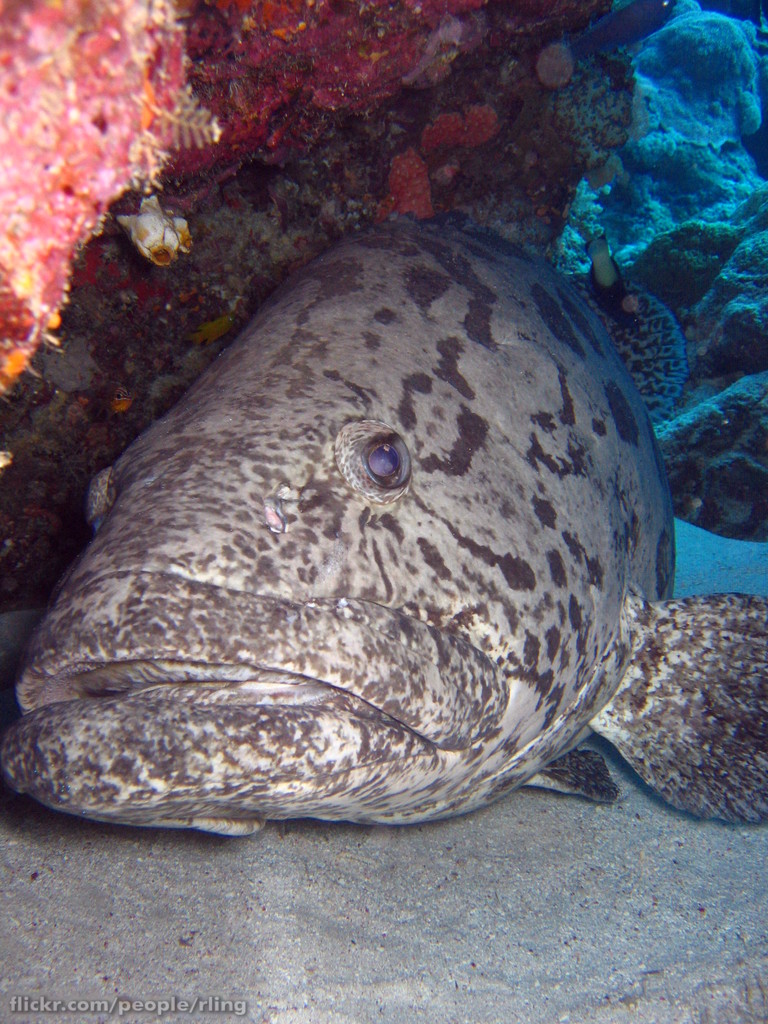 Potato GrouperEpinephelus tukula
Compare
Questions and answers
What is the scientific name of the Flathead Perch?
The scientific name of the Flathead Perch is Rainfordia opercularis. Written with its author, the full name is Rainfordia opercularis McCulloch, 1923.
Which family does the Flathead Perch belong to?
Rainfordia opercularis belongs to the family Epinephelidae, in the order Perciformes and the class Teleostei.
Where is the Flathead Perch found?
Checklists and occurrence records place Rainfordia opercularis in 1 country: Australia.
What is the conservation status of the Flathead Perch?
The IUCN Red List category recorded for Rainfordia opercularis is Least Concern (LC).
What other names does the Flathead Perch have?
Rainfordia opercularis is also known in English as Rainford's Perch and Rainford's Reef-basslet.
Sources
Passages the profile rests on
- The fish has a dark orange body with six lilac stripes bordered by black along each flank. Source passage: “overall dark orange colour broken by six black-margined lilac stripes along each flank” — English Wikipedia
- The orange coloration is darkest in the middle of the flanks and fades to yellow on the back and belly. Source passage: “the background orange colour is darkest on the centre of the flanks, fading to yellow on the back and belly.” — English Wikipedia
- The dorsal-fin spines are yellowish, with transparent membranes between them. Source passage: “The spines in the dorsal fin are yellowish with a transparent membrane between them.” — English Wikipedia
- The second dorsal fin has a dark base and a wide yellow band extending from the first soft ray to the tip of the seventh soft ray. Source passage: “The second dorsal fin has a dark base and a wide-angled yellow band just short of its edge which runs from the first soft ray to the tip of the seventh soft ray.” — English Wikipedia
- The second dorsal fin has a whitish outer edge and reddish-brown remaining soft rays. Source passage: “The edge itself is whitish in colour and the remaining soft rays are reddish-brown.” — English Wikipedia
- The anal fin has a colour pattern similar to that of the dorsal fin. Source passage: “The anal fin shows a similar pattern to the dorsal fin.” — English Wikipedia
- The pectoral and pelvic fins are pinkish yellow. Source passage: “The pectoral fins and the pelvic fin are pinkish yellow in colour.” — English Wikipedia
- A black eyespot edged in blue occurs at the base of the tail. Source passage: “There is a black, blue-edged eyespot at the base of the tail.” — English Wikipedia
- The caudal fin is brown and has white edging at its outer corners. Source passage: “The caudal fin is brown with its outer margin having a white edge at its corners.” — English Wikipedia
- The species has eyes positioned relatively far forward and a wide mouth. Source passage: “This species is also characterised by the forward placement of its eyes and its wide mouth.” — English Wikipedia
- The maximum recorded total length is 15 centimetres. Source passage: “It attains a maximum recorded total length of 15 centimetres (5.9 in).” — English Wikipedia
- The species inhabits inshore waters. Source passage: “The rainfordia occurs in inshore waters” — English Wikipedia
- The species shelters in caves and crevices within coral reefs. Source passage: “it is found in caves and crevices in coral reefs” — English Wikipedia
- The species is generally solitary. Source passage: “and is generally solitary.” — English Wikipedia
- The species is traded in the aquarium industry and commands high prices. Source passage: “fetches high prices in the aquarium trade” — English Wikipedia
Data
- Catalogue of Life, 2026-10-16 XR cc by
- Global Biodiversity Information Facility CC BY 4.0
- Wikidata CC0
- GeoNames CC BY 4.0
- Wikimedia Commons per image; credit shown with each image
- Within the Catalogue of Life, this name comes from World Register of Marine Species cc by
References
- McCulloch, A. R. (1923). Fishes from Australia and Lord Howe Island. No. 2. Records of the Australian Museum, 14 (2): 113–125, Pls. 14–16. https://doi.org/10.3853/j.0067-1975.14.1923.833 Link where the name was published
This species in other databases
- Catalogue of Life 6X3K4
- Wikidata Q1808343
- iNaturalist 111513
- WoRMS urn:lsid:marinespecies.org:taxname:282545
- ITIS 643397
Page built on 27 November 2026. See how the catalog is made and all sources and licences.
Cite this page
ScientificNames.org. (2026). Rainfordia opercularis (Flathead Perch). Retrieved November 27, 2026, from https://scientificnames.org/species/rainfordia-opercularis
“Rainfordia opercularis (Flathead Perch).” ScientificNames.org, 2026, scientificnames.org/species/rainfordia-opercularis. Accessed 27 Nov. 2026.
ScientificNames.org. “Rainfordia opercularis (Flathead Perch).” Accessed November 27, 2026. https://scientificnames.org/species/rainfordia-opercularis.
@misc{scientificnames_rainfordia_opercularis_flathead_perch,
  author = {{ScientificNames.org}},
  title = {Rainfordia opercularis (Flathead Perch)},
  year = {2026},
  url = {https://scientificnames.org/species/rainfordia-opercularis},
  note = {Accessed 2026-11-27}
}