Species · Fishes
Rubicundus rubicundus
Rubicundus rubicundus has no English name on record in the checklists used here. It is a species of fish in the family Myxinidae (hagfishes), order Myxiniformes. The name dates from 2010.
- Scientific name
- Rubicundus rubicundus (Kuo, Lee & Mok, 2010)
- Genus
- Rubicundus
- Family
- Myxinidae (Hagfishes)
- Order
- Myxiniformes
- Class
- Myxini
- Environment
- marine
- Name status
- accepted in the Catalogue of Life
Overview
The species occurs in northeastern Taiwan, mostly near 24°56.5'N, 121°53.0'E, close to the town of Dali. It has a pink-colored body, five gill apertures, and an unforked ventral aorta.
Written 27 November 2026 from the sources listed below. Each statement was checked against the passage it cites; statements that could not be supported were removed.
Appearance
The species has a pink-colored body and five gill apertures. It has no dorsal or anal spines or soft rays.[1][2][3]
The branchial slime pores and gill apertures are arranged in a straight line. The distances from a branchial slime pore to its immediately preceding and posterior gill apertures are similar.[4][5]
The species has an unforked ventral aorta.[6]
Habitat
The species occurs in northeastern Taiwan. It is mostly found near 24°56.5'N, 121°53.0'E, close to the town of Dali in northeastern Taiwan.[7][8]
Classification of Rubicundus rubicundus
| Kingdom | Animalia |
|---|---|
| Phylum | Chordata |
| Subphylum | Vertebrata |
| Infraphylum | Agnatha |
| Superclass | Cyclostomi |
| Class | Myxini |
| Order | Myxiniformes (Hagfish) |
| Family | Myxinidae (Hagfishes) |
| Subfamily | Rubicundinae |
| Genus | Rubicundus |
| Species | Rubicundus rubicundus (Kuo, Lee & Mok, 2010) |
Synonyms
One other scientific name has been used for this species and is now treated as a synonym of Rubicundus rubicundus.
- Eptatretus rubicundus Kuo, Lee & Mok, 2010
Related species
- Pink HagfishRubicundus eos
- Lophelia's HagfishRubicundus lopheliae
- Lakeside HagfishRubicundus lakeside
-
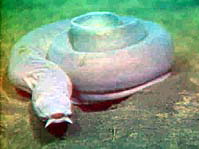 Pacific HagfishEptatretus stoutii
-
 Atlantic HagfishMyxine glutinosa
-
 Inshore HagfishEptatretus burgeri
- Goliath HagfishEptatretus goliath
-
 Sixgill HagfishEptatretus hexatrema
Compare
Questions and answers
What does the specific epithet Rubicundus mean?
The specific epithet combines the Latin word ruber, meaning red, with the suffix -cundus, indicating continuance or augmentation. The species name refers to its pink body coloration.[9][10]
Who discovered the species?
The species was discovered by Chien-Hsein Kuo, Sin-Che Lee, and Hin Kiu Mok.[11]
Sources
Passages the profile rests on
- The species has a pink-colored body. Source passage: “The body color is pink.” — English Wikipedia
- The species has five gill apertures. Source passage: “It has 5 gill apertures.” — English Wikipedia
- The species has no dorsal spines or soft rays and no anal spines or soft rays. Source passage: “It has zero dorsal spines, zero dorsal soft rays, zero anal spines, and zero anal soft rays.” — English Wikipedia
- The branchial slime pores and gill apertures are arranged in a straight line. Source passage: “The Branchial slime spores and the gill apertures are arranged in a straight line” — English Wikipedia
- The distances from a branchial slime pore to its immediately preceding and posterior gill apertures are similar. Source passage: “the distances from a branchial slime pore to its immediately preceding and posterior gill apertures similar” — English Wikipedia
- The species has an unforked ventral aorta. Source passage: “the ventral aorta isn't bifurcated.” — English Wikipedia
- The species occurs in northeastern Taiwan. Source passage: “The species is found in Northeastern Taiwan” — English Wikipedia
- The species is mostly found near the coordinates 24°56.5'N, 121°53.0'E, close to the town of Dali in northeastern Taiwan. Source passage: “mostly in the coordinates 24°56.5'N, 121°53.0'E, near the town of Dali.” — English Wikipedia
- The specific epithet combines the Latin word ruber, meaning red, with the suffix -cundus, indicating continuance or augmentation. Source passage: “The specific epithet is a combination of the Latin ruber (= red), and -cundus (= denoting continuance or augmentation).” — English Wikipedia
- The species name refers to its pink body coloration. Source passage: “The name refers to the pink body color of the animal.” — English Wikipedia
- The species was discovered by Chien-Hsein Kuo, Sin-Che Lee, and Hin Kiu Mok. Source passage: “It was discovered by Aquatic Scientists Chien-Hsein Kuo, Sin-Che Lee, and Hin Kiu Mok.” — English Wikipedia
Data
- Catalogue of Life, 2026-10-16 XR cc by
- Wikidata CC0
- Within the Catalogue of Life, this name comes from World Register of Marine Species cc by
This species in other databases
- Catalogue of Life 4TJ5H
- Wikidata Q25473364
- iNaturalist 607569
- WoRMS urn:lsid:marinespecies.org:taxname:1008143
Page built on 29 November 2026. See how the catalog is made and all sources and licences.
Cite this page
ScientificNames.org. (2026). Rubicundus rubicundus. Retrieved November 29, 2026, from https://scientificnames.org/species/rubicundus-rubicundus
“Rubicundus rubicundus.” ScientificNames.org, 2026, scientificnames.org/species/rubicundus-rubicundus. Accessed 29 Nov. 2026.
ScientificNames.org. “Rubicundus rubicundus.” Accessed November 29, 2026. https://scientificnames.org/species/rubicundus-rubicundus.
@misc{scientificnames_rubicundus_rubicundus,
  author = {{ScientificNames.org}},
  title = {Rubicundus rubicundus},
  year = {2026},
  url = {https://scientificnames.org/species/rubicundus-rubicundus},
  note = {Accessed 2026-11-29}
}