Species · Birds
Glossy Antshrike Sakesphorus luctuosus
The scientific name of the Glossy Antshrike is Sakesphorus luctuosus. It is a species of bird in the family Thamnophilidae (antbird), order Passeriformes. The name dates from 1823.
- Scientific name
- Sakesphorus luctuosus (M. H. C. Lichtenstein, 1823)
- Common name
- Glossy Antshrike
- Genus
- Sakesphorus
- Family
- Thamnophilidae (Antbird)
- Order
- Passeriformes
- Class
- Aves
- Red List category
- LC Least Concern
- Recorded in
- 1 country
- Name status
- accepted in the Catalogue of Life

Overview
Sakesphorus luctuosus is endemic to Brazil and occurs throughout much of the Brazilian Amazon Basin, particularly along the main Amazon River and its southern tributaries. Both sexes have a shaggy crest, while adult males are almost entirely black and adult females have a deep chestnut-brown forehead and crest.
Written 27 November 2026 from the sources listed below. Each statement was checked against the passage it cites; statements that could not be supported were removed.
Appearance
The Glossy Antshrike measures approximately 17 cm in length and weighs between 27 and 33 g.[1][2]
Both sexes have a spiky, shaggy crest. Adult males are almost entirely black, with dark gray lower backs, rumps, lower bellies, and crissums. They also have some white feathers concealed beneath their scapulars and white tips on their tail feathers.[3][4][5][6][7][8]
Adult females have a deep chestnut-brown forehead and crest. Subadult males resemble adult females and usually have some black in the crest.[9][10]
The amount of white plumage varies among populations across the species' range.[11]
Habitat
The Glossy Antshrike inhabits forests and woodlands along rivers and smaller watercourses. It primarily occupies igapó and várzea forests but also occurs in areas that seldom flood and locally on islands within large rivers.[12][13][14]
It favors forest understorey and mid-storey vegetation with abundant shrubs and vines. It occurs from sea level to approximately 250 m elevation.[15][16]
Its range extends through much of the Brazilian Amazon Basin. The northwestern boundary lies in east-central Amazonas, the northeastern boundary extends through Pará and Tocantins, and the southwestern boundary reaches northeastern Rondônia. The southern and southeastern limits extend to southeastern Mato Grosso and Goiás.[17][18][19][20][21]
Diet
The Glossy Antshrike feeds on a wide variety of insects and other arthropods.[22]
Behaviour
The Glossy Antshrike is presumed to remain in its range throughout the year. It usually forages alone or in pairs and only occasionally joins mixed-species feeding flocks.[23][24]
It typically forages between ground level and approximately 15 m above the ground. It searches for prey by hopping through dense vegetation and gleaning from leaves, stems, vines, and branches.[25][26]
It sometimes makes short upward jumps from perches while foraging and has been observed descending to the ground to capture prey.[27][28]
Reproduction and life cycle
The only documented Glossy Antshrike nest was discovered in December and contained nestlings. It was a pendant bag constructed from plant fibers and a few leaves.[29][30]
The nest was suspended near the top of a tree approximately 3 m above the ground. The tree was the only tree on a small river island.[31][32]
Both parents provisioned the nestlings.[33]
Conservation
The Glossy Antshrike is classified as Least Concern by the IUCN and is considered generally common. It has a very large geographic range, although its population size is unknown and its population is believed to be decreasing.[34][35][36][37][38]
No immediate threats to the Glossy Antshrike have been identified. Its reliance on flooded forests reduces its susceptibility to disturbance, and it can colonize nearby disturbed second-growth thickets.[39][40][41]
Classification of the Glossy Antshrike
| Kingdom | Animalia |
|---|---|
| Phylum | Chordata |
| Subphylum | Vertebrata |
| Infraphylum | Gnathostomata |
| Parvphylum | Osteichthyes |
| Megaclass | Tetrapoda |
| Class | Aves (Bird) |
| Order | Passeriformes (Passerine) |
| Family | Thamnophilidae (Antbird) |
| Genus | Sakesphorus (Antshrikes) |
| Species | Sakesphorus luctuosus (M. H. C. Lichtenstein, 1823) |
Where the Glossy Antshrike is found
Checklists and occurrence records place Sakesphorus luctuosus in 1 country across South America. GBIF holds 5,221 georeferenced records of it.
Countries
Regions and cities with the most records
- Mato Grosso, Brazil 1,655
- Pará, Brazil 1,276
- Tocantins, Brazil 932
- Amazonas, Brazil 576
- Goiás, Brazil 153
- Parauapebas, Brazil 142
- Rondônia, Brazil 129
- São Félix do Xingu, Brazil 63
- Humaitá, Brazil 58
- Itacoatiara, Brazil 57
- Conceição do Araguaia, Brazil 54
- Careiro da Várzea, Brazil 52
- Maranhão, Brazil 50
- Santarém, Brazil 38
- Colinas do Tocantins, Brazil 36
- Amapá, Brazil 35
- Sinop, Brazil 34
- Palmas, Brazil 29
- Iranduba, Brazil 25
- Mazagão, Brazil 23
- Santana, Brazil 22
- Arari, Brazil 20
- Vitória do Mearim, Brazil 20
- Canaã dos Carajás, Brazil 16
- Porangatu, Brazil 16
- Ji Paraná, Brazil 14
- Nova Olinda do Norte, Brazil 13
- Oriximiná, Brazil 13
- Vitória do Xingu, Brazil 13
- Altamira, Brazil 12
- Tucumã, Brazil 12
- Araguatins, Brazil 10
- Santa Maria das Barreiras, Brazil 10
- Água Azul do Norte, Brazil 10
- Araguaína, Brazil 9
- Careiro, Brazil 9
Range as the checklists state it
South America
A number beside a place is its count of GBIF occurrence records. A place without a number comes from a checklist alone. Records show where a species has been observed or collected, which can include escapes and vagrants.
Common names
English
- Glossy Antshrike
Names in 24 other languages
- Catalan
- batarà crestat
- Chinese
- 辉蚁鵙, 閃光蟻鵙
- Croatian
- kudrava mravarica
- Czech
- mravenčík černolesklý
- Danish
- Glansmyretornskade
- Dutch
- Rouwmierklauwier
- Esperanto
- glacea formikulo
- Finnish
- hohtomuura
- French
- Batara luisant
- German
- Trauer-Ameisenwürger, Trauerameisenwürger
- Italian
- Averla formichiera lucente
- Japanese
- クロエボシアリモズ
- Lithuanian
- juodasis esperitas
- Norwegian
- sørgemaurvarsler
- Polish
- mrowiec żałobny
- Portuguese
- Choca-d'água, choca-de-água, formigueiro-reluzente
- Russian
- Траурный колючник, Чёрный малый эсперито
- Serbian
- Sjajni mravlji svračak
- Slovak
- batara lesklá
- Spanish
- Batará luctuoso
- Swedish
- glansmyrtörnskata
- Turkish
- Parlak Siyah Karıncaavcısı
- Ukrainian
- сорокуш-малюк чорний
- Welsh
- morgrugydd gloyw
Synonyms
4 other scientific names have been used for this species and are now treated as synonyms of Sakesphorus luctuosus.
- Lanius luctuosus M. H. C. Lichtenstein, 1823
- Myrmelastes luctuosus araguayae Hellmayr, 1908
- Sakesphorus luctuosus araguayae (Hellmayr, 1908)
- Sakesphorus luctuosus luctuosus (M. H. C. Lichtenstein, 1823)
Related species
-
 Black-crested AntshrikeSakesphorus canadensis
-
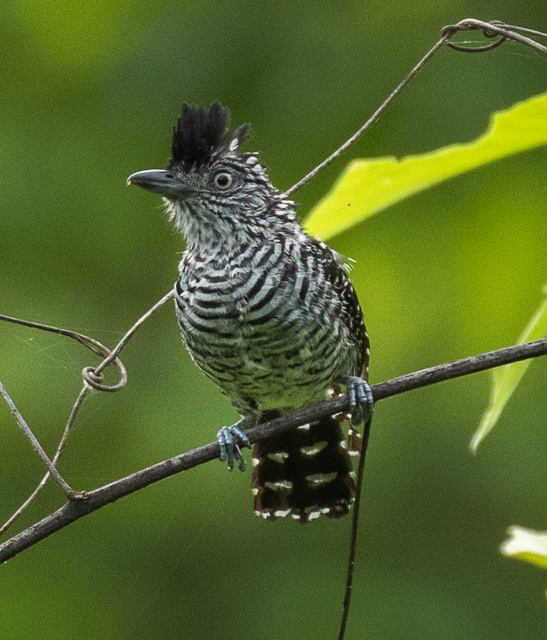 Barred AntshrikeThamnophilus doliatus
-
 Great AntshrikeTaraba major
-
 Black-crowned AntshrikeThamnophilus atrinucha
-
 Ocellated AntbirdPhaenostictus mcleannani
-
 Bicolored AntbirdGymnopithys bicolor
-
 Fasciated AntshrikeCymbilaimus lineatus
-
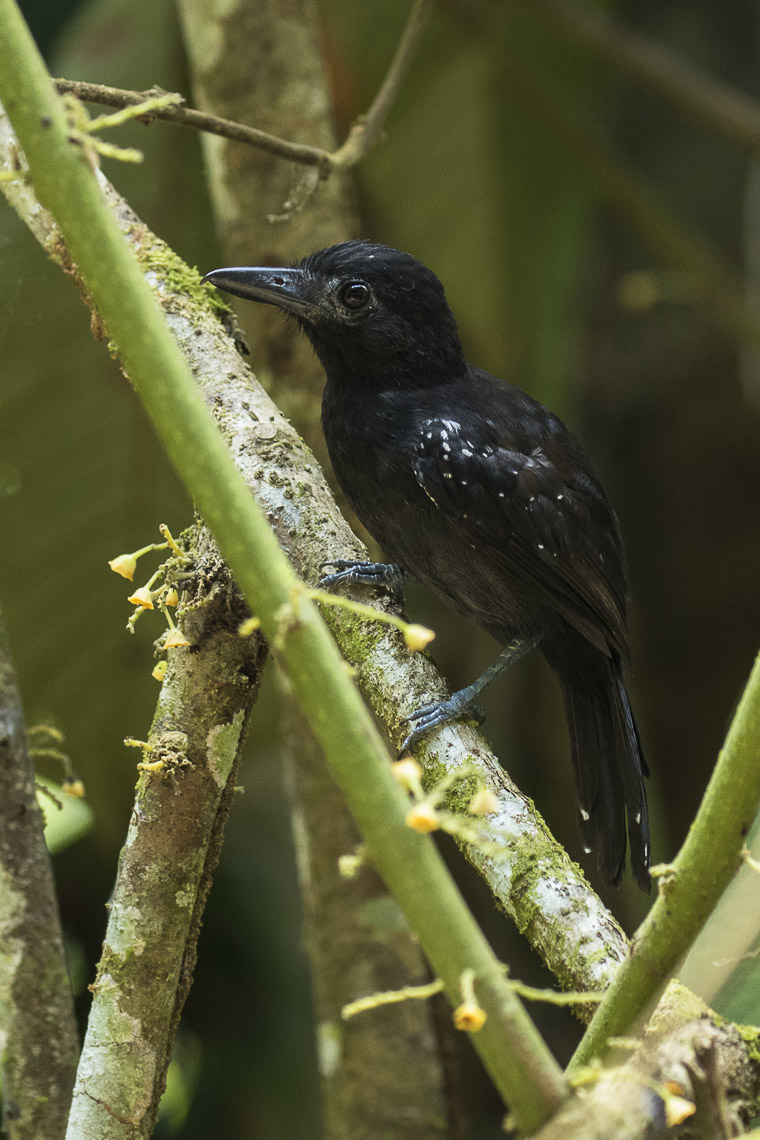 Black-hooded AntshrikeThamnophilus bridgesi
Compare
Questions and answers
What is the scientific name of the Glossy Antshrike?
The scientific name of the Glossy Antshrike is Sakesphorus luctuosus. Written with its author, the full name is Sakesphorus luctuosus (M. H. C. Lichtenstein, 1823).
Which family does the Glossy Antshrike belong to?
Sakesphorus luctuosus belongs to the family Thamnophilidae, in the order Passeriformes and the class Aves.
Where is the Glossy Antshrike found?
Checklists and occurrence records place Sakesphorus luctuosus in 1 country: Brazil.
What is the conservation status of the Glossy Antshrike?
The IUCN Red List category recorded for Sakesphorus luctuosus is Least Concern (LC).
What does the Glossy Antshrike sound like?
Its song consists of an accelerating sequence of 10 to 15 high, nasal notes. It also produces slowly repeated, descending whistles, soft, raspy caw notes, a long descending whistle, and a shorter descending whistle that immediately transitions into a short rattle.[42][43][44][45][46]
Where does the Glossy Antshrike live?
It is endemic to Brazil and occurs throughout much of the Brazilian Amazon Basin, particularly along the main Amazon River and its southern tributaries.[47][17]
What does the Glossy Antshrike eat?
It feeds on a wide variety of insects and other arthropods.[22]
Sources
Passages the profile rests on
- The glossy antshrike measures approximately 17 cm in length. Source passage: “The glossy antshrike is about 17 cm (6.7 in) long” — English Wikipedia
- The glossy antshrike weighs between 27 and 33 g. Source passage: “weighs 27 to 33 g (0.95 to 1.2 oz).” — English Wikipedia
- Both sexes of the glossy antshrike have a shaggy crest. Source passage: “both sexes have a shaggy crest.” — English Wikipedia
- Adult male glossy antshrikes are almost entirely black. Source passage: “Adult males are almost entirely black.” — English Wikipedia
- Adult male glossy antshrikes have dark gray lower backs, rumps, lower bellies, and crissums. Source passage: “Their lower back, rump, lower belly, and crissum are dark gray.” — English Wikipedia
- Adult male glossy antshrikes have some white feathers concealed beneath their scapulars. Source passage: “Some white is mostly concealed under their scapulars” — English Wikipedia
- Adult male glossy antshrikes have white tips on their tail feathers. Source passage: “the tips of their tail feathers are white.” — English Wikipedia
- The glossy antshrike has a spiky crest. Source passage: “A large antshrike with a spiky crest” — ebird.org
- Adult female glossy antshrikes have a deep chestnut-brown forehead and crest. Source passage: “Adult females are almost like males but with a deep chestnut-brown forehead and crest.” — English Wikipedia
- Subadult male glossy antshrikes resemble adult females and usually have some black in the crest. Source passage: “Subadult males resemble adult females with usually some black in the crest.” — English Wikipedia
- The amount of white plumage varies among glossy antshrike populations across the species' range. Source passage: “The amount of white varies somewhat across the species' range.” — English Wikipedia
- The glossy antshrike inhabits forests and woodlands along rivers and smaller watercourses. Source passage: “It inhabits forest and woodlands along rivers and smaller watercourses” — English Wikipedia
- The species primarily occupies igapó and várzea forests but also occurs in areas that seldom flood. Source passage: “mainly in igapó and várzea but also in areas that seldom flood.” — English Wikipedia
- The glossy antshrike occurs locally on islands within large rivers. Source passage: “It occurs locally on islands within the larger rivers.” — English Wikipedia
- The species favors forest understorey and mid-storey vegetation with abundant shrubs and vines. Source passage: “It tends to favor forest understorey to mid-storey that is heavy with shrubs and vines.” — English Wikipedia
- The glossy antshrike occurs from sea level to approximately 250 m elevation. Source passage: “In elevation it ranges from sea level to about 250 m (800 ft).” — English Wikipedia
- The glossy antshrike occurs throughout much of the Brazilian Amazon Basin, particularly along the main Amazon River and its southern tributaries. Source passage: “found throughout much of the Brazilian Amazon Basin, generally along the main Amazon river and its southern tributaries.” — English Wikipedia
- The species' northwestern range boundary lies in east-central Amazonas. Source passage: “in the northwest by east-central Amazonas” — English Wikipedia
- The species' northeastern range boundary extends through Pará and Tocantins. Source passage: “in the northeast by Pará and Tocantins” — English Wikipedia
- The species' southwestern range boundary reaches northeastern Rondônia. Source passage: “in the southwest by northeastern Rondônia” — English Wikipedia
- The southern and southeastern limits of the glossy antshrike's range extend to southeastern Mato Grosso and Goiás. Source passage: “in the south and southeast by southeastern Mato Grosso and Goiás.” — English Wikipedia
- The glossy antshrike feeds on a wide variety of insects and other arthropods. Source passage: “The glossy antshrike feeds on a wide variety of insects and other arthropods.” — English Wikipedia
- The glossy antshrike is presumed to remain in its range throughout the year. Source passage: “The glossy antshrike is presumed to be a year-round resident throughout its range.” — English Wikipedia
- The glossy antshrike usually forages alone or in pairs and only occasionally joins mixed-species feeding flocks. Source passage: “It forages singly or in pairs and only occasionally joins mixed-species feeding flocks.” — English Wikipedia
- The species typically forages between ground level and approximately 15 m above the ground. Source passage: “It typically feeds from the ground up to about 15 m (50 ft) above it.” — English Wikipedia
- The glossy antshrike searches for prey by hopping through dense vegetation and gleaning from leaves, stems, vines, and branches. Source passage: “It hops through dense vegetation, gleaning prey from leaves, stems, vines, and branches” — English Wikipedia
- The glossy antshrike sometimes makes short upward jumps from perches while foraging. Source passage: “by reaching and sometimes making short upward jumps from a perch.” — English Wikipedia
- The glossy antshrike has been observed descending to the ground to capture prey. Source passage: “It has been observed dropping to the ground to capture prey.” — English Wikipedia
- The only documented glossy antshrike nest was discovered in December and contained nestlings. Source passage: “The only known nest of a glossy antshrike was found in December; it contained nestlings.” — English Wikipedia
- The documented glossy antshrike nest was a pendant bag constructed from plant fibers and a few leaves. Source passage: “It was a "pendant bag" made of plant fibers and a few leaves” — English Wikipedia
- The documented nest was suspended near the top of a tree approximately 3 m above the ground. Source passage: “suspended at the top of a tree about 3 m (10 ft) above the ground.” — English Wikipedia
- The documented nest tree was the only tree on a small river island. Source passage: “The tree was the only one on a small river island.” — English Wikipedia
- Both parents provisioned the nestlings. Source passage: “Both parents provisioned the nestlings.” — English Wikipedia
- The glossy antshrike is classified as Least Concern by the IUCN. Source passage: “The IUCN has assessed the glossy antshrike as being of Least Concern.” — English Wikipedia
- The glossy antshrike has a very large geographic range. Source passage: “It has a very large range;” — English Wikipedia
- The population size of the glossy antshrike is unknown. Source passage: “its population size is not known” — English Wikipedia
- The glossy antshrike population is believed to be decreasing. Source passage: “and is believed to be decreasing.” — English Wikipedia
- The glossy antshrike is considered generally common. Source passage: “It is considered generally common.” — English Wikipedia
- No immediate threats to the glossy antshrike have been identified. Source passage: “No immediate threats have been identified.” — English Wikipedia
- The glossy antshrike's reliance on flooded forests reduces its susceptibility to disturbance. Source passage: “Reliance on flooded-forest habitat makes this species less prone to disturbance” — English Wikipedia
- The glossy antshrike can colonize nearby disturbed second-growth thickets. Source passage: “its ability to colonize adjacent disturbed second-growth thickets suggests a low sensitivity.” — English Wikipedia
- The glossy antshrike's song consists of an accelerating sequence of 10 to 15 high, nasal notes. Source passage: “short, accelerating series of 10-15 high, nasal 'ah' notes” — English Wikipedia
- The glossy antshrike also produces slowly repeated, descending whistles. Source passage: “a slowly repeated series of downslurred whistles” — English Wikipedia
- The glossy antshrike produces soft, raspy caw notes. Source passage: “soft and raspy 'caw' notes” — English Wikipedia
- The glossy antshrike produces a long descending whistle. Source passage: “long downslurred whistle” — English Wikipedia
- The glossy antshrike also produces a shorter descending whistle that immediately transitions into a short rattle. Source passage: “shorter downslurred whistle that immediately becomes a short rattle” — English Wikipedia
- The glossy antshrike is endemic to Brazil. Source passage: “It is endemic to Brazil.” — English Wikipedia
Data
- Catalogue of Life, 2026-10-16 XR cc by
- Global Biodiversity Information Facility CC BY 4.0
- Wikidata CC0
- GeoNames CC BY 4.0
- Wikimedia Commons per image; credit shown with each image
- Within the Catalogue of Life, this name comes from The Integrated Taxonomic Information System cc0
References
- Gill, Frank, & and Minturn Wright. (2006). Birds of the World: Recommended English Names.
This species in other databases
Page built on 27 November 2026. See how the catalog is made and all sources and licences.
Cite this page
ScientificNames.org. (2026). Sakesphorus luctuosus (Glossy Antshrike). Retrieved November 27, 2026, from https://scientificnames.org/species/sakesphorus-luctuosus
“Sakesphorus luctuosus (Glossy Antshrike).” ScientificNames.org, 2026, scientificnames.org/species/sakesphorus-luctuosus. Accessed 27 Nov. 2026.
ScientificNames.org. “Sakesphorus luctuosus (Glossy Antshrike).” Accessed November 27, 2026. https://scientificnames.org/species/sakesphorus-luctuosus.
@misc{scientificnames_sakesphorus_luctuosus_glossy_antshrike,
  author = {{ScientificNames.org}},
  title = {Sakesphorus luctuosus (Glossy Antshrike)},
  year = {2026},
  url = {https://scientificnames.org/species/sakesphorus-luctuosus},
  note = {Accessed 2026-11-27}
}