Species · Flowering plants
Siberian Violet Willow Salix acutifolia
The scientific name of the Siberian Violet Willow is Salix acutifolia. It is a species of flowering plant in the family Salicaceae (willow family), order Malpighiales.
- Scientific name
- Salix acutifolia Willd.
- Common name
- Siberian Violet Willow
- Genus
- Salix
- Family
- Salicaceae (Willow Family)
- Order
- Malpighiales
- Class
- Magnoliopsida
- Red List category
- LC Least Concern
- Recorded in
- 25 countries
- Name status
- accepted in the Catalogue of Life

Overview
Salix acutifolia is native to Russia and eastern Asia. It is distinguished by deep purple young shoots covered with a white bloom and silvery male catkins with gold-coloured anthers.
Written 26 November 2026 from the sources listed below. Each statement was checked against the passage it cites; statements that could not be supported were removed.
Appearance
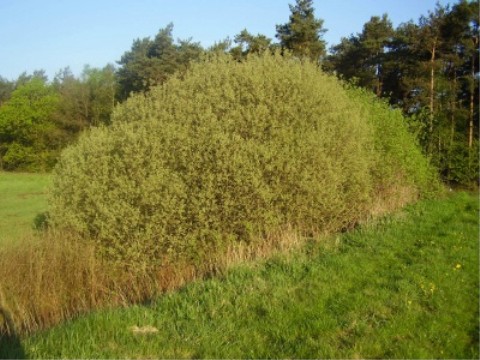
The Siberian violet willow is a spreading, deciduous shrub or tree that can grow to 10 m in height. Its narrow leaves can reach 10 cm in length, and its older bark develops a fine netted pattern.[1][2][3][4]
The young shoots are deep purple and covered with a white bloom. Male catkins are silvery with gold-coloured anthers and measure 5 cm in length, while female catkins are green and measure 3 cm.[5][6][7][8][9]
The specific epithet acutifolia refers to the plant's sharp leaves.[10]
Reproduction and life cycle
The Siberian violet willow has separate male and female individuals. It produces catkins in early spring before its leaves emerge.[11][12]
Habitat
The Siberian violet willow is native to Russia and eastern Asia.[13]
Classification of the Siberian Violet Willow
| Kingdom | Plantae |
|---|---|
| Subkingdom | Pteridobiotina |
| Phylum | Tracheophyta |
| Class | Magnoliopsida |
| Order | Malpighiales |
| Family | Salicaceae (Willow Family) |
| Tribe | Saliceae |
| Genus | Salix (Willow) |
| Species | Salix acutifolia Willd. |
Where the Siberian Violet Willow is found
Checklists and occurrence records place Salix acutifolia in 25 countries across Asia and Europe. GBIF holds 4,675 georeferenced records of it.
Countries where it is native or its origin is not stated
- Belarus 82
- Belgium 140
- Czechia 3
- Denmark 52
- Finland 32
- France 14
- India 5
- Kazakhstan 52
- Norway 18
- Pakistan
- Poland 213
- Russia 2,073
- South Korea 8
- Spain 3
- Sweden 541
- Switzerland 3
- The Netherlands 29
- Ukraine 468
Countries where it has been introduced
Regions and cities with the most records
- Vladimir Oblast, Russia 328
- Saperna Slobidka, Ukraine 145
- England, United Kingdom 135
- Kyiv Oblast, Ukraine 135
- Kyiv, Ukraine 121
- Moscow Oblast, Russia 121
- Bortnychi, Ukraine 118
- Vyshneve, Ukraine 112
- Sofiivska Borschahivka, Ukraine 106
- Vyshhorod, Ukraine 106
- Bilychi, Ukraine 104
- Kotsyubynske, Ukraine 98
- Chuvash Republic, Russia 95
- Hoboken, Belgium 87
- Berchem, Belgium 85
- Borgerhout, Belgium 85
- Antwerp, Belgium 84
- Beveren, Belgium 84
- Deurne, Belgium 84
- Merksem, Belgium 84
- Schoten, Belgium 84
- Brasschaat, Belgium 83
- Sint-Gillis-Waas, Belgium 83
- Zwijndrecht, Belgium 83
- Ekeren, Belgium 82
- Kapellen, Belgium 82
- Kirov Oblast, Russia 82
- Stabroek, Belgium 82
- Bavaria, Germany 81
- Brovary, Ukraine 81
- Bergen op Zoom, The Netherlands 80
- Kalmthout, Belgium 80
- Ryazan Oblast, Russia 73
- Skåne, Sweden 67
- Novocheboksarsk, Russia 65
- Yaroslavl Oblast, Russia 64
4 more countries have a few records outside this range
These countries hold a few records of Salix acutifolia but lie outside the range the checklists give for it. Such records are often zoo or garden specimens, museum material or vagrants, so the species is not counted as occurring there.
Range as the checklists state it
England [I] (England [I], Wales [I], Isle of Man [I], Scotland [I]); Ireland [I] (Northern Ireland [I]); Germany [I]; Estonia [I]; Latvia [I]; Lithuania [I]; Belarus; C-European Russia; E-European Russia; N-European Russia; W-European Russia; Ukraine; Siberia [I] (W-Siberia [I]); Kazakhstan; Tajikistan [I]; Northern Caucasus; Pakistan (Kurram)
A number beside a place is its count of GBIF occurrence records. A place without a number comes from a checklist alone. Records show where a species has been observed or collected, which can include escapes and vagrants.
Common names
English
- Siberian Violet Willow
- Caspic Willow
- Siberian Violet-Willow
- Violet Willow
- Sharp-leaf Willow
Names in 7 other languages
- Czech
- vrba špičatolistá
- French
- osier violet, saule à feuilles aiguës
- German
- Spitzblättrige Weide, kaspische Weide
- Norwegian Bokmål
- plommepil
- Russian
- iva ostrolistnaja, krasnaja verba, šeljuga
- Swedish
- rysk daggpil, spetsbladigt daggvide, spetsdaggvide
- Welsh
- Helygen Borffor Siberia
Synonyms
10 other scientific names have been used for this species and are now treated as synonyms of Salix acutifolia.
- Salix acutifolia f. pendula I.V.Belyaeva, N.Y.Stepanova & O.V.Epanch.
- Salix daphnoides subsp. acutifolia (Willd.) Ahlfv.
- Salix daphnoides subsp. acutifolia (Willd.) Zahn
- Salix daphnoides var. acutifolia (Willd.) Döll
- Salix violacea Andrews
- Vimen violacea Raf.
- Salix pomeranica J.Forbes ambiguous synonym
- Salix pruinosa Besser ambiguous synonym
- Salix violacea G.Anderson ex Sm. ambiguous synonym
- Salix violacea Willd. ambiguous synonym
Related species
-
 Weeping WillowSalix babylonica
-
 European WillowSalix alba
-
 Goat WillowSalix caprea
-
 Black WillowSalix nigra
-
 Arctic WillowSalix arctica
-
 Common OsierSalix viminalis
-
 Snowbed WillowSalix herbacea
-
 Common SallowSalix cinerea
Compare
Questions and answers
What is the scientific name of the Siberian Violet Willow?
The scientific name of the Siberian Violet Willow is Salix acutifolia. Written with its author, the full name is Salix acutifolia Willd..
Which family does the Siberian Violet Willow belong to?
Salix acutifolia belongs to the family Salicaceae, in the order Malpighiales and the class Magnoliopsida.
Where is the Siberian Violet Willow found?
Checklists and occurrence records place Salix acutifolia in 25 countries, including Russia, Sweden, Ukraine, Poland, Belgium and Belarus.
What is the conservation status of the Siberian Violet Willow?
The IUCN Red List category recorded for Salix acutifolia is Least Concern (LC).
What other names does the Siberian Violet Willow have?
Salix acutifolia is also known in English as Caspic Willow, Siberian Violet-Willow, Violet Willow and Sharp-leaf Willow.
Sources
Passages the profile rests on
- Salix acutifolia is a spreading, deciduous shrub or tree. Source passage: “It is a spreading, deciduous shrub or tree” — English Wikipedia
- Its leaves are narrow and can reach 10 cm in length. Source passage: “The leaves are narrow, up to 10 cm (4 in) long.” — English Wikipedia
- The older bark develops a fine netted pattern. Source passage: “Older bark has a fine, netted pattern.” — English Wikipedia
- The species can grow to a height of 10 m. Source passage: “growing to 10 m (33 ft) tall” — English Wikipedia
- The young shoots are deep purple and covered with a white bloom. Source passage: “The young shoots are deep purple with a white bloom.” — English Wikipedia
- Male catkins are silvery and bear gold-coloured anthers. Source passage: “Male catkins are 5 cm (2 in) and silvery, with gold anthers” — English Wikipedia
- Female catkins are green and measure 3 cm in length. Source passage: “female catkins are green and 3 cm (1 in) long.” — English Wikipedia
- Male catkins measure 5 cm in length. Source passage: “Male catkins are 5 cm (2 in)” — English Wikipedia
- Female catkins measure 3 cm in length. Source passage: “female catkins are green and 3 cm (1 in) long.” — English Wikipedia
- The specific epithet acutifolia refers to the plant's sharp leaves. Source passage: “The specific epithet acutifolia means "sharp-leaved".” — English Wikipedia
- Salix acutifolia has separate male and female individuals. Source passage: “Like all willows this species is dioecious.” — English Wikipedia
- The species produces catkins in early spring before its leaves emerge. Source passage: “The catkins are produced in early spring, before the leaves.” — English Wikipedia
- The species is native to Russia and eastern Asia. Source passage: “native to Russia and eastern Asia.” — English Wikipedia
Data
- Catalogue of Life, 2026-10-16 XR cc by
- Global Biodiversity Information Facility CC BY 4.0
- Wikidata CC0
- GeoNames CC BY 4.0
- Wikimedia Commons per image; credit shown with each image
- Within the Catalogue of Life, this name comes from Synonymic Checklists of the Vascular Plants of the World cc by
References
- Willd. (1806). Sp. Pl., ed. 4 [Willdenow] 4(2): 668 (1806). where the name was published
This species in other databases
Page built on 28 November 2026. See how the catalog is made and all sources and licences.
Cite this page
ScientificNames.org. (2026). Salix acutifolia (Siberian Violet Willow). Retrieved November 28, 2026, from https://scientificnames.org/species/salix-acutifolia
“Salix acutifolia (Siberian Violet Willow).” ScientificNames.org, 2026, scientificnames.org/species/salix-acutifolia. Accessed 28 Nov. 2026.
ScientificNames.org. “Salix acutifolia (Siberian Violet Willow).” Accessed November 28, 2026. https://scientificnames.org/species/salix-acutifolia.
@misc{scientificnames_salix_acutifolia_siberian_violet_willow,
  author = {{ScientificNames.org}},
  title = {Salix acutifolia (Siberian Violet Willow)},
  year = {2026},
  url = {https://scientificnames.org/species/salix-acutifolia},
  note = {Accessed 2026-11-28}
}