Species · Flowering plants
Black Willow Salix nigra
The scientific name of the Black Willow is Salix nigra. It is a species of flowering plant in the family Salicaceae (willow family), order Malpighiales.
- Scientific name
- Salix nigra Marshall
- Common name
- Black Willow
- Genus
- Salix
- Family
- Salicaceae (Willow Family)
- Order
- Malpighiales
- Class
- Magnoliopsida
- Red List category
- LC Least Concern
- Recorded in
- 4 countries
- Name status
- accepted in the Catalogue of Life

Overview
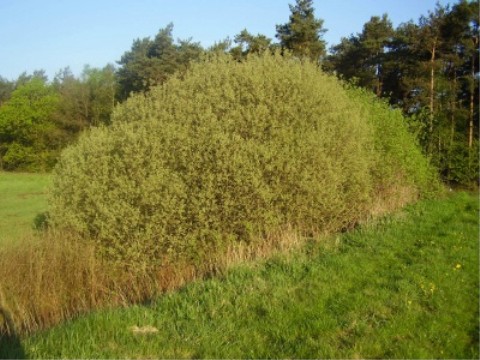
Salix nigra typically grows along streams and in swamps. It is distinguished by its dark brown to blackish fissured bark, narrow dark green leaves, and greenish yellow to yellow flowers growing in catkins.
Written 26 November 2026 from the sources listed below. Each statement was checked against the passage it cites; statements that could not be supported were removed.
Appearance
Its leaves are alternate, narrow, dark green, and finely serrated along their margins. They measure approximately 5–15 centimeters long and 0.5–2 centimeters wide, and turn lemon yellow during autumn.[1][2][3]
Its flowers are small and greenish yellow to yellow, growing in catkins approximately 2.5–7.5 centimeters long. Its mature fruit is a capsule approximately 5 millimeters long that splits open to release seeds.[4][5][6]
Black willow typically grows between 10 and 30 meters tall, with exceptional individuals reaching 45 meters. Its trunk typically measures 50–80 centimeters in diameter.[7][8]
Habitat
Black willow typically grows along streams and in swamps. It grows best in locations receiving full sunlight and having wet or moist soils.[9][10]
Behaviour
Black willow shoots are brittle near their bases and can snap evenly at branch junctions when sharply bent. The species is sensitive to drought, which inhibits the growth of its branches and roots.[11][12]
Reproduction and life cycle
Black willow is dioecious, with male and female flowers occurring on separate trees. Its flowers appear in early spring alongside the emergence of new leaves.[13][14]
Flowering occurs around February in the southern portion of its range and continues until June in northern areas. Trees can begin producing seeds at approximately 10 years of age.[15][16]
The species produces consistently good seed crops in most years, with only occasional failures. Its seeds are minute and covered with down.[17][18]
Seedlings can grow rapidly when exposed to abundant sunlight and moisture during the growing season.[19]
Uses
Black willow roots have historically been used as a substitute for quinine. Various Native American tribes have used black willow in basketry and for treating fever, headaches, and coughs.[20][21]
Black willow timber is used to manufacture furniture and shipping containers. Its lightweight wood has historically been used to manufacture artificial limbs, including wooden hands.[22][23]
Black willow wood has moderately high shock resistance and can withstand continuous moderate impacts.[24]
The species is used in environmental restoration projects to control erosion. It is also planted in marshland stabilization and restoration projects.[25][26]
Similar species
Black willow can hybridize with peachleaf willow (Salix amygdaloides). A hybrid between these species is named Salix × glatfelteri C.K. Schneid.[27][28]
Peachleaf willow and black willow occur together in terrace communities. They can codominate on shorelines of sandy alluvium.[29][30]
Classification of the Black Willow
| Kingdom | Plantae |
|---|---|
| Subkingdom | Pteridobiotina |
| Phylum | Tracheophyta |
| Class | Magnoliopsida |
| Order | Malpighiales |
| Family | Salicaceae (Willow Family) |
| Tribe | Saliceae |
| Genus | Salix (Willow) |
| Species | Salix nigra Marshall |
Where the Black Willow is found
Checklists and occurrence records place Salix nigra in 4 countries across North America. GBIF holds 26,025 georeferenced records of it.
Countries
Regions and cities with the most records
- Texas, United States 7,243
- New South Wales, Australia 1,105
- Frisco, United States 769
- The Colony, United States 743
- Little Elm, United States 685
- The Trails of Frisco, United States 684
- Pennsylvania, United States 673
- Addison, United States 666
- Allen, United States 659
- Highland Village, United States 649
- Plano, United States 645
- Lewisville, United States 625
- Carrollton, United States 580
- Corinth, United States 539
- Prosper, United States 534
- Brushy Creek, United States 519
- Pflugerville, United States 517
- Richardson, United States 505
- Round Rock, United States 495
- Louisiana, United States 494
- Farmers Branch, United States 490
- Haltom City, United States 485
- Austin, United States 481
- Grapevine, United States 471
- Fort Worth, United States 464
- Murphy, United States 424
- Coppell, United States 423
- North Richland Hills, United States 423
- Virginia, United States 422
- Kansas, United States 419
- Arkansas, United States 404
- Hurst, United States 403
- Ohio, United States 399
- Cedar Park, United States 396
- Watauga, United States 394
- Southlake, United States 392
6 more countries have a few records outside this range
These countries hold a few records of Salix nigra but lie outside the range the checklists give for it. Such records are often zoo or garden specimens, museum material or vagrants, so the species is not counted as occurring there.
Range as the checklists state it
Canada (Manitoba, New Brunswick, Ontario, Québec); USA (Alabama, Arkansas, Colorado, Connecticut, District of Columbia, Delaware, Florida, Georgia, Iowa, Illinois, Indiana, Kansas, Kentucky, Louisiana, Massachusetts, Maryland, Maine, Michigan, Minnesota, Missouri, Mississippi, North Carolina, Nebraska, New Hampshire, New Jersey, New York, Ohio, Oklahoma, Pennsylvania, Rhode Island, South Carolina, Tennessee, Texas, Virginia, Vermont, Wisconsin, West Virginia); Mexico (Chihuahua, Coahuila, Durango, Nayarit, Nuevo León, Oaxaca, Puebla, San Luis Potosí, Sinaloa, Tamaulipas, Zacatecas)
A number beside a place is its count of GBIF occurrence records. A place without a number comes from a checklist alone. Records show where a species has been observed or collected, which can include escapes and vagrants.
Common names
English
- Black Willow
- Dudley Willow
- Goodding
- Swamp Willow
Names in 12 other languages
- Chinese
- 北美黑柳, 黑柳
- Czech
- vrba černá
- French
- saule noir
- German
- Amerikanische Schwarz-Weide, Schwarze Weide
- Japanese
- アメリカポッキリヤナギ
- Portuguese
- Salgueiro-negro
- Russian
- Ива чёрная
- Slovak
- vŕba čierna
- Spanish
- Sauce negro, Sauz Willow
- Swedish
- svartpil
- Turkish
- Kara Söğüt
- Ukrainian
- Верба чорна
Synonyms
27 other scientific names have been used for this species and are now treated as synonyms of Salix nigra.
- Amerina balduiniana Raf.
- Amerina houstoniana (Pursh) Raf.
- Amerina nigra (Marshall) Raf.
- Nectolis ambigua (Pursh) Raf.
- Nestylix falcata (Pursh) Raf.
- Pleiarina nigra (Marshall) N.Chao & G.T.Gong
- Salix flavovirens Hornem.
- Salix gongylocarpa Shuttlew. ex Andersson
- Salix houstoniana Pursh
- Salix ludoviciana Raf.
- Salix nigra f. falcata (Pursh) Rehder
- Salix nigra var. altissima Sarg.
- Salix nigra var. falcata (Pursh) Torr.
- Salix nigra var. lindheimeri C.K.Schneid.
- Salix nigra var. longifolia Andersson
- Salix nigra var. nigra
- Salix testacea C.Wright ex Andersson
- Salix vulgaris J.Clayton ex Gronov.
- Salix ambigua Pursh ambiguous synonym
- Salix denudata Raf. ambiguous synonym
- Salix dubia Trautv. ambiguous synonym
- Salix falcata Pursh ambiguous synonym
- Salix ligustrina F.Michx. ambiguous synonym
- Salix pensylvanica F.Dietr. ambiguous synonym
- Salix pentandra Walter ambiguous synonym
- Salix purshiana Spreng. ambiguous synonym
- Salix tristis Pursh ambiguous synonym
Related species
-
 Weeping WillowSalix babylonica
-
 European WillowSalix alba
-
 Goat WillowSalix caprea
-
 Arctic WillowSalix arctica
-
 Common OsierSalix viminalis
-
 Snowbed WillowSalix herbacea
-
 Common SallowSalix cinerea
-
 Purple WillowSalix purpurea
Compare
Questions and answers
What is the scientific name of the Black Willow?
The scientific name of the Black Willow is Salix nigra. Written with its author, the full name is Salix nigra Marshall.
Which family does the Black Willow belong to?
Salix nigra belongs to the family Salicaceae, in the order Malpighiales and the class Magnoliopsida.
Where is the Black Willow found?
Checklists and occurrence records place Salix nigra in 4 countries: United States, Australia, Canada and Mexico.
What is the conservation status of the Black Willow?
The IUCN Red List category recorded for Salix nigra is Least Concern (LC).
What other names does the Black Willow have?
Salix nigra is also known in English as Dudley Willow, Goodding and Swamp Willow.
What is the habitat of a willow tree?
Black willow typically grows along streams and in swamps. It grows best in locations receiving full sunlight and having wet or moist soils.[9][10]
Is black willow good for anything?
Black willow is used in basketry, furniture manufacturing, shipping containers, and artificial limbs. It is also used in erosion control, marshland stabilization, and environmental restoration projects.[21][22][23][25][26]
What is salix nigra used for?
Black willow roots have historically been used as a substitute for quinine, and various Native American tribes have used the species for treating fever, headaches, and coughs. Its wood is used to manufacture furniture, shipping containers, and artificial limbs. The species is also used for erosion control and marshland restoration.[20][21][22][23][25][26]
Sources
Passages the profile rests on
- Its leaves are alternate, narrow, dark green, and finely serrated along their margins. Source passage: “The leaves are alternate, long, thin, 5–15 centimeters (2–6 in) long and 0.5–2 centimeters (1⁄4–3⁄4 in) broad, usually somewhat falcate, dark, shiny green on both sides or with a lighter green underside, with a finely serrated margin” — English Wikipedia
- Its leaves turn lemon yellow during autumn. Source passage: “The leaves turn a lemon yellow in the fall.” — English Wikipedia
- Its leaves measure approximately 5–15 centimeters long and 0.5–2 centimeters wide. Source passage: “5–15 centimeters (2–6 in) long and 0.5–2 centimeters (1⁄4–3⁄4 in) broad” — English Wikipedia
- Its flowers are small and greenish yellow to yellow, growing in catkins. Source passage: “with small, greenish yellow to yellow flowers borne on catkins 2.5–7.5 centimeters (1–3 in) long” — English Wikipedia
- Its mature fruit is a capsule approximately 5 millimeters long that splits open to release seeds. Source passage: “The fruit is a 5 millimeters (3⁄16 in) capsule which splits open when mature to release the numerous minute, down-covered seeds.” — English Wikipedia
- Its flower-bearing catkins measure approximately 2.5–7.5 centimeters long. Source passage: “borne on catkins 2.5–7.5 centimeters (1–3 in) long” — English Wikipedia
- Salix nigra typically grows between 10 and 30 meters tall, with exceptional individuals reaching 45 meters. Source passage: “growing to 10–30 m (35–100 ft) tall, exceptionally up to 45 m (148 ft)” — English Wikipedia
- Its trunk typically measures 50–80 centimeters in diameter. Source passage: “with a trunk 50–80 centimeters (20–30 in) diameter.” — English Wikipedia
- Salix nigra typically grows along streams and in swamps. Source passage: “Thus, it is typically found along streams and in swamps.” — English Wikipedia
- It grows best in locations receiving full sunlight and having wet or moist soils. Source passage: “Salix nigra grows best in areas of full sun and wet or moist soils.” — English Wikipedia
- Its shoots are brittle near their bases and can snap evenly at branch junctions when sharply bent. Source passage: “they are (like the related European Salix fragilis) brittle at the base, snapping evenly at the branch junction if bent sharply.” — English Wikipedia
- Black willow is sensitive to drought, which inhibits the growth of its branches and roots. Source passage: “Black willows are also sensitive to drought conditions. Black willows living in drought conditions experience inhibition of their branch and root growth.” — English Wikipedia
- Salix nigra is dioecious, with male and female flowers occurring on separate trees. Source passage: “Salix nigra is dioecious, which means it has separate male and female trees.” — English Wikipedia
- Its flowers appear in early spring alongside the emergence of new leaves. Source passage: “in early spring at the same time as the new leaves appear.” — English Wikipedia
- Flowering occurs around February in the southern portion of its range and continues until June in northern areas. Source passage: “It flowers during February in the southern part of its range, and flowers until June in the northern parts.” — English Wikipedia
- Black willow trees can begin producing seeds at approximately 10 years of age. Source passage: “These trees are capable of producing seeds when they are around the age of 10 years.” — English Wikipedia
- The species produces consistently good seed crops in most years, with only occasional failures. Source passage: “The black willow continuously has good seed crops year after year, with only a few failures.” — English Wikipedia
- Its seeds are minute and covered with down. Source passage: “the numerous minute, down-covered seeds.” — English Wikipedia
- Seedlings can grow rapidly when exposed to abundant sunlight and moisture during the growing season. Source passage: “After they germinate, they can experience excellent growth if they are exposed to high sunlight and copious moisture during the growing season.” — English Wikipedia
- Black willow roots have historically been used as a substitute for quinine. Source passage: “Black willow roots are very bitter and have been used as a substitute for quinine in the past.” — English Wikipedia
- Various Native American tribes have used black willow in basketry and for treating fever, headaches, and coughs. Source passage: “Ethnobotanical uses of black willow by various Native American tribes include basketry, and treatment of fever, headache, and coughs.” — English Wikipedia
- Black willow timber is used to manufacture furniture and shipping containers. Source passage: “Black willow lumber is used in furniture and shipping containers.” — English Wikipedia
- Its lightweight wood has historically been used to manufacture artificial limbs, including wooden hands. Source passage: “The wood was once used for artificial limbs, such as wooden hands.” — English Wikipedia
- Black willow wood has moderately high shock resistance and can withstand continuous moderate impacts. Source passage: “has a moderately high shock resistance, allowing it to sustain continuous moderate impacts.” — English Wikipedia
- The species is used in environmental restoration projects to control erosion. Source passage: “It is also used in environmental restoration, especially as an erosion control tool.” — English Wikipedia
- Black willow is planted in marshland stabilization and restoration projects. Source passage: “Salix nigra is used for marshland stabilization or restoration projects” — English Wikipedia
- Salix nigra can hybridize with peachleaf willow (Salix amygdaloides). Source passage: “Peachleaf willow hybridizes with other Humboldtiana willows [86], including coastal plain willow (S. caroliniana) [7,81], black willow (S. nigra) [33,81]” — fs.usda.gov
- A hybrid between peachleaf willow and black willow is named Salix × glatfelteri C.K. Schneid. Source passage: “Salix × glatfelteri C.K. Schneid. (× S. nigra), Glatfelter's willow” — fs.usda.gov
- Peachleaf willow and black willow occur together in terrace communities. Source passage: “It also grows in terrace communities with plains cottonwood, boxelder (Acer negundo), and black willow (S. nigra) [82].” — fs.usda.gov
- Peachleaf willow and black willow can codominate on shorelines of sandy alluvium. Source passage: “peachleaf willow codominates on shorelines of sandy alluvium with black willow” — fs.usda.gov
Data
- Catalogue of Life, 2026-10-16 XR cc by
- Global Biodiversity Information Facility CC BY 4.0
- Wikidata CC0
- GeoNames CC BY 4.0
- Wikimedia Commons per image; credit shown with each image
- Within the Catalogue of Life, this name comes from Synonymic Checklists of the Vascular Plants of the World cc by
References
- Marshall. Arbust. Amer. 293 (1785). where the name was published
This species in other databases
- Catalogue of Life 79BZL
- Wikidata Q469220
- iNaturalist 54847
- World Flora Online wfo-0000929858
- GRIN 102718
Page built on 27 November 2026. See how the catalog is made and all sources and licences.
Cite this page
ScientificNames.org. (2026). Salix nigra (Black Willow). Retrieved November 27, 2026, from https://scientificnames.org/species/salix-nigra
“Salix nigra (Black Willow).” ScientificNames.org, 2026, scientificnames.org/species/salix-nigra. Accessed 27 Nov. 2026.
ScientificNames.org. “Salix nigra (Black Willow).” Accessed November 27, 2026. https://scientificnames.org/species/salix-nigra.
@misc{scientificnames_salix_nigra_black_willow,
  author = {{ScientificNames.org}},
  title = {Salix nigra (Black Willow)},
  year = {2026},
  url = {https://scientificnames.org/species/salix-nigra},
  note = {Accessed 2026-11-27}
}