Species · Flowering plants
Alaska Willow Salix alaxensis
The scientific name of the Alaska Willow is Salix alaxensis. It is a species of flowering plant in the family Salicaceae (willow family), order Malpighiales.
- Scientific name
- Salix alaxensis (Andersson) Coville
- Common name
- Alaska Willow
- Genus
- Salix
- Family
- Salicaceae (Willow Family)
- Order
- Malpighiales
- Class
- Magnoliopsida
- Red List category
- LC Least Concern
- Recorded in
- 4 countries
- Name status
- accepted in the Catalogue of Life

Overview
Salix alaxensis is native to northern North America and eastern Siberia and grows along rivers, streams, and lakes. It can reach 9 metres in height and is one of the tallest willow species in the Canadian Arctic Archipelago.
Written 26 November 2026 from the sources listed below. Each statement was checked against the passage it cites; statements that could not be supported were removed.
Appearance
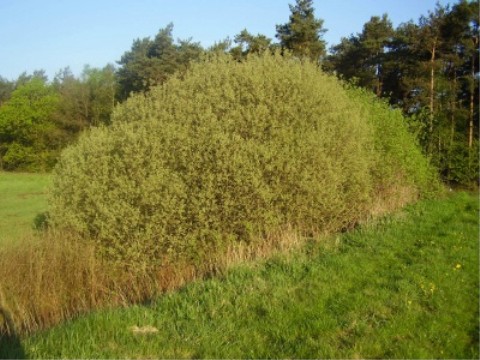
Alaska willow grows as a shrub or tree. Its bark is initially smooth and gray but develops furrows and scales with age, and its leaves have woolly undersides.[1][2][3]
It can reach 9 metres in height, with stems up to 18 centimetres in diameter. Its leaves can grow up to 11 centimetres long, and its inflorescences can reach 10 centimetres in length.[4][5][6][7]
It blooms from late May through early June. Its catkins are yellowish and sometimes greenish, and its flowers provide an important resource for bumblebees.[8][9][10]
Habitat
Alaska willow grows along rivers, streams, and lakes. It colonizes disturbed riverbanks and areas exposed by retreating glaciers.[11][12]
It occupies open areas in forested habitats because it does not tolerate shade. It occurs occasionally in openings within black spruce and Sitka spruce forests.[13][14]
It commonly dominates early-successional willow communities and riparian communities on recently exposed alluvial deposits subject to periodic flooding. It is also a dominant plant on active sand dunes.[15][16][17]
It typically occurs in slightly acidic to mildly alkaline mineral soils that are aerated, relatively nutrient-rich, and well to moderately well drained. Its most common soil types include gravel, sand, and silt, and it occurs in soils ranging from wet to dry.[18][19][20][21]
Its communities can develop over permafrost that thaws deeply during summer. It occurs across coastal, montane, and alpine elevation zones.[22][23]
Diet
Moose consume Alaska willow twigs and can eat up to 90 percent of the twigs on an individual plant. In some areas of northern Alaska, the species provides 95 percent of the winter food consumed by moose.[24][25]
Moose favor feltleaf willow as a food source. They primarily browse green leaves during summer and consume willow twigs during winter.[26][27][28]
Snowshoe hares consume Alaska willow, eating its bark and smaller twigs. Willow ptarmigan also feed on it and consume its buds.[29][30][31][32]
Behaviour
Alaska willow is intolerant of shade and is characteristic of early-successional habitats. Its density and ground cover typically reach their maximum within 10 to 20 years after disturbance.[33][34]
It can regenerate by sprouting from its root crown, rooting from stem fragments, and layering. It can also resprout after fire if the plant survives and recover rapidly after low-severity fires by producing shoots from root crowns.[35][36][37]
Reproduction and life cycle
Alaska willow has male and female reproductive structures on separate individuals. Its fruit is a capsule.[38][39]
The species reproduces primarily through seeds but can also reproduce vegetatively. Its seeds have a downy covering of fibers that facilitates dispersal by wind and moving water.[40][41]
Its seeds remain viable for approximately one week and can germinate within 24 hours after landing on moist soil. They germinate readily in high-light conditions and moist mineral soils, and the soil seed bank is transient.[42][43][44][45]
Uses
Native Americans have used Alaska willow for medicinal purposes, basket weaving, making bows and arrows, and constructing animal traps.[46]
The species is planted for habitat restoration and revegetation of disturbed sites, including pipelines. Dormant branches can be planted directly in the ground to establish new plants.[47][48]
Mechanical crushing is recommended as a management technique to stimulate sprouting and provide wildlife browse.[49]
Classification of the Alaska Willow
| Kingdom | Plantae |
|---|---|
| Subkingdom | Pteridobiotina |
| Phylum | Tracheophyta |
| Class | Magnoliopsida |
| Order | Malpighiales |
| Family | Salicaceae (Willow Family) |
| Tribe | Saliceae |
| Genus | Salix (Willow) |
| Species | Salix alaxensis (Andersson) Coville |
Where the Alaska Willow is found
Checklists and occurrence records place Salix alaxensis in 4 countries across North America. GBIF holds 3,399 georeferenced records of it.
Countries
Regions and cities with the most records
- Alaska, United States 729
- Yukon, Canada 318
- Northwest Territories, Canada 226
- Chukotka, Russia 221
- Sakha, Russia 165
- British Columbia, Canada 143
- Krasnoyarsk Krai, Russia 139
- Nunavut, Canada 113
- Kamchatka, Russia 84
- Buryatiya Republic, Russia 76
- Magadan Oblast, Russia 72
- Badger, United States 58
- Fairbanks, United States 57
- Manitoba, Canada 50
- Quebec, Canada 37
- Alberta, Canada 26
- Whitehorse, Canada 22
- Khabarovsk, Russia 15
- Juneau, United States 14
- Irkutsk Oblast, Russia 9
- Anchorage, United States 8
- Kujalleq, Greenland 7
- Talnakh, Russia 7
- Eagle River, United States 5
- Anadyr, Russia 4
- Norilsk, Russia 4
- Magadan, Russia 3
- Yellowknife, Canada 3
3 more countries have a few records outside this range
These countries hold a few records of Salix alaxensis but lie outside the range the checklists give for it. Such records are often zoo or garden specimens, museum material or vagrants, so the species is not counted as occurring there.
Range as the checklists state it
Siberia (Buryatia, Yakutia); Russian Far East (Kamchatka, Magadan); Alaska; Canada (Alberta, British Columbia, Manitoba, Northern Territories, Nunavut, Québec, Yukon)
A number beside a place is its count of GBIF occurrence records. A place without a number comes from a checklist alone. Records show where a species has been observed or collected, which can include escapes and vagrants.
Common names
English
- Alaska Willow
- Felt-leaf Willow
- Felt-leaved Willow
Names in 7 other languages
- Chinese
- 阿拉斯加柳
- Finnish
- alaskanpaju
- French
- saule d'Alaska, saule feutré
- Norwegian Bokmål
- alaskavier
- Polish
- wierzba alaskańska
- Russian
- Ива аляскинская
- Swedish
- alaskavide
Synonyms
6 other scientific names have been used for this species and are now treated as synonyms of Salix alaxensis.
- Salix alaxensis f. obovalifolia (C.R.Ball) Brayshaw
- Salix alaxensis var. obovalifolia C.R.Ball
- Salix lapponum var. ajanensis Trautv.
- Salix speciosa var. alaxensis Andersson
- Salix speciosa var. alaxensis Hook. & Arn.
- Salix speciosa Hook. & Arn. ambiguous synonym
Subspecies and varieties
- Salix alaxensis var. alaxensis (Alaska Willow) variety
- Salix alaxensis var. longistylis (Feltleaf Willow) variety
Related species
-
 Weeping WillowSalix babylonica
-
 European WillowSalix alba
-
 Goat WillowSalix caprea
-
 Black WillowSalix nigra
-
 Arctic WillowSalix arctica
-
 Common OsierSalix viminalis
-
 Snowbed WillowSalix herbacea
-
 Common SallowSalix cinerea
Compare
Questions and answers
What is the scientific name of the Alaska Willow?
The scientific name of the Alaska Willow is Salix alaxensis. Written with its author, the full name is Salix alaxensis (Andersson) Coville.
Which family does the Alaska Willow belong to?
Salix alaxensis belongs to the family Salicaceae, in the order Malpighiales and the class Magnoliopsida.
Where is the Alaska Willow found?
Checklists and occurrence records place Salix alaxensis in 4 countries: Canada, United States, Russia and Greenland.
What is the conservation status of the Alaska Willow?
The IUCN Red List category recorded for Salix alaxensis is Least Concern (LC).
What other names does the Alaska Willow have?
Salix alaxensis is also known in English as Felt-leaf Willow and Felt-leaved Willow.
Are there willow trees in Alaska?
Yes. Alaska willow is a shrub or tree that occurs throughout Alaska.[1][50]
What is the habitat of a willow tree?
Alaska willow grows along rivers, streams, and lakes. It also occurs on disturbed riverbanks, recently exposed alluvial deposits, active sand dunes, and open areas in forested habitats.[11][12][16][17][13]
Sources
Passages the profile rests on
- The species grows as a shrub or tree. Source passage: “This plant is a shrub or tree up to 9 m (30 ft) tall.” — English Wikipedia
- Its bark is initially smooth and gray but develops furrows and scales with age. Source passage: “The smooth, gray bark becomes furrowed and scaly with age.” — English Wikipedia
- Its leaves have woolly undersides. Source passage: “The leaves are up to 11 cm long and have woolly undersides.” — English Wikipedia
- The species can reach 9 metres in height. Source passage: “This plant is a shrub or tree up to 9 m (30 ft) tall.” — English Wikipedia
- Its stems can reach 18 centimetres in diameter. Source passage: “The stem diameter is up to 18 cm (7.1 in).” — English Wikipedia
- Its leaves can grow up to 11 centimetres long. Source passage: “The leaves are up to 11 cm long” — English Wikipedia
- Its inflorescences can reach 10 centimetres in length. Source passage: “The inflorescence is a catkin up to 10 cm long.” — English Wikipedia
- The species blooms from late May through early June. Source passage: “They bloom late May through early June” — adfg.alaska.gov
- Its catkins are yellowish and sometimes greenish. Source passage: “you’ll see them busily making the rounds around the yellowish, sometimes greenish, catkins.” — adfg.alaska.gov
- Its flowers provide an important resource for bumblebees. Source passage: “which is especially important for our bumblebees” — adfg.alaska.gov
- The species grows along rivers, streams, and lakes. Source passage: “It grows along rivers and streams and lakes.” — English Wikipedia
- It colonizes disturbed riverbanks and areas exposed by retreating glaciers. Source passage: “Because it germinates quickly, it easily colonizes disturbed habitat, such as riverbanks scoured by recent floods and areas where glaciers have receded.” — English Wikipedia
- It occupies open areas in forested habitats because it does not tolerate shade. Source passage: “It grows in forested habitat, but it does not tolerate shade, so it persists only in open areas.” — English Wikipedia
- It occurs occasionally in openings within black spruce and Sitka spruce forests. Source passage: “It occurs occasionally in black spruce and Sitka spruce forest openings.” — fs.usda.gov
- It commonly dominates early-successional willow communities. Source passage: “This willow is commonly dominant in willow communities across its range.” — English Wikipedia
- It commonly dominates early-successional riparian communities on recently exposed alluvial deposits subject to periodic flooding. Source passage: “It dominates and is typically dense in early-seral riparian communities on newly exposed alluvial deposits that are periodically flooded.” — fs.usda.gov
- It is also a dominant plant on active sand dunes. Source passage: “It is also a dominant plant on active sand dunes.” — fs.usda.gov
- It typically occurs in slightly acidic to mildly alkaline mineral soils. Source passage: “Feltleaf willow typically occurs in slightly acidic to mildly alkaline mineral soils” — fs.usda.gov
- Its usual soils are aerated, relatively nutrient-rich, and well to moderately well drained. Source passage: “that are aerated, relatively nutrient-rich, and well to moderately well drained.” — fs.usda.gov
- It occurs in soils ranging from wet to dry. Source passage: “Feltleaf willow occurs in wet to dry soils” — fs.usda.gov
- Its most common soil types include gravel, sand, and silt. Source passage: “It is most common in gravel but is also common in sand and silt” — fs.usda.gov
- Its communities can develop over permafrost that thaws deeply during summer. Source passage: “Soils in feltleaf willow communities may be underlain by permafrost that thaws deeply in summer.” — fs.usda.gov
- It occurs across coastal, montane, and alpine elevation zones. Source passage: “Feltleaf willow occurs from coastal up to montane and alpine zones” — fs.usda.gov
- Moose consume the species' twigs and can eat up to 90 percent of the twigs on an individual plant. Source passage: “Moose are especially fond of this plant, pulling down and breaking branches up to 4 cm in diameter and eating up to 90% of the twigs on the plant.” — English Wikipedia
- In some areas of northern Alaska, the species provides 95 percent of the winter food consumed by moose. Source passage: “In some areas of northern Alaska, this plant provides 95% of the winter food for moose.” — English Wikipedia
- Moose favor feltleaf willow as a food source. Source passage: “Feltleaf Willow (Salix alaxensis) - also known as big willow, river willow, or Alaska willow - they’re a moose favorite.” — adfg.alaska.gov
- Moose primarily browse green leaves during summer. Source passage: “In the summertime, they’re more focused on stripping the green leaves off the plant” — adfg.alaska.gov
- Moose consume twigs from willows during winter. Source passage: “whereas in winter, they’re biting off the twigs.” — adfg.alaska.gov
- Snowshoe hares also consume this species. Source passage: “Snowshoe hares also prefer it.” — English Wikipedia
- Snowshoe hares and willow ptarmigan also feed on feltleaf willow. Source passage: “They’re also favored by snowshoe hares and Willow Ptarmigan.” — adfg.alaska.gov
- Snowshoe hares eat willow bark and smaller twigs. Source passage: “Other species that enjoy them are hares, who eat the bark and smaller twigs.” — adfg.alaska.gov
- Willow ptarmigan consume willow buds. Source passage: “Willow ptarmigan pick the buds.” — adfg.alaska.gov
- The species is intolerant of shade and is characteristic of early-successional habitats. Source passage: “Feltleaf willow is an early-seral species that quickly colonizes moist, disturbed sites. It is shade intolerant.” — fs.usda.gov
- Its density and ground cover typically reach their maximum within 10 to 20 years after disturbance. Source passage: “Its density and cover typically peak within 10 to 20 years after disturbance.” — fs.usda.gov
- It can regenerate by sprouting from its root crown, rooting from stem fragments, and layering. Source passage: “Feltleaf willow is a deciduous tree or shrub that sprouts from the root crown, roots from stem fragments, and layers.” — fs.usda.gov
- It can resprout after fire if the plant survives. Source passage: “Feltleaf willows typically sprout if they survive fire.” — fs.usda.gov
- It can recover rapidly after low-severity fires by producing shoots from root crowns. Source passage: “Following low-severity fires, most willows recover quickly, sending up new shoots from root crowns.” — fs.usda.gov
- The species has male and female reproductive structures on separate individuals. Source passage: “The species is dioecious, with male and female reproductive parts on separate individuals.” — English Wikipedia
- Its fruit is a capsule. Source passage: “The fruit is a capsule.” — English Wikipedia
- Its seeds have a downy covering of fibers that facilitates dispersal by wind and moving water. Source passage: “The seed has a downy layer of fibers that helps it disperse via wind and moving water.” — English Wikipedia
- The species reproduces primarily through seeds but can also reproduce vegetatively. Source passage: “The plant primarily reproduces sexually, via seed, but it can also reproduce vegetatively.” — English Wikipedia
- Its seeds remain viable for approximately one week. Source passage: “The seed remains viable for about a week” — English Wikipedia
- Its seeds can germinate within 24 hours after landing on moist soil. Source passage: “it germinates within 24 hours of deposition upon a moist soil substrate.” — English Wikipedia
- Its seeds germinate readily in high-light conditions and moist mineral soils. Source passage: “Its seeds readily germinate in high light and in moist mineral soils.” — fs.usda.gov
- Its soil seed bank is transient. Source passage: “It has a transient soil seed bank.” — fs.usda.gov
- Native Americans have used this species for medicinal purposes, basket weaving, making bows and arrows, and constructing animal traps. Source passage: “Native Americans used parts of willows, including this species, for medicinal purposes, basket weaving, to make bows and arrows, and for building animal traps.” — English Wikipedia
- The species is planted for habitat restoration and revegetation of disturbed sites, including pipelines. Source passage: “This plant is used for habitat restoration and revegetation of disturbed sites, such as pipelines.” — English Wikipedia
- Dormant branches can be planted directly in the ground to establish new plants. Source passage: “Cuttings and bundles of dormant branches can be directly planted in the ground and will take root.” — English Wikipedia
- Mechanical crushing of the species is recommended as a management technique to stimulate sprouting and provide wildlife browse. Source passage: “Management recommendations include mechanically crushing feltleaf willows to induce sprouting and produce browse for wildlife.” — fs.usda.gov
- It occurs throughout Alaska and northwestern Canada. Source passage: “where it occurs throughout Alaska and northwestern Canada.” — English Wikipedia
Data
- Catalogue of Life, 2026-10-16 XR cc by
- Global Biodiversity Information Facility CC BY 4.0
- Wikidata CC0
- GeoNames CC BY 4.0
- Wikimedia Commons per image; credit shown with each image
- Within the Catalogue of Life, this name comes from Synonymic Checklists of the Vascular Plants of the World cc by
References
- Coville. (1900). Proc. Wash. Acad. Sci. 2: 280 (1900). where the name was published
This species in other databases
- Catalogue of Life 79CH8
- Wikidata Q7404878
- iNaturalist 168313
- World Flora Online wfo-0000929086
- GRIN 312146
Page built on 29 November 2026. See how the catalog is made and all sources and licences.
Cite this page
ScientificNames.org. (2026). Salix alaxensis (Alaska Willow). Retrieved November 29, 2026, from https://scientificnames.org/species/salix-alaxensis
“Salix alaxensis (Alaska Willow).” ScientificNames.org, 2026, scientificnames.org/species/salix-alaxensis. Accessed 29 Nov. 2026.
ScientificNames.org. “Salix alaxensis (Alaska Willow).” Accessed November 29, 2026. https://scientificnames.org/species/salix-alaxensis.
@misc{scientificnames_salix_alaxensis_alaska_willow,
  author = {{ScientificNames.org}},
  title = {Salix alaxensis (Alaska Willow)},
  year = {2026},
  url = {https://scientificnames.org/species/salix-alaxensis},
  note = {Accessed 2026-11-29}
}