Species · Flowering plants
Little-tree Willow Salix arbusculoides
The scientific name of the Little-tree Willow is Salix arbusculoides. It is a species of flowering plant in the family Salicaceae (willow family), order Malpighiales.
- Scientific name
- Salix arbusculoides Andersson
- Common name
- Little-tree Willow
- Genus
- Salix
- Family
- Salicaceae (Willow Family)
- Order
- Malpighiales
- Class
- Magnoliopsida
- Red List category
- LC Least Concern
- Recorded in
- 2 countries
- Name status
- accepted in the Catalogue of Life
Overview
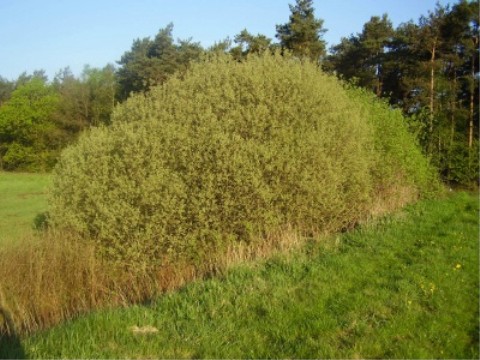
The little-tree willow (Salix arbusculoides Andersson) is a flowering plant in the family Salicaceae, order Malpighiales, and class Magnoliopsida. It grows as either a shrub or a tree. It occurs in central Alaska, Yukon Territory, adjacent Northwest Territories, and areas extending eastward through the boreal forest to Hudson Bay, with a southern distribution through northeastern British Columbia, northern Alberta, Saskatchewan, and Manitoba. Its mature leaves have green, hairless upper surfaces, white finely hairy undersides, and toothed margins bearing resin glands and hydathodes.
Written 27 November 2026 from the sources listed below. Each statement was checked against the passage it cites; statements that could not be supported were removed.
Appearance
The little-tree willow grows as a shrub or tree with numerous branches bearing smooth gray or reddish-brown bark. Its roots are shallow.[1][2][3]
Its mature leaves are approximately 2.5–7.5 centimeters long, with green, hairless upper surfaces and white, finely hairy undersides. Their toothed margins bear glands that function as resin glands and hydathodes.[4][5][6]
Immature leaves are paler, yellowish, and more densely hairy than mature leaves. Its catkins are small, slender, and borne on short stalks.[7][8]
The little-tree willow can grow as an erect shrub approximately 3.3–4.5 meters tall. As a small tree, it can reach approximately 7.5–9 meters in height.[9][10]
Habitat
The little-tree willow occurs in upland and lowland forests of Alaska and northern Canada. It also grows in open tundra above the timberline, along riverbanks and streambanks, and on floodplains.[11][12][13]
In interior Alaska, it forms dense thickets in riparian habitats. It also grows in white spruce and black spruce woodlands and black spruce muskegs.[14][15]
It grows best in deep, moist alluvial bottomlands and commonly colonizes freshly deposited alluvium, glacial outwash, and silty-sandy alluvial deposits. Its growth is reduced when water remains at or above the root collar for extended periods.[16][17][18]
Diet
The little-tree willow provides food for moose, deer, caribou, snowshoe hares, beavers, small mammals, and birds.[19]
Behaviour
The little-tree willow is an early-successional species that colonizes recently disturbed habitats. Once established on floodplains, it can withstand flooding and silting and slow river flow.[20][21]
It can regenerate after fire by sprouting from its root crown and roots. High-severity fires can damage its roots and rhizomes enough to prevent recovery.[22][23]
In young black spruce stands established after fire, its regeneration density has been recorded at approximately 9,880–12,350 stems per hectare. It can dominate black spruce communities for six to twenty-five years following fire.[24][25]
Reproduction and life cycle
The little-tree willow is dioecious, with male and female flowers borne on separate plants. Its flowering period extends from April to early August.[26][27]
Its flowers are primarily insect-pollinated, with bees playing the most important role. The species reaches optimum seed production between two and ten years of age.[28][29]
Its fruit is a capsule that splits into two halves to release numerous seeds. The fruit ripens shortly after flowering, and seed dispersal occurs from early to midsummer by wind or water.[30][31][32]
Its seeds are short-lived, lack dormancy, and germinate immediately on moist surfaces. Germination occurs across a temperature range of approximately 5–25 degrees Celsius and is most successful on moist, exposed mineral substrates receiving substantial sunlight.[33][34][35]
The species can reproduce vegetatively by sprouting from its root crown or basal stems. It can also reproduce through underground rhizomes or roots.[36][37]
Uses
The little-tree willow has been used medicinally by the Eskimo for treating skin sores and watery eyes. Parts of the species have also been used in basket weaving.[38][39]
Its wood can be used for woodworking because the species is a diamond willow.[40]
Conservation
The little-tree willow is classified as native and noninvasive in the United States Forest Service species review. It does not occur in the contiguous United States.[41][42]
Classification of the Little-tree Willow
| Kingdom | Plantae |
|---|---|
| Subkingdom | Pteridobiotina |
| Phylum | Tracheophyta |
| Class | Magnoliopsida |
| Order | Malpighiales |
| Family | Salicaceae (Willow Family) |
| Tribe | Saliceae |
| Genus | Salix (Willow) |
| Species | Salix arbusculoides Andersson |
Where the Little-tree Willow is found
Checklists and occurrence records place Salix arbusculoides in 2 countries across North America. GBIF holds 1,889 georeferenced records of it.
Countries
Regions and cities with the most records
- Alaska, United States 402
- Northwest Territories, Canada 313
- Yukon, Canada 157
- Alberta, Canada 92
- British Columbia, Canada 90
- Fairbanks, United States 61
- Manitoba, Canada 60
- Badger, United States 56
- Nunavut, Canada 51
- Saskatchewan, Canada 29
- Quebec, Canada 21
- Yellowknife, Canada 21
- Edmonton, Canada 8
- Sherwood Park, Canada 8
- St. Albert, Canada 6
- Ontario, Canada 5
- Fort McMurray, Canada 4
- Whitehorse, Canada 4
1 more country has a few records outside this range
These countries hold a few records of Salix arbusculoides but lie outside the range the checklists give for it. Such records are often zoo or garden specimens, museum material or vagrants, so the species is not counted as occurring there.
Range as the checklists state it
Alaska; Canada (Alberta, British Columbia, Manitoba, Northern Territories, Nunavut, Ontario, Québec, Saskatchewan, Yukon)
A number beside a place is its count of GBIF occurrence records. A place without a number comes from a checklist alone. Records show where a species has been observed or collected, which can include escapes and vagrants.
Common names
English
- Little-tree Willow
- Northern Bush Willow
- Shrubby Willow
Names in 1 other language
- French
- saule arbustif
Synonyms
6 other scientific names have been used for this species and are now treated as synonyms of Salix arbusculoides.
- Salix arbusculoides f. arbusculoides
- Salix arbusculoides f. puberula Andersson
- Salix humillima Andersson
- Salix humillima var. puberula (Andersson) Andersson
- Salix saskatchavana Seemen
- Salix saskatchevana Seem.
Related species
-
 Weeping WillowSalix babylonica
-
 European WillowSalix alba
-
 Goat WillowSalix caprea
-
 Black WillowSalix nigra
-
 Arctic WillowSalix arctica
-
 Common OsierSalix viminalis
-
 Snowbed WillowSalix herbacea
-
 Common SallowSalix cinerea
Compare
Questions and answers
What is the scientific name of the Little-tree Willow?
The scientific name of the Little-tree Willow is Salix arbusculoides. Written with its author, the full name is Salix arbusculoides Andersson.
Which family does the Little-tree Willow belong to?
Salix arbusculoides belongs to the family Salicaceae, in the order Malpighiales and the class Magnoliopsida.
Where is the Little-tree Willow found?
Checklists and occurrence records place Salix arbusculoides in 2 countries: Canada and United States.
What is the conservation status of the Little-tree Willow?
The IUCN Red List category recorded for Salix arbusculoides is Least Concern (LC).
What other names does the Little-tree Willow have?
Salix arbusculoides is also known in English as Northern Bush Willow and Shrubby Willow.
What are some native willow shrubs?
The little-tree willow is a willow species classified as native and noninvasive in the United States Forest Service species review. It can grow as an erect shrub approximately 3.3–4.5 meters tall.[1][9][42]
Are willow shrub roots invasive?
The little-tree willow has shallow roots. It is classified as native and noninvasive in the United States Forest Service species review.[3][42]
What is the habitat of a willow tree?
The little-tree willow grows in upland and lowland forests, open tundra above the timberline, riverbanks, streambanks, floodplains, spruce woodlands, and black spruce muskegs. It grows best in deep, moist alluvial bottomlands.[11][12][13][15][16]
What do willow trees eat?
The little-tree willow provides food for moose, deer, caribou, snowshoe hares, beavers, small mammals, and birds.[19]
What does an arctic willow eat?
The little-tree willow provides food for moose, deer, caribou, snowshoe hares, beavers, small mammals, and birds.[19]
What kind of willow do moose eat?
The little-tree willow is one willow species that provides food for moose.[19]
Sources
Passages the profile rests on
- The species grows as either a shrub or a tree. Source passage: “This willow is a shrub or tree growing up to 9 meters tall.” — English Wikipedia
- Its numerous branches have smooth gray or reddish-brown bark. Source passage: “It has many branches with smooth gray or reddish-brown bark.” — English Wikipedia
- Its roots are shallow. Source passage: “Roots of littletree willow are shallow.” — research.fs.usda.gov
- Its mature leaves are green and hairless on the upper surface and white with fine hairs underneath. Source passage: “The leaves are green and hairless above and white and finely hairy beneath” — research.fs.usda.gov
- Its mature leaves have toothed margins bearing glands that function as resin glands and hydathodes. Source passage: “The leaves have toothed edges that are studded with glands that function as resin glands as well as hydathodes.” — English Wikipedia
- Its mature leaves measure approximately 2.5–7.5 centimeters in length. Source passage: “The mature leaves are 1 to 3 inches (2.5-7.5 cm) long.” — research.fs.usda.gov
- Its immature leaves are paler, yellowish, and more densely hairy than mature leaves. Source passage: “Immature leaves have thicker coats of hair and are paler and yellowish in color.” — English Wikipedia
- Its catkins are small, slender, and borne on short stalks. Source passage: “Catkins are small and slender on short stalks” — research.fs.usda.gov
- The species can grow as an erect shrub approximately 3.3–4.5 meters tall. Source passage: “Littletree willow is an erect shrub 10 to 15 feet (3.3-4.5 m) tall” — research.fs.usda.gov
- When growing as a small tree, the species can reach approximately 7.5–9 meters in height. Source passage: “or a small tree 25 to 30 feet (7.5-9 m) tall” — research.fs.usda.gov
- The species occurs in both upland and lowland forests of Alaska and northern Canada. Source passage: “In Alaska and northern Canada, littletree willow is found in both upland and lowland forests.” — research.fs.usda.gov
- It grows in open tundra above the timberline. Source passage: “It grows in the open tundra above timberline” — research.fs.usda.gov
- It occupies riverbanks, streambanks, and floodplains. Source passage: “along riverbanks and streambanks, and on floodplains.” — research.fs.usda.gov
- In interior Alaska, it forms dense thickets in riparian habitats. Source passage: “In interior Alaska, it forms dense thickets in riparian habitats” — research.fs.usda.gov
- It grows in white spruce and black spruce woodlands and black spruce muskegs. Source passage: “grows as small shrubs in white spruce (Picea glauca) and black spruce (P. mariana) woodlands and in black spruce muskegs” — research.fs.usda.gov
- The species grows best in deep, moist alluvial bottomlands. Source passage: “Littletree willow grows best in deep, moist alluvial bottomlands” — research.fs.usda.gov
- Its growth is reduced when water remains at or above the root collar for extended periods. Source passage: “Growth of littletree willow is reduced when water levels are maintained at or above the root collar for extended periods” — research.fs.usda.gov
- It commonly colonizes freshly deposited alluvium, glacial outwash, and silty-sandy alluvial deposits. Source passage: “Littletree willow is a common early seral species that will invade fresh alluvium deposits, glacial outwash, and silty-sandy alluvial deposits” — research.fs.usda.gov
- The species provides food for moose, deer, caribou, snowshoe hares, beavers, small mammals, and birds. Source passage: “This plant provides food for many animals, such as moose, deer, caribou, snowshoe hares, beavers, and small mammals and birds.” — English Wikipedia
- It is an early-successional species that colonizes recently disturbed habitats. Source passage: “This is an early seral species that colonizes freshly disturbed habitats” — English Wikipedia
- Once established on floodplains, it can withstand flooding and silting and slow river flow. Source passage: “Once they are well established they can withstand both flooding and silting and can slow down river flow” — research.fs.usda.gov
- It can regenerate after fire by sprouting from its root crown and roots. Source passage: “Littletree willow is a fire-adapted species that can sprout from the root crown and roots” — research.fs.usda.gov
- High-severity fires can damage its roots and rhizomes enough to prevent recovery. Source passage: “High-severity fires can damage the roots and rhizomes to the point of no recovery” — research.fs.usda.gov
- In young black spruce stands established after fire, its regeneration density has been recorded at approximately 9,880–12,350 stems per hectare. Source passage: “littletree willow regenerated at about 4,000 to 5,000 stems per acre (9,880-12,350 stems/ha)” — research.fs.usda.gov
- It can dominate black spruce communities for six to twenty-five years following fire. Source passage: “Littletree willow is the dominant species following fire in black spruce communities for 6 to 25 years” — research.fs.usda.gov
- The species is dioecious, with male and female flowers borne on separate plants. Source passage: “Male and female flowers are borne in catkins on separate plants.” — research.fs.usda.gov
- Its flowering period extends from April to early August. Source passage: “Littletree willow flowers from April to early August.” — research.fs.usda.gov
- The species reaches optimum seed production between two and ten years of age. Source passage: “Optimum seed production is reached when trees are between 2 and 10 years of age” — research.fs.usda.gov
- Its flowers are primarily insect-pollinated, with bees playing the most important role. Source passage: “The flowers are mostly insect pollinated, with bees playing the most important role” — research.fs.usda.gov
- Its fruit ripens shortly after flowering, with seed dispersal occurring from early to midsummer. Source passage: “The fruit ripens shortly after flowering; seed dispersal occurs form early to midsummer” — research.fs.usda.gov
- Its fruit is a capsule that splits into two halves to release numerous seeds. Source passage: “The fruit is contained in a capsule that splits in half to release many seeds” — research.fs.usda.gov
- Its seeds are dispersed by wind or water. Source passage: “that are then dispersed by wind or water” — research.fs.usda.gov
- Its seeds are short-lived, lack dormancy, and germinate immediately on moist surfaces. Source passage: “The seeds of littletree willow are short-lived and nondormant, and germinate immediately on moist surfaces.” — research.fs.usda.gov
- Its seeds germinate across a temperature range of approximately 5–25 degrees Celsius. Source passage: “The broad temperature range of germination for these seeds, 41 to 77 degrees Fahrenheit (5-25 deg C)” — research.fs.usda.gov
- Seed germination occurs most successfully on moist, exposed mineral substrates receiving substantial sunlight. Source passage: “Germination occurs best in moist, exposed mineral substrates that receive substantial sunlight.” — research.fs.usda.gov
- The species can reproduce vegetatively by sprouting from its root crown or basal stems. Source passage: “Littletree willow will sprout from the root crown or basal stems” — research.fs.usda.gov
- It can also reproduce vegetatively through underground rhizomes or roots. Source passage: “It is also capable of vegetative reproduction by underground rhizomes or roots” — research.fs.usda.gov
- The species has been used medicinally by the Eskimo for treating skin sores and watery eyes. Source passage: “This plant was used medicinally by the Eskimo for ailments such as skin sores and watery eyes.” — English Wikipedia
- Parts of this species have been used in basket weaving. Source passage: “Native Americans used parts of willows, including this species, for medicinal purposes, basket weaving, to make bows and arrows, and for building animal traps.” — English Wikipedia
- Its wood can be used for woodworking because the species is a diamond willow. Source passage: “It is a species of diamond willow and can be used for woodworking.” — English Wikipedia
- The species does not occur in the contiguous United States. Source passage: “Littletree willow does not occur in the contiguous United States” — research.fs.usda.gov
- The species is classified as native and noninvasive in the United States Forest Service species review. Source passage: “Fed. Protected: NoNativity: NativeInvasiveness: Noninvasive” — research.fs.usda.gov
Data
- Catalogue of Life, 2026-10-16 XR cc by
- Global Biodiversity Information Facility CC BY 4.0
- Wikidata CC0
- GeoNames CC BY 4.0
- Within the Catalogue of Life, this name comes from Synonymic Checklists of the Vascular Plants of the World cc by
References
- Andersson. (1867). Kongl. Svenska Vetensk.-Akad. Handl., n. s. 6(1): 147 (1867). where the name was published
This species in other databases
- Catalogue of Life 6XCJ5
- Wikidata Q7404881
- iNaturalist 168314
- World Flora Online wfo-0000929010
- GRIN 455739
Page built on 27 November 2026. See how the catalog is made and all sources and licences.
Cite this page
ScientificNames.org. (2026). Salix arbusculoides (Little-tree Willow). Retrieved November 27, 2026, from https://scientificnames.org/species/salix-arbusculoides
“Salix arbusculoides (Little-tree Willow).” ScientificNames.org, 2026, scientificnames.org/species/salix-arbusculoides. Accessed 27 Nov. 2026.
ScientificNames.org. “Salix arbusculoides (Little-tree Willow).” Accessed November 27, 2026. https://scientificnames.org/species/salix-arbusculoides.
@misc{scientificnames_salix_arbusculoides_little_tree_willow,
  author = {{ScientificNames.org}},
  title = {Salix arbusculoides (Little-tree Willow)},
  year = {2026},
  url = {https://scientificnames.org/species/salix-arbusculoides},
  note = {Accessed 2026-11-27}
}