Species · Flowering plants
Mountain Willow Salix barclayi
The scientific name of the Mountain Willow is Salix barclayi. It is a species of flowering plant in the family Salicaceae (willow family), order Malpighiales.
- Scientific name
- Salix barclayi Andersson
- Common name
- Mountain Willow
- Genus
- Salix
- Family
- Salicaceae (Willow Family)
- Order
- Malpighiales
- Class
- Magnoliopsida
- Red List category
- LC Least Concern
- Recorded in
- 2 countries
- Name status
- accepted in the Catalogue of Life

Overview
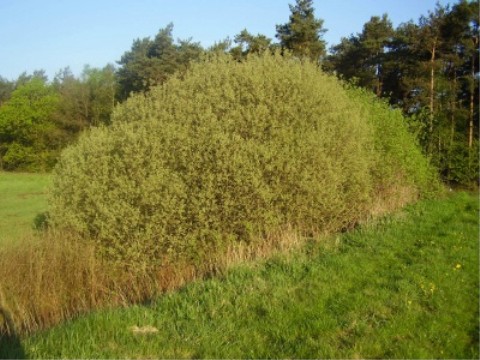
Salix barclayi is native to North America and grows near lakes and streams at elevated locations. It is a slender shrub with elliptic to obovate leaves and catkins that grow on short, leafy peduncles.
Written 27 November 2026 from the sources listed below. Each statement was checked against the passage it cites; statements that could not be supported were removed.
Appearance
Mountain willow is a slender shrub that can reach a height of 2.5 metres (8 feet). Its leaves are elliptic to obovate and measure 2–6 cm long and 1–2.5 cm wide.[1][2][3]
Young leaves are hairy, and hairs along the midrib persist as the leaves mature. Its catkins grow on short, leafy peduncles.[4][5]
Male catkins measure approximately 3 cm long and contain two stamens. Female catkins measure 2.5–5 cm long and are hairless.[6][7]
Habitat
Mountain willow grows near lakes and streams at elevated locations. It is native to North America, occurring primarily in the northwestern United States and Canada.[8][9]
Behaviour
Mountain willow grows quickly but spreads slowly.[10]
Conservation
The Idaho Fish and Game species catalog assigns Salix barclayi the state rank SNR.[11]
Uses
Equations developed for Barclay willow were used to predict the mass of sweetgale eaten in a moose-forage study.[12]
Classification of the Mountain Willow
| Kingdom | Plantae |
|---|---|
| Subkingdom | Pteridobiotina |
| Phylum | Tracheophyta |
| Class | Magnoliopsida |
| Order | Malpighiales |
| Family | Salicaceae (Willow Family) |
| Tribe | Saliceae |
| Genus | Salix (Willow) |
| Species | Salix barclayi Andersson |
Where the Mountain Willow is found
Checklists and occurrence records place Salix barclayi in 2 countries across North America. GBIF holds 3,646 georeferenced records of it.
Countries
Regions and cities with the most records
- Alaska, United States 883
- British Columbia, Canada 597
- Washington, United States 313
- Alberta, Canada 127
- Yukon, Canada 125
- Montana, United States 84
- Idaho, United States 77
- Juneau, United States 62
- Northwest Territories, Canada 36
- Whitehorse, Canada 20
- Eagle River, United States 14
- Oregon, United States 13
- Anchorage, United States 12
- North Vancouver, Canada 6
- Port Angeles, United States 6
- Richmond, Canada 6
- Riley Park, Canada 6
- Vancouver, Canada 6
- Victoria-Fraserview, Canada 6
- West Vancouver, Canada 6
- Colorado, United States 5
- Wyoming, United States 4
- Manitoba, Canada 3
- Salmon Arm, Canada 3
Range as the checklists state it
Russian Far East (Kamchatka); Alaska; Canada (Alberta, British Columbia, Northern Territories, Yukon); USA (Colorado, Idaho, Montana, Washington State, Wyoming)
A number beside a place is its count of GBIF occurrence records. A place without a number comes from a checklist alone. Records show where a species has been observed or collected, which can include escapes and vagrants.
Common names
English
- Mountain Willow
Names in 2 other languages
- French
- saule de Barclay
- Russian
- Ива копьевидная
Synonyms
8 other scientific names have been used for this species and are now treated as synonyms of Salix barclayi.
- Salix barclayi var. angustifolia Andersson
- Salix barclayi var. conjuncta (Bebb) C.R.Ball & C.K.Schneid.
- Salix barclayi var. grandifolia Andersson
- Salix barclayi var. rotundifolia Andersson
- Salix conjuncta Bebb
- Salix hoyeriana Dieck ex Dippel
- Salix pyrolifolia var. hoyeriana (Dieck) Dippel
- Salix regelii Andersson
Related species
-
 Weeping WillowSalix babylonica
-
 European WillowSalix alba
-
 Goat WillowSalix caprea
-
 Black WillowSalix nigra
-
 Arctic WillowSalix arctica
-
 Common OsierSalix viminalis
-
 Snowbed WillowSalix herbacea
-
 Common SallowSalix cinerea
Compare
Questions and answers
What is the scientific name of the Mountain Willow?
The scientific name of the Mountain Willow is Salix barclayi. Written with its author, the full name is Salix barclayi Andersson.
Which family does the Mountain Willow belong to?
Salix barclayi belongs to the family Salicaceae, in the order Malpighiales and the class Magnoliopsida.
Where is the Mountain Willow found?
Checklists and occurrence records place Salix barclayi in 2 countries: United States and Canada.
What is the conservation status of the Mountain Willow?
The IUCN Red List category recorded for Salix barclayi is Least Concern (LC).
Are there any willows native to North America?
Mountain willow (Salix barclayi) is native to North America, occurring primarily in the northwestern United States and Canada.[9]
Sources
Passages the profile rests on
- Salix barclayi is a slender shrub. Source passage: “It is a shrub, that can grow up to 2.5 m. (8 ft.) tall and tends to be slender.” — English Wikipedia
- The shrub can reach a height of 2.5 metres (8 feet). Source passage: “It is a shrub, that can grow up to 2.5 m. (8 ft.) tall” — English Wikipedia
- Its leaves are elliptic to obovate in shape and measure 2–6 cm long and 1–2.5 cm wide. Source passage: “Leaves are elliptic to obovate, 2–6 cm long and 1–2.5 cm wide.” — English Wikipedia
- Young leaves are hairy, and hairs along the midrib persist as the leaves mature. Source passage: “Leaves are hairy when young, with midrib hairs lasting into maturity.” — English Wikipedia
- Its catkins grow on short, leafy peduncles. Source passage: “Catkins are on short, leafy peduncles.” — English Wikipedia
- Male catkins measure approximately 3 cm long and contain two stamens. Source passage: “Staminate catkins are 3 cm long with 2 stamens” — English Wikipedia
- Female catkins measure 2.5–5 cm long and are hairless. Source passage: “pistillate catkins are 2.5–5 cm long and glabrous.” — English Wikipedia
- The species grows near lakes and streams at elevated locations. Source passage: “It grows near lakes and streams at elevation.” — English Wikipedia
- The species is native to North America, occurring primarily in the northwestern United States and Canada. Source passage: “native to North America, found primarily in the Northwestern area of the United States and Canada.” — English Wikipedia
- The plant is described as growing quickly but spreading slowly. Source passage: “This plant should grow very quickly, but tends to spread very slowly.” — English Wikipedia
- The Idaho Fish and Game species catalog assigns Salix barclayi the state rank SNR. Source passage: “Salix barclayi (Barclay's Willow) Plantae/Anthophyta/Dicotyledoneae/Salicales/Salicaceae/Salix barclayi State Rank: SNR” — idfg.idaho.gov
- Equations developed for Barclay willow were used to predict the mass of sweetgale eaten in a moose-forage study. Source passage: “sweetgale mass eaten were better predicted using Sitka and. Barclay willow (Salix barclayi) equations, respectively” — nrm.dfg.ca.gov
Data
- Catalogue of Life, 2026-10-16 XR cc by
- Global Biodiversity Information Facility CC BY 4.0
- Wikidata CC0
- GeoNames CC BY 4.0
- Wikimedia Commons per image; credit shown with each image
- Within the Catalogue of Life, this name comes from Synonymic Checklists of the Vascular Plants of the World cc by
References
- Andersson. (1858). Öfvers. Kongl. Vetensk.-Akad. Förh. 15: 125 (1858). where the name was published
This species in other databases
- Catalogue of Life 6XCLZ
- Wikidata Q4195448
- iNaturalist 168319
- World Flora Online wfo-0000929257
- GRIN 312148
Page built on 27 November 2026. See how the catalog is made and all sources and licences.
Cite this page
ScientificNames.org. (2026). Salix barclayi (Mountain Willow). Retrieved November 27, 2026, from https://scientificnames.org/species/salix-barclayi
“Salix barclayi (Mountain Willow).” ScientificNames.org, 2026, scientificnames.org/species/salix-barclayi. Accessed 27 Nov. 2026.
ScientificNames.org. “Salix barclayi (Mountain Willow).” Accessed November 27, 2026. https://scientificnames.org/species/salix-barclayi.
@misc{scientificnames_salix_barclayi_mountain_willow,
  author = {{ScientificNames.org}},
  title = {Salix barclayi (Mountain Willow)},
  year = {2026},
  url = {https://scientificnames.org/species/salix-barclayi},
  note = {Accessed 2026-11-27}
}