Species · Flowering plants
Bebb's Willow Salix bebbiana
The scientific name of the Bebb's Willow is Salix bebbiana. It is a species of flowering plant in the family Salicaceae (willow family), order Malpighiales.
- Scientific name
- Salix bebbiana Sarg.
- Common name
- Bebb's Willow
- Genus
- Salix
- Family
- Salicaceae (Willow Family)
- Order
- Malpighiales
- Class
- Magnoliopsida
- Red List category
- LC Least Concern
- Recorded in
- 11 countries
- Name status
- accepted in the Catalogue of Life

Overview
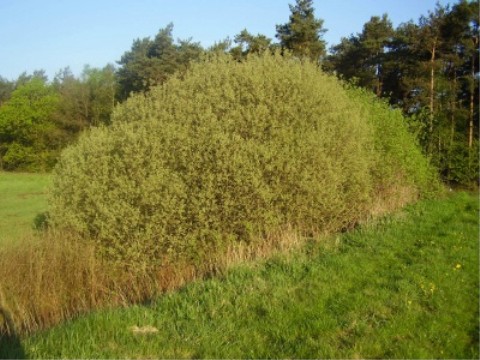
Salix bebbiana is native to Canada and the northern United States, ranging from Alaska and Yukon south to California and Arizona and northeast to Newfoundland and New England. It typically grows as a large, multiple-stemmed shrub or small shrubby tree and can form dense colonial thickets.
Written 26 November 2026 from the sources listed below. Each statement was checked against the passage it cites; statements that could not be supported were removed.
Habitat
Bebb's willow grows in loose, saturated soils along riverbanks, lakesides, swamps, marshes, and bogs. It tolerates heavy clay and rocky soils and is dominant in many marshland areas within its native range.[1][2][3]
Appearance
Bebb's willow typically grows approximately 5–20 feet tall, and its trunk can reach approximately 8 inches in diameter. It has a short, twisted trunk and a broadly rounded crown.[4][5][6]
Its leaves are alternately arranged, simple, and ovate, with their widest point near the midrib. They narrow toward a tapering base, have pointed tips, and generally have entire margins that can sometimes be finely serrated.[7][8][9]
Mature leaves are dull blue-green and smooth, while new leaves are covered with downy hairs. The leaves can reach 5 inches in length.[10][11][12]
The flowers are arranged in small, dangling catkins.[13]
Reproduction and life cycle
Bebb's willow is dioecious, with male and female flowers produced on separate plants. Female flowers produce spherical seeds covered with long, threadlike fibers that assist wind dispersal.[14][15]
The species reproduces vegetatively by sprouting from stem bases or root segments and can also reproduce through layering. These processes enable it to form clonal colonies.[16][17][18]
Uses
The wood of Bebb's willow is used for carving and is associated with the production of diamond willow wood. Native Americans use its twigs and branches for basket weaving and arrowmaking.[19][20][21]
The document reports no commercial importance for Bebb's willow.[22]
Diet
Cattle consume the foliage of Bebb's willow as forage.[23]
Behaviour
Bebb's willow readily hybridizes with several other willow species.[24]
Classification of the Bebb's Willow
| Kingdom | Plantae |
|---|---|
| Subkingdom | Pteridobiotina |
| Phylum | Tracheophyta |
| Class | Magnoliopsida |
| Order | Malpighiales |
| Family | Salicaceae (Willow Family) |
| Tribe | Saliceae |
| Genus | Salix (Willow) |
| Species | Salix bebbiana Sarg. |
Where the Bebb's Willow is found
Checklists and occurrence records place Salix bebbiana in 11 countries across Asia, Europe and North America. GBIF holds 25,916 georeferenced records of it.
Countries
- Canada 8,542
- China 221
- Finland 1,181
- Kazakhstan 55
- Mongolia 89
- North Korea 55
- Norway 161
- Russia 3,434
- South Korea 285
- Sweden 805
- United States 11,088
Regions and cities with the most records
- Quebec, Canada 1,504
- Ontario, Canada 1,440
- Alberta, Canada 1,063
- Lapland, Finland 894
- Wisconsin, United States 868
- British Columbia, Canada 648
- Norrbotten, Sweden 603
- Minnesota, United States 576
- Sakha, Russia 534
- Alaska, United States 507
- Colorado, United States 428
- Montana, United States 386
- Michigan, United States 364
- Northwest Territories, Canada 346
- South Dakota, United States 335
- Manitoba, Canada 323
- Vermont, United States 309
- Massachusetts, United States 296
- Saskatchewan, Canada 289
- Buryatiya Republic, Russia 282
- Irkutsk Oblast, Russia 280
- Pennsylvania, United States 273
- Arizona, United States 247
- Idaho, United States 247
- Yukon, Canada 225
- Krasnoyarsk Krai, Russia 218
- New Hampshire, United States 218
- Calgary, Canada 206
- Kamchatka, Russia 189
- Maine, United States 182
- Khabarovsk, Russia 179
- New Brunswick, Canada 178
- New York, United States 173
- Washington, United States 170
- New Mexico, United States 163
- Nova Scotia, Canada 162
Range as the checklists state it
Norway; Sweden; Finland; N-European Russia; Siberia (Altay, Yakutia); Russian Far East (Primorye); Kazakhstan; China (N-Hebei, Heilongjiang, Jilin, Liaoning, E-Nei Mongol, Shanxi); Mongolia; North Korea; Alaska; Canada (Alberta, British Columbia, Labrador, Manitoba, New Brunswick, Newfoundland, Nova Scotia, Northern Territories, Nunavut, Ontario, Prince Edward Isl., Québec, Saskatchewan, Yukon); USA (Arizona, California, Colorado, Connecticut, Iowa, Idaho, Illinois, Indiana, Massachusetts, Maryland, Maine, Michigan, Minnesota, Montana, North Dakota, Nebraska, New Hampshire, New Jersey, New Mexico, Nevada, New York, Ohio, Oregon, Pennsylvania, Rhode Island, South Dakota, Utah, Vermont, Washington State, Wisconsin, Wyoming)
A number beside a place is its count of GBIF occurrence records. A place without a number comes from a checklist alone. Records show where a species has been observed or collected, which can include escapes and vagrants.
Common names
English
- Bebb's Willow
- Aridland Willow
- Beak Willow
- Beaked Willow
- Diamond Willow
- Gray Willow
- Grey Willow
- Long-beak Willow
- Long-beaked Willow
Names in 9 other languages
- Chinese
- 長喙柳
- Finnish
- kangaspaju
- French
- chaton, saule de Bebb
- Japanese
- ナガバチョウセンキツネヤナギ
- Korean
- 여우버들
- Northern Sami
- ordesieđga
- Norwegian Bokmål
- finnmarksvier
- Russian
- Ива Бебба
- Swedish
- finnvide
Synonyms
46 other scientific names have been used for this species and are now treated as synonyms of Salix bebbiana.
- Salix bebbiana f. capreifolia (Fernald) C.K.Schneid.
- Salix bebbiana f. luxurians (Fernald) C.K.Schneid.
- Salix bebbiana var. bebbiana
- Salix bebbiana var. capreifolia (Fernald) Fernald
- Salix bebbiana var. depilis Raup
- Salix bebbiana var. luxurians (Fernald) Fernald
- Salix bebbiana var. perrostrata (Rydb.) C.K.Schneid.
- Salix bebbiana var. projecta (Fernald) C.K.Schneid.
- Salix cinerascens Wahlenb.
- Salix depressa f. cinerascens (Wahlenb.) Regel
- Salix depressa subsp. rostrata (Andersson) Hiitonen
- Salix depressa var. cinerascens (Wahlenb.) Fr.
- Salix floderusii (Wahlenb.) Nakai
- Salix floderusii f. manshurica (Siuzew) Nakai
- Salix floderusii var. fuscescens Nakai
- Salix hsinganica Y.L.Chang & A.K.Skvortsov
- Salix ilectica Y.L.Chou
- Salix ilectica var. integristyla Y.L.Chou
- Salix livida var. cinerascens Wahlenb.
- Salix livida var. occidentalis (Andersson) A.Gray
- Salix livida var. rostrata (Andersson) Dippel
- Salix macropoda Stschegl.
- Salix orotchonorum Kimura
- Salix perrostrata Rydb.
- Salix rostrata var. capreifolia Fernald
- Salix rostrata var. luxurians Fernald
- Salix rostrata var. perrostrata (Rydb.) Fernald
- Salix rostrata var. projecta Fernald
- Salix starkeana subsp. bebbiana (Sarg.) Youngberg
- Salix starkeana subsp. cinerascens (Wahlenb.) Hultén
- Salix starkeana var. cinerascens (Wahlenb.) C.K.Schneid.
- Salix vagans f. manshurica Siuzew
- Salix vagans subsp. cinerascens (Wahlenb.)
- Salix vagans var. cinerascens (Wahlenb.) Andersson
- Salix vagans var. glabrescens Andersson
- Salix vagans var. intermedia Andersson
- Salix vagans var. linnaeana Andersson
- Salix vagans var. rostrata (Richardson) Andersson
- Salix xerophila Flod.
- Salix xerophila f. manshurica (Siuzew) Kitag.
Showing 40 of 46.
Related species
-
 Weeping WillowSalix babylonica
-
 European WillowSalix alba
-
 Goat WillowSalix caprea
-
 Black WillowSalix nigra
-
 Arctic WillowSalix arctica
-
 Common OsierSalix viminalis
-
 Snowbed WillowSalix herbacea
-
 Common SallowSalix cinerea
Compare
Questions and answers
What is the scientific name of the Bebb's Willow?
The scientific name of the Bebb's Willow is Salix bebbiana. Written with its author, the full name is Salix bebbiana Sarg..
Which family does the Bebb's Willow belong to?
Salix bebbiana belongs to the family Salicaceae, in the order Malpighiales and the class Magnoliopsida.
Where is the Bebb's Willow found?
Checklists and occurrence records place Salix bebbiana in 11 countries, including United States, Canada, Russia, Finland, Sweden and South Korea.
What is the conservation status of the Bebb's Willow?
The IUCN Red List category recorded for Salix bebbiana is Least Concern (LC).
What other names does the Bebb's Willow have?
Salix bebbiana is also known in English as Aridland Willow, Beak Willow, Beaked Willow, Diamond Willow, Gray Willow and Grey Willow.
How tall can Bebb's willow grow?
Bebb's willow grows approximately 5–20 feet tall.[4]
Are there any willows native to North America?
Bebb's willow is native to Canada and the northern United States.[25]
Sources
Passages the profile rests on
- The species grows in loose, saturated soils along riverbanks, lakesides, swamps, marshes, and bogs. Source passage: “It can be found in loose, saturated soils such as that on riverbanks, lake sides, swamps, marshes, and bogs.” — English Wikipedia
- Salix bebbiana tolerates heavy clay and rocky soils. Source passage: “It is capable of tolerating heavy clay and rocky soils” — English Wikipedia
- The species is dominant in many marshland areas within its native range. Source passage: “It is a dominant species in many marshland areas in its native range.” — English Wikipedia
- Salix bebbiana grows approximately 5–20 feet tall. Source passage: “It is a large shrub or small bushy tree from 5 to 20 feet in height” — English Wikipedia
- The trunk of the species can reach approximately 8 inches in diameter. Source passage: “with a trunk up to about 8 inches in diameter.” — English Wikipedia
- The species has a short, twisted trunk and a broadly rounded crown. Source passage: “The trunk is short and twisted with a broadly rounded crown.” — English Wikipedia
- Its leaves are alternately arranged, simple, and ovate, with their widest point near the midrib. Source passage: “Leaves are alternately arranged, simple, and ovate in shape, widest near the midrib” — English Wikipedia
- The leaves narrow toward a tapering base and have pointed tips. Source passage: “narrowing to a tapering base and pointed tip.” — English Wikipedia
- The leaf margins are generally entire but can sometimes be finely serrated. Source passage: “The leaf edges are generally entire, though sometimes finely serrated.” — English Wikipedia
- Mature leaves are dull blue-green and smooth. Source passage: “The leaves are dull blue-green in color and smooth in texture when mature” — English Wikipedia
- New leaves are covered with downy hairs. Source passage: “new leaves are coated in downy hairs.” — English Wikipedia
- The leaves can reach 5 inches in length. Source passage: “The leaves are up to 5 in long” — English Wikipedia
- The flowers are arranged in small, dangling catkins. Source passage: “male and female plants producing small, dangling catkins.” — English Wikipedia
- Salix bebbiana is dioecious, with male and female flowers produced on separate plants. Source passage: “Like other willows, this plant is dioecious, with male and female plants producing small, dangling catkins.” — English Wikipedia
- Female flowers produce spherical seeds covered with long, threadlike fibers that assist wind dispersal. Source passage: “Female flowers yield spherical seeds covered in long, threadlike fibers that help them disperse on the wind.” — English Wikipedia
- The species reproduces vegetatively by sprouting from stem bases or root segments. Source passage: “The plant also spreads via vegetative reproduction, sprouting from the base of the stem or from segments of root” — English Wikipedia
- Salix bebbiana can reproduce through layering. Source passage: “and by layering, allowing the plant to form colonies of clones.” — English Wikipedia
- Vegetative reproduction and layering enable the species to form clonal colonies. Source passage: “allowing the plant to form colonies of clones.” — English Wikipedia
- The wood of Salix bebbiana is used for carving and is associated with the production of diamond willow wood. Source passage: “This is the most important species of diamond willow, a type of willow which produces fine, colorful wood used for carving.” — English Wikipedia
- Native Americans use the species' twigs and branches for basket weaving. Source passage: “The twigs and branches are used by Native Americans for basket weaving and arrowmaking” — English Wikipedia
- Native Americans use the species' twigs and branches for arrowmaking. Source passage: “The twigs and branches are used by Native Americans for basket weaving and arrowmaking” — English Wikipedia
- The document reports no commercial importance for Salix bebbiana. Source passage: “There seems to be no commercial importance for the plant.” — English Wikipedia
- Cattle consume the foliage of Salix bebbiana as forage. Source passage: “Many parts of the plant are consumed by animals, especially cattle, which find the foliage a palatable forage.” — English Wikipedia
- Salix bebbiana readily hybridizes with several other willow species. Source passage: “This species readily hybridizes with several other species of willow.” — English Wikipedia
- Salix bebbiana is native to Canada and the northern United States, ranging from Alaska and Yukon south to California and Arizona and northeast to Newfoundland and New England. Source passage: “Salix bebbiana is a species of willow indigenous to Canada and the northern United States, from Alaska and Yukon south to California and Arizona and northeast to Newfoundland and New England.” — English Wikipedia
Data
- Catalogue of Life, 2026-10-16 XR cc by
- Global Biodiversity Information Facility CC BY 4.0
- Wikidata CC0
- GeoNames CC BY 4.0
- Wikimedia Commons per image; credit shown with each image
- Within the Catalogue of Life, this name comes from Synonymic Checklists of the Vascular Plants of the World cc by
References
- Sarg. (1895). Gard. & Forest 8: 463 (1895). where the name was published
This species in other databases
- Catalogue of Life 79CMC
- Wikidata Q2578880
- iNaturalist 54843
- World Flora Online wfo-0000929260
- GRIN 312149
Page built on 26 November 2026. See how the catalog is made and all sources and licences.
Cite this page
ScientificNames.org. (2026). Salix bebbiana (Bebb's Willow). Retrieved November 26, 2026, from https://scientificnames.org/species/salix-bebbiana
“Salix bebbiana (Bebb's Willow).” ScientificNames.org, 2026, scientificnames.org/species/salix-bebbiana. Accessed 26 Nov. 2026.
ScientificNames.org. “Salix bebbiana (Bebb's Willow).” Accessed November 26, 2026. https://scientificnames.org/species/salix-bebbiana.
@misc{scientificnames_salix_bebbiana_bebbs_willow,
  author = {{ScientificNames.org}},
  title = {Salix bebbiana (Bebb's Willow)},
  year = {2026},
  url = {https://scientificnames.org/species/salix-bebbiana},
  note = {Accessed 2026-11-26}
}