Species · Flowering plants
Caspian Willow Salix caspica
The scientific name of the Caspian Willow is Salix caspica. It is a species of flowering plant in the family Salicaceae (willow family), order Malpighiales.
- Scientific name
- Salix caspica Pall.
- Common name
- Caspian Willow
- Genus
- Salix
- Family
- Salicaceae (Willow Family)
- Order
- Malpighiales
- Class
- Magnoliopsida
- Recorded in
- 4 countries
- Name status
- accepted in the Catalogue of Life

Overview
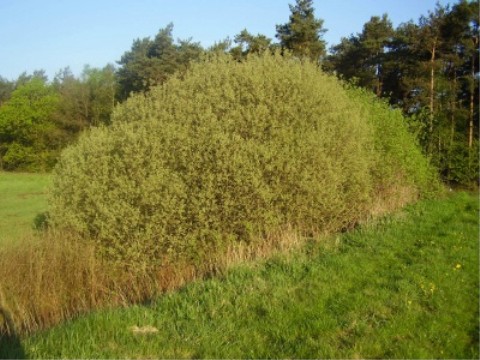
The Caspian willow (Salix caspica Pall.) is a large shrub in the family Salicaceae. Its natural range extends from eastern European Russia through Kazakhstan, Turkmenistan and Iran to Mongolia and western Xinjiang in China. It is distinguished by its straight, thin and flexible stems, which can exceed 2 meters in length within one growing season.
Written 27 November 2026 from the sources listed below. Each statement was checked against the passage it cites; statements that could not be supported were removed.
Appearance
The Caspian willow is a large shrub with gray bark and relatively thin, yellowish, shiny branches. It can reach a height of 5 meters, and its pointed buds are approximately 5 millimeters long.[1][2][3]
The plant has linear, deciduous stipules. Its inflorescences are densely flowered, cylindrical catkins that are nearly stalkless, with brownish, hairy bracts that have blunt tips.[4][5][6]
Male flowers have two stamens with fused filaments and downy hairs at their bases, as well as yellow anthers. Female flowers have densely hairy, ovoid-conical ovaries that are nearly stalkless.[7][8][9]
The species produces brownish capsules covered with hairs.[10]
Habitat
In China, the Caspian willow grows in open forests along rivers. Outside China, it grows along rivers in deserts and steppes, particularly in loose sandy soil and sand dunes with high water tables.[11][12]
The species also occurs in mountain valleys at elevations of up to 2,000 meters and is typically found in blowouts. It requires abundant light for growth.[13][14][15]
Reproduction and life cycle
The Caspian willow flowers before its leaves emerge. In Xinjiang, flowering occurs from April to May, while in Russia it occurs in May.[16][17][18]
Similar species
The Caspian willow forms a natural hybrid with rosemary-leaved willow (Salix rosmarinifolia) in Kazakhstan. It also hybridizes with Salix siberica, Salix tenuijulis and Salix viminalis sensu lato.[19][20]
Uses
The species is planted to stabilize slopes and sandy soils. Its branches are used to weave baskets and other wicker products.[21][22]
The Caspian willow is considered excellent for wickerwork because it produces straight, thin and flexible stems that can exceed 2 meters in length within one growing season.[23]
The species was cultivated as an ornamental plant in the Soviet Union.[24]
Classification of the Caspian Willow
| Kingdom | Plantae |
|---|---|
| Subkingdom | Pteridobiotina |
| Phylum | Tracheophyta |
| Class | Magnoliopsida |
| Order | Malpighiales |
| Family | Salicaceae (Willow Family) |
| Tribe | Saliceae |
| Genus | Salix (Willow) |
| Species | Salix caspica Pall. |
Where the Caspian Willow is found
Checklists and occurrence records place Salix caspica in 4 countries across Asia. GBIF holds 202 georeferenced records of it.
Countries
Regions and cities with the most records
- Burqin, China 22
- West Kazakhstan, Kazakhstan 16
- Karaganda, Kazakhstan 13
- Jinshanlu, China 7
- Liaoning, China 7
- East Kazakhstan, Kazakhstan 4
- Karagandy, Kazakhstan 4
- Saran, Kazakhstan 4
- Shihezi, China 4
- Alamaiti, China 3
- Awati, China 3
- Azhatebage, China 3
- Bage'awati, China 3
- Baishikante, China 3
- Elixku, China 3
- Fuyun, China 3
- Hebei, China 3
- Heilongjiang, China 3
- Kuoshi'airike, China 3
- Paikeqi, China 3
- Tage'erqi, China 3
- Xinjiang, China
3 more countries have a few records outside this range
These countries hold a few records of Salix caspica but lie outside the range the checklists give for it. Such records are often zoo or garden specimens, museum material or vagrants, so the species is not counted as occurring there.
Range as the checklists state it
SE-European Russia; Kazakhstan; Turkmenistan; Northern Caucasus; China (Xinjiang)
A number beside a place is its count of GBIF occurrence records. A place without a number comes from a checklist alone. Records show where a species has been observed or collected, which can include escapes and vagrants.
Common names
English
- Caspian Willow
Names in 2 other languages
- Chinese
- you chai liu, 油柴柳
- Russian
- iva kaspijskaja
Synonyms
2 other scientific names have been used for this species and are now treated as synonyms of Salix caspica.
- Salix caspica f. pruinosa E.L.Wolf
- Salix volgensis Andersson
Related species
-
 Weeping WillowSalix babylonica
-
 European WillowSalix alba
-
 Goat WillowSalix caprea
-
 Black WillowSalix nigra
-
 Arctic WillowSalix arctica
-
 Common OsierSalix viminalis
-
 Snowbed WillowSalix herbacea
-
 Common SallowSalix cinerea
Compare
Questions and answers
What is the scientific name of the Caspian Willow?
The scientific name of the Caspian Willow is Salix caspica. Written with its author, the full name is Salix caspica Pall..
Which family does the Caspian Willow belong to?
Salix caspica belongs to the family Salicaceae, in the order Malpighiales and the class Magnoliopsida.
Where is the Caspian Willow found?
Checklists and occurrence records place Salix caspica in 4 countries: Kazakhstan, China, Mongolia and Turkmenistan.
Sources
Passages the profile rests on
- The Caspian willow is a large shrub with gray bark and relatively thin, yellowish, shiny branches. Source passage: “Salix caspica is a large shrub with a height of up to 5 meters. The bark is gray. The bark of the relatively thin branches is yellowish and shiny.” — English Wikipedia
- The shrub can reach a height of 5 meters. Source passage: “Salix caspica is a large shrub with a height of up to 5 meters.” — English Wikipedia
- Its pointed buds are approximately 5 millimeters long. Source passage: “The buds are about 5 millimeters long and pointed.” — English Wikipedia
- The plant has linear, deciduous stipules. Source passage: “The caducous stipules are linear.” — English Wikipedia
- Its inflorescences are densely flowered, cylindrical catkins that are nearly stalkless. Source passage: “The inflorescences are long, cylindrical, almost subsessile, terete, densely flowered catkins” — English Wikipedia
- Its catkin bracts are brownish, covered with hairs, and have blunt tips. Source passage: “The bracts are brownish, pilose-hairy with a blunt tip.” — English Wikipedia
- Male flowers have two stamens with filaments fused together and downy hairs at their bases. Source passage: “Male flowers have two stamens, with their filaments fused to each other and downy-haired at the base” — English Wikipedia
- The male flowers have yellow anthers. Source passage: “and with yellow anthers.” — English Wikipedia
- Female flowers have densely hairy, ovoid-conical ovaries that are nearly stalkless. Source passage: “Female flowers have an ovoid-conical, densely tomentose, subsessile ovary.” — English Wikipedia
- The species produces brownish capsules covered with hairs. Source passage: “The fruit is a brownish, pubescent capsule.” — English Wikipedia
- In China, the species grows in open forests along rivers. Source passage: “It grows in open forests along rivers in China” — English Wikipedia
- Outside China, it grows along rivers in deserts and steppes, particularly in loose sandy soil and sand dunes with high water tables. Source passage: “elsewhere it grows along rivers in deserts and steppes in loose sandy soil or sand dunes with a high water table” — English Wikipedia
- The species also occurs in mountain valleys at elevations of up to 2,000 meters. Source passage: “and in mountain valleys up to 2,000 metres in altitude.” — English Wikipedia
- The species is typically found in blowouts. Source passage: “It is also typically found in blow outs.” — English Wikipedia
- The Caspian willow requires abundant light for growth. Source passage: “It requires much light to grow.” — English Wikipedia
- The species flowers before its leaves emerge. Source passage: “Salix caspica blooms before the leaves appear” — English Wikipedia
- In Xinjiang, flowering occurs from April to May. Source passage: “in Xinjiang from April to May.” — English Wikipedia
- In Russia, the species flowers in May. Source passage: “In Russia it also flowers in May” — English Wikipedia
- The Caspian willow forms a natural hybrid with rosemary-leaved willow (Salix rosmarinifolia) in Kazakhstan. Source passage: “It forms the natural hybrid S. × turgaiskensis E.L.Wolf with S. rosmarinifolia in Kazakhstan.” — English Wikipedia
- The species also hybridizes with Salix siberica, Salix tenuijulis and Salix viminalis sensu lato. Source passage: “It also hybridises with S. siberica, S. tenuijulis and S. viminalis sensu lato.” — English Wikipedia
- The species is planted to stabilize slopes and sandy soils. Source passage: “Salix caspica is planted to stabilize slopes and sandy soils.” — English Wikipedia
- Its branches are used to weave baskets and other wicker products. Source passage: “Baskets and other wicker articles are woven from the branches.” — English Wikipedia
- The species is considered excellent for wickerwork because it produces straight, thin and flexible stems that can exceed 2 meters in length within one growing season. Source passage: “It is considered an excellent species for this purpose, growing straight, thin, pliable stems to 2m or longer in a season.” — English Wikipedia
- The Caspian willow was cultivated as an ornamental plant in the Soviet Union. Source passage: “It was also grown as an ornamental plant in the Soviet Union.” — English Wikipedia
Data
- Catalogue of Life, 2026-10-16 XR cc by
- Global Biodiversity Information Facility CC BY 4.0
- Wikidata CC0
- GeoNames CC BY 4.0
- Wikimedia Commons per image; credit shown with each image
- Within the Catalogue of Life, this name comes from Synonymic Checklists of the Vascular Plants of the World cc by
References
- Pall. (1788). Fl. Ross. [Pallas] 1(2): 74 (1788). where the name was published
This species in other databases
Page built on 27 November 2026. See how the catalog is made and all sources and licences.
Cite this page
ScientificNames.org. (2026). Salix caspica (Caspian Willow). Retrieved November 27, 2026, from https://scientificnames.org/species/salix-caspica
“Salix caspica (Caspian Willow).” ScientificNames.org, 2026, scientificnames.org/species/salix-caspica. Accessed 27 Nov. 2026.
ScientificNames.org. “Salix caspica (Caspian Willow).” Accessed November 27, 2026. https://scientificnames.org/species/salix-caspica.
@misc{scientificnames_salix_caspica_caspian_willow,
  author = {{ScientificNames.org}},
  title = {Salix caspica (Caspian Willow)},
  year = {2026},
  url = {https://scientificnames.org/species/salix-caspica},
  note = {Accessed 2026-11-27}
}