Species · Flowering plants
Salix cathayana
Salix cathayana has no English name on record in the checklists used here. It is a species of flowering plant in the family Salicaceae (willow family), order Malpighiales.
- Scientific name
- Salix cathayana Diels
- Genus
- Salix
- Family
- Salicaceae (Willow Family)
- Order
- Malpighiales
- Class
- Magnoliopsida
- Recorded in
- 1 country
- Name status
- accepted in the Catalogue of Life
Overview
Salix cathayana grows in thickets on mountain slopes and in valleys at elevations between 1,800 and 3,000 meters. It is a strongly branched shrub reaching 1.5 meters in height, with tomentose young branches and elliptical or elliptical-lanceolate leaves.
Written 27 November 2026 from the sources listed below. Each statement was checked against the passage it cites; statements that could not be supported were removed.
Appearance
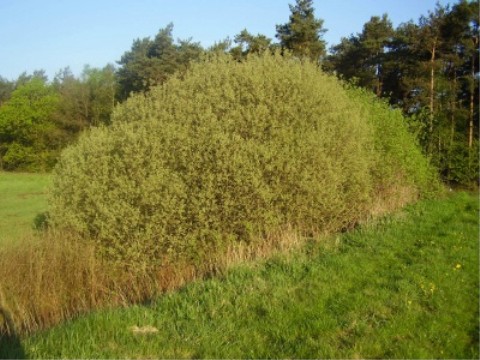
Salix cathayana is a strongly branched shrub with brown or gray-brown young branches covered in tomentose hairs. It reaches a maximum height of 1.5 meters.[1][2]
The leaf blades are elliptical or elliptical-lanceolate and measure 1.5 to 5.2 inches long and 0.6 to 1.5 inches wide. The upper surface is dull green and sometimes tomentose, while the underside is blue-green.[3][4]
The leaf petioles measure 2 to 5 millimeters long and have fine hairs.[5]
The male inflorescences are dense-flowered catkins measuring 2 to 3.5 centimeters long and 5 to 8 millimeters in diameter. The female catkins are densely flowered, usually measuring 2 to 3 centimeters long and occasionally reaching 5 centimeters.[6][7]
The shrub produces round, sessile or almost sessile capsules.[8]
Reproduction and life cycle
Salix cathayana flowers in May. Its fruits ripen in June and July.[9][10]
The male flowers have two free stamens. The ovary is elliptical, approximately 3 millimeters long, glabrous, and sessile.[11][12]
Habitat
Salix cathayana grows in thickets on mountain slopes and in valleys at elevations between 1,800 and 3,000 meters.[13][14]
Its natural distribution includes the Chinese provinces of Guizhou, Hebei, Henan, Hubei, Shaanxi, Sichuan, and Yunnan.[15]
Uses
Salix cathayana has been reported as a superabsorbent plant.[16]
Similar species
Salix hsinhsuaniana Fang is listed as a synonym of Salix cathayana.[17]
Classification of Salix cathayana
| Kingdom | Plantae |
|---|---|
| Subkingdom | Pteridobiotina |
| Phylum | Tracheophyta |
| Class | Magnoliopsida |
| Order | Malpighiales |
| Family | Salicaceae (Willow Family) |
| Tribe | Saliceae |
| Genus | Salix (Willow) |
| Species | Salix cathayana Diels |
Where Salix cathayana is found
Checklists and occurrence records place Salix cathayana in 1 country across Asia. GBIF holds 743 georeferenced records of it.
Countries
Regions and cities with the most records
- Sichuan, China 238
- Yunnan, China 159
- Chongqing, China 64
- Shaanxi, China 61
- Huangshan, China 54
- Lijiang, China 54
- Conglin, China 49
- Daguan, China 49
- Nanchuan, China 49
- Nanping, China 49
- Xinglong, China 49
- Gansu, China 46
- Dali, China 36
- Dali Old Town, China 36
- Fengyi, China 36
- Haidong Zhen, China 36
- Kangding, China 35
- Yongjian, China 33
- Guizhou, China 25
- Barkam, China 18
- Hebei, China 17
- Shanxi, China 16
- Qinghai, China 10
- Lintan Chengguanzhen, China 9
- Liulin, China 9
- Hubei, China 8
- Anhua, China 7
- Chengjiao, China 7
- Daocheng, China 7
- Dongjiang, China 7
- Hanwang, China 7
- Liangshui, China 7
- Longnan, China 7
- Majie, China 7
- Puchi, China 7
- Zhouxi, China 7
Range as the checklists state it
China (Yunnan, Sichuan, Guizhou, Hebei, Henan, Hubei, Shaanxi)
A number beside a place is its count of GBIF occurrence records. A place without a number comes from a checklist alone. Records show where a species has been observed or collected, which can include escapes and vagrants.
Common names
Names in 1 other language
- Chinese
- 中华柳, 柳枝
Synonyms
One other scientific name has been used for this species and is now treated as a synonym of Salix cathayana.
- Salix hsinhsuaniana W.P.Fang
Related species
-
 Weeping WillowSalix babylonica
-
 European WillowSalix alba
-
 Goat WillowSalix caprea
-
 Black WillowSalix nigra
-
 Arctic WillowSalix arctica
-
 Common OsierSalix viminalis
-
 Snowbed WillowSalix herbacea
-
 Common SallowSalix cinerea
Compare
Sources
Passages the profile rests on
- Salix cathayana is a strongly branched shrub with brown or gray-brown young branches covered in tomentose hairs. Source passage: “Salix cathayana is a strongly branched shrub from the genus of the willow (Salix) with brown or gray-brown, young tomentose hairy branches.” — English Wikipedia
- The shrub reaches a maximum height of 1.5 meters. Source passage: “Salix cathayana is a strongly branched shrub up to 1.5 meters high.” — English Wikipedia
- The leaf blades are elliptical or elliptical-lanceolate and measure 1.5 to 5.2 inches long and 0.6 to 1.5 inches wide. Source passage: “The leaf blade is elliptical or elliptical-lanceolate, 1.5 to 5.2 inches long and 0.6 to 1.5 inches wide, entire,” — English Wikipedia
- The upper leaf surface is dull green and sometimes tomentose, while the underside is blue-green. Source passage: “The upper side of the leaf is dull green and sometimes tomentose, the underside is blue-green.” — English Wikipedia
- The leaf petioles measure 2 to 5 millimeters long and have fine hairs. Source passage: “The leaves have a 2 to 5 millimeter long, finely hairy petiole.” — English Wikipedia
- The male inflorescences are dense-flowered catkins measuring 2 to 3.5 centimeters long and 5 to 8 millimeters in diameter. Source passage: “The male inflorescences are 2 to 3.5 centimeters long and 5 to 8 millimeters in diameter, dense-flowered catkins.” — English Wikipedia
- The female catkins are densely flowered and usually measure 2 to 3 centimeters long, occasionally reaching 5 centimeters. Source passage: “The female catkins are 2 to 3 seldom up to 5 centimeters long, densely flowered and with short stems.” — English Wikipedia
- The shrub produces round, sessile or almost sessile capsules. Source passage: “Round, seated or almost seated capsules are formed as fruits.” — English Wikipedia
- Salix cathayana flowers in May. Source passage: “Salix cathayana flowers in May,” — English Wikipedia
- The fruits of Salix cathayana ripen in June and July. Source passage: “and the fruits ripen in June and July.” — English Wikipedia
- The male flowers have two free stamens. Source passage: “The two stamens stand free,” — English Wikipedia
- The ovary is elliptical, approximately 3 millimeters long, glabrous, and sessile. Source passage: “The ovary is elliptical, about 3 millimeters long, glabrous and sessile.” — English Wikipedia
- Salix cathayana grows in thickets on mountain slopes and in valleys. Source passage: “It grows in thickets on mountain slopes and in valleys” — English Wikipedia
- The species occurs at elevations between 1,800 and 3,000 meters. Source passage: “at altitudes of 1800 to 3000 meters.” — English Wikipedia
- The natural distribution of Salix cathayana includes the Chinese provinces of Guizhou, Hebei, Henan, Hubei, Shaanxi, Sichuan, and Yunnan. Source passage: “The natural range is in the Chinese provinces of Guizhou, Hebei, Henan, Hubei, Shaanxi, Sichuan, and Yunnan.” — English Wikipedia
- Salix cathayana has been reported as a superabsorbent plant. Source passage: “reported that the Salix cathayana has known as a superabsorbent plant” — academia.edu
- Salix hsinhsuaniana Fang is listed as a synonym of Salix cathayana. Source passage: “A synonym of the species is Salix hsinhsuaniana Fang.” — English Wikipedia
Data
- Catalogue of Life, 2026-10-16 XR cc by
- Global Biodiversity Information Facility CC BY 4.0
- Wikidata CC0
- GeoNames CC BY 4.0
- Within the Catalogue of Life, this name comes from Synonymic Checklists of the Vascular Plants of the World cc by
References
- Diels. (1912). Notes Roy. Bot. Gard. Edinburgh 5(25): 281 (1912). where the name was published
This species in other databases
Page built on 28 November 2026. See how the catalog is made and all sources and licences.
Cite this page
ScientificNames.org. (2026). Salix cathayana. Retrieved November 28, 2026, from https://scientificnames.org/species/salix-cathayana
“Salix cathayana.” ScientificNames.org, 2026, scientificnames.org/species/salix-cathayana. Accessed 28 Nov. 2026.
ScientificNames.org. “Salix cathayana.” Accessed November 28, 2026. https://scientificnames.org/species/salix-cathayana.
@misc{scientificnames_salix_cathayana,
  author = {{ScientificNames.org}},
  title = {Salix cathayana},
  year = {2026},
  url = {https://scientificnames.org/species/salix-cathayana},
  note = {Accessed 2026-11-28}
}