Species · Flowering plants
Salix cheilophila
Salix cheilophila has no English name on record in the checklists used here. It is a species of flowering plant in the family Salicaceae (willow family), order Malpighiales.
- Scientific name
- Salix cheilophila C.K.Schneid.
- Genus
- Salix
- Family
- Salicaceae (Willow Family)
- Order
- Malpighiales
- Class
- Magnoliopsida
- Recorded in
- 1 country
- Name status
- accepted in the Catalogue of Life
Overview
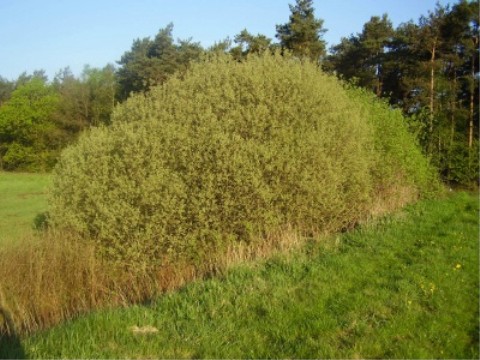
Salix cheilophila C.K.Schneid. is a flowering plant in the genus Salix and family Salicaceae, assigned to the section Cheilophilae. It grows along rivers at elevations between 700 and 3,000 meters, with a natural distribution that includes Gansu, Hebei, Henan, Qinghai, Shaanxi, Shanxi, Sichuan, Yunnan, Inner Mongolia, Ningxia, and Tibet. It is a shrub or small tree with silky-haired, white-gray leaf undersides and branches that become hairless with age.
Written 27 November 2026 from the sources listed below. Each statement was checked against the passage it cites; statements that could not be supported were removed.
Appearance
Its leaf blades are generally 2.5 to 3.5 centimeters long and 3 to 5 millimeters wide, occasionally reaching 6 centimeters in length and 10 millimeters in width. Their upper surfaces are green and finely hairy, while their undersides are white-gray and densely covered with silky hairs.[1][2][3]
The leaf margins have glandular serrations toward their tips. Male inflorescences are 1.5 to 2.5 centimeters long and 3 to 4 millimeters in diameter.[4][5]
Its fruits are capsules approximately 3 millimeters long.[6]
Reproduction and life cycle
The species flowers from April to May as its leaves emerge. Its fruits ripen in May.[7][8]
Habitat
Salix cheilophila grows along rivers at elevations between 700 and 3,000 meters. It is described as a xerophytic species and can grow in saline-alkaline soils.[9][10][11]
Classification of Salix cheilophila
| Kingdom | Plantae |
|---|---|
| Subkingdom | Pteridobiotina |
| Phylum | Tracheophyta |
| Class | Magnoliopsida |
| Order | Malpighiales |
| Family | Salicaceae (Willow Family) |
| Tribe | Saliceae |
| Genus | Salix (Willow) |
| Species | Salix cheilophila C.K.Schneid. |
Where Salix cheilophila is found
Checklists and occurrence records place Salix cheilophila in 1 country across Asia. GBIF holds 1,278 georeferenced records of it.
Countries
Regions and cities with the most records
- Sichuan, China 491
- Barkam, China 168
- Gansu, China 151
- Shaanxi, China 146
- Tibet, China 84
- Shanxi, China 83
- Yunnan, China 54
- Hebei, China 52
- Kangding, China 46
- Henan, China 37
- Chéngguān Qū, China 30
- Doilungdêqên, China 30
- Lhasa, China 30
- Qinghai, China 28
- Shangri-La, China 21
- Huangshan, China 20
- Lijiang, China 20
- Labuleng, China 17
- Zhouqu Chengguanzhen, China 16
- Xinzhi, China 14
- Lintan Chengguanzhen, China 13
- Liulin, China 13
- Xigazê, China 13
- Shiquan, China 12
- Dasha, China 11
- Guangdong, China 11
- Xincheng, China 10
- Bayi, China 9
- Beijing, China 9
- Daocheng, China 9
- Lüliang, China 9
- Nyingchi, China 9
- Mentougou, China 8
- Nima, China 8
- Gengqing, China 7
- Pingwu County, China 7
Range as the checklists state it
China (Gansu, Hebei, Henan, Nei Mongol, Ningxia, Qinghai, Shaanxi, Shanxi, Sichuan, E-Yunnan); Tibet
A number beside a place is its count of GBIF occurrence records. A place without a number comes from a checklist alone. Records show where a species has been observed or collected, which can include escapes and vagrants.
Common names
Names in 2 other languages
- Chinese
- 乌柳, 沙柳
- Japanese
- カラスヤナギ
Synonyms
One other scientific name has been used for this species and is now treated as a synonym of Salix cheilophila.
- Salix cheilophila var. cheilophila
Subspecies and varieties
Related species
-
 Weeping WillowSalix babylonica
-
 European WillowSalix alba
-
 Goat WillowSalix caprea
-
 Black WillowSalix nigra
-
 Arctic WillowSalix arctica
-
 Common OsierSalix viminalis
-
 Snowbed WillowSalix herbacea
-
 Common SallowSalix cinerea
Compare
Questions and answers
What is the scientific classification of Salix cheilophila?
It is a flowering plant in the family Salicaceae, order Malpighiales, and class Magnoliopsida. It belongs to the genus Salix and the section Cheilophilae.[12][13]
When does Salix cheilophila flower and produce ripe fruits?
It flowers from April to May when its leaves emerge. Its fruits ripen in May.[7][8]
Where does Salix cheilophila grow naturally?
It grows along rivers at elevations between 700 and 3,000 meters. Its natural distribution includes Gansu, Hebei, Henan, Qinghai, Shaanxi, Shanxi, Sichuan, and Yunnan, as well as Inner Mongolia, Ningxia, and Tibet.[9][14]
Can Salix cheilophila grow in saline-alkaline soils?
Yes. The species is capable of growing in saline-alkaline soils.[11]
When was Salix cheilophila first scientifically described?
It was first scientifically described in 1916 by Camillo Karl Schneider.[15]
Sources
Passages the profile rests on
- Its leaf blades are generally 2.5 to 3.5 centimeters long but can occasionally reach 6 centimeters. Source passage: “2.5 to 3.5 seldom up to 6 centimeters long” — English Wikipedia
- Its leaf blades are generally 3 to 5 millimeters wide and can occasionally reach 10 millimeters. Source passage: “3 to 5 seldom 10 millimeters wide” — English Wikipedia
- The upper surfaces of its leaves are green and finely hairy, while the undersides are white-gray and densely covered with silky hairs. Source passage: “The top is green and finely haired, the underside white-gray and densely hairy silky.” — English Wikipedia
- Its leaf margins have glandular serrations toward their tips. Source passage: “serrated glandularly towards the tip of the leaf Leaf margin.” — English Wikipedia
- Its male inflorescences are 1.5 to 2.5 centimeters long and 3 to 4 millimeters in diameter. Source passage: “The male inflorescences are 1.5 to 2.5 centimeters long and 3 to 4 millimeters in diameter” — English Wikipedia
- Its fruits are capsules approximately 3 millimeters long. Source passage: “Capsules about 3 millimeters long are formed as fruits.” — English Wikipedia
- The species flowers from April to May when its leaves emerge. Source passage: “Salix cheilophila flowers from April to May when the leaves shoot” — English Wikipedia
- Its fruits ripen in May. Source passage: “the fruits ripen in May.” — English Wikipedia
- The species grows along rivers at elevations between 700 and 3,000 meters. Source passage: “along rivers at altitudes of 700 to 3000 meters.” — English Wikipedia
- Salix cheilophila is described as a xerophytic species. Source passage: “Salix cheilophila is a xerophytic species” — pmc.ncbi.nlm.nih.gov
- The species is capable of growing in saline-alkaline soils. Source passage: “one of the few plants capable of thriving in saline-alkaline soils” — pmc.ncbi.nlm.nih.gov
- The species belongs to the genus Salix and the family Salicaceae. Source passage: “Salix cheilophila is a species of willow (genus Salix), in the family Salicaceae.” — English Wikipedia
- The species is assigned to the Salix section Cheilophilae. Source passage: “It is assigned to the section Cheilophilae.” — English Wikipedia
- Its natural distribution includes the Chinese provinces of Gansu, Hebei, Henan, Qinghai, Shaanxi, Shanxi, Sichuan, and Yunnan, as well as Inner Mongolia, Ningxia, and Tibet. Source passage: “The natural range is in the Chinese provinces of Gansu, Hebei, Henan, in Inner Mongolia, in Ningxia, Qinghai, Shaanxi, Shanxi, Sichuan, Yunnan, and in Tibet” — English Wikipedia
- The species was first scientifically described in 1916 by Camillo Karl Schneider. Source passage: “It was first described scientifically in 1916 by Camillo Karl Schneider.” — English Wikipedia
Data
- Catalogue of Life, 2026-10-16 XR cc by
- Global Biodiversity Information Facility CC BY 4.0
- Wikidata CC0
- GeoNames CC BY 4.0
- Within the Catalogue of Life, this name comes from Synonymic Checklists of the Vascular Plants of the World cc by
References
- C.K.Schneid. (1916). Pl. Wilson. [Sargent] 3: 69 (1916). where the name was published
This species in other databases
Page built on 29 November 2026. See how the catalog is made and all sources and licences.
Cite this page
ScientificNames.org. (2026). Salix cheilophila. Retrieved November 29, 2026, from https://scientificnames.org/species/salix-cheilophila
“Salix cheilophila.” ScientificNames.org, 2026, scientificnames.org/species/salix-cheilophila. Accessed 29 Nov. 2026.
ScientificNames.org. “Salix cheilophila.” Accessed November 29, 2026. https://scientificnames.org/species/salix-cheilophila.
@misc{scientificnames_salix_cheilophila,
  author = {{ScientificNames.org}},
  title = {Salix cheilophila},
  year = {2026},
  url = {https://scientificnames.org/species/salix-cheilophila},
  note = {Accessed 2026-11-29}
}