Species · Flowering plants
Sanddune Willow Salix cordata
The scientific name of the Sanddune Willow is Salix cordata. It is a species of flowering plant in the family Salicaceae (willow family), order Malpighiales.
- Scientific name
- Salix cordata Michx.
- Common name
- Sanddune Willow
- Genus
- Salix
- Family
- Salicaceae (Willow Family)
- Order
- Malpighiales
- Class
- Magnoliopsida
- Recorded in
- 2 countries
- Name status
- accepted in the Catalogue of Life
Overview
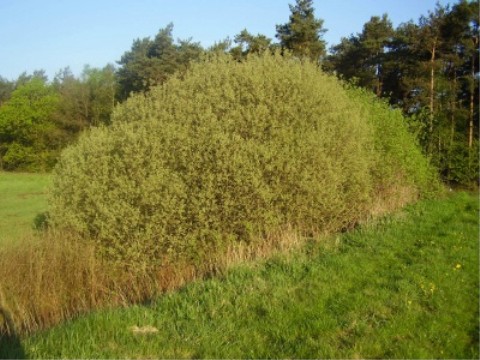
The sanddune willow is a perennial shrub. It grows on sand dunes, river banks, and lake shores. It typically grows between 3 and 12 feet (0.91–3.66 m) tall.
Written 27 November 2026 from the sources listed below. Each statement was checked against the passage it cites; statements that could not be supported were removed.
Appearance
The sanddune willow is a perennial shrub. It typically grows between 3 and 12 feet (0.91–3.66 m) tall, although individuals taller than 6 feet (1.8 m) are rare.[1][2][3]
Habitat
The sanddune willow grows on sand dunes, river banks, and lake shores. It occurs in sandy, silty, or gravelly soils.[4][5]
Behaviour
The sanddune willow readily hybridizes with Salix eriocephala.[6]
Conservation
The sanddune willow is endangered in Wisconsin. It is classified as an endangered plant in Wisconsin.[7][8]
It is not listed under the United States federal Endangered Species Act of 1973.[9]
Uses
The sanddune willow has been used in revegetation projects at former coal mines in New Brunswick, Canada.[10]
It is among the fastest-growing and easiest-to-propagate willow species tested for biomass production.[11]
Classification of the Sanddune Willow
| Kingdom | Plantae |
|---|---|
| Subkingdom | Pteridobiotina |
| Phylum | Tracheophyta |
| Class | Magnoliopsida |
| Order | Malpighiales |
| Family | Salicaceae (Willow Family) |
| Tribe | Saliceae |
| Genus | Salix (Willow) |
| Species | Salix cordata Michx. |
Where the Sanddune Willow is found
Checklists and occurrence records place Salix cordata in 2 countries across North America. GBIF holds 2,079 georeferenced records of it.
Countries
Regions and cities with the most records
- Ontario, Canada 362
- Michigan, United States 205
- Quebec, Canada 115
- Quinte West, Canada 68
- Illinois, United States 59
- Prince Edward, Canada 56
- Wisconsin, United States 53
- Connecticut, United States 37
- Manitowoc, United States 31
- Pennsylvania, United States 30
- Massachusetts, United States 29
- Chicago, United States 27
- Cicero, United States 27
- Pleasant Prairie, United States 26
- Zion, United States 26
- Berwyn, United States 25
- Elmwood Park, United States 25
- Maywood, United States 25
- Oak Park, United States 25
- Burbank, United States 24
- Evergreen Park, United States 24
- Indiana, United States 24
- Melrose Park, United States 24
- Brookfield, United States 23
- Oak Lawn, United States 23
- Bellwood, United States 22
- Bridgeview, United States 22
- Franklin Park, United States 22
- Kenosha, United States 22
- La Grange, United States 21
- Westchester, United States 21
- Gurnee, United States 19
- Needham, United States 18
- Newton, United States 18
- Waltham, United States 18
- Wellesley, United States 18
8 more countries have a few records outside this range
These countries hold a few records of Salix cordata but lie outside the range the checklists give for it. Such records are often zoo or garden specimens, museum material or vagrants, so the species is not counted as occurring there.
Range as the checklists state it
Canada (Labrador, Newfoundland, Ontario, Québec); USA (Illinois, Indiana, Massachusetts, Maryland, Michigan, New Jersey, New York, Pennsylvania, Wisconsin)
A number beside a place is its count of GBIF occurrence records. A place without a number comes from a checklist alone. Records show where a species has been observed or collected, which can include escapes and vagrants.
Common names
English
- Sanddune Willow
- Heart-leaf Willow
- Heart-leaved Willow
Names in 1 other language
- French
- saule à feuilles cordées, saule à feuilles en coeur
Synonyms
8 other scientific names have been used for this species and are now treated as synonyms of Salix cordata.
- Salix adenophylla Hook.
- Salix cordata var. angustifolia Zabel
- Salix cordata var. brevifolia Zabel
- Salix cordata var. cordata
- Salix cordata var. serrata Zabel
- Salix cordata var. viridula Zabel
- Salix syrticola Fernald
- Salix cordifolia Banks ex Pursh ambiguous synonym
Related species
-
 Weeping WillowSalix babylonica
-
 European WillowSalix alba
-
 Goat WillowSalix caprea
-
 Black WillowSalix nigra
-
 Arctic WillowSalix arctica
-
 Common OsierSalix viminalis
-
 Snowbed WillowSalix herbacea
-
 Common SallowSalix cinerea
Compare
Questions and answers
What is the scientific name of the Sanddune Willow?
The scientific name of the Sanddune Willow is Salix cordata. Written with its author, the full name is Salix cordata Michx..
Which family does the Sanddune Willow belong to?
Salix cordata belongs to the family Salicaceae, in the order Malpighiales and the class Magnoliopsida.
Where is the Sanddune Willow found?
Checklists and occurrence records place Salix cordata in 2 countries: United States and Canada.
What other names does the Sanddune Willow have?
Salix cordata is also known in English as Heart-leaf Willow and Heart-leaved Willow.
What plants are known to grow in sand dunes?
The sanddune willow grows on sand dunes, including dunes around lakes such as Lake Michigan.[4][12][13]
Is willow a tree or a shrub?
The sanddune willow is a perennial shrub.[1]
Sources
Passages the profile rests on
- Salix cordata is a perennial shrub. Source passage: “is a perennial shrub” — English Wikipedia
- Salix cordata typically grows between 3 and 12 feet (0.91–3.66 m) tall. Source passage: “grows 3 to 12 feet (0.91 to 3.66 m) tall” — English Wikipedia
- Individuals taller than 6 feet (1.8 m) are rare. Source passage: “plants taller than 6 feet (1.8 m) are rare.” — English Wikipedia
- Salix cordata grows on sand dunes, river banks, and lake shores. Source passage: “it is found on sand dunes, river banks, and lake shores” — English Wikipedia
- Salix cordata occurs in sandy, silty, or gravelly soils. Source passage: “in sandy, silty or gravelly soils.” — English Wikipedia
- Salix cordata readily hybridizes with Salix eriocephala. Source passage: “Salix cordata readily hybridizes with Salix eriocephala.” — English Wikipedia
- Salix cordata is endangered in Wisconsin. Source passage: “Salix cordata is endangered in Wisconsin.” — English Wikipedia
- Salix cordata is classified as an endangered plant in Wisconsin. Source passage: “Sand Dune Willow (Salix cordata), a Wisconsin Endangered plant” — apps.dnr.wi.gov
- Salix cordata is not listed under the United States federal Endangered Species Act of 1973. Source passage: “Although not listed on the federal Endangered Species Act of 1973” — English Wikipedia
- Salix cordata has been used in revegetation projects at former coal mines in New Brunswick, Canada. Source passage: “has been used in revegetation efforts around former coal mines in New Brunswick, Canada.” — English Wikipedia
- Salix cordata is among the fastest-growing and easiest-to-propagate willow species tested for biomass production. Source passage: “It is one of the fastest growing and most easily propagated of eight different Salix species being tested for biomass production.” — English Wikipedia
- Salix cordata occurs in sand dunes around lakes, including Lake Michigan. Source passage: “It is found in the sand dunes of lakes, such as Lake Michigan.” — English Wikipedia
- Salix cordata is found on Lake Michigan dunes. Source passage: “is found on Lake Michigan dunes.” — apps.dnr.wi.gov
Data
- Catalogue of Life, 2026-10-16 XR cc by
- Global Biodiversity Information Facility CC BY 4.0
- Wikidata CC0
- GeoNames CC BY 4.0
- Within the Catalogue of Life, this name comes from Synonymic Checklists of the Vascular Plants of the World cc by
References
- Michx. (1803). Fl. Bor.-Amer. [Michaux] 2: 225 (1803). where the name was published
This species in other databases
Page built on 27 November 2026. See how the catalog is made and all sources and licences.
Cite this page
ScientificNames.org. (2026). Salix cordata (Sanddune Willow). Retrieved November 27, 2026, from https://scientificnames.org/species/salix-cordata
“Salix cordata (Sanddune Willow).” ScientificNames.org, 2026, scientificnames.org/species/salix-cordata. Accessed 27 Nov. 2026.
ScientificNames.org. “Salix cordata (Sanddune Willow).” Accessed November 27, 2026. https://scientificnames.org/species/salix-cordata.
@misc{scientificnames_salix_cordata_sanddune_willow,
  author = {{ScientificNames.org}},
  title = {Salix cordata (Sanddune Willow)},
  year = {2026},
  url = {https://scientificnames.org/species/salix-cordata},
  note = {Accessed 2026-11-27}
}