Species · Flowering plants
Salix denticulata
Salix denticulata has no English name on record in the checklists used here. It is a species of flowering plant in the family Salicaceae (willow family), order Malpighiales.
- Scientific name
- Salix denticulata Andersson
- Genus
- Salix
- Family
- Salicaceae (Willow Family)
- Order
- Malpighiales
- Class
- Magnoliopsida
- Recorded in
- 5 countries
- Name status
- accepted in the Catalogue of Life

Overview
Salix denticulata Andersson is a shrub or small tree. It typically inhabits mountain gullies and river valleys at approximately 2,500 metres elevation and occurs in Afghanistan, Pakistan, Nepal, India, Sichuan, Tibet and Yunnan. It has downy young shoots, toothed leaves and separate male and female reproductive structures on different plants.
Written 27 November 2026 from the sources listed below. Each statement was checked against the passage it cites; statements that could not be supported were removed.
Appearance
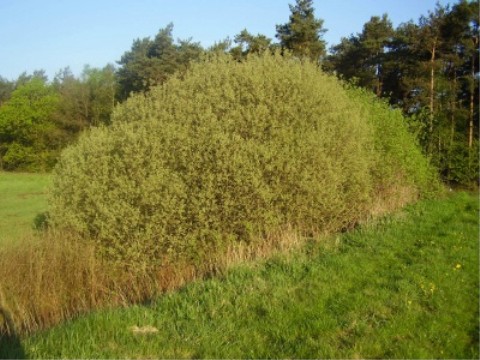
Salix denticulata grows as a shrub or small tree and can reach a height of 6 metres. Its young shoots are covered with downy hairs.[1][2][3]
Its leaves are dull green on the upper surface and paler underneath. They may be obovate, lanceolate or elliptic, measuring approximately 3.5 cm in length and 1.2–2.2 cm in width, with toothed margins and very short petioles.[4][5][6][7]
Reproduction and life cycle
Salix denticulata is dioecious, with male and female reproductive structures occurring on separate plants. Its flowers bloom in April and May.[8][9]
Male catkins measure approximately 2.5 cm in length, while female catkins measure approximately 4 cm. Female catkins can lengthen to approximately 9 cm when bearing fruit.[10][11][12]
Habitat
Salix denticulata typically inhabits mountain gullies and river valleys at approximately 2,500 metres elevation.[13][14]
The species is native to the mountainous regions of central Asia. Its documented distribution includes Afghanistan, Pakistan, Nepal and India, as well as the Chinese provinces of Sichuan, Tibet and Yunnan.[15][16][17]
Uses
The twigs of Salix denticulata are used as fuel.[18]
Classification of Salix denticulata
| Kingdom | Plantae |
|---|---|
| Subkingdom | Pteridobiotina |
| Phylum | Tracheophyta |
| Class | Magnoliopsida |
| Order | Malpighiales |
| Family | Salicaceae (Willow Family) |
| Tribe | Saliceae |
| Genus | Salix (Willow) |
| Species | Salix denticulata Andersson |
Where Salix denticulata is found
Checklists and occurrence records place Salix denticulata in 5 countries across Asia. GBIF holds 280 georeferenced records of it.
Countries
Regions and cities with the most records
- Khyber Pakhtunkhwa, Pakistan 28
- Dhirkot, Pakistan 5
- Murree, Pakistan 5
- Sichuan, China 5
- Gengqing, China 3
- Upper Dir, Pakistan 3
- Himachal Pradesh, India 2
- Tibet, China 1
- Uttarakhand, India 1
- Yunnan, China 1
- Arunachal Pradesh, India
Range as the checklists state it
China (Sichuan, Yunnan); Tibet; Pakistan (Kurram, Chitral, Astor, Swat, Hazara); Nepal; NW-India (Arunachal Pradesh, Himachal Pradesh, Jammu & Kashmir, Uttarakhand)
A number beside a place is its count of GBIF occurrence records. A place without a number comes from a checklist alone. Records show where a species has been observed or collected, which can include escapes and vagrants.
Common names
Names in 1 other language
- Chinese
- 齿叶柳
Synonyms
10 other scientific names have been used for this species and are now treated as synonyms of Salix denticulata.
- Salix denticulata subsp. denticulata
- Salix denticulata subsp. hazarica (Parker) Ali
- Salix denticulata var. hazarica (Parker) Parker
- Salix elegans var. hazarica R.Parker
- Salix elegans var. himalensis Andersson
- Salix himalensis Klotzsch ex Andersson
- Salix kamaunensis Lindl.
- Salix elegans Wall. ex Andersson ambiguous synonym
- Salix elegans ambiguous synonym
- Salix elegans Wall. ambiguous synonym
Related species
-
 Weeping WillowSalix babylonica
-
 European WillowSalix alba
-
 Goat WillowSalix caprea
-
 Black WillowSalix nigra
-
 Arctic WillowSalix arctica
-
 Common OsierSalix viminalis
-
 Snowbed WillowSalix herbacea
-
 Common SallowSalix cinerea
Compare
Questions and answers
Sources
Passages the profile rests on
- Salix denticulata grows as a shrub or small tree. Source passage: “Salix denticulata is a species of shrub or small tree in the family Salicaceae.” — English Wikipedia
- The species can reach a height of 6 metres. Source passage: “Salix denticulata can reach a height of 6 m (20 ft).” — English Wikipedia
- Young shoots of this species are covered with downy hairs. Source passage: “The shoots are downy when young.” — English Wikipedia
- Its leaves are dull green on the upper surface and paler underneath. Source passage: “The dull green leaves are paler underneath” — English Wikipedia
- Its leaves may be obovate, lanceolate or elliptic in shape. Source passage: “obovate, lanceolate or elliptic” — English Wikipedia
- Its leaves measure approximately 3.5 cm in length and 1.2–2.2 cm in width. Source passage: “3.5 by 1.2 to 2.2 centimetres (1.38 by 0.47 to 0.87 in) long” — English Wikipedia
- The leaves have toothed margins and very short petioles. Source passage: “with toothed margins, 3.5 by 1.2 to 2.2 centimetres (1.38 by 0.47 to 0.87 in) long, with very short petioles.” — English Wikipedia
- Salix denticulata is a dioecious species with male and female reproductive structures occurring on separate plants. Source passage: “Like all willows this species is dioecious.” — English Wikipedia
- The flowers of Salix denticulata bloom in April and May. Source passage: “The flowers bloom in April and May.” — English Wikipedia
- Its male catkins measure approximately 2.5 cm in length. Source passage: “Male catkins are 2.5 cm (1 in) long” — English Wikipedia
- Its female catkins measure approximately 4 cm in length. Source passage: “female catkins 4 centimetres (1.6 in) long” — English Wikipedia
- Female catkins can lengthen to approximately 9 cm when bearing fruit. Source passage: “lengthening to 9 centimetres (3.5 in) in fruit.” — English Wikipedia
- The species typically inhabits mountain gullies and river valleys. Source passage: “Its typical habitat is gullies and river valleys” — English Wikipedia
- Its typical habitat occurs at approximately 2,500 metres elevation. Source passage: “at around 2,500 m (8,200 ft).” — English Wikipedia
- Salix denticulata is native to the mountainous regions of central Asia. Source passage: “Salix denticulata is native to the mountainous regions of central Asia” — English Wikipedia
- Its documented distribution includes Afghanistan, Pakistan, Nepal and India. Source passage: “being present in Afghanistan, Pakistan, Nepal, India” — English Wikipedia
- The species also occurs in the Chinese provinces of Sichuan, Tibet and Yunnan. Source passage: “and the Chinese provinces of Sichuan, Tibet and Yunnan.” — English Wikipedia
- The twigs of Salix denticulata are used as fuel. Source passage: “Twigs are used as fuel by” — academia.edu
Data
- Catalogue of Life, 2026-10-16 XR cc by
- Global Biodiversity Information Facility CC BY 4.0
- Wikidata CC0
- GeoNames CC BY 4.0
- Wikimedia Commons per image; credit shown with each image
- Within the Catalogue of Life, this name comes from Synonymic Checklists of the Vascular Plants of the World cc by
References
- Andersson. (1851). Kongl. Vetensk.-Akad. Handl. 1850: 481 (1851). where the name was published
This species in other databases
Page built on 27 November 2026. See how the catalog is made and all sources and licences.
Cite this page
ScientificNames.org. (2026). Salix denticulata. Retrieved November 27, 2026, from https://scientificnames.org/species/salix-denticulata
“Salix denticulata.” ScientificNames.org, 2026, scientificnames.org/species/salix-denticulata. Accessed 27 Nov. 2026.
ScientificNames.org. “Salix denticulata.” Accessed November 27, 2026. https://scientificnames.org/species/salix-denticulata.
@misc{scientificnames_salix_denticulata,
  author = {{ScientificNames.org}},
  title = {Salix denticulata},
  year = {2026},
  url = {https://scientificnames.org/species/salix-denticulata},
  note = {Accessed 2026-11-27}
}