Species · Flowering plants
Bitter Willow Salix eleagnos
The scientific name of the Bitter Willow is Salix eleagnos. It is a species of flowering plant in the family Salicaceae (willow family), order Malpighiales.
- Scientific name
- Salix eleagnos Scop.
- Common name
- Bitter Willow
- Genus
- Salix
- Family
- Salicaceae (Willow Family)
- Order
- Malpighiales
- Class
- Magnoliopsida
- Red List category
- LC Least Concern
- Recorded in
- 38 countries
- Name status
- accepted in the Catalogue of Life

Overview
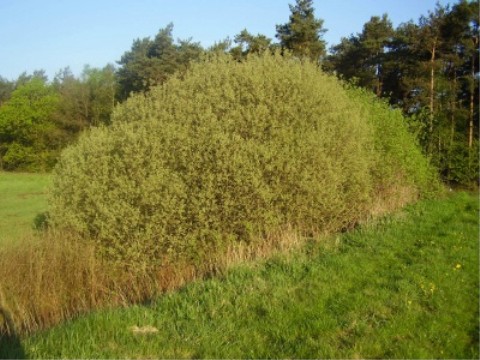
Bitter willow (Salix eleagnos) is an erect, bushy, deciduous shrub with narrow grey-green leaves. It is native to central and southern Europe and southwestern Asia. It produces green catkins measuring 3–6 centimetres in length.
Written 26 November 2026 from the sources listed below. Each statement was checked against the passage it cites; statements that could not be supported were removed.
Appearance
Bitter willow is an erect, bushy, deciduous shrub that can grow up to 3 metres tall and 5 metres broad. Its narrow grey-green leaves can reach 20 centimetres in length and turn yellow during autumn.[1][2][3][4]
It produces green catkins measuring 3–6 centimetres in length. Male catkins have yellow anthers.[5][6]
Reproduction and life cycle
Bitter willow is dioecious. Its catkins appear alongside its leaves in spring.[7][8]
Habitat
Bitter willow is native to central and southern Europe and southwestern Asia.[9]
Classification of the Bitter Willow
| Kingdom | Plantae |
|---|---|
| Subkingdom | Pteridobiotina |
| Phylum | Tracheophyta |
| Class | Magnoliopsida |
| Order | Malpighiales |
| Family | Salicaceae (Willow Family) |
| Tribe | Saliceae |
| Genus | Salix (Willow) |
| Species | Salix eleagnos Scop. |
Where the Bitter Willow is found
Checklists and occurrence records place Salix eleagnos in 38 countries across Africa, Asia, Europe, North America and Oceania. GBIF holds 53,707 georeferenced records of it.
Countries where it is native or its origin is not stated
- Albania 29
- Andorra 22
- Austria 7,918
- Belgium 295
- Bosnia and Herzegovina 17
- Bulgaria 11
- Czechia 112
- Denmark 21
- France 21,486
- Greece 124
- Hungary 6
- Italy 833
- Kosovo
- Latvia 4
- Liechtenstein 13
- Luxembourg 6
- Montenegro 31
- Morocco 15
- North Macedonia 16
- Poland 372
- Romania 19
- Serbia 3
- Slovakia 586
- Slovenia 123
- Spain 6,285
- Switzerland 7,022
- The Netherlands 295
- Turkey 14
- Ukraine 13
Countries where it has been introduced
- Canada 13
- Croatia 12
- Germany 6,567
- Ireland 3
- New Zealand 88
- San Marino
- Sweden 129
- United Kingdom 1,158
- United States 46
Regions and cities with the most records
- Auvergne-Rhône-Alpes, France 9,962
- Provence-Alpes-Côte d'Azur, France 7,413
- Bavaria, Germany 5,616
- Upper Austria, Austria 4,859
- Catalonia, Spain 1,855
- Occitanie, France 1,797
- Valencia, Spain 1,684
- Salzburg, Austria 1,429
- Bern, Switzerland 1,250
- Cluses, France 1,032
- England, United Kingdom 993
- Bourgogne-Franche-Comté, France 940
- Annecy-le-Vieux, France 930
- Annecy, France 917
- Cran-Gevrier, France 915
- Seynod, France 910
- Digne-les-Bains, France 909
- Vaud, Switzerland 874
- Fribourg, Switzerland 776
- Gap, France 750
- Fribourg, Switzerland 718
- Bad Reichenhall, Germany 673
- Thonon-les-Bains, France 673
- Sallanches, France 663
- Tyrol, Austria 663
- Valais, Switzerland 659
- Nice, France 657
- Gauting, Germany 631
- Carouge, Switzerland 630
- Monthey, Switzerland 626
- Germering, Germany 615
- Onex, Switzerland 610
- Ticino, Switzerland 610
- Garmisch-Partenkirchen, Germany 598
- Vernier, Switzerland 563
- Gilching, Germany 554
Range as the checklists state it
Newfoundland
A number beside a place is its count of GBIF occurrence records. A place without a number comes from a checklist alone. Records show where a species has been observed or collected, which can include escapes and vagrants.
Common names
English
- Bitter Willow
- Elaeagnus Willow
- Hoary Willow
- Olive Willow
- Rosemary Willow
Names in 20 other languages
- Basque
- Sahats hostoestua
- Catalan
- sarga
- Chinese
- 橄欖柳, 百楊柳, 苦柳, 迷迭香柳
- Czech
- vrba hlošinovitá, vrba šedá
- Dutch
- Grijze wilg, Lavendelwilg
- Finnish
- Huopapaju, laventelipaju
- French
- saule drapé, Saule blanchâtre, saule à feuilles cotonneuses
- German
- Grau-Weide, Lavendel-Weide
- Hungarian
- Parti fűz
- Italian
- Salice ripaiolo
- Lithuanian
- Balsvasis gluosnis
- Norwegian Bokmål
- dunpil
- Polish
- Wierzba siwa
- Romanian
- Salcie albă
- Russian
- Ива лоховидная
- Slovak
- vŕba sivá
- Slovenian
- siva vrba
- Swedish
- lavendelvide
- Turkish
- Cığ, İğde Söğüdü, İğde yapraklı söğüt, İğne Yapraklı Söğüt
- Welsh
- helygen dail olewydd
Synonyms
One other scientific name has been used for this species and is now treated as a synonym of Salix eleagnos.
- Salix elaeagnos Scopoli
Subspecies and varieties
- Salix eleagnos subsp. angustifolia subspecies
- Salix eleagnos subsp. eleagnos subspecies
Related species
-
 Weeping WillowSalix babylonica
-
 European WillowSalix alba
-
 Goat WillowSalix caprea
-
 Black WillowSalix nigra
-
 Arctic WillowSalix arctica
-
 Common OsierSalix viminalis
-
 Snowbed WillowSalix herbacea
-
 Common SallowSalix cinerea
Compare
Questions and answers
What is the scientific name of the Bitter Willow?
The scientific name of the Bitter Willow is Salix eleagnos. Written with its author, the full name is Salix eleagnos Scop..
Which family does the Bitter Willow belong to?
Salix eleagnos belongs to the family Salicaceae, in the order Malpighiales and the class Magnoliopsida.
Where is the Bitter Willow found?
Checklists and occurrence records place Salix eleagnos in 38 countries, including France, Austria, Switzerland, Spain, Italy and Slovakia.
What is the conservation status of the Bitter Willow?
The IUCN Red List category recorded for Salix eleagnos is Least Concern (LC).
What other names does the Bitter Willow have?
Salix eleagnos is also known in English as Elaeagnus Willow, Hoary Willow, Olive Willow and Rosemary Willow.
Sources
Passages the profile rests on
- Salix eleagnos is an erect, bushy, deciduous shrub with narrow grey-green leaves. Source passage: “it is an erect bushy deciduous shrub with narrow grey-green leaves” — English Wikipedia
- Salix eleagnos can grow up to 3 metres tall and 5 metres broad. Source passage: “Growing to 3 m (10 ft) tall by 5 m (16 ft) broad” — English Wikipedia
- The leaves of Salix eleagnos can reach 20 centimetres in length. Source passage: “leaves up to 20 cm (8 in) long” — English Wikipedia
- The leaves of Salix eleagnos turn yellow during autumn. Source passage: “which turn yellow in autumn (fall)” — English Wikipedia
- Salix eleagnos produces green catkins measuring 3–6 centimetres in length. Source passage: “The green catkins, 3–6 cm (1–2 in) long” — English Wikipedia
- Male catkins of Salix eleagnos have yellow anthers. Source passage: “male catkins having yellow anthers.” — English Wikipedia
- Salix eleagnos is dioecious. Source passage: “Like all willows, the species is dioecious.” — English Wikipedia
- The catkins of Salix eleagnos appear alongside its leaves in spring. Source passage: “appear with the leaves in spring” — English Wikipedia
- Salix eleagnos is native to central and southern Europe and southwestern Asia. Source passage: “native to central and southern Europe and south west Asia.” — English Wikipedia
Data
- Catalogue of Life, 2026-10-16 XR cc by
- Global Biodiversity Information Facility CC BY 4.0
- Wikidata CC0
- GeoNames CC BY 4.0
- Wikimedia Commons per image; credit shown with each image
- Within the Catalogue of Life, this name comes from Synonymic Checklists of the Vascular Plants of the World cc by
References
- Scop. where the name was published
This species in other databases
- Catalogue of Life 93CNT
- Wikidata Q159484
- iNaturalist 338098
- World Flora Online wfo-0000928552
- GRIN 70587
Page built on 28 November 2026. See how the catalog is made and all sources and licences.
Cite this page
ScientificNames.org. (2026). Salix eleagnos (Bitter Willow). Retrieved November 28, 2026, from https://scientificnames.org/species/salix-eleagnos
“Salix eleagnos (Bitter Willow).” ScientificNames.org, 2026, scientificnames.org/species/salix-eleagnos. Accessed 28 Nov. 2026.
ScientificNames.org. “Salix eleagnos (Bitter Willow).” Accessed November 28, 2026. https://scientificnames.org/species/salix-eleagnos.
@misc{scientificnames_salix_eleagnos_bitter_willow,
  author = {{ScientificNames.org}},
  title = {Salix eleagnos (Bitter Willow)},
  year = {2026},
  url = {https://scientificnames.org/species/salix-eleagnos},
  note = {Accessed 2026-11-28}
}