Species · Flowering plants
Narrowleaf Willow Salix exigua
The scientific name of the Narrowleaf Willow is Salix exigua. It is a species of flowering plant in the family Salicaceae (willow family), order Malpighiales.
- Scientific name
- Salix exigua Nutt.
- Common name
- Narrowleaf Willow
- Genus
- Salix
- Family
- Salicaceae (Willow Family)
- Order
- Malpighiales
- Class
- Magnoliopsida
- Red List category
- LC Least Concern
- Recorded in
- 4 countries
- Name status
- accepted in the Catalogue of Life

Overview
Salix exigua is native to most of North America, with a range extending from Alaska east to New Brunswick and south to northern Mexico. It is distinguished by narrow lanceolate leaves, silky white hairs when young, and flowers arranged in catkins.
Written 26 November 2026 from the sources listed below. Each statement was checked against the passage it cites; statements that could not be supported were removed.
Appearance
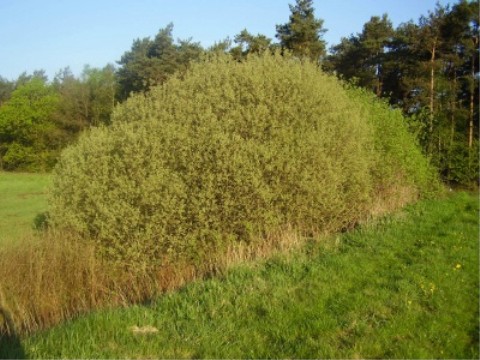
The shrub typically reaches 4–7 metres in height, with exceptional individuals reaching 7.6 metres.[1]
Reproduction and life cycle
Its flowers grow in catkins that emerge in late spring after the leaves appear. Male and female flowers occur on different plants; male catkins can reach 10 centimetres in length, while female catkins can reach 8 centimetres.[2][3][4]
Behaviour
Narrowleaf Willow spreads through basal shoots to form dense clonal colonies.[5]
Male flowers provide pollen for bees.[6]
Diet
Livestock browse the foliage of Narrowleaf Willow.[7]
Conservation
Narrowleaf Willow is classified as threatened in Massachusetts. It is classified as endangered in Connecticut, Maryland, and New Hampshire.[8][9]
Uses
Its bark is used to make cord and string. Its bark and leaves also have medicinal uses.[10][11]
The Zuni people use an infusion of its bark for coughs and sore throats.[12]
Classification of the Narrowleaf Willow
| Kingdom | Plantae |
|---|---|
| Subkingdom | Pteridobiotina |
| Phylum | Tracheophyta |
| Class | Magnoliopsida |
| Order | Malpighiales |
| Family | Salicaceae (Willow Family) |
| Tribe | Saliceae |
| Genus | Salix (Willow) |
| Species | Salix exigua Nutt. |
Where the Narrowleaf Willow is found
Checklists and occurrence records place Salix exigua in 4 countries across Europe and North America. GBIF holds 18,361 georeferenced records of it.
Countries where it is native or its origin is not stated
Countries where it has been introduced
Regions and cities with the most records
- California, United States 4,688
- Colorado, United States 1,591
- Lakewood, United States 648
- Englewood, United States 647
- Littleton, United States 637
- Greenwood Village, United States 634
- New Mexico, United States 626
- Dakota Ridge, United States 625
- Columbine, United States 613
- Highlands Ranch, United States 612
- Utah, United States 602
- Centennial, United States 598
- Ken Caryl, United States 589
- Arizona, United States 521
- Nevada, United States 512
- Idaho, United States 478
- Oregon, United States 464
- Washington, United States 333
- National City, United States 268
- La Presa, United States 260
- San Diego, United States 241
- Chula Vista, United States 236
- Coronado, United States 225
- Montana, United States 197
- Lemon Grove, United States 186
- Spring Valley, United States 176
- La Mesa, United States 171
- British Columbia, Canada 170
- Tustin, United States 170
- North Tustin, United States 161
- Denver, United States 159
- Santa Ana, United States 155
- Orange, United States 154
- Imperial Beach, United States 153
- Ontario, Canada 152
- Wheat Ridge, United States 148
3 more countries have a few records outside this range
These countries hold a few records of Salix exigua but lie outside the range the checklists give for it. Such records are often zoo or garden specimens, museum material or vagrants, so the species is not counted as occurring there.
Range as the checklists state it
Germany [I]; Canada (Alberta, British Columbia, Saskatchewan); USA (Arizona, California, Colorado, Idaho, Montana, New Mexico, Nevada, Oregon, Texas, Utah, Washington State, Wyoming); Mexico (Baja California Norte, Chihuahua, Coahuila, Durango, Sonora, Tamaulipas, Veracruz, Hidalgo, Nuevo León)
A number beside a place is its count of GBIF occurrence records. A place without a number comes from a checklist alone. Records show where a species has been observed or collected, which can include escapes and vagrants.
Common names
English
- Narrowleaf Willow
- Narrow-leaf Willow
- Coyote Willow
- Desert Willow
- Narrow-leaved Willow
- Sandbar Willow
- Western Sandbar Willow
Names in 9 other languages
- Chinese
- 黃線柳
- Dutch
- Smalbladige wilg
- French
- saule à feuilles en faucilles, saule à feuilles exiguës
- Polish
- wierzba łachowa
- Russian
- Ива скудная
- Spanish
- Sauce de hojas angostas
- Swedish
- coyotevide
- mte
- sühübü
- nav
- K'ei'libáhi', Sǫʼtsoh nátʼoh
Synonyms
45 other scientific names have been used for this species and are now treated as synonyms of Salix exigua.
- Salix argophylla Nutt.
- Salix exigua subsp. exigua
- Salix exigua var. angustissima (Andersson) Reveal & C.R.Broome
- Salix exigua var. exigua
- Salix exigua var. hindsiana (Benth.) Dorn
- Salix exigua var. luteosericea (Rydb.) C.K.Schneid.
- Salix exigua var. nevadensis (S.Watson) C.K.Schneid.
- Salix exigua var. parishiana (Rowlee) Jeps.
- Salix exigua var. stenophylla (Rydb.) C.K.Schneid.
- Salix exigua var. virens Rowlee
- Salix fluviatilis f. hindsiana (Benth.) B.Boivin
- Salix fluviatilis var. argophylla (Nutt.) Sarg.
- Salix fluviatilis var. argyrophylla Sarg.
- Salix fluviatilis var. exigua (Nutt.) Sarg.
- Salix hindsiana Benth.
- Salix hindsiana f. tenuifolia Andersson
- Salix hindsiana var. leucodendroides (Rowlee) C.R.Ball
- Salix hindsiana var. parishiana (Rowlee) C.R.Ball
- Salix hindsiana var. tenuifolia (Andersson) Andersson
- Salix hindsiana var. tenuifolia (Andersson) C.K.Schneid.
- Salix interior var. angustissima (Andersson) Dayton
- Salix interior var. luteosericea (Rydb.) C.K.Schneid.
- Salix longifolia f. integerrima Kuntze
- Salix longifolia f. multidenticulata Kuntze
- Salix longifolia f. opaca (Andersson) Andersson
- Salix longifolia f. opaca (Andersson) C.K.Schneid.
- Salix longifolia f. paucidenticulata Kuntze
- Salix longifolia var. angustissima (Andersson) Andersson
- Salix longifolia var. argophylla (Nutt.) Andersson
- Salix longifolia var. argophylla (Nutt.) S.Watson
- Salix longifolia var. argyrophylla Andersson
- Salix longifolia var. exigua (Nutt.) Bebb
- Salix longifolia var. opaca Andersson
- Salix longifolia var. opaca C.R.Ball
- Salix luteosericea Rydb.
- Salix macrostachya var. leucodendroides Rowlee
- Salix malacophylla Nutt. ex C.R.Ball
- Salix nevadensis S.Watson
- Salix parishiana Rowlee
- Salix sessilifolia subsp. hindsiana (Benth.) Andersson
Showing 40 of 45.
Related species
-
 Weeping WillowSalix babylonica
-
 European WillowSalix alba
-
 Goat WillowSalix caprea
-
 Black WillowSalix nigra
-
 Arctic WillowSalix arctica
-
 Common OsierSalix viminalis
-
 Snowbed WillowSalix herbacea
-
 Common SallowSalix cinerea
Compare
Questions and answers
What is the scientific name of the Narrowleaf Willow?
The scientific name of the Narrowleaf Willow is Salix exigua. Written with its author, the full name is Salix exigua Nutt..
Which family does the Narrowleaf Willow belong to?
Salix exigua belongs to the family Salicaceae, in the order Malpighiales and the class Magnoliopsida.
Where is the Narrowleaf Willow found?
Checklists and occurrence records place Salix exigua in 4 countries, including United States, Canada and Mexico.
What is the conservation status of the Narrowleaf Willow?
The IUCN Red List category recorded for Salix exigua is Least Concern (LC).
What other names does the Narrowleaf Willow have?
Salix exigua is also known in English as Narrow-leaf Willow, Coyote Willow, Desert Willow, Narrow-leaved Willow, Sandbar Willow and Western Sandbar Willow.
Sources
Passages the profile rests on
- The shrub typically reaches a height of 4–7 metres, with exceptional individuals reaching 7.6 metres. Source passage: “It is a deciduous shrub reaching 4–7 metres (13–23 ft) in height, exceptionally 7.6 m (25 ft)” — English Wikipedia
- Its flowers grow in catkins that emerge in late spring after the leaves appear. Source passage: “The flowers are produced in catkins in late spring, after the leaves appear.” — English Wikipedia
- Salix exigua has separate male and female flowers on different plants. Source passage: “It is dioecious, with staminate and pistillate catkins on separate plants” — English Wikipedia
- Male catkins can reach 10 centimetres in length, while female catkins can reach 8 centimetres. Source passage: “the male catkins up to 10 cm (4 in) long, the female catkins up to 8 cm (3 in) long.” — English Wikipedia
- Salix exigua spreads through basal shoots to form dense clonal colonies. Source passage: “spreading by basal shoots to form dense clonal colonies.” — English Wikipedia
- Male flowers provide pollen for bees. Source passage: “The male flowers provide pollen for bees.” — English Wikipedia
- Livestock browse the foliage of Salix exigua. Source passage: “The foliage is browsed by livestock.” — English Wikipedia
- Salix exigua is classified as threatened in Massachusetts. Source passage: “It is considered a threatened species in Massachusetts” — English Wikipedia
- Salix exigua is classified as endangered in Connecticut, Maryland, and New Hampshire. Source passage: “in Connecticut, Maryland, and New Hampshire it is considered endangered.” — English Wikipedia
- Its bark is used to make cord and string. Source passage: “the bark is made into cord and string” — English Wikipedia
- Its bark and leaves have medicinal uses. Source passage: “the bark and leaves have several medicinal uses.” — English Wikipedia
- The Zuni people use an infusion of its bark for coughs and sore throats. Source passage: “The Zuni people take an infusion of the bark for coughs and sore throats.” — English Wikipedia
Data
- Catalogue of Life, 2026-10-16 XR cc by
- Global Biodiversity Information Facility CC BY 4.0
- Wikidata CC0
- GeoNames CC BY 4.0
- Wikimedia Commons per image; credit shown with each image
- Within the Catalogue of Life, this name comes from Synonymic Checklists of the Vascular Plants of the World cc by
References
- Nutt. N. Amer. Sylv. [Nuttall] 75 (1842). where the name was published
This species in other databases
- Catalogue of Life 6XC73
- Wikidata Q2060469
- iNaturalist 59008
- World Flora Online wfo-0000928657
- GRIN 313877
Page built on 26 November 2026. See how the catalog is made and all sources and licences.
Cite this page
ScientificNames.org. (2026). Salix exigua (Narrowleaf Willow). Retrieved November 26, 2026, from https://scientificnames.org/species/salix-exigua
“Salix exigua (Narrowleaf Willow).” ScientificNames.org, 2026, scientificnames.org/species/salix-exigua. Accessed 26 Nov. 2026.
ScientificNames.org. “Salix exigua (Narrowleaf Willow).” Accessed November 26, 2026. https://scientificnames.org/species/salix-exigua.
@misc{scientificnames_salix_exigua_narrowleaf_willow,
  author = {{ScientificNames.org}},
  title = {Salix exigua (Narrowleaf Willow)},
  year = {2026},
  url = {https://scientificnames.org/species/salix-exigua},
  note = {Accessed 2026-11-26}
}