Species · Flowering plants
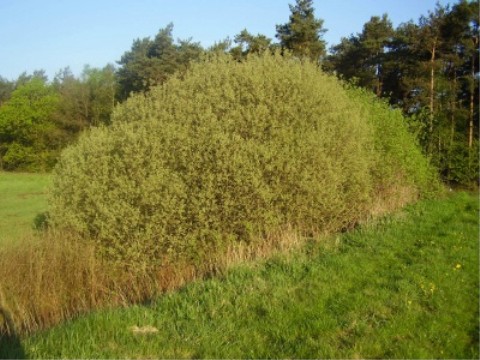
Gmelin's Willow Salix gmelinii
The scientific name of the Gmelin's Willow is Salix gmelinii. It is a species of flowering plant in the family Salicaceae (willow family), order Malpighiales.
- Scientific name
- Salix gmelinii Pall.
- Common name
- Gmelin's Willow
- Genus
- Salix
- Family
- Salicaceae (Willow Family)
- Order
- Malpighiales
- Class
- Magnoliopsida
- Red List category
- DD Data Deficient
- Recorded in
- 27 countries
- Name status
- accepted in the Catalogue of Life

Overview
Salix gmelinii is native to central Europe, including Germany, Austria, and Poland, and extends eastward through south-western Siberia to central Asia. It contains salicortin, a toxic phenolglycoside associated with resistance to herbivory by Phratora vulgatissima.
Written 27 November 2026 from the sources listed below. Each statement was checked against the passage it cites; statements that could not be supported were removed.
Habitat
Gmelin's willow is native to central Europe, including Germany, Austria, and Poland. Its distribution extends eastward through south-western Siberia to central Asia.[1]
Diet
Gmelin's willow contains salicortin, a toxic phenolglycoside associated with resistance to herbivory by Phratora vulgatissima.[2]
Behaviour
Gmelin's willow is avoided by the blue willow beetle, Phratora vulgatissima, in Britain.[3]
Uses
The Yakut name for Gmelin's willow refers to its use in braiding. The Yakut name örüü üöte includes örüü, meaning braid.[4][5]
Classification of the Gmelin's Willow
| Kingdom | Plantae |
|---|---|
| Subkingdom | Pteridobiotina |
| Phylum | Tracheophyta |
| Class | Magnoliopsida |
| Order | Malpighiales |
| Family | Salicaceae (Willow Family) |
| Tribe | Saliceae |
| Genus | Salix (Willow) |
| Species | Salix gmelinii Pall. |
Where the Gmelin's Willow is found
Checklists and occurrence records place Salix gmelinii in 27 countries across Asia, Europe and North America. GBIF holds 8,428 georeferenced records of it.
Countries where it is native or its origin is not stated
- Belgium 862
- China 80
- Estonia 301
- Finland 22
- France 37
- Japan 3
- Kazakhstan 9
- Kyrgyzstan 5
- Latvia 82
- Lithuania
- Mongolia 7
- Norway 99
- Pakistan
- Russia 3,526
- Switzerland 6
- The Netherlands 919
- Ukraine 3
- United Kingdom 177
Countries where it has been introduced
Regions and cities with the most records
- Bavaria, Germany 584
- Sliedrecht, The Netherlands 489
- Hendrik-Ido-Ambacht, The Netherlands 477
- Alblasserdam, The Netherlands 476
- Papendrecht, The Netherlands 476
- Zwijndrecht, The Netherlands 472
- Dordrecht, The Netherlands 468
- Bornem, Belgium 457
- Temse, Belgium 449
- Zele, Belgium 442
- Puurs, Belgium 440
- Ridderkerk, The Netherlands 439
- Willebroek, Belgium 438
- Lokeren, Belgium 437
- Hamme, Belgium 435
- Boom, Belgium 434
- Sint-Niklaas, Belgium 419
- Lebbeke, Belgium 409
- Dendermonde, Belgium 398
- Hoboken, Belgium 389
- Barendrecht, The Netherlands 386
- Beveren, Belgium 377
- Gorinchem, The Netherlands 364
- Wilrijk, Belgium 351
- Sint-Gillis-Waas, Belgium 348
- Geertruidenberg, The Netherlands 346
- Irkutsk Oblast, Russia 334
- Kontich, Belgium 333
- Zwijndrecht, Belgium 320
- Stekene, Belgium 307
- Edegem, Belgium 293
- Lede, Belgium 284
- Oosterhout, The Netherlands 283
- Meise, Belgium 278
- Krimpen aan den IJssel, The Netherlands 272
- Krasnoyarsk Krai, Russia 250
2 more countries have a few records outside this range
These countries hold a few records of Salix gmelinii but lie outside the range the checklists give for it. Such records are often zoo or garden specimens, museum material or vagrants, so the species is not counted as occurring there.
Range as the checklists state it
Denmark [I]; Sweden [I]; Netherlands [I]; Germany [I]; Austria [I]; Poland [I]; Czech Republic [I]; Slovakia [I]; Channel Isl. [I]; Estonia; Latvia; Lithuania; Belarus [I]; European Russia [I]; Siberia (Altay); Kazakhstan; China (Heilongjiang, Jilin, Nei Mongol, Shaanxi, Shandong, Xinjiang); Mongolia; ?Japan; Pakistan (Gilgit, Hunza, Baltistan, Astor); Canada [I] (New Brunswick [I], Newfoundland [I], Nova Scotia [I], Prince Edward Isl. [I])
A number beside a place is its count of GBIF occurrence records. A place without a number comes from a checklist alone. Records show where a species has been observed or collected, which can include escapes and vagrants.
Common names
English
- Gmelin's Willow
- Holme Willow
- Silky-leaved Osier
Names in 10 other languages
- Chinese
- 偽蒿柳
- Dutch
- Duitse dot, Kattekletters
- Estonian
- pikalehine paju
- Finnish
- aropaju, vannepaju
- German
- Filzast-Weide
- Lithuanian
- Ilgalapis gluosnis
- Norwegian Bokmål
- fløyelsvier
- Polish
- Wierzba Smitha
- Russian
- Ива Гмелина, Ива шелковистейшая
- Swedish
- sammetssälg, sidenvide
Synonyms
25 other scientific names have been used for this species and are now treated as synonyms of Salix gmelinii.
- Diplima stipularis (Sm.) Raf.
- Salix burjatica Nasarow
- Salix ferruginea G.Anderson ex J.Forbes
- Salix jacutica Nasarow
- Salix lanceolata var. angustifolia Ser.
- Salix lanceolata var. coetanea Ser.
- Salix lanceolata var. gemmata Ser.
- Salix lanceolata var. macrophylla Ser.
- Salix macrostipulacea J.Forbes
- Salix macrostipularis Schleich.
- Salix micheliana J.Forbes
- Salix pseudocaprea Bluff & Fingerh.
- Salix smithiana subsp. acuminata Nyman
- Salix smithiana subsp. dasyclados (Wimm.) Nyman
- Salix viminalis subsp. gmelinii (Pall.) Sukaczev
- Salix viminalis var. gmelinii (Pall.) Andersson
- Salix viminalis var. gmelinii Turcz.
- Salix viminalis var. longifolia (Host) Jess.
- Salix xdasyclados Wimm.
- Salix × dasyclados Wimm.
- Salix conformis J.Forbes ambiguous synonym
- Salix dasyclados subsp. stipularis (Sm.) Seemen ambiguous synonym
- Salix geminata J.Forbes ambiguous synonym
- Salix longifolia Host ambiguous synonym
- Salix × sericans Tausch ambiguous synonym
Related species
-
 Weeping WillowSalix babylonica
-
 European WillowSalix alba
-
 Goat WillowSalix caprea
-
 Black WillowSalix nigra
-
 Arctic WillowSalix arctica
-
 Common OsierSalix viminalis
-
 Snowbed WillowSalix herbacea
-
 Common SallowSalix cinerea
Compare
Questions and answers
What is the scientific name of the Gmelin's Willow?
The scientific name of the Gmelin's Willow is Salix gmelinii. Written with its author, the full name is Salix gmelinii Pall..
Which family does the Gmelin's Willow belong to?
Salix gmelinii belongs to the family Salicaceae, in the order Malpighiales and the class Magnoliopsida.
Where is the Gmelin's Willow found?
Checklists and occurrence records place Salix gmelinii in 27 countries, including Russia, The Netherlands, Belgium, Estonia, United Kingdom and Norway.
What is the conservation status of the Gmelin's Willow?
The IUCN Red List category recorded for Salix gmelinii is Data Deficient (DD).
What other names does the Gmelin's Willow have?
Salix gmelinii is also known in English as Holme Willow and Silky-leaved Osier.
Sources
Passages the profile rests on
- Salix gmelinii is native to central Europe, including Germany, Austria, and Poland, and extends eastward through south-western Siberia to central Asia. Source passage: “Its native range is central Europe from Germany, Austria, and Poland east through south-western Siberia to central Asia.” — English Wikipedia
- Salix gmelinii contains salicortin, a toxic phenolglycoside associated with resistance to herbivory by Phratora vulgatissima. Source passage: “the resistance of S. gmelinii to herbivory by P. vulgatissima is likely due to the high amounts of the toxic phenolglycoside (salicylate) salicortin in the plant.” — pmc.ncbi.nlm.nih.gov
- Salix gmelinii is avoided by the blue willow beetle, Phratora vulgatissima, in Britain. Source passage: “in Britain, P. vulgatissima, while present on most willows, avoids Salix gmelinii” — pmc.ncbi.nlm.nih.gov
- The Yakut name for Salix gmelinii refers to its use in braiding. Source passage: “өрүү үөтэ örüü üöte “ᴛᴜʀ örme söğüdü ᴇɴɢ willow of braiding” — academia.edu
- The Yakut name örüü üöte includes örüü, meaning braid. Source passage: “< өрүү örüü “ᴛᴜʀ örgü, örme ᴇɴɢ braid” — academia.edu
Data
- Catalogue of Life, 2026-10-16 XR cc by
- Global Biodiversity Information Facility CC BY 4.0
- Wikidata CC0
- GeoNames CC BY 4.0
- Wikimedia Commons per image; credit shown with each image
- Within the Catalogue of Life, this name comes from Synonymic Checklists of the Vascular Plants of the World cc by
References
- Pall. (1788). Fl. Ross. [Pallas] 1(2): 77 (1788). where the name was published
This species in other databases
Page built on 28 November 2026. See how the catalog is made and all sources and licences.
Cite this page
ScientificNames.org. (2026). Salix gmelinii (Gmelin's Willow). Retrieved November 28, 2026, from https://scientificnames.org/species/salix-gmelinii
“Salix gmelinii (Gmelin's Willow).” ScientificNames.org, 2026, scientificnames.org/species/salix-gmelinii. Accessed 28 Nov. 2026.
ScientificNames.org. “Salix gmelinii (Gmelin's Willow).” Accessed November 28, 2026. https://scientificnames.org/species/salix-gmelinii.
@misc{scientificnames_salix_gmelinii_gmelins_willow,
  author = {{ScientificNames.org}},
  title = {Salix gmelinii (Gmelin's Willow)},
  year = {2026},
  url = {https://scientificnames.org/species/salix-gmelinii},
  note = {Accessed 2026-11-28}
}