Species · Flowering plants
Halberd Willow Salix hastata
The scientific name of the Halberd Willow is Salix hastata. It is a species of flowering plant in the family Salicaceae (willow family), order Malpighiales.
- Scientific name
- Salix hastata L.
- Common name
- Halberd Willow
- Genus
- Salix
- Family
- Salicaceae (Willow Family)
- Order
- Malpighiales
- Class
- Magnoliopsida
- Recorded in
- 31 countries
- Name status
- accepted in the Catalogue of Life

Overview
Halberd willow (Salix hastata L.) is a multibranched, spreading flowering shrub in the family Salicaceae, order Malpighiales, and class Magnoliopsida. It has an almost circumpolar distribution across northern latitudes of the Northern Hemisphere and grows in Arctic and alpine habitats, riverbanks, and tundra. Its erect catkins measure approximately 1.5–5 cm long, and sparse reddish hairs on the main leaf vein distinguish it from Barclay willow.
Written 26 November 2026 from the sources listed below. Each statement was checked against the passage it cites; statements that could not be supported were removed.
Appearance
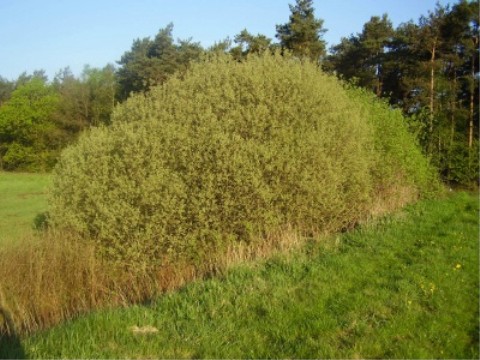
Halberd willow is a multibranched, spreading shrub. Its leaves are small, simple, alternate, and deciduous, and are often hairy, particularly on their undersides.[1][2][3]
Its inflorescences are erect catkins measuring approximately 1.5–5 cm long. The leaves can grow up to 9.2 centimeters long.[4][5]
The shrub typically grows 1–2 meters tall but can reach 4 meters.[6]
Habitat
Halberd willow grows on Arctic slopes, riverbanks, alpine sites, and tundra. In Alaska and northern Canada, it occurs in heaths, riverbeds, streams, and floodplains affected by flooding and erosion.[7][8]
In interior Alaska, it grows along streambanks, glacial drift formations, outwash deposits, and old river floodplains with rocky substrates. It commonly occurs in willow thickets along small streams and occasionally in alpine sedge bogs.[9][10][11]
The species grows best in moist alluvial bottomlands but also occurs on well-drained sandy or gravelly soils. It grows best in full sunlight and is intolerant of shade.[12][13]
Halberd willow colonizes recently cleared habitats, including floodplains scoured by water and recently burned areas. It also grows in areas that have recently burned.[14][15]
Diet
Halberd willow provides food for various mammals and birds. Moose do not consider it an important browse compared with several other willow species.[16][17]
Behaviour
Halberd willow readily adapts its growth form to different habitats.[18]
On the Alaska North Slope, low-growing plants are usually covered by snow during winter.[19]
Reproduction and life cycle
Halberd willow is dioecious, with male and female flowers occurring on separate plants. It flowers between May and June, and bees are its principal pollinators.[20][21][22]
Its fruit ripens soon after flowering, with seed dispersal occurring in late July and early August. The fruits are dehiscent capsules that release numerous seeds dispersed by wind or water.[23][24]
Optimum seed production occurs when plants are between 2 and 10 years old. Seeds germinate immediately on moist surfaces with high relative humidity and exposed mineral substrates in full sunlight.[25][26]
Seed germination occurs across temperatures of approximately 5–25 degrees Celsius. Detached stem fragments can develop adventitious roots when kept moist.[27][28]
Conservation
Halberd willow is classified as noninvasive.[29]
Uses
Halberd willow is cultivated in parks and gardens.[30]
Native Americans used parts of the species for medicinal purposes, basket weaving, bow and arrow making, and animal traps. In Yukon, willow leaves were chewed to treat mosquito bites, bee stings, and stomach aches.[31][32]
Similar species
Halberd willow resembles Barclay willow in appearance and distribution. Sparse reddish hairs on the main leaf vein distinguish the two species, although they can form natural hybrids.[33][34][35]
The specific epithet hastata means spear-shaped.[36]
Classification of the Halberd Willow
| Kingdom | Plantae |
|---|---|
| Subkingdom | Pteridobiotina |
| Phylum | Tracheophyta |
| Class | Magnoliopsida |
| Order | Malpighiales |
| Family | Salicaceae (Willow Family) |
| Tribe | Saliceae |
| Genus | Salix (Willow) |
| Species | Salix hastata L. |
Where the Halberd Willow is found
Checklists and occurrence records place Salix hastata in 31 countries across Asia, Europe and North America. GBIF holds 33,840 georeferenced records of it.
Countries
- Albania
- Andorra 16
- Austria 1,517
- Belgium 4
- Canada 164
- China 74
- Croatia
- Czechia 98
- Denmark 1,338
- Finland 6,574
- France 4,667
- Germany 557
- Hungary 4
- India 27
- Italy 200
- Kazakhstan 22
- Liechtenstein 4
- Mongolia 9
- Norway 6,876
- Pakistan 11
- Poland 24
- Romania 4
- Russia 3,235
- Slovakia 64
- Slovenia 4
- Spain 121
- Sweden 5,057
- Switzerland 2,780
- Ukraine 13
- United Kingdom 3
- United States 373
Regions and cities with the most records
- Lapland, Finland 5,512
- Auvergne-Rhône-Alpes, France 2,948
- Norrbotten, Sweden 2,086
- Nordland, Norway 1,718
- Provence-Alpes-Côte d'Azur, France 1,201
- Valais, Switzerland 1,028
- Cluses, France 677
- Finnmark, Norway 634
- Troms, Norway 571
- Krasnoyarsk Krai, Russia 550
- Västra Götaland, Sweden 539
- Sallanches, France 522
- Tyrol, Austria 519
- Salzburg, Austria 467
- Møre og Romsdal, Norway 460
- Monthey, Switzerland 448
- Jämtland, Sweden 410
- Falköping, Sweden 383
- Bodø, Norway 349
- Hjørring, Denmark 342
- Bavaria, Germany 339
- Sakha, Russia 337
- Alaska, United States 257
- Östergötland, Sweden 255
- Montreux, Switzerland 242
- Murmansk, Russia 234
- Central Jutland, Denmark 231
- Bern, Switzerland 229
- Ticino, Switzerland 229
- Chukotka, Russia 226
- Sierre, Switzerland 214
- Martigny-Ville, Switzerland 213
- Sitten, Switzerland 204
- Vevey, Switzerland 197
- Buryatiya Republic, Russia 195
- Vaud, Switzerland 193
A number beside a place is its count of GBIF occurrence records. A place without a number comes from a checklist alone. Records show where a species has been observed or collected, which can include escapes and vagrants.
Common names
English
- Halberd Willow
- Large-stipuled Willow
Names in 14 other languages
- Chinese
- ji liu, 戟柳
- Czech
- vrba hrotolistá svěží
- Danish
- Spyd-pil
- Finnish
- kalvaspaju, tunturikalvaspaju
- French
- saule hasté
- German
- Spieß-Weide
- Hungarian
- Dárdás fűz
- Northern Sami
- gokšessieđga
- Norwegian Bokmål
- bleikvier, blekvier
- Polish
- Wierzba oszczepowata
- Russian
- Ива копьевидная
- Slovenian
- kopjasta vrba
- Swedish
- blekvide, spjutvide
- hsb
- Hlebjojta wjerba
Synonyms
2 other scientific names have been used for this species and are now treated as synonyms of Salix hastata.
- Salix farrae var. walpoleii Coville & C.R.Ball
- Salix psyloides Kom.
Subspecies and varieties
- Salix hastata subsp. hastata subspecies
- Salix hastata subsp. picoeuropeana subspecies
- Salix hastata subsp. sierrae-nevadae subspecies
- Salix hastata subsp. vegeta subspecies
Related species
-
 Weeping WillowSalix babylonica
-
 European WillowSalix alba
-
 Goat WillowSalix caprea
-
 Black WillowSalix nigra
-
 Arctic WillowSalix arctica
-
 Common OsierSalix viminalis
-
 Snowbed WillowSalix herbacea
-
 Common SallowSalix cinerea
Compare
Questions and answers
What is the scientific name of the Halberd Willow?
The scientific name of the Halberd Willow is Salix hastata. Written with its author, the full name is Salix hastata L..
Which family does the Halberd Willow belong to?
Salix hastata belongs to the family Salicaceae, in the order Malpighiales and the class Magnoliopsida.
Where is the Halberd Willow found?
Checklists and occurrence records place Salix hastata in 31 countries, including Norway, Finland, Sweden, France, Russia and Switzerland.
What other names does the Halberd Willow have?
Salix hastata is also known in English as Large-stipuled Willow.
Is Salix willow invasive?
Halberd willow (Salix hastata) is classified as noninvasive.[29]
Sources
Passages the profile rests on
- Salix hastata is a multibranched, spreading shrub. Source passage: “Halberd willow is a native, multibranched, spreading shrub typically between 3 and 6 feet (1-2 m) tall” — research.fs.usda.gov
- Its leaves are small, simple, alternate, and deciduous. Source passage: “It has small, simple, alternate, deciduous leaves.” — research.fs.usda.gov
- Its leaves are often hairy, particularly on their undersides. Source passage: “The leaves are often hairy, especially along the underside.” — English Wikipedia
- Its inflorescences are erect catkins measuring approximately 1.5–5 cm long. Source passage: “Male and female flowers occur on separate plants in 0.75- to 2-inch-long (1.5-5 cm), erect catkins [21].” — research.fs.usda.gov
- Its leaves can grow up to 9.2 centimeters long. Source passage: “The deciduous, alternately arranged leaves are up to 9.2 centimeters long.” — English Wikipedia
- The shrub typically grows 1–2 meters tall but can reach 4 meters. Source passage: “In general, it is a shrub growing 1 to 2 meters tall, but known to reach 4 meters.” — English Wikipedia
- The species grows on Arctic slopes, riverbanks, alpine sites, and tundra. Source passage: “Thickets of the shrub occur on slopes and riverbanks in the Arctic, in alpine climates, and on tundra.” — English Wikipedia
- In Alaska and northern Canada, the species occurs in heaths, riverbeds, streams, and floodplains affected by flooding and erosion. Source passage: “In Alaska and northern Canada, Halberd willow is found in wet areas such as heaths, riverbeds, and streams and on floodplains frequently disturbed by flooding and the resulting erosion and siltation [1].” — research.fs.usda.gov
- In interior Alaska, the species grows along streambanks, glacial drift formations, outwash deposits, and old river floodplains with rocky substrates. Source passage: “In interior Alaska, Halberd willow occurs along streambanks, areas formed by glacial drift, outwash deposition areas, and old river floodplains with rocky substrates [3,17].” — research.fs.usda.gov
- The species occurs occasionally in alpine sedge bogs in interior Alaska. Source passage: “It is found occasionally in alpine sedge bogs [17,21].” — research.fs.usda.gov
- The species commonly occurs in willow thickets along small streams in interior Alaska. Source passage: “In the boreal forest of interior Alaska, Halberd willow occurs primarily in willow thickets along small streams” — research.fs.usda.gov
- The species grows best in moist alluvial bottomlands but also occurs on well-drained sandy or gravelly soils. Source passage: “Halberd willow grows best in moist, alluvial bottomlands but is also found in well-drained sandy or gravelly substrates.” — research.fs.usda.gov
- The species grows best in full sunlight and is intolerant of shade. Source passage: “Halberd willow is also shade intolerant and grows best in full sunlight [4,10].” — research.fs.usda.gov
- The species colonizes recently cleared habitats, including floodplains scoured by water and recently burned areas. Source passage: “It is a pioneer species, colonizing recently cleared habitat, such as floodplains that have recently been scoured by water.” — English Wikipedia
- The species also grows in areas that have recently burned. Source passage: “It also grows in recently burned areas.” — English Wikipedia
- Salix hastata provides food for various mammals and birds. Source passage: “Halberd willow is a food source for a number of mammals and birds.” — English Wikipedia
- Moose do not consider the species an important browse compared with several other willow species. Source passage: “It is, however, not considered an important browse for moose, as it is not as palatable compared to other willows” — English Wikipedia
- The species readily adapts its growth form to different habitats. Source passage: “Halberd willow has a remarkable characteristic of plasticity; its growth form adapts readily to a wide variety of habitats [10].” — research.fs.usda.gov
- On the Alaska North Slope, low-growing plants of this species are usually covered by snow during winter. Source passage: “On the Alaska North Slope, low-growing willows such as Halberd, tealeaf, sandbar, and littletree willow are usually covered by snow during the winter” — English Wikipedia
- Salix hastata is dioecious, with male and female flowers occurring on separate plants. Source passage: “The species is dioecious, with male and female reproductive parts occurring on separate plants.” — English Wikipedia
- The species flowers between May and June. Source passage: “Halberd willow flowers in late spring or midsummer (May-June).” — research.fs.usda.gov
- Bees are the principal pollinators of the species. Source passage: “Bees are the chief pollinating agents [10].” — research.fs.usda.gov
- Its fruit ripens soon after flowering, with seed dispersal occurring in late July and early August. Source passage: “The fruit ripens soon after flowering, followed by seed dispersal in late July and early August [21,26].” — research.fs.usda.gov
- Its fruits are dehiscent capsules that release numerous seeds dispersed by wind or water. Source passage: “The fruit is contained in a dehiscent capsule that releases many seeds that are dispersed by wind or water.” — research.fs.usda.gov
- Optimum seed production occurs when plants are between 2 and 10 years old. Source passage: “Optimum seed production occurs between 2 and 10 years.” — research.fs.usda.gov
- The seeds germinate immediately on moist surfaces with high relative humidity and exposed mineral substrates in full sunlight. Source passage: “The seeds of Halberd willow are short-lived, germinating immediately on moist surfaces with high relative humidity, exposed mineral substrates, and in full sunlight.” — research.fs.usda.gov
- Seed germination occurs across temperatures of approximately 5–25 degrees Celsius. Source passage: “Seed germination occurs over a broad temperature range, 41 to 77 degrees Fahrenheit (5-25 deg C).” — research.fs.usda.gov
- Detached stem fragments can develop adventitious roots when kept moist. Source passage: “Detached stem fragments form adventitious roots if kept moist [1,23].” — research.fs.usda.gov
- The species is classified as noninvasive. Source passage: “Invasiveness: Noninvasive” — research.fs.usda.gov
- Salix hastata is cultivated in parks and gardens. Source passage: “This species is cultivated in parks and gardens.” — English Wikipedia
- Native Americans used parts of the species for medicinal purposes, basket weaving, bow and arrow making, and animal traps. Source passage: “Native Americans used parts of willows, including this species, for medicinal purposes, basket weaving, to make bows and arrows, and for building animal traps.” — English Wikipedia
- In Yukon, willow leaves were chewed to treat mosquito bites, bee stings, and stomach aches. Source passage: “In Yukon, willow leaves were chewed to treat mosquito bites and bee stings, as well as stomach aches.” — English Wikipedia
- Salix hastata resembles Barclay willow in appearance and distribution. Source passage: “Halberd willow and Barclay willow are similar in appearance and distribution” — English Wikipedia
- Sparse reddish hairs on the main leaf vein distinguish Salix hastata from Barclay willow. Source passage: “the two species can be distinguished by the presence of sparse reddish hairs on the main leaf vein of Halberd willow.” — English Wikipedia
- Salix hastata and Barclay willow can form natural hybrids. Source passage: “These two species of willow can also form natural hybrids with each other.” — English Wikipedia
- The specific epithet hastata means spear-shaped. Source passage: “The Latin specific epithet hastata means "spear-shaped".” — English Wikipedia
Data
- Catalogue of Life, 2026-10-16 XR cc by
- Global Biodiversity Information Facility CC BY 4.0
- Wikidata CC0
- GeoNames CC BY 4.0
- Wikimedia Commons per image; credit shown with each image
- Within the Catalogue of Life, this name comes from Synonymic Checklists of the Vascular Plants of the World cc by
References
- L. where the name was published
This species in other databases
Page built on 27 November 2026. See how the catalog is made and all sources and licences.
Cite this page
ScientificNames.org. (2026). Salix hastata (Halberd Willow). Retrieved November 27, 2026, from https://scientificnames.org/species/salix-hastata
“Salix hastata (Halberd Willow).” ScientificNames.org, 2026, scientificnames.org/species/salix-hastata. Accessed 27 Nov. 2026.
ScientificNames.org. “Salix hastata (Halberd Willow).” Accessed November 27, 2026. https://scientificnames.org/species/salix-hastata.
@misc{scientificnames_salix_hastata_halberd_willow,
  author = {{ScientificNames.org}},
  title = {Salix hastata (Halberd Willow)},
  year = {2026},
  url = {https://scientificnames.org/species/salix-hastata},
  note = {Accessed 2026-11-27}
}