Species · Flowering plants
Coastal Willow Salix hookeriana
The scientific name of the Coastal Willow is Salix hookeriana. It is a species of flowering plant in the family Salicaceae (willow family), order Malpighiales.
- Scientific name
- Salix hookeriana Barratt
- Common name
- Coastal Willow
- Genus
- Salix
- Family
- Salicaceae (Willow Family)
- Order
- Malpighiales
- Class
- Magnoliopsida
- Red List category
- LC Least Concern
- Recorded in
- 2 countries
- Name status
- accepted in the Catalogue of Life

Overview
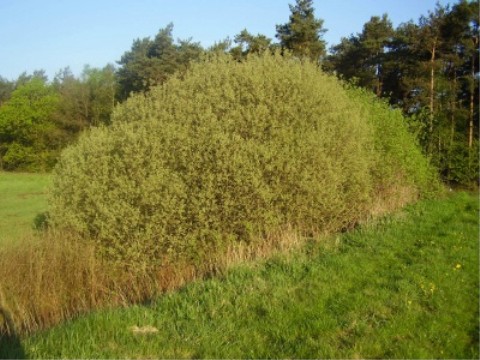
Salix hookeriana is native to the west coast of North America, with a range extending from Alaska to northern California, and occurs in coastal habitats including beaches. It grows as a shrub or tree, with oval-shaped, wavy-margined leaves that have a hairy to woolly texture and shiny upper surfaces.
Written 26 November 2026 from the sources listed below. Each statement was checked against the passage it cites; statements that could not be supported were removed.
Appearance
The coastal willow grows as either a shrub or a tree and can reach a height of 8 m.[1][2]
Its leaves can reach 11 cm in length and are generally oval-shaped, with wavy margins and a hairy to woolly texture. Their upper surfaces are shiny.[3][4][5][6][7]
Its flowers are arranged in catkin inflorescences, which can reach 9 cm in length.[8][9]
Habitat
The coastal willow occurs in coastal habitats, including beaches. It is native to the west coast of North America, with a native range extending from Alaska to northern California.[10][11][12]
Behaviour
The coastal willow sometimes forms dense, bushy colonies.[13]
Reproduction and life cycle
Female catkins increase in length as their fruits develop. The coastal willow can hybridize with similar species.[14][15]
Classification of the Coastal Willow
| Kingdom | Plantae |
|---|---|
| Subkingdom | Pteridobiotina |
| Phylum | Tracheophyta |
| Class | Magnoliopsida |
| Order | Malpighiales |
| Family | Salicaceae (Willow Family) |
| Tribe | Saliceae |
| Genus | Salix (Willow) |
| Species | Salix hookeriana Barratt |
Where the Coastal Willow is found
Checklists and occurrence records place Salix hookeriana in 2 countries across North America. GBIF holds 3,684 georeferenced records of it.
Countries
Regions and cities with the most records
- Oregon, United States 1,043
- California, United States 696
- McKinleyville, United States 345
- Arcata, United States 324
- Washington, United States 314
- British Columbia, Canada 241
- Bayside, United States 235
- Eureka, United States 223
- Albany, United States 104
- Corvallis, United States 101
- Richmond, Canada 76
- Victoria-Fraserview, Canada 71
- Riley Park, Canada 70
- Central Saanich, Canada 68
- Vancouver, Canada 68
- Oak Bay, Canada 66
- Colwood, Canada 65
- Delta, Canada 65
- Esquimalt, Canada 65
- Langford, Canada 65
- Saanich, Canada 65
- Victoria, Canada 61
- Columbia City, United States 48
- Mercer Island, United States 48
- Bellevue, United States 47
- Kirkland, United States 47
- Seattle, United States 46
- Bothell, United States 45
- Inglewood-Finn Hill, United States 45
- Kenmore, United States 45
- North Vancouver, Canada 45
- Bainbridge Island, United States 43
- Shoreline, United States 43
- West Vancouver, Canada 41
- Coos Bay, United States 39
- Redmond, United States 39
3 more countries have a few records outside this range
These countries hold a few records of Salix hookeriana but lie outside the range the checklists give for it. Such records are often zoo or garden specimens, museum material or vagrants, so the species is not counted as occurring there.
Range as the checklists state it
Alaska; Canada (British Columbia); USA (California, Oregon, Washington State)
A number beside a place is its count of GBIF occurrence records. A place without a number comes from a checklist alone. Records show where a species has been observed or collected, which can include escapes and vagrants.
Common names
English
- Coastal Willow
- Bigleaf Willow
- Hooker Willow
- Hooker's Willow
Names in 5 other languages
- Chinese
- 沙丘柳, 胡克柳
- Czech
- vrba Hookerova
- French
- saule de Hooker, saule à feuilles larges
- Lithuanian
- Kopinis karklas
- Russian
- Ива Гукера
Synonyms
5 other scientific names have been used for this species and are now treated as synonyms of Salix hookeriana.
- Salix amplifolia Coville
- Salix hookeriana var. hookeriana
- Salix hookeriana var. laurifolia J.K.Henry
- Salix hookeriana var. tomentosa J.K.Henry
- Salix piperi Bebb
Related species
-
 Weeping WillowSalix babylonica
-
 European WillowSalix alba
-
 Goat WillowSalix caprea
-
 Black WillowSalix nigra
-
 Arctic WillowSalix arctica
-
 Common OsierSalix viminalis
-
 Snowbed WillowSalix herbacea
-
 Common SallowSalix cinerea
Compare
Questions and answers
What is the scientific name of the Coastal Willow?
The scientific name of the Coastal Willow is Salix hookeriana. Written with its author, the full name is Salix hookeriana Barratt.
Which family does the Coastal Willow belong to?
Salix hookeriana belongs to the family Salicaceae, in the order Malpighiales and the class Magnoliopsida.
Where is the Coastal Willow found?
Checklists and occurrence records place Salix hookeriana in 2 countries: United States and Canada.
What is the conservation status of the Coastal Willow?
The IUCN Red List category recorded for Salix hookeriana is Least Concern (LC).
What other names does the Coastal Willow have?
Salix hookeriana is also known in English as Bigleaf Willow, Hooker Willow and Hooker's Willow.
Are there any willows native to North America?
Yes. The coastal willow is native to the west coast of North America, with a range extending from Alaska to northern California.[11][12]
What is the habitat of a willow tree?
The coastal willow occurs in coastal habitats, including beaches.[10]
Sources
Passages the profile rests on
- Salix hookeriana grows as either a shrub or a tree. Source passage: “Salix hookeriana is a shrub or tree growing up to 8 m (26 ft) tall” — English Wikipedia
- Salix hookeriana can reach a height of 8 m. Source passage: “growing up to 8 m (26 ft) tall” — English Wikipedia
- The leaves of Salix hookeriana can reach 11 cm in length. Source passage: “The leaves are up to 11 cm long” — English Wikipedia
- The leaves of Salix hookeriana are generally oval-shaped. Source passage: “generally oval in shape” — English Wikipedia
- The leaf margins of Salix hookeriana are wavy. Source passage: “wavy along the edges” — English Wikipedia
- The leaves of Salix hookeriana have a hairy to woolly texture. Source passage: “hairy to woolly in texture” — English Wikipedia
- The upper surfaces of Salix hookeriana leaves are shiny. Source passage: “with shiny upper surfaces.” — English Wikipedia
- The flowers of Salix hookeriana are arranged in catkin inflorescences. Source passage: “The inflorescence is a catkin of flowers” — English Wikipedia
- The flower catkins of Salix hookeriana can reach 9 cm in length. Source passage: “a catkin of flowers up to 9 cm long” — English Wikipedia
- Salix hookeriana occurs in coastal habitats, including beaches. Source passage: “where it grows in coastal habitat such as beaches” — English Wikipedia
- Salix hookeriana is native to the west coast of North America. Source passage: “The plant is native to the west coast of North America” — English Wikipedia
- The native range of Salix hookeriana extends from Alaska to northern California. Source passage: “from Alaska to northern California” — English Wikipedia
- Salix hookeriana sometimes forms dense, bushy colonies. Source passage: “sometimes forming bushy colonial thickets.” — English Wikipedia
- Female catkins of Salix hookeriana increase in length as their fruits develop. Source passage: “with the female catkins growing longer as the fruits develop.” — English Wikipedia
- Salix hookeriana can hybridize with similar species. Source passage: “This willow may hybridize with similar species.” — English Wikipedia
Data
- Catalogue of Life, 2026-10-16 XR cc by
- Global Biodiversity Information Facility CC BY 4.0
- Wikidata CC0
- GeoNames CC BY 4.0
- Wikimedia Commons per image; credit shown with each image
- Within the Catalogue of Life, this name comes from Synonymic Checklists of the Vascular Plants of the World cc by
References
- Barratt. (1838). Fl. Bor.-Amer. [Hooker] 2: 145, t. 180 (1838). where the name was published
This species in other databases
- Catalogue of Life 6XC8L
- Wikidata Q2091516
- iNaturalist 78941
- World Flora Online wfo-0000928813
- GRIN 311379
Page built on 27 November 2026. See how the catalog is made and all sources and licences.
Cite this page
ScientificNames.org. (2026). Salix hookeriana (Coastal Willow). Retrieved November 27, 2026, from https://scientificnames.org/species/salix-hookeriana
“Salix hookeriana (Coastal Willow).” ScientificNames.org, 2026, scientificnames.org/species/salix-hookeriana. Accessed 27 Nov. 2026.
ScientificNames.org. “Salix hookeriana (Coastal Willow).” Accessed November 27, 2026. https://scientificnames.org/species/salix-hookeriana.
@misc{scientificnames_salix_hookeriana_coastal_willow,
  author = {{ScientificNames.org}},
  title = {Salix hookeriana (Coastal Willow)},
  year = {2026},
  url = {https://scientificnames.org/species/salix-hookeriana},
  note = {Accessed 2026-11-27}
}