Species · Flowering plants
Grey Willow Salix humilis
The scientific name of the Grey Willow is Salix humilis. It is a species of flowering plant in the family Salicaceae (willow family), order Malpighiales.
- Scientific name
- Salix humilis Marshall
- Common name
- Grey Willow
- Genus
- Salix
- Family
- Salicaceae (Willow Family)
- Order
- Malpighiales
- Class
- Magnoliopsida
- Recorded in
- 2 countries
- Name status
- accepted in the Catalogue of Life

Overview
Salix humilis is native to the United States and Canada, east of the Rocky Mountains. Its green silky catkins appear before the leaves emerge in spring.
Written 26 November 2026 from the sources listed below. Each statement was checked against the passage it cites; statements that could not be supported were removed.
Appearance
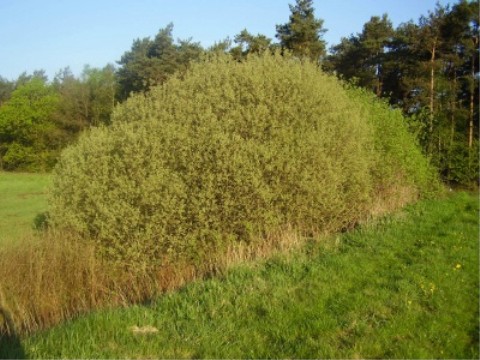
The grey willow is a shrub with yellowish to brown stems and gray-green to blue-green foliage. It typically grows between 2 and 12 feet tall.[1][2]
Its leaves measure 1.5–11.5 centimeters long and 0.6–3 centimeters wide. They can be oblanceolate, obovate, or elliptic.[3][4]
The foliage has insignificant fall color.[5]
Habitat
The grey willow occurs in areas with loamy sand, including pine flatwoods and pond shorelines.[6][7]
It is native to the United States and Canada, east of the Rocky Mountains.[8]
Behaviour
The grey willow often grows in thickets. It has also been observed in disturbed areas, including burned pine woods and hiking trails.[9][10]
Reproduction and life cycle
Male and female flowers occur on separate grey willow plants. Its green silky catkins appear before the leaves emerge in spring.[11][12]
Classification of the Grey Willow
| Kingdom | Plantae |
|---|---|
| Subkingdom | Pteridobiotina |
| Phylum | Tracheophyta |
| Class | Magnoliopsida |
| Order | Malpighiales |
| Family | Salicaceae (Willow Family) |
| Tribe | Saliceae |
| Genus | Salix (Willow) |
| Species | Salix humilis Marshall |
Where the Grey Willow is found
Checklists and occurrence records place Salix humilis in 2 countries across North America. GBIF holds 15,119 georeferenced records of it.
Countries
Regions and cities with the most records
- Quebec, Canada 1,050
- Wisconsin, United States 941
- Ontario, Canada 872
- Massachusetts, United States 717
- Pennsylvania, United States 646
- Minnesota, United States 566
- Illinois, United States 423
- Michigan, United States 376
- North Carolina, United States 288
- New York, United States 257
- New Jersey, United States 221
- Connecticut, United States 194
- Ohio, United States 189
- Tennessee, United States 181
- Missouri, United States 176
- Nova Scotia, Canada 163
- Indiana, United States 161
- Virginia, United States 154
- Kansas, United States 144
- Waltham, United States 120
- Belmont, United States 119
- New Hampshire, United States 119
- Newton, United States 118
- Watertown, United States 117
- Chestnut Hill, United States 115
- Brighton, United States 114
- Roslindale, United States 111
- Silver Spring, United States 111
- Wellesley, United States 110
- Maryland, United States 109
- Takoma Park, United States 109
- Wheaton, United States 109
- Auburn, United States 108
- Bethesda, United States 108
- Grafton, United States 108
- Langley Park, United States 108
Range as the checklists state it
Canada (Labrador, Manitoba, New Brunswick, Newfoundland, Nova Scotia, Ontario, Prince Edward Isl., Québec); USA (Alabama, Arkansas, Connecticut, District of Columbia, Delaware, Florida, Georgia, Iowa, Illinois, Indiana, Kansas, Kentucky, Louisiana, Massachusetts, Maryland, Maine, Michigan, Minnesota, Missouri, Mississippi, North Carolina, North Dakota, Nebraska, New Hampshire, New Jersey, New York, Ohio, Oklahoma, Pennsylvania, Rhode Island, South Carolina, South Dakota, Tennessee, Texas, Virginia, Vermont, Wisconsin, West Virginia)
A number beside a place is its count of GBIF occurrence records. A place without a number comes from a checklist alone. Records show where a species has been observed or collected, which can include escapes and vagrants.
Common names
English
- Grey Willow
- Small Pussy Willow
- Upland Willow
Names in 2 other languages
- French
- saule humble
- German
- Prärieweide
Synonyms
18 other scientific names have been used for this species and are now treated as synonyms of Salix humilis.
- Biggina conifera (Muhl.) Raf.
- Salix conifera Muhl.
- Salix humilis f. curtifolia Fernald
- Salix humilis f. festiva Fernald
- Salix humilis f. tortifolia Fernald
- Salix humilis var. angustifolia (Barratt) Zabel
- Salix humilis var. grandifolia (Barratt) Zabel
- Salix humilis var. hyporhysa Fernald
- Salix humilis var. keweenawensis Farw.
- Salix humilis var. longifolia Zabel
- Salix humilis var. rigidiuscula (Andersson) B.L.Rob. & Fernald
- Salix muhlenbergiana var. angustifolia Barratt
- Salix muhlenbergiana var. grandifolia Barratt
- Salix tristis var. glabrata (Andersson) Andersson
- Usionis humilis (Marshall) Raf.
- Salix flava Schoepf ex J.F.Gmel. ambiguous synonym
- Salix muehlenbergiana Barratt ex Torr. ambiguous synonym
- Salix recurvata Pursh ambiguous synonym
Subspecies and varieties
- Salix humilis var. humilis (Upland Willow) variety
- Salix humilis var. tristis (Prairie Willow) variety
Related species
-
 Weeping WillowSalix babylonica
-
 European WillowSalix alba
-
 Goat WillowSalix caprea
-
 Black WillowSalix nigra
-
 Arctic WillowSalix arctica
-
 Common OsierSalix viminalis
-
 Snowbed WillowSalix herbacea
-
 Common SallowSalix cinerea
Compare
Questions and answers
What is the scientific name of the Grey Willow?
The scientific name of the Grey Willow is Salix humilis. Written with its author, the full name is Salix humilis Marshall.
Which family does the Grey Willow belong to?
Salix humilis belongs to the family Salicaceae, in the order Malpighiales and the class Magnoliopsida.
Where is the Grey Willow found?
Checklists and occurrence records place Salix humilis in 2 countries: United States and Canada.
What other names does the Grey Willow have?
Salix humilis is also known in English as Small Pussy Willow and Upland Willow.
Sources
Passages the profile rests on
- Salix humilis is a shrub with yellowish to brown stems and gray-green to blue-green foliage. Source passage: “The stems are yellowish to brown. The gray-green to blue-green foliage has insignificant fall color.” — English Wikipedia
- Salix humilis typically grows between 2 and 12 feet tall. Source passage: “S. humilis is a shrub, 2–12 feet tall, which often forms thickets.” — English Wikipedia
- Its leaves measure 1.5–11.5 centimeters long and 0.6–3 centimeters wide. Source passage: “They range in size between 1.5 and 11.5 centimeters (0.6 to 4.5 inches) in length and 0.6 to 3 (0.23 to 1.18 inches) centimeters in width.” — English Wikipedia
- Its leaves can be oblanceolate, obovate, or elliptic. Source passage: “The leaves may be oblanceolate, obovate, or elliptic in shape.” — English Wikipedia
- The foliage of Salix humilis has insignificant fall color. Source passage: “The gray-green to blue-green foliage has insignificant fall color.” — English Wikipedia
- Salix humilis occurs in areas with loamy sand. Source passage: “This species has been observed in areas with loamy sand” — English Wikipedia
- The species occurs in pine flatwoods and along pond shorelines. Source passage: “as well as specific habitat types such as pine flatwoods and along pond shorelines.” — English Wikipedia
- Salix humilis is native to the United States and Canada, east of the Rocky Mountains. Source passage: “Salix humilis, known as prairie willow, is a species of willow native to the United States and Canada, east of the Rockies.” — English Wikipedia
- Salix humilis often grows in thickets. Source passage: “which often forms thickets.” — English Wikipedia
- Salix humilis has been observed in disturbed areas, including burned pine woods and hiking trails. Source passage: “Individuals have also been observed occurring in areas that are or had previously been disturbed, such as within burned pine woods or along hiking trails.” — English Wikipedia
- Male and female flowers occur on separate Salix humilis plants. Source passage: “Male and female flowers are found on separate plants.” — English Wikipedia
- Its green silky catkins appear before the leaves emerge in spring. Source passage: “The green silky catkins appear before the leaves emerge in spring.” — English Wikipedia
Data
- Catalogue of Life, 2026-10-16 XR cc by
- Global Biodiversity Information Facility CC BY 4.0
- Wikidata CC0
- GeoNames CC BY 4.0
- Wikimedia Commons per image; credit shown with each image
- Within the Catalogue of Life, this name comes from Synonymic Checklists of the Vascular Plants of the World cc by
References
- Marshall. Arbust. Amer. 140 (1785). where the name was published
This species in other databases
Page built on 29 November 2026. See how the catalog is made and all sources and licences.
Cite this page
ScientificNames.org. (2026). Salix humilis (Grey Willow). Retrieved November 29, 2026, from https://scientificnames.org/species/salix-humilis
“Salix humilis (Grey Willow).” ScientificNames.org, 2026, scientificnames.org/species/salix-humilis. Accessed 29 Nov. 2026.
ScientificNames.org. “Salix humilis (Grey Willow).” Accessed November 29, 2026. https://scientificnames.org/species/salix-humilis.
@misc{scientificnames_salix_humilis_grey_willow,
  author = {{ScientificNames.org}},
  title = {Salix humilis (Grey Willow)},
  year = {2026},
  url = {https://scientificnames.org/species/salix-humilis},
  note = {Accessed 2026-11-29}
}