Species · Flowering plants
Barrens Willow Salix jejuna
The scientific name of the Barrens Willow is Salix jejuna. It is a species of flowering plant in the family Salicaceae (willow family), order Malpighiales.
- Scientific name
- Salix jejuna Fernald
- Common name
- Barrens Willow
- Genus
- Salix
- Family
- Salicaceae (Willow Family)
- Order
- Malpighiales
- Class
- Magnoliopsida
- Recorded in
- 1 country
- Name status
- accepted in the Catalogue of Life
Overview
Salix jejuna inhabits coastal limestone barrens along the Strait of Belle Isle on Newfoundland's Great Northern Peninsula. It grows in flat, spreading mats, with individual plants approximately 1–2 cm tall.
Written 27 November 2026 from the sources listed below. Each statement was checked against the passage it cites; statements that could not be supported were removed.
Appearance
Individual plants grow approximately 1–2 cm tall. Their spreading mats can reach 30 cm in extent within a couple of years.[1][2]
Habitat
The barrens willow inhabits highly restricted limestone barrens containing limestone crevices beneath thin soils. It occupies coastal barren lands along the Strait of Belle Isle.[3][4]
Behaviour
The barrens willow is a pioneer species. Its low-growing, spreading growth form helps it exploit sun-heated soil boundaries and persist under harsh environmental conditions.[5][6]
It can persist in conditions involving strong winds, wind-entrained ice, and soil frost heaving.[7]
Reproduction and life cycle
The barrens willow flowers from late June through mid-July.[8]
Conservation
The barrens willow is considered critically endangered. It is restricted to a 30 km stretch of coastal barren lands on Newfoundland's Great Northern Peninsula along the Strait of Belle Isle and is currently known from only eight remaining sites in Newfoundland.[9][10][11]
The species was assessed by COSEWIC in 2001 and determined to be endangered. It was listed under Newfoundland and Labrador's Endangered Species Act and Canada's federal Species at Risk Act in 2002.[12][13]
Limestone extraction is the principal identified threat to the species. Off-road vehicles threaten it by crushing individual plants, and climate change is identified as a potential threat because it may alter the limestone barrens habitat.[14][15][16]
Classification of the Barrens Willow
| Kingdom | Plantae |
|---|---|
| Subkingdom | Pteridobiotina |
| Phylum | Tracheophyta |
| Class | Magnoliopsida |
| Order | Malpighiales |
| Family | Salicaceae (Willow Family) |
| Tribe | Saliceae |
| Genus | Salix (Willow) |
| Species | Salix jejuna Fernald |
Where the Barrens Willow is found
Checklists and occurrence records place Salix jejuna in 1 country across North America. GBIF holds 67 georeferenced records of it.
Countries
Regions and cities with the most records
Range as the checklists state it
Canada (Newfoundland)
A number beside a place is its count of GBIF occurrence records. A place without a number comes from a checklist alone. Records show where a species has been observed or collected, which can include escapes and vagrants.
Common names
English
- Barrens Willow
- Belle Isle Dwarf Willow
- Calcareous Mat Willow
Names in 1 other language
- French
- saule des landes
Related species
-
 Weeping WillowSalix babylonica
-
 European WillowSalix alba
-
 Goat WillowSalix caprea
-
 Black WillowSalix nigra
-
 Arctic WillowSalix arctica
-
 Common OsierSalix viminalis
-
 Snowbed WillowSalix herbacea
-
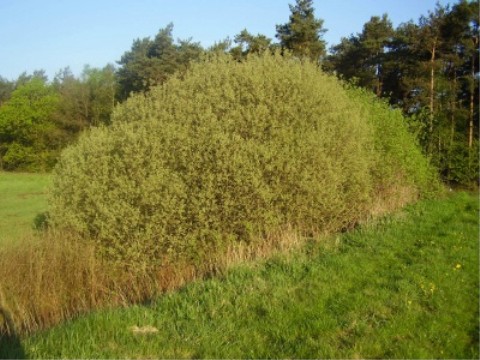 Common SallowSalix cinerea
Compare
Questions and answers
What is the scientific name of the Barrens Willow?
The scientific name of the Barrens Willow is Salix jejuna. Written with its author, the full name is Salix jejuna Fernald.
Which family does the Barrens Willow belong to?
Salix jejuna belongs to the family Salicaceae, in the order Malpighiales and the class Magnoliopsida.
Where is the Barrens Willow found?
Checklists and occurrence records place Salix jejuna in 1 country: Canada.
What other names does the Barrens Willow have?
Salix jejuna is also known in English as Belle Isle Dwarf Willow and Calcareous Mat Willow.
Are there any willows native to North America?
The barrens willow is a willow species recorded on Newfoundland's Great Northern Peninsula.[9][17]
What is the scientific name for the willow tree?
The scientific name of the barrens willow is Salix jejuna Fernald.[18]
Sources
Passages the profile rests on
- Individual plants grow approximately 1–2 cm tall. Source passage: “It is characterized as a woody shrub that grows around 1-2 cm in height.” — English Wikipedia
- Its spreading mats can reach 30 cm in extent within a couple of years. Source passage: “Mats can extend to 30 cm in a couple of years.” — English Wikipedia
- The species inhabits highly restricted limestone barrens containing limestone crevices beneath thin soils. Source passage: “It grows in highly restricted limestone barrens where limestone crevices are found among thin soils that conceal fields of fissured limestone.” — English Wikipedia
- The species occupies coastal barren lands along the Strait of Belle Isle. Source passage: “Salix jejuna, the barrens willow, is a tiny willow restricted to a 30 km stretch of coastal barren lands of the Strait of Belle Isle on the Great Northern Peninsula of Newfoundland.” — English Wikipedia
- Its low-growing, spreading growth form helps it exploit sun-heated soil boundaries and persist under harsh environmental conditions. Source passage: “Barrens willow's low-growing habit and spreading form allows it to take advantage of the sun-heated soil boundary and persist in harsh conditions” — English Wikipedia
- Salix jejuna is a pioneer species. Source passage: “Like all willows, it is a pioneer species.” — English Wikipedia
- The species can persist in conditions involving strong winds, wind-entrained ice, and soil frost heaving. Source passage: “including wind, wind-entrained ice, and soil frost heaving.” — English Wikipedia
- The species flowers from late June through mid-July. Source passage: “It flowers in late June to mid-July.” — English Wikipedia
- Salix jejuna is restricted to a 30 km stretch of coastal barren lands on Newfoundland's Great Northern Peninsula along the Strait of Belle Isle. Source passage: “restricted to a 30 km stretch of coastal barren lands of the Strait of Belle Isle on the Great Northern Peninsula of Newfoundland.” — English Wikipedia
- The species is currently known from only eight remaining sites in Newfoundland. Source passage: “Currently, it is limited to only eight remaining sites in Newfoundland.” — English Wikipedia
- Salix jejuna is considered critically endangered. Source passage: “S. jejuna is considered critically endangered.” — English Wikipedia
- The species was assessed by COSEWIC in 2001 and determined to be endangered. Source passage: “It was assessed by the Committee on the Status of Endangered Wildlife in Canada (COSEWIC) in 2001 and determined to be an endangered species” — English Wikipedia
- The species was listed under Newfoundland and Labrador's Endangered Species Act and Canada's federal Species at Risk Act in 2002. Source passage: “as listed in the Newfoundland and Labrador Endangered Species Act and the Canadian federal Species at Risk Act in 2002.” — English Wikipedia
- Limestone extraction is the principal identified threat to the species. Source passage: “The main threat to S. jejuna is habitat degradation due to limestone extraction.” — English Wikipedia
- Off-road vehicles threaten the species by crushing individual plants. Source passage: “the use of off-roading vehicles crushing plants” — English Wikipedia
- Climate change is identified as a potential threat because it may alter the limestone barrens habitat. Source passage: “climate change potentially altering the limestone barrens habitat.” — English Wikipedia
- Salix jejuna belongs to the willow family. Source passage: “belonging to the willow family (Salix).” — English Wikipedia
- Salix jejuna is a woody shrub with small rounded leaves borne on short petioles close to its stems. Source passage: “It is characterized by small rounded leaves on short petioles growing close to the stems.” — English Wikipedia
Data
- Catalogue of Life, 2026-10-16 XR cc by
- Global Biodiversity Information Facility CC BY 4.0
- Wikidata CC0
- GeoNames CC BY 4.0
- Within the Catalogue of Life, this name comes from Synonymic Checklists of the Vascular Plants of the World cc by
References
- Fernald. (1926). Rhodora 28: 177 (1926). where the name was published
This species in other databases
Page built on 29 November 2026. See how the catalog is made and all sources and licences.
Cite this page
ScientificNames.org. (2026). Salix jejuna (Barrens Willow). Retrieved November 29, 2026, from https://scientificnames.org/species/salix-jejuna
“Salix jejuna (Barrens Willow).” ScientificNames.org, 2026, scientificnames.org/species/salix-jejuna. Accessed 29 Nov. 2026.
ScientificNames.org. “Salix jejuna (Barrens Willow).” Accessed November 29, 2026. https://scientificnames.org/species/salix-jejuna.
@misc{scientificnames_salix_jejuna_barrens_willow,
  author = {{ScientificNames.org}},
  title = {Salix jejuna (Barrens Willow)},
  year = {2026},
  url = {https://scientificnames.org/species/salix-jejuna},
  note = {Accessed 2026-11-29}
}