Species · Flowering plants
Salix lasiolepis
Salix lasiolepis has no English name on record in the checklists used here. It is a species of flowering plant in the family Salicaceae (willow family), order Malpighiales.
- Scientific name
- Salix lasiolepis Benth.
- Genus
- Salix
- Family
- Salicaceae (Willow Family)
- Order
- Malpighiales
- Class
- Magnoliopsida
- Red List category
- LC Least Concern
- Recorded in
- 2 countries
- Name status
- accepted in the Catalogue of Life

Overview
Salix lasiolepis is native to western North America, with a core range that includes most of California, Arizona, and the Klamath Mountains, Peninsular Ranges, Sierra Nevada, and Transverse Ranges. It is a deciduous large shrub or small multi-trunked tree that can grow to 10 metres tall and is classified as a severe allergen.
Written 26 November 2026 from the sources listed below. Each statement was checked against the passage it cites; statements that could not be supported were removed.
Appearance
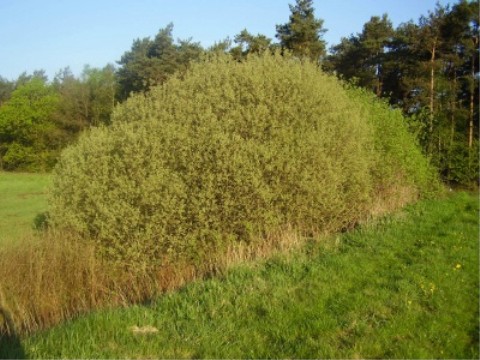
Salix lasiolepis is a deciduous large shrub or small multi-trunked tree that can grow to 10 metres tall. Its young shoots are yellowish brown and densely hairy.[1][2][3]
Its broadly lanceolate leaves measure 3.5–12.5 centimetres in length. The upper surfaces are green, while the lower surfaces are glaucous green and bear whitish or rusty hairs that gradually wear off during summer.[4][5][6][7]
Mature leaves can have revolute, entire, or serrate margins, and their apices range from acute to obtuse. The stipules can appear absent or leaf-like, and the petioles are hairy.[8][9][10][11]
Male flowers occur in yellow catkins measuring 1.7–5.5 centimetres long. Female flowers occur in green catkins measuring 1.5–6 centimetres long.[12][13][14]
Habitat
The species commonly grows in riparian zones in canyons and valleys, along pond shores, and in marshes and wetlands.[15]
It occurs in chaparral, oak woodland, mixed evergreen forest, and coast redwood forest. It also occurs in yellow pine forest, red fir forest, lodgepole pine forest, and grasslands.[16][17]
Behaviour
The species serves as a host plant for Lorquin's admiral, mourning cloak, and western tiger swallowtail butterflies.[18]
Its seeds measure approximately 1 millimetre and are dispersed by wind.[19][20]
Reproduction and life cycle
The flowers are unisexual, and the species is primarily pollinated by insects. Pollination occurs in spring, depending on latitude and elevation.[21][22][12]
Male and female catkins are produced in early spring. The flowering period extends from February through May, and flowers can develop before the leaves.[23][24][25]
Uses
Indigenous peoples of California used the species for various purposes. Infusions made from its leaves, bark, or flowers were traditionally used as remedies for several diseases.[26][27]
Its bark was used to prepare tea intended to relieve pains and fevers, while its inner bark was used to make rope.[28][29]
Its shoots were used in coiled and twined basketry, and its branches were used to make baskets for storing acorns. Its leaves were used as thatching material for ramadas.[30][31][32]
Classification of Salix lasiolepis
| Kingdom | Plantae |
|---|---|
| Subkingdom | Pteridobiotina |
| Phylum | Tracheophyta |
| Class | Magnoliopsida |
| Order | Malpighiales |
| Family | Salicaceae (Willow Family) |
| Tribe | Saliceae |
| Genus | Salix (Willow) |
| Species | Salix lasiolepis Benth. |
Where Salix lasiolepis is found
Checklists and occurrence records place Salix lasiolepis in 2 countries across North America. GBIF holds 16,158 georeferenced records of it.
Countries
Regions and cities with the most records
- California, United States 8,643
- Encinitas, United States 597
- San Diego, United States 586
- National City, United States 571
- La Presa, United States 532
- San Marcos, United States 526
- Lemon Grove, United States 520
- Carlsbad, United States 511
- La Mesa, United States 508
- Coronado, United States 504
- Spring Valley, United States 497
- Chula Vista, United States 448
- San Francisco, United States 440
- Bayview-Hunters Point, United States 431
- Arizona, United States 430
- Lake Forest, United States 405
- Casa de Oro-Mount Helix, United States 401
- Daly City, United States 394
- El Cajon, United States 394
- Irvine, United States 394
- Rancho San Diego, United States 389
- Tustin, United States 387
- Laguna Hills, United States 385
- Laguna Woods, United States 372
- Santee, United States 371
- South San Francisco, United States 370
- North Tustin, United States 366
- Baja California, Mexico 363
- Poway, United States 357
- Oakland, United States 353
- Bostonia, United States 348
- Aliso Viejo, United States 346
- La Crescenta-Montrose, United States 346
- La Cañada Flintridge, United States 343
- Burbank, United States 340
- Mission Viejo, United States 340
1 more country has a few records outside this range
These countries hold a few records of Salix lasiolepis but lie outside the range the checklists give for it. Such records are often zoo or garden specimens, museum material or vagrants, so the species is not counted as occurring there.
Range as the checklists state it
USA (Arizona, California, Idaho, New Mexico, Nevada, Oregon, Texas, Utah, Washington State); Mexico (Aguascalientes, Baja California Norte, Baja California Sur, Chihuahua, Coahuila, Durango, Guanajuato, Hidalgo, Jalisco, Mexico State, Morelos, Nuevo León, Querétaro, San Luis Potosí, Sinaloa, Sonora, Tamaulipas, Veracruz, Zacatecas)
A number beside a place is its count of GBIF occurrence records. A place without a number comes from a checklist alone. Records show where a species has been observed or collected, which can include escapes and vagrants.
Common names
Names in 2 other languages
- Chinese
- 阿罗约柳, 阿羅約柳
- Spanish
- ahuejote
Synonyms
16 other scientific names have been used for this species and are now treated as synonyms of Salix lasiolepis.
- Salix bakeri Seemen
- Salix boiseana A.Nelson
- Salix humilis f. opaca (Andersson) Andersson
- Salix lasiolepis f. glabrescens Kuntze
- Salix lasiolepis var. bakeri (Seemen) C.R.Ball
- Salix lasiolepis var. bracelinae C.R.Ball
- Salix lasiolepis var. fallax Bebb
- Salix lasiolepis var. lasiolepis
- Salix lasiolepis var. nivaria Jeps.
- Salix lasiolepis var. sandbergii (Rydb.) C.R.Ball
- Salix lasiolepis var. velutina Kuntze
- Salix lutea var. nivaria Jeps.
- Salix parishii Gand.
- Salix sandbergii Rydb.
- Salix schaffneri C.K.Schneid.
- Salix suksdorfii Gand.
Subspecies and varieties
- Salix lasiolepis var. bigelovii variety
Related species
-
 Weeping WillowSalix babylonica
-
 European WillowSalix alba
-
 Goat WillowSalix caprea
-
 Black WillowSalix nigra
-
 Arctic WillowSalix arctica
-
 Common OsierSalix viminalis
-
 Snowbed WillowSalix herbacea
-
 Common SallowSalix cinerea
Compare
Questions and answers
What is the habitat of a willow tree?
Salix lasiolepis commonly grows in riparian zones in canyons and valleys, along pond shores, and in marshes and wetlands. It also occurs in chaparral, oak woodland, mixed evergreen forest, coast redwood forest, yellow pine forest, red fir forest, lodgepole pine forest, and grasslands.[15][16][17]
Sources
Passages the profile rests on
- The species is a deciduous large shrub or small multi-trunked tree. Source passage: “Salix lasiolepis is a deciduous large shrub or small multi−trunked tree” — English Wikipedia
- The species can grow to 10 metres tall. Source passage: “growing to 10 metres (33 ft) tall.” — English Wikipedia
- Young shoots are yellowish brown and densely hairy. Source passage: “The shoots are yellowish brown and densely hairy when young.” — English Wikipedia
- Its leaves measure 3.5–12.5 centimetres in length. Source passage: “The leaves are 3.5–12.5 centimetres (1.4–4.9 in) long” — English Wikipedia
- Its leaves are broadly lanceolate. Source passage: “and broadly lanceolate in shape.” — English Wikipedia
- The upper leaf surfaces are green, while the lower surfaces are glaucous green. Source passage: “They are green above and glaucous green below.” — English Wikipedia
- The undersides of its leaves bear whitish or rusty hairs that gradually wear off during summer. Source passage: “The undersides are covered with whitish or rusty hairs which gradually wear off during the summer.” — English Wikipedia
- Mature leaves can have revolute, entire, or serrate margins. Source passage: “at maturity its leaf margins can be revolute, entire, or serrate.” — English Wikipedia
- Its leaf apices range from acute to obtuse. Source passage: “Its apices can be acute to obtuse.” — English Wikipedia
- Its stipules can appear absent or leaf-like. Source passage: “The stipules of S. lasiolepis can appear absent or leaf-like” — English Wikipedia
- Its petioles are hairy. Source passage: “and its petioles are hairy.” — English Wikipedia
- The flowers of the species are unisexual. Source passage: “The flowers are unisexual.” — English Wikipedia
- Male flowers occur in yellow catkins measuring 1.7–5.5 centimetres long. Source passage: “Male (staminate) flowers feature yellow catkins 1.7–5.5 centimetres (0.67–2.17 in) long” — English Wikipedia
- Female flowers occur in green catkins measuring 1.5–6 centimetres long. Source passage: “female (pistillate) flowers have green catkins 1.5–6 centimetres (0.59–2.36 in) long.” — English Wikipedia
- The species commonly grows in riparian zones in canyons and valleys, along pond shores, and in marshes and wetlands. Source passage: “The plant is commonly found growing in riparian zones in canyons and valleys, along pond shores, and in marshes and wetlands.” — English Wikipedia
- The species occurs in chaparral, oak woodland, mixed evergreen forest, and coast redwood forest. Source passage: “It is found in many plant communities, including: chaparral, oak woodland, mixed evergreen forest, coast redwood forest” — English Wikipedia
- The species also occurs in yellow pine forest, red fir forest, lodgepole pine forest, and grasslands. Source passage: “yellow pine forest, red fir forest, lodgepole pine forest, and grasslands.” — English Wikipedia
- The species serves as a host plant for Lorquin's admiral, mourning cloak, and western tiger swallowtail butterflies. Source passage: “S. lasiolepis serves as a host plant for various insects, including Lorquin's admiral, mourning cloak, and western tiger swallowtail butterflies.” — English Wikipedia
- Its seeds measure approximately 1 millimetre. Source passage: “Its seeds are tiny, measuring approximately 1 millimetre (0.039 in)” — English Wikipedia
- Its seeds are dispersed by wind. Source passage: “and are distributed by wind.” — English Wikipedia
- The species is primarily pollinated by insects. Source passage: “It is primarily pollinated through insects.” — English Wikipedia
- Its pollination occurs in spring, depending on latitude and elevation. Source passage: “Occurs in following seasons depending on latitude and elevation: Spring.” — English Wikipedia
- Male and female catkins are produced in early spring. Source passage: “Both are produced in early spring.” — English Wikipedia
- The species has a flowering period from February through May. Source passage: “The bloom period is February to May.” — English Wikipedia
- Its flowers can develop before its leaves. Source passage: “Precocious inflorescence has been observed in the species, meaning that the flowers develop before the leaves.” — English Wikipedia
- Indigenous peoples of California used the species for various purposes. Source passage: “The indigenous peoples of California used the species in various ways.” — English Wikipedia
- Infusions made from its leaves, bark, or flowers were traditionally used as remedies for several diseases. Source passage: “As a traditional medicinal plant, infusions of the leaves, bark, or flowers were used for several disease remedies.” — English Wikipedia
- Its bark was used to prepare tea intended to relieve pains and fevers. Source passage: “The bark has been used to make tea to help with pains and fevers.” — English Wikipedia
- The inner bark was used to make rope. Source passage: “The inner bark was used to make rope.” — English Wikipedia
- Its shoots were used in coiled and twined basketry. Source passage: “Shoots were used in coiled and twined basketry” — English Wikipedia
- Its branches were used to make baskets for storing acorns. Source passage: “and branches were used to make acorn storage baskets.” — English Wikipedia
- Its leaves were used as thatching material for ramadas. Source passage: “The leaves were used to thatch ramadas.” — English Wikipedia
Data
- Catalogue of Life, 2026-10-16 XR cc by
- Global Biodiversity Information Facility CC BY 4.0
- Wikidata CC0
- GeoNames CC BY 4.0
- Wikimedia Commons per image; credit shown with each image
- Within the Catalogue of Life, this name comes from Synonymic Checklists of the Vascular Plants of the World cc by
References
- Benth. Pl. Hartw. [Bentham] 335 (1843). where the name was published
This species in other databases
- Catalogue of Life 6XC7R
- Wikidata Q5240848
- iNaturalist 53452
- World Flora Online wfo-0000928742
- GRIN 316020
Page built on 27 November 2026. See how the catalog is made and all sources and licences.
Cite this page
ScientificNames.org. (2026). Salix lasiolepis. Retrieved November 27, 2026, from https://scientificnames.org/species/salix-lasiolepis
“Salix lasiolepis.” ScientificNames.org, 2026, scientificnames.org/species/salix-lasiolepis. Accessed 27 Nov. 2026.
ScientificNames.org. “Salix lasiolepis.” Accessed November 27, 2026. https://scientificnames.org/species/salix-lasiolepis.
@misc{scientificnames_salix_lasiolepis,
  author = {{ScientificNames.org}},
  title = {Salix lasiolepis},
  year = {2026},
  url = {https://scientificnames.org/species/salix-lasiolepis},
  note = {Accessed 2026-11-27}
}