Species · Flowering plants
Salix lemmonii
Salix lemmonii has no English name on record in the checklists used here. It is a species of flowering plant in the family Salicaceae (willow family), order Malpighiales.
- Scientific name
- Salix lemmonii Bebb
- Genus
- Salix
- Family
- Salicaceae (Willow Family)
- Order
- Malpighiales
- Class
- Magnoliopsida
- Recorded in
- 2 countries
- Name status
- accepted in the Catalogue of Life

Overview
Salix lemmonii is native to western North America, ranging from British Columbia through California to Colorado. It is distinguished by its clustered stems, slender spreading branches, and stout flower catkins.
Written 27 November 2026 from the sources listed below. Each statement was checked against the passage it cites; statements that could not be supported were removed.
Appearance
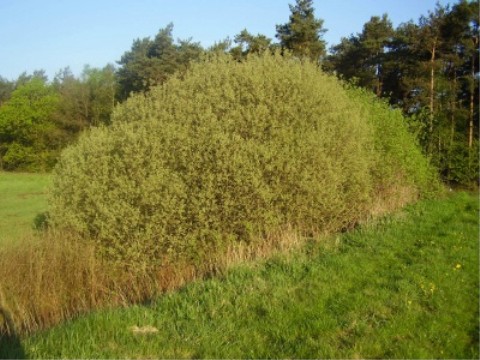
Salix lemmonii grows as a shrub typically reaching a height of 1 to 4 meters. Its stems emerge in clusters, and its numerous branches are slender, angular, and spreading.[1][2][3][4]
Its leaves can reach 11 centimeters in length and are lance-shaped to oval with pointed tips. Their margins are smooth or slightly serrated, and the leaves are hairless and waxy or slightly hairy.[5][6][7][8]
Habitat
The species grows in moist and wet areas, including mountain coniferous forests, streambanks, and meadows.[9][10][11]
Behaviour
Salix lemmonii sometimes forms colonial thickets and sometimes hybridizes with Salix geyeriana.[12][13]
Reproduction and life cycle
The species produces stout catkins containing flowers. These catkins are initially a few centimeters long, and female catkins elongate as their fruits develop, reaching 6 to 7 centimeters.[14][15][16][17]
Similar species
Salix geyeriana is a closely related species with which Salix lemmonii sometimes hybridizes.[13][18]
Uses
Salix lemmonii is commonly used in revegetation projects within its native range. It is also used to stabilize eroded riparian habitats.[19][20]
Classification of Salix lemmonii
| Kingdom | Plantae |
|---|---|
| Subkingdom | Pteridobiotina |
| Phylum | Tracheophyta |
| Class | Magnoliopsida |
| Order | Malpighiales |
| Family | Salicaceae (Willow Family) |
| Tribe | Saliceae |
| Genus | Salix (Willow) |
| Species | Salix lemmonii Bebb |
Where Salix lemmonii is found
Checklists and occurrence records place Salix lemmonii in 2 countries across North America. GBIF holds 2,679 georeferenced records of it.
Countries
Regions and cities with the most records
- California, United States 817
- Oregon, United States 184
- Idaho, United States 95
- Truckee, United States 89
- Nevada, United States 79
- South Lake Tahoe, United States 75
- Carson City, United States 23
- Washington, United States 22
- Moscow, United States 20
- Pullman, United States 20
- Redmond, United States 20
- Bend, United States 14
- Montana, United States 12
- Wyoming, United States 10
- Yucaipa, United States 6
- Reno, United States 5
- Highland, United States 4
- Sun Valley, United States 4
- Paradise, United States 3
- Sparks, United States 3
- Susanville, United States 3
- British Columbia, Canada
- Colorado, United States
Range as the checklists state it
Canada (British Columbia); USA (California, Colorado, Idaho, Montana, Nevada, Oregon, Washington State, Wyoming)
A number beside a place is its count of GBIF occurrence records. A place without a number comes from a checklist alone. Records show where a species has been observed or collected, which can include escapes and vagrants.
Common names
Names in 1 other language
- French
- saule de Lemmon
Synonyms
5 other scientific names have been used for this species and are now treated as synonyms of Salix lemmonii.
- Salix austinae Bebb
- Salix lemmonii var. austinae (Bebb) C.K.Schneid.
- Salix lemmonii var. macrostachya Bebb
- Salix lemmonii var. melanolepis Bebb
- Salix lemmonii var. sphaerostachya Bebb
Related species
-
 Weeping WillowSalix babylonica
-
 European WillowSalix alba
-
 Goat WillowSalix caprea
-
 Black WillowSalix nigra
-
 Arctic WillowSalix arctica
-
 Common OsierSalix viminalis
-
 Snowbed WillowSalix herbacea
-
 Common SallowSalix cinerea
Compare
Sources
Passages the profile rests on
- The species grows as a shrub. Source passage: “Salix lemmonii is a shrub” — English Wikipedia
- The shrub typically reaches a height of 1 to 4 meters. Source passage: “growing 1 to 4 meters tall” — English Wikipedia
- Its stems emerge in clusters. Source passage: “Its stems arise in a cluster” — English Wikipedia
- Its branches are numerous, slender, angular, and spreading. Source passage: “spread into many slender, angular branches.” — English Wikipedia
- Its leaves can reach 11 centimeters in length. Source passage: “The leaves are up to 11 centimeters long” — English Wikipedia
- Its leaves are lance-shaped to oval and have pointed tips. Source passage: “lance-shaped to oval with pointed tips” — English Wikipedia
- Its leaf margins are smooth or slightly serrated. Source passage: “smooth or lightly serrated along the edges” — English Wikipedia
- Its leaves are hairless and waxy or slightly hairy. Source passage: “hairless and waxy or slightly hairy.” — English Wikipedia
- The species grows in moist and wet areas. Source passage: “where it grows in moist and wet areas” — English Wikipedia
- The species occurs in mountain coniferous forests. Source passage: “in mountain coniferous forest habitat” — English Wikipedia
- Streambanks and meadows are among the species' habitats. Source passage: “such as streambanks and meadows.” — English Wikipedia
- The species sometimes forms colonial thickets. Source passage: “sometimes forming colonial thickets.” — English Wikipedia
- The species sometimes hybridizes with Salix geyeriana. Source passage: “This willow sometimes hybridizes with Salix geyeriana” — English Wikipedia
- The species produces stout catkins containing flowers. Source passage: “The inflorescence is a stout catkin of flowers” — English Wikipedia
- Its flower catkins are initially a few centimeters long. Source passage: “of flowers a few centimeters long” — English Wikipedia
- Female catkins elongate as their fruits develop. Source passage: “the female catkins lengthening to 6 or 7 centimeters as the fruits develop.” — English Wikipedia
- Female catkins can reach 6 to 7 centimeters during fruit development. Source passage: “lengthening to 6 or 7 centimeters as the fruits develop.” — English Wikipedia
- Salix geyeriana is a closely related species. Source passage: “to which it is closely related.” — English Wikipedia
- The species is commonly used in revegetation projects within its native range. Source passage: “This shrub is commonly used in revegetation projects in its native range” — English Wikipedia
- The species is used to stabilize eroded riparian habitats. Source passage: “where it is useful for stabilizing eroded riparian habitat.” — English Wikipedia
Data
- Catalogue of Life, 2026-10-16 XR cc by
- Global Biodiversity Information Facility CC BY 4.0
- Wikidata CC0
- GeoNames CC BY 4.0
- Wikimedia Commons per image; credit shown with each image
- Within the Catalogue of Life, this name comes from Synonymic Checklists of the Vascular Plants of the World cc by
References
- Bebb. (1880). Bot. California [W.H.Brewer] 2: 88 (1880). where the name was published
This species in other databases
- Catalogue of Life 79BVT
- Wikidata Q7404905
- iNaturalist 78944
- World Flora Online wfo-0000928761
- GRIN 318674
Page built on 27 November 2026. See how the catalog is made and all sources and licences.
Cite this page
ScientificNames.org. (2026). Salix lemmonii. Retrieved November 27, 2026, from https://scientificnames.org/species/salix-lemmonii
“Salix lemmonii.” ScientificNames.org, 2026, scientificnames.org/species/salix-lemmonii. Accessed 27 Nov. 2026.
ScientificNames.org. “Salix lemmonii.” Accessed November 27, 2026. https://scientificnames.org/species/salix-lemmonii.
@misc{scientificnames_salix_lemmonii,
  author = {{ScientificNames.org}},
  title = {Salix lemmonii},
  year = {2026},
  url = {https://scientificnames.org/species/salix-lemmonii},
  note = {Accessed 2026-11-27}
}