Species · Flowering plants
Purple Willow Salix purpurea
The scientific name of the Purple Willow is Salix purpurea. It is a species of flowering plant in the family Salicaceae (willow family), order Malpighiales.
- Scientific name
- Salix purpurea L.
- Common name
- Purple Willow
- Genus
- Salix
- Family
- Salicaceae (Willow Family)
- Order
- Malpighiales
- Class
- Magnoliopsida
- Red List category
- LC Least Concern
- Recorded in
- 53 countries
- Name status
- accepted in the Catalogue of Life

Overview
The native distribution includes Europe, western Asia and northwestern Africa. It is distinguished by its narrow, usually opposite leaves, flexible young branches and upright cylindrical catkins.
Written 26 November 2026 from the sources listed below. Each statement was checked against the passage it cites; statements that could not be supported were removed.
Uses
Purple willow is widely used in basket making. Its stems are harvested for basketry and are sometimes marketed as Brittany Green willow.[1][2]
Its wood is used to manufacture cricket bats, and its branches are used for tying grapevines in vineyards.[3][4]
The species is used for erosion control along streambanks affected by floods and ice. It is also planted as an ornamental shrub in gardens and landscapes.[5][6]
Appearance
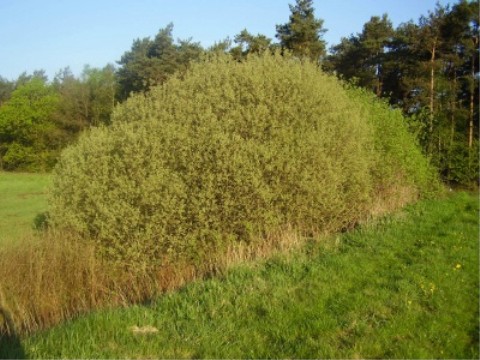
Purple willow is a deciduous shrub or small tree with numerous stems. Its bark is smooth and greyish, with a bitter taste, and its vegetative parts are hairless.[7][8][9]
Its young branches are cylindrical and flexible, and are often yellowish or purple-tinged. Its leaves are usually opposite or nearly opposite, narrowly oblong and pointed at the tips, measuring approximately 2–10 cm in length.[10][11][12]
Fresh leaves are dull pale green and turn black after harvesting. Their margins are entire or slightly serrated near the tips.[13][14]
Its catkins are narrow cylinders that generally grow upright, measuring approximately 3 cm long and 0.5 cm wide. Male catkins have two long stamens and red anthers that release bright yellow pollen.[15][16][17]
Female flowers have two bifid stigmas on a very short style. The fruit is a capsule approximately 4 mm long and 2 mm wide.[18][19]
Habitat
Purple willow grows in wetlands, including lake margins and river floodplains. In southern Europe and North Africa, it characteristically grows in scrub along watercourses.[20][21]
In Britain and northern France, it occurs in riverside scrub. It can also grow in grey willow carr beside lakes, including in standing water.[22][23]
The species prefers bright sunlight and very wet, base-rich conditions with low fertility and no salinity.[24]
Reproduction and life cycle
Purple willow is dioecious, with male and female flowers occurring on separate plants. Its catkins emerge before the leaves in spring.[25][26]
Conservation
Purple willow is classified as Least Concern globally and in Britain.[27]
Classification of the Purple Willow
| Kingdom | Plantae |
|---|---|
| Subkingdom | Pteridobiotina |
| Phylum | Tracheophyta |
| Class | Magnoliopsida |
| Order | Malpighiales |
| Family | Salicaceae (Willow Family) |
| Tribe | Saliceae |
| Genus | Salix (Willow) |
| Species | Salix purpurea L. |
Where the Purple Willow is found
Checklists and occurrence records place Salix purpurea in 53 countries across Africa, Asia, Europe, North America, Oceania and South America. GBIF holds 156,993 georeferenced records of it.
Countries where it is native or its origin is not stated
- Albania 11
- Algeria 16
- Andorra 18
- Austria 11,102
- Belarus 114
- Belgium 2,547
- Bosnia and Herzegovina 13
- Bulgaria 24
- Croatia 59
- Czechia 739
- Estonia 218
- Finland 89
- France 48,427
- Germany 40,951
- Greece 44
- Hungary 78
- Ireland 69
- Isle of Man 40
- Italy 1,219
- Jersey
- Kosovo
- Latvia 139
- Liechtenstein 37
- Lithuania 64
- Luxembourg 118
- Moldova 4
- Montenegro 13
- Morocco 100
- North Macedonia 1
- Norway 184
- Poland 3,566
- Portugal 2
- Romania 59
- Russia 531
- San Marino
- Serbia 7
- Slovakia 2,478
- Slovenia 172
- Spain 5,253
- Switzerland 13,007
- The Netherlands 3,624
- Tunisia 2
- Ukraine 437
- United Kingdom 16,110
Countries where it has been introduced
- Bolivia 9
- Canada 551
- Colombia 24
- Denmark 555
- New Zealand 222
- Sweden 2,544
- Tajikistan 1
- United States 1,401
- Uzbekistan
Regions and cities with the most records
- Bavaria, Germany 33,640
- Auvergne-Rhône-Alpes, France 19,098
- England, United Kingdom 10,397
- Provence-Alpes-Côte d'Azur, France 10,357
- Bourgogne-Franche-Comté, France 5,710
- Upper Austria, Austria 5,137
- Scotland, United Kingdom 3,909
- Salzburg, Austria 3,747
- Grand Est, France 3,417
- Centre-Val de Loire, France 3,247
- Occitanie, France 3,146
- Gauting, Germany 2,253
- Germering, Germany 2,252
- Gilching, Germany 2,241
- Vaud, Switzerland 2,151
- Puchheim, Germany 2,133
- Bern, Switzerland 2,067
- Gröbenzell, Germany 2,025
- Olching, Germany 1,892
- Fürstenfeldbruck, Germany 1,876
- Starnberg, Germany 1,860
- Donauwörth, Germany 1,748
- Salzburg, Austria 1,711
- Karlsfeld, Germany 1,652
- Freilassing, Germany 1,648
- Penzberg, Germany 1,583
- Thonon-les-Bains, France 1,573
- Unterschleißheim, Germany 1,571
- Landsberg am Lech, Germany 1,565
- Dachau, Germany 1,558
- Garching, Germany 1,547
- Valais, Switzerland 1,544
- Weilheim, Germany 1,523
- Bad Reichenhall, Germany 1,510
- Baden-Wurttemberg, Germany 1,479
- Munich, Germany 1,469
12 more countries have a few records outside this range
These countries hold a few records of Salix purpurea but lie outside the range the checklists give for it. Such records are often zoo or garden specimens, museum material or vagrants, so the species is not counted as occurring there.
Range as the checklists state it
England (England, Wales, Isle of Man, Scotland, Outer Hebrides, Orkney Isl., Isles of Scilly); Ireland (Ireland, Northern Ireland); Denmark [I]; Norway [I]; Sweden [I]; Netherlands; Belgium; Luxembourg; Germany (Brandenburg, Berlin, Baden-Württemberg, Bayern, Hessen, Hamburg, Mecklenburg-Vorpommern, Niedersachsen, Nordrhein-Westfalen, Rheinland-Pfalz, Schleswig-Holstein, Saarland, Sachsen, Sachsen-Anhalt, Thüringen); Switzerland; Liechtenstein; Austria; Poland; Czech Republic; Slovakia; Hungary; Portugal; Spain; Andorra; France; Channel Isl. (Alderney, Jersey); Corsica; Sardinia; Italy; Sicily; San Marino; Slovenia; Croatia; Bosnia & Hercegovina; Montenegro; Serbia; Kosovo; North Macedonia; Albania; Romania; Bulgaria; SE-Estonia; Latvia; Lithuania; Belarus; C-European Russia; E-European Russia; N-European Russia; W-European Russia; Moldova; Ukraine; Crimea; Morocco; Algeria; Tunisia; Uzbekistan [I]; Tajikistan [I]; New Zealand [I]; Canada [I] (New Brunswick [I], Newfoundland [I], Nova Scotia [I], Ontario [I], Prince Edward Isl. [I], Québec [I]); USA [I] (Colorado [I], Connecticut [I], District of Columbia [I], Delaware [I], Georgia [I], Iowa [I], Illinois [I], Kentucky [I], Massachusetts [I], Maryland [I], Maine [I], Michigan [I], Minnesota [I], Missouri [I], North Carolina [I], New Hampshire [I], New Jersey [I], New York [I], Ohio [I], Pennsylvania [I], Rhode Island [I], Virginia [I], Vermont [I], Washington State [I], Wisconsin [I], West Virginia [I]); Colombia [I]; Bolivia [I]
A number beside a place is its count of GBIF occurrence records. A place without a number comes from a checklist alone. Records show where a species has been observed or collected, which can include escapes and vagrants.
Common names
English
- Purple Willow
- Basket Willow
- Purple Osier
- Purple-osier Willow
Names in 27 other languages
- Asturian
- salguera bermeya
- Basque
- Sahats gorria
- Catalan
- Saulic, Sàlic
- Chinese
- 紫柳, 紫红柳
- Croatian
- Crvena vrba, Rakita
- Czech
- vrba nachová
- Danish
- Purpur pil, Purpur-pil
- Dutch
- Bittere wilg
- Finnish
- punapaju
- French
- Osier pourpre, osier, osier rouge, saule pourpre
- German
- Lamberts Weide, Pupurweide, Purpur-Weide, Purpur-Weide (Unterart), Purpurweide, Stein-Weide
- Hungarian
- Csigolyafűz
- Italian
- Salice rosso, salcio da vimini, salcio rosso
- Japanese
- セイヨウコリヤナギ
- Lithuanian
- Purpurinis karklas
- Norwegian Bokmål
- rødpil
- Norwegian Nynorsk
- raudpil
- Polish
- wierzba purpurowa
- Portuguese
- salgueiro-de-casca-roxa
- Russian
- Ива пурпурная
- Slovak
- vŕba purpurová
- Slovenian
- rdeča vrba
- Spanish
- Mimbrera púrpura, sargatillo, sauce colorado
- Swedish
- rödvide
- Turkish
- Mor Söğüt, Sepetçi Söğüdü
- Ukrainian
- Верба пурпурова, Верба червона
- Welsh
- Helyg Cochlas, Helygen Gochlas
Synonyms
101 other scientific names have been used for this species and are now treated as synonyms of Salix purpurea.
- Knafia helix (Walk.) Opiz
- Knafia purpurea (L.) Opiz
- Salix angustior (D.Lautenschl. & Lautenschl.) Landolt
- Salix arborescens Hartig
- Salix baumgarteniana Schur
- Salix bifurcata Chevall.
- Salix caesifolia Drobow
- Salix carniolica Host
- Salix cinerea subsp. catalaunica L.
- Salix elaeagnifolia Tausch ex Opiz
- Salix fissa var. olivacea (Thuill.) DC.
- Salix heliciflora Tausch ex Andersson
- Salix helix L.
- Salix helix J.Walker
- Salix helix var. olivacea (Thuill.) Mérat
- Salix helix var. purpurea (L.) Lej.
- Salix helix var. purpurea (L.) Hampe
- Salix hippophaeifolia Wimm. & Grab.
- Salix mollissima Wahlenb.
- Salix monadelpha Koch ex Schur
- Salix monandra Ard.
- Salix monandra var. angustifolia DC.
- Salix monandra var. brevifolia DC.
- Salix monandra var. helix (L.) Boenn.
- Salix monandra var. monadelpha Moritzi
- Salix monandra var. myrtifolia Boenn.
- Salix monandra var. purpurea (L.) Boenn.
- Salix monandra var. sericea Ser.
- Salix monandra var. subverticillata Ser.
- Salix neilreichii A.Kern.
- Salix oppositifolia Host
- Salix purpurea f. augsburgensis Schwer.
- Salix purpurea f. catalaunica Goerz
- Salix purpurea f. eriantha Wimm.
- Salix purpurea f. furcata Wimm.
- Salix purpurea f. gracilis (Gren. & Godr.) C.K.Schneid.
- Salix purpurea f. gracilis Wimm.
- Salix purpurea f. pendula (Regel) Dippel
- Salix purpurea f. purpurea
- Salix purpurea f. sericea (Ser.) Wimm.
Showing 40 of 101.
Subspecies and varieties
- Salix purpurea subsp. purpurea subspecies
- Salix purpurea var. eburnea variety
Related species
-
 Weeping WillowSalix babylonica
-
 European WillowSalix alba
-
 Goat WillowSalix caprea
-
 Black WillowSalix nigra
-
 Arctic WillowSalix arctica
-
 Common OsierSalix viminalis
-
 Snowbed WillowSalix herbacea
-
 Common SallowSalix cinerea
Compare
Questions and answers
What is the scientific name of the Purple Willow?
The scientific name of the Purple Willow is Salix purpurea. Written with its author, the full name is Salix purpurea L..
Which family does the Purple Willow belong to?
Salix purpurea belongs to the family Salicaceae, in the order Malpighiales and the class Magnoliopsida.
Where is the Purple Willow found?
Checklists and occurrence records place Salix purpurea in 53 countries, including France, Germany, United Kingdom, Switzerland, Austria and Spain.
What is the conservation status of the Purple Willow?
The IUCN Red List category recorded for Salix purpurea is Least Concern (LC).
What other names does the Purple Willow have?
Salix purpurea is also known in English as Basket Willow, Purple Osier and Purple-osier Willow.
Is purple willow invasive?
Purple willow has been introduced to many regions outside its native range as an ornamental plant. It has become naturalised in wetlands in North America.[28][29]
How to identify purple willow?
Purple willow is a deciduous shrub or small tree with numerous stems, smooth greyish bark and hairless vegetative parts. Its young branches are flexible, cylindrical and often yellowish or purple-tinged. Its leaves are usually opposite or nearly opposite, narrowly oblong and pointed, while its narrow cylindrical catkins generally grow upright.[7][8][9][10][11][15]
Sources
Passages the profile rests on
- The species is widely used in basket making. Source passage: “it is widely used in basket making.” — English Wikipedia
- Its stems are harvested for basketry and are sometimes marketed as Brittany Green willow. Source passage: “Purple willow has long been used for basket making and is still harvested for that purpose, when it is often known as "Brittany Green" willow” — English Wikipedia
- Its wood is used in the manufacture of cricket bats. Source passage: “The wood of this and other willow species is used in making cricket bats.” — English Wikipedia
- Its branches are used for tying grapevines in vineyards. Source passage: “The malleable branches are useful in vineyards for tying up grapevines” — trees.umn.edu
- The species is used for erosion control along streambanks affected by floods and ice. Source passage: “This willow is used in erosion control along streambanks resulting from flood and ice damage.” — trees.umn.edu
- The species is planted as an ornamental shrub in gardens and landscapes. Source passage: “It makes a great companion plant next to mid-sized or taller ornamental grasses in landscapes and gardens.” — trees.umn.edu
- Salix purpurea is a deciduous shrub or small tree with numerous stems. Source passage: “Purple willow is a dioecious shrub or small tree up to about 5 m tall, usually with numerous stems.” — English Wikipedia
- Its bark is smooth and greyish and has a bitter taste. Source passage: “The bark is greyish and smooth, with a bitter taste.” — English Wikipedia
- Its vegetative parts are hairless. Source passage: “The vegetative parts of the plant are all glabrous.” — English Wikipedia
- Its young branches are cylindrical, flexible and often yellowish or purple-tinged. Source passage: “The twigs and young branches are terete and flexible, often yellowish or tinged with purple.” — English Wikipedia
- Its leaves are usually opposite or nearly opposite and narrowly oblong, with pointed tips. Source passage: “The leaves are - unusually, for a willow - opposite or almost opposite and narrowly oblong in shape, with a pointed tip” — English Wikipedia
- Its leaves measure approximately 2–10 cm in length. Source passage: “ranging from 2 cm to about 10 cm long.” — English Wikipedia
- Fresh leaves are dull pale green and turn black after harvesting. Source passage: “They are a characteristically dull, pale green when fresh, turning black if the stems are harvested.” — English Wikipedia
- Its leaf margins are entire or slightly serrated near the tips. Source passage: “The margins are entire or slightly serrated towards the tip.” — English Wikipedia
- Its catkins are narrow cylinders that generally grow upright. Source passage: “They are narrowly cylindrical and usually held upright” — English Wikipedia
- Its catkins are approximately 3 cm long and 0.5 cm wide. Source passage: “about 3 cm long by 0.5 cm wide.” — English Wikipedia
- Male catkins have two long stamens and red anthers that release bright yellow pollen. Source passage: “The male catkins have flowers with 2 long stamens, exceeding the scales, and red anthers which open at maturity to reveal bright yellow pollen” — English Wikipedia
- Female flowers have two bifid stigmas on a very short style. Source passage: “the female ones have 2 bifid stigmas on a very short style.” — English Wikipedia
- Its fruit is a capsule approximately 4 mm long and 2 mm wide. Source passage: “The fruit is a capsule about 4 mm long by half as wide” — English Wikipedia
- The species grows in wetlands, including lake margins and river floodplains. Source passage: “it is found in wetlands such as lake margins and the floodplains of rivers.” — English Wikipedia
- In southern Europe and North Africa, it characteristically grows in scrub along watercourses. Source passage: “purple willow scrub, which comprises stands of purple, olive- and almond willow lining watercourses.” — English Wikipedia
- In Britain and northern France, it occurs in riverside scrub. Source passage: “It is also found in riverside scrub in Britain and northern France.” — English Wikipedia
- The species can grow in grey willow carr beside lakes, including in standing water. Source passage: “Here it grows in grey willow carr, sometimes in standing water” — English Wikipedia
- The species prefers bright sunlight and very wet, base-rich conditions with low fertility and no salinity. Source passage: “a preference for bright sunlight, very wet conditions, base-rich water, low fertility and no salinity.” — English Wikipedia
- The species is dioecious, with male and female flowers occurring on separate plants. Source passage: “Catkins appear before the leaves in the spring, and have either male or female flowers (on separate plants).” — English Wikipedia
- Its catkins emerge before the leaves in spring. Source passage: “Catkins appear before the leaves in the spring” — English Wikipedia
- The species is classified as Least Concern globally and in Britain. Source passage: “Its status globally and in Britain is LC (least concern).” — English Wikipedia
- The species has been introduced to many regions outside its native range as an ornamental plant. Source passage: “It has also been introduced into many other parts of the world, mostly as an ornamental plant.” — English Wikipedia
- The species has become naturalised in wetlands in North America. Source passage: “It is naturalised in wetlands in North America.” — English Wikipedia
Data
- Catalogue of Life, 2026-10-16 XR cc by
- Global Biodiversity Information Facility CC BY 4.0
- Wikidata CC0
- GeoNames CC BY 4.0
- Wikimedia Commons per image; credit shown with each image
- iNaturalist per image; credit shown with each image
- Within the Catalogue of Life, this name comes from Synonymic Checklists of the Vascular Plants of the World cc by
References
- L. (1753). Sp. Pl. [Linnaeus] 2: 1017 (1753). where the name was published
This species in other databases
Page built on 28 November 2026. See how the catalog is made and all sources and licences.
Cite this page
ScientificNames.org. (2026). Salix purpurea (Purple Willow). Retrieved November 28, 2026, from https://scientificnames.org/species/salix-purpurea
“Salix purpurea (Purple Willow).” ScientificNames.org, 2026, scientificnames.org/species/salix-purpurea. Accessed 28 Nov. 2026.
ScientificNames.org. “Salix purpurea (Purple Willow).” Accessed November 28, 2026. https://scientificnames.org/species/salix-purpurea.
@misc{scientificnames_salix_purpurea_purple_willow,
  author = {{ScientificNames.org}},
  title = {Salix purpurea (Purple Willow)},
  year = {2026},
  url = {https://scientificnames.org/species/salix-purpurea},
  note = {Accessed 2026-11-28}
}