Species · Flowering plants
Salix pedicellata
Salix pedicellata has no English name on record in the checklists used here. It is a species of flowering plant in the family Salicaceae (willow family), order Malpighiales.
- Scientific name
- Salix pedicellata Desf.
- Genus
- Salix
- Family
- Salicaceae (Willow Family)
- Order
- Malpighiales
- Class
- Magnoliopsida
- Red List category
- LC Least Concern
- Recorded in
- 9 countries
- Name status
- accepted in the Catalogue of Life

Overview
Salix pedicellata is native to Mediterranean regions extending from Portugal to Lebanon and Syria, with a southern distribution extending from the Canary Islands to Tunisia. It grows as a shrub or small tree, with leaves that have a green upper surface and a greyish lower surface with prominent veins.
Written 26 November 2026 from the sources listed below. Each statement was checked against the passage it cites; statements that could not be supported were removed.
Appearance
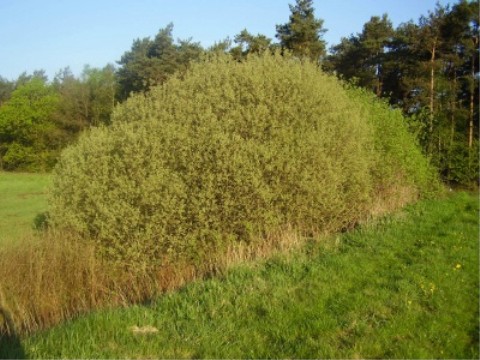
Salix pedicellata grows as a shrub or small tree and reaches approximately 6–8 metres in height. Its trunk can reach 1.4 metres in length.[1][2][3]
Its twigs are initially covered with short hairs but become smooth as they mature. Removing the bark from the twigs reveals prominent longitudinal ridges or lines.[4][5]
Its leaves are approximately oblong and measure 4–16 centimetres in length and 1–5 centimetres in width. The upper surface is green, while the lower surface is greyish with prominent veins.[6][7][8]
Its cylindrical seeds range in colour from black to olive and measure approximately 1.25 millimetres long and 0.5 millimetres wide.[9][10]
Habitat
Salix pedicellata is native to Mediterranean regions extending from Portugal to Lebanon and Syria. Its native southern distribution extends from the Canary Islands to Tunisia.[11][12]
Salix pedicellata subsp. canariensis is native to Madeira and the Canary Islands. Salix pedicellata has been introduced to Ethiopia.[13][14]
Reproduction and life cycle
Salix pedicellata flowers between February and April in its native habitat. Both male and female flowers possess one nectary each.[15][16]
Male catkins are generally densely packed with flowers and measure 2–4 centimetres long. Female catkins are less densely flowered, usually expose the stem, and measure 5–8 centimetres long.[17][18]
Similar species
Salix canariensis is treated by some taxonomists as a subspecies of Salix pedicellata. Salix pedicellata also hybridizes with Salix atrocinerea.[19][20]
Classification of Salix pedicellata
| Kingdom | Plantae |
|---|---|
| Subkingdom | Pteridobiotina |
| Phylum | Tracheophyta |
| Class | Magnoliopsida |
| Order | Malpighiales |
| Family | Salicaceae (Willow Family) |
| Tribe | Saliceae |
| Genus | Salix (Willow) |
| Species | Salix pedicellata Desf. |
Where Salix pedicellata is found
Checklists and occurrence records place Salix pedicellata in 9 countries across Africa and Europe. GBIF holds 2,782 georeferenced records of it.
Countries
Regions and cities with the most records
- Estepona, Spain 316
- Córdoba, Spain 288
- Ubrique, Spain 239
- Nerja, Spain 184
- Torrox, Spain 183
- Almuñécar, Spain 168
- Vélez-Málaga, Spain 163
- Torre del Mar, Spain 153
- Motril, Spain 145
- San Pedro Alcántara, Spain 114
- Marbella, Spain 107
- San Roque, Spain 106
- Ronda, Spain 99
- Coín, Spain 85
- Los Barrios, Spain 84
- La Línea de la Concepción, Spain 70
- Algeciras, Spain 61
- Gibraltar, Gibraltar 54
- Tarifa, Spain 44
- Málaga, Spain 43
- Alhaurín el Grande, Spain 35
- Cártama, Spain 32
- Sicily, Italy 32
- Berja, Spain 31
- Chefchaouen, Morocco 31
- Mijas, Spain 27
- Murcia, Spain 27
- Rincón de la Victoria, Spain 27
- Alhaurín de la Torre, Spain 24
- Alhama de Murcia, Spain 23
- Fuengirola, Spain 22
- Totana, Spain 22
- Benalmádena, Spain 20
- Arroyo de la Miel, Spain 19
- Canary Islands, Spain 19
- Antequera, Spain 17
3 more countries have a few records outside this range
These countries hold a few records of Salix pedicellata but lie outside the range the checklists give for it. Such records are often zoo or garden specimens, museum material or vagrants, so the species is not counted as occurring there.
Range as the checklists state it
S-Spain; Morocco; Algeria; Tunisia
A number beside a place is its count of GBIF occurrence records. A place without a number comes from a checklist alone. Records show where a species has been observed or collected, which can include escapes and vagrants.
Common names
Names in 4 other languages
- Chinese
- 地中海柳
- French
- Saule Pédicellé
- Italian
- Salice Pedicellato
- Turkish
- Pisiklik
Synonyms
10 other scientific names have been used for this species and are now treated as synonyms of Salix pedicellata.
- Salix antiatlantica Maire & Wilczek
- Salix aurita var. pedicellata (Desf.) Fiori
- Salix cinerea var. pedicellata (Desf.) Moris
- Salix nigricans var. pedicellata (Desf.) Bertol.
- Salix pedicellata subsp. antiatlantica (Maire & Wilczek) Maire
- Salix pedicellata subsp. hesperia Maire & Weiller
- Salix pedicellata var. laevipes Maire & Weiller
- Salix pedicellata var. longidentata Maire
- Salix pedicellata var. santamariae Goerz & Sennen
- Salix pedicellata var. villipes Maire & Weiller
Related species
-
 Weeping WillowSalix babylonica
-
 European WillowSalix alba
-
 Goat WillowSalix caprea
-
 Black WillowSalix nigra
-
 Arctic WillowSalix arctica
-
 Common OsierSalix viminalis
-
 Snowbed WillowSalix herbacea
-
 Common SallowSalix cinerea
Compare
Questions and answers
Who first described Salix pedicellata and when?
Salix pedicellata was first described by René Desfontaines in 1799.[21]
How tall does Salix pedicellata grow?
It reaches approximately 6–8 metres in height.[2]
When does Salix pedicellata flower?
It flowers between February and April in its native habitat.[15]
Which species does Salix pedicellata hybridize with?
It hybridizes with Salix atrocinerea.[20]
Sources
Passages the profile rests on
- Salix pedicellata grows as a shrub or small tree. Source passage: “It forms a shrub or small tree up to 6–8 m tall.” — English Wikipedia
- Salix pedicellata reaches approximately 6–8 metres in height. Source passage: “It is a shrub or small tree to about 6–8 m tall” — English Wikipedia
- The trunk of Salix pedicellata can reach 1.4 metres in length. Source passage: “Its trunk may be up to 1.4 m, but is usually shorter.” — English Wikipedia
- Its twigs are initially covered with short hairs but become smooth as they mature. Source passage: “Its twigs are dark brown, initially with short hairs (tomentose), later smooth (glabrous).” — English Wikipedia
- Removing the bark from its twigs reveals prominent longitudinal ridges or lines. Source passage: “If the bark is removed from a twig, prominent longitudinal ridges or lines are visible.” — English Wikipedia
- Its leaves are approximately oblong in shape. Source passage: “The leaves are more-or-less oblong, 4–16 cm long and 1–5 cm wide.” — English Wikipedia
- Its leaves measure 4–16 centimetres in length and 1–5 centimetres in width. Source passage: “The leaves are more-or-less oblong, 4–16 cm long and 1–5 cm wide.” — English Wikipedia
- The upper leaf surface is green, while the lower surface is greyish and has prominent veins. Source passage: “The upper surface of the leaf is green, the lower greyish with prominent veins.” — English Wikipedia
- Its seeds range in colour from black to olive. Source passage: “The seeds are black to olive in colour, cylindrical, about 1.25 mm long and 0.5 mm wide.” — English Wikipedia
- Its cylindrical seeds measure approximately 1.25 millimetres long and 0.5 millimetres wide. Source passage: “The seeds are black to olive in colour, cylindrical, about 1.25 mm long and 0.5 mm wide.” — English Wikipedia
- Salix pedicellata is native to Mediterranean regions extending from Portugal to Lebanon and Syria. Source passage: “native around the Mediterranean Sea from Portugal to Lebanon and Syria in the north” — English Wikipedia
- The species' native southern distribution extends from the Canary Islands to Tunisia. Source passage: “from the Canary Islands to Tunisia in the south.” — English Wikipedia
- Salix pedicellata has been introduced to Ethiopia. Source passage: “It has been introduced to Ethiopia.” — English Wikipedia
- Salix pedicellata subsp. canariensis is native to Madeira and the Canary Islands. Source passage: “Salix pedicellata subsp. canariensis is native to Madeira and the Canary Islands.” — English Wikipedia
- Salix pedicellata flowers between February and April in its native habitat. Source passage: “S. pedicellata flowers in early Spring – February to April in its native habitat.” — English Wikipedia
- Both male and female flowers possess one nectary each. Source passage: “Both male and female flowers have a single nectary.” — English Wikipedia
- Male catkins are generally densely packed with flowers and measure 2–4 centimetres long. Source passage: “The male catkins are usually densely packed with flowers and are 2–4 cm long.” — English Wikipedia
- Female catkins are less densely flowered, usually expose the stem, and measure 5–8 centimetres long. Source passage: “The female catkins are less dense, usually revealing the stem, and slightly longer at 5–8 cm.” — English Wikipedia
- Salix canariensis is treated by some taxonomists as a subspecies of Salix pedicellata. Source passage: “Salix canariensis is treated by some taxonomists as a subspecies of S. pedicellata” — English Wikipedia
- Salix pedicellata hybridizes with Salix atrocinerea. Source passage: “It hybridizes with Salix atrocinerea.” — English Wikipedia
- Salix pedicellata was first described by René Desfontaines in 1799. Source passage: “Salix pedicellata was first described by René Desfontaines in 1799.” — English Wikipedia
Data
- Catalogue of Life, 2026-10-16 XR cc by
- Global Biodiversity Information Facility CC BY 4.0
- Wikidata CC0
- GeoNames CC BY 4.0
- Wikimedia Commons per image; credit shown with each image
- Within the Catalogue of Life, this name comes from Synonymic Checklists of the Vascular Plants of the World cc by
References
- Desf. (1799). Fl. Atlant. 2: 362 (1799). where the name was published
This species in other databases
- Catalogue of Life 79DS2
- Wikidata Q6117352
- iNaturalist 443220
- World Flora Online wfo-0000930350
- GRIN 406597
Page built on 27 November 2026. See how the catalog is made and all sources and licences.
Cite this page
ScientificNames.org. (2026). Salix pedicellata. Retrieved November 27, 2026, from https://scientificnames.org/species/salix-pedicellata
“Salix pedicellata.” ScientificNames.org, 2026, scientificnames.org/species/salix-pedicellata. Accessed 27 Nov. 2026.
ScientificNames.org. “Salix pedicellata.” Accessed November 27, 2026. https://scientificnames.org/species/salix-pedicellata.
@misc{scientificnames_salix_pedicellata,
  author = {{ScientificNames.org}},
  title = {Salix pedicellata},
  year = {2026},
  url = {https://scientificnames.org/species/salix-pedicellata},
  note = {Accessed 2026-11-27}
}