Species · Flowering plants
Net-leaved Willow Salix reticulata
The scientific name of the Net-leaved Willow is Salix reticulata. It is a species of flowering plant in the family Salicaceae (willow family), order Malpighiales.
- Scientific name
- Salix reticulata L.
- Common name
- Net-leaved Willow
- Genus
- Salix
- Family
- Salicaceae (Willow Family)
- Order
- Malpighiales
- Class
- Magnoliopsida
- Recorded in
- 30 countries
- Name status
- accepted in the Catalogue of Life

Overview
The net-leaved willow (Salix reticulata L.) is a dwarf, prostrate, deciduous shrub in the family Salicaceae. It is native to colder regions of Europe, North America and Northern Asia. Its leaves have a conspicuous network of veins, and it produces slender yellow catkins with pink tips in spring.
Written 26 November 2026 from the sources listed below. Each statement was checked against the passage it cites; statements that could not be supported were removed.
Appearance
The net-leaved willow is a dwarf, prostrate, deciduous shrub that forms loose, open mats supported by extensive, highly branched underground stems. Its exposed stems can grow upright to 20 cm high.[1][2][3]
Young twigs are slightly hairy before becoming hairless and dark reddish-brown. The leaves initially have dense hairs but become hairless at least on their upper surfaces.[4][5]
The leaves have a conspicuous network of veins. The species produces slender yellow catkins with pink tips in spring.[6][7]
The shrub grows to approximately 8 cm tall and 30 cm broad. Its leaves measure between 1.2 and 5 cm long and 1 to 3.5 cm wide.[8][9]
Habitat
The net-leaved willow grows on wet rocks and ledges that are often slightly calcareous.[10]
The species is native to colder regions of Europe, North America and Northern Asia. Its European distribution extends south through the Carpathian Mountains and Alps to the Pyrenees and the mountains of Bulgaria and North Macedonia.[11][12]
The species is common in Canada, Greenland and Finland and occurs rarely in Scotland. In the western United States, it occurs as the subspecies Salix reticulata subsp. nivalis.[13][14][15]
Diet
The net-leaved willow is among the plant species consumed by the Porcupine caribou herd during summer.[16]
Uses
The net-leaved willow is cultivated as an ornamental plant for groundcover. It is recommended for rock gardens, troughs and containers.[17][18]
The species has received the Royal Horticultural Society's Award of Garden Merit. The Royal Horticultural Society growing guide describes it as approximately 7.5 cm tall and 30 cm wide.[19][20]
Classification of the Net-leaved Willow
| Kingdom | Plantae |
|---|---|
| Subkingdom | Pteridobiotina |
| Phylum | Tracheophyta |
| Class | Magnoliopsida |
| Order | Malpighiales |
| Family | Salicaceae (Willow Family) |
| Tribe | Saliceae |
| Genus | Salix (Willow) |
| Species | Salix reticulata L. |
Where the Net-leaved Willow is found
Checklists and occurrence records place Salix reticulata in 30 countries across Asia, Europe and North America. GBIF holds 46,283 georeferenced records of it.
Countries
- Albania 2
- Andorra 37
- Austria 2,125
- Bulgaria 21
- Canada 2,872
- Croatia
- Finland 1,065
- France 13,981
- Germany 636
- Hungary 12
- Iceland 3
- Italy 606
- Kazakhstan 12
- Kosovo 1
- Liechtenstein 18
- Mongolia 16
- North Macedonia 12
- Norway 9,237
- Poland 170
- Romania 31
- Russia 2,280
- Serbia
- Slovakia 461
- Slovenia 13
- Spain 554
- Svalbard and Jan Mayen 278
- Sweden 2,910
- Switzerland 5,793
- United Kingdom 1,337
- United States 1,800
Regions and cities with the most records
- Auvergne-Rhône-Alpes, France 6,829
- Provence-Alpes-Côte d'Azur, France 5,691
- Nordland, Norway 1,916
- Valais, Switzerland 1,781
- Norrbotten, Sweden 1,326
- Scotland, United Kingdom 1,196
- Alaska, United States 991
- Troms, Norway 904
- Finnmark, Norway 815
- Jämtland, Sweden 754
- Salzburg, Austria 735
- Monthey, Switzerland 684
- Cluses, France 670
- Sierre, Switzerland 646
- Occitanie, France 645
- Sitten, Switzerland 629
- Tyrol, Austria 625
- Lapland, Finland 609
- Sallanches, France 606
- Yukon, Canada 523
- Martigny-Ville, Switzerland 443
- Møre og Romsdal, Norway 435
- Vaud, Switzerland 434
- Bavaria, Germany 424
- British Columbia, Canada 422
- Bern, Switzerland 410
- Nunavut, Canada 398
- Västerbotten, Sweden 394
- Catalonia, Spain 316
- Ticino, Switzerland 304
- Buskerud, Norway 289
- Montreux, Switzerland 289
- Zakopane, Poland 287
- Murmansk, Russia 267
- Krasnoyarsk Krai, Russia 255
- Quebec, Canada 254
1 more country has a few records outside this range
These countries hold a few records of Salix reticulata but lie outside the range the checklists give for it. Such records are often zoo or garden specimens, museum material or vagrants, so the species is not counted as occurring there.
Range as the checklists state it
Svalbard; England (Scotland); Norway; Sweden; Finland; Germany (Bayern); Switzerland; Liechtenstein; Austria; Poland; Slovakia; Spain; Andorra; France; Italy; Slovenia; ?Croatia; Serbia; Kosovo; North Macedonia; Albania; Romania; Bulgaria; C-European Russia; N-European Russia; W-European Russia; Siberia (Altay, Buryatia, Irkutsk, Krasnoyarsk, Tuva, W-Siberia, Yakutia); Russian Far East (Kamchatka, Magadan); Kazakhstan; Mongolia; Alaska; Canada (Alberta, British Columbia, Labrador, Manitoba, Newfoundland, Nova Scotia, Northern Territories, Nunavut, Ontario, Québec, Saskatchewan, Yukon)
A number beside a place is its count of GBIF occurrence records. A place without a number comes from a checklist alone. Records show where a species has been observed or collected, which can include escapes and vagrants.
Common names
English
- Net-leaved Willow
- Net-veined Willow
- Netleaf Willow
- Reticulated Willow
Names in 21 other languages
- Catalan
- Salze nan
- Chinese
- 網脈柳
- Czech
- vrba síťnatá
- Danish
- Net-Pil
- Dutch
- Netnervige wilg, Netwilg
- Finnish
- verkkolehtipaju
- French
- saule réticulé, saule à réseau
- German
- Netz-Weide, Netzblättrige Weide
- Hungarian
- recéslevelű fűz
- Italian
- Salice reticolato
- Lithuanian
- Tinklalapis karklas
- Northern Sami
- fierbmegironlasta
- Norwegian Bokmål
- rynkevier
- Norwegian Nynorsk
- rukkevier
- Polish
- Wierzba żyłkowana
- Russian
- Ива сетчатая
- Slovak
- vŕba sieťkovaná
- Slovenian
- mrežolistna vrba
- Spanish
- Sauce Enano Reticulado
- Swedish
- nätvide
- Welsh
- Helyg Rhwyllog, Helygen Rwydog, Helygen Rwyllog
Synonyms
28 other scientific names have been used for this species and are now treated as synonyms of Salix reticulata.
- Chamitea reticulata (L.) A.Kern.
- Nectusion reticulata (L.) Raf.
- Oisodix reticulata (L.) Raf.
- Salix aemulans Seemen
- Salix orbicularis Andersson
- Salix reticulata f. grandifolia Andersson
- Salix reticulata f. latifolia Toepff.
- Salix reticulata f. oblongifolia Polunin
- Salix reticulata f. obovata Zapał.
- Salix reticulata f. parvifolia Andersson
- Salix reticulata f. pseudovestita Zapał.
- Salix reticulata f. pubisquamis Zapał.
- Salix reticulata f. subrotunda (Ser.) Bolzon
- Salix reticulata f. tenuis Zapał.
- Salix reticulata f. villosa Kimura ex Tatew. & Kobayasi
- Salix reticulata subsp. glabellicarpa Argus
- Salix reticulata subsp. orbicularis (Andersson) Flod.
- Salix reticulata subsp. reticulata
- Salix reticulata var. cuneata Bornm.
- Salix reticulata var. gigantifolia C.R.Ball
- Salix reticulata var. glabra Trautv.
- Salix reticulata var. orbicularis (Andersson) Kom.
- Salix reticulata var. reticulata
- Salix reticulata var. semicalva Fernald
- Salix reticulata var. sericea Gaudin
- Salix reticulata var. subrotunda Ser.
- Salix reticuloides Andersson
- Salix cyclophylla Gand. ambiguous synonym
Related species
-
 Weeping WillowSalix babylonica
-
 European WillowSalix alba
-
 Goat WillowSalix caprea
-
 Black WillowSalix nigra
-
 Arctic WillowSalix arctica
-
 Common OsierSalix viminalis
-
 Snowbed WillowSalix herbacea
-
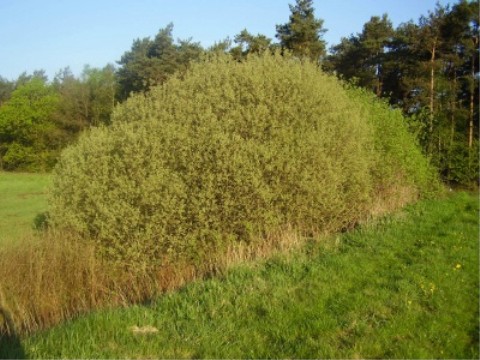 Common SallowSalix cinerea
Compare
Questions and answers
What is the scientific name of the Net-leaved Willow?
The scientific name of the Net-leaved Willow is Salix reticulata. Written with its author, the full name is Salix reticulata L..
Which family does the Net-leaved Willow belong to?
Salix reticulata belongs to the family Salicaceae, in the order Malpighiales and the class Magnoliopsida.
Where is the Net-leaved Willow found?
Checklists and occurrence records place Salix reticulata in 30 countries, including France, Norway, Switzerland, Sweden, Canada and Russia.
What other names does the Net-leaved Willow have?
Salix reticulata is also known in English as Net-veined Willow, Netleaf Willow and Reticulated Willow.
Are there any willows native to North America?
Yes. The net-leaved willow is native to North America.[11]
What is the habitat of a willow tree?
The net-leaved willow grows on wet rocks and ledges that are often slightly calcareous.[10]
Sources
Passages the profile rests on
- Salix reticulata is a dwarf, prostrate, deciduous shrub. Source passage: “Salix reticulata is a dwarf, prostrate, deciduous shrub” — English Wikipedia
- The species forms loose, open mats supported by extensive, highly branched underground stems. Source passage: “forming loose open mats with extensive, much-branched, underground stems.” — English Wikipedia
- Its exposed stems can grow upright to 20 cm high. Source passage: “The exposed stems can rise to 20 cm (7.9 in) high.” — English Wikipedia
- Young twigs are slightly hairy before becoming hairless and dark reddish-brown. Source passage: “The twigs are slightly hairy at first, then hairless and dark reddish-brown later.” — English Wikipedia
- The leaves initially have dense hairs but become hairless at least on their upper surfaces. Source passage: “densely hairy at first, becoming hairless at least on the upper side.” — English Wikipedia
- The leaves have a conspicuous network of veins. Source passage: “The leaves have a conspicuous network of veins.” — English Wikipedia
- The species produces slender yellow catkins with pink tips in spring. Source passage: “In Spring, slender yellow catkins with pink tips appear.” — English Wikipedia
- The shrub grows to approximately 8 cm tall and 30 cm broad. Source passage: “growing to 8 cm (3 in) tall by 30 cm (12 in) broad” — English Wikipedia
- Its leaves measure between 1.2 and 5 cm long and 1 to 3.5 cm wide. Source passage: “Leaves are 1.2 cm to 5 cm long, 1 to 3.5 cm wide” — English Wikipedia
- The species grows on wet rocks and ledges that are often slightly calcareous. Source passage: “The plant grows on wet, often slightly calcareous, rocks and ledges.” — English Wikipedia
- The species is native to colder regions of Europe, North America and Northern Asia. Source passage: “native to the colder parts of Europe, North America, and Northern Asia.” — English Wikipedia
- Its European distribution extends south through the Carpathian Mountains and Alps to the Pyrenees and the mountains of Bulgaria and North Macedonia. Source passage: “In Europe it extends south through the Carpathian Mountains and Alps to the Pyrenees and the mountains of Bulgaria and North Macedonia.” — English Wikipedia
- The species occurs in the western United States as the subspecies Salix reticulata subsp. nivalis. Source passage: “It is found in the western United States (Salix reticulata subsp. nivalis)” — English Wikipedia
- The species is common in Canada, Greenland and Finland. Source passage: “It is common in Canada, Greenland and Finland” — English Wikipedia
- The species occurs rarely in Scotland. Source passage: “present but rare in Scotland.” — English Wikipedia
- Netleaf willow is among the plant species consumed by the Porcupine caribou herd during summer. Source passage: “the most common plant species consumed during the summer were diamond-leaf willow, netleaf willow, dwarf birch, Arctic sweet coltsfoot, and tussock cottongrass” — fws.gov
- The species is cultivated as an ornamental plant for groundcover. Source passage: “Salix reticulata is cultivated as an ornamental plant, for use as groundcover.” — English Wikipedia
- The species is recommended for rock gardens, troughs and containers. Source passage: “For rock gardens , troughs and containers – popular options include the netleaf willow ( Salix reticulata )” — rhs.org.uk
- The species has received the Royal Horticultural Society's Award of Garden Merit. Source passage: “It has gained the Royal Horticultural Society's Award of Garden Merit.” — English Wikipedia
- The Royal Horticultural Society growing guide describes the species as approximately 7.5 cm tall and 30 cm wide. Source passage: “the netleaf willow ( Salix reticulata )at only 7.5cm (3in) tall and 30cm (1ft) wide” — rhs.org.uk
Data
- Catalogue of Life, 2026-10-16 XR cc by
- Global Biodiversity Information Facility CC BY 4.0
- Wikidata CC0
- GeoNames CC BY 4.0
- Wikimedia Commons per image; credit shown with each image
- Within the Catalogue of Life, this name comes from Synonymic Checklists of the Vascular Plants of the World cc by
References
- L. (1753). Sp. Pl. [Linnaeus] 2: 1018 (1753). where the name was published
This species in other databases
Page built on 28 November 2026. See how the catalog is made and all sources and licences.
Cite this page
ScientificNames.org. (2026). Salix reticulata (Net-leaved Willow). Retrieved November 28, 2026, from https://scientificnames.org/species/salix-reticulata
“Salix reticulata (Net-leaved Willow).” ScientificNames.org, 2026, scientificnames.org/species/salix-reticulata. Accessed 28 Nov. 2026.
ScientificNames.org. “Salix reticulata (Net-leaved Willow).” Accessed November 28, 2026. https://scientificnames.org/species/salix-reticulata.
@misc{scientificnames_salix_reticulata_net_leaved_willow,
  author = {{ScientificNames.org}},
  title = {Salix reticulata (Net-leaved Willow)},
  year = {2026},
  url = {https://scientificnames.org/species/salix-reticulata},
  note = {Accessed 2026-11-28}
}