Species · Flowering plants
Richardson’s Willow Salix richardsonii
The scientific name of the Richardson’s Willow is Salix richardsonii. It is a species of flowering plant in the family Salicaceae (willow family), order Malpighiales.
- Scientific name
- Salix richardsonii Hook.
- Common name
- Richardson’s Willow
- Genus
- Salix
- Family
- Salicaceae (Willow Family)
- Order
- Malpighiales
- Class
- Magnoliopsida
- Red List category
- LC Least Concern
- Recorded in
- 2 countries
- Name status
- accepted in the Catalogue of Life

Overview
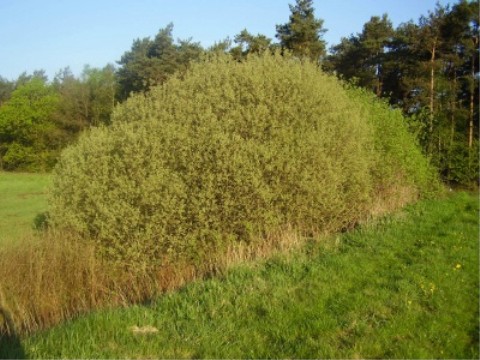
Richardson’s Willow is a branching shrub that forms dense thickets. It grows along streams and in other moist areas of the Arctic, as well as in spruce forests and woodlands. Its young twigs are very hairy, and its catkins emerge before the leaves in spring.
Written 27 November 2026 from the sources listed below. Each statement was checked against the passage it cites; statements that could not be supported were removed.
Appearance
Richardson’s Willow is a branching shrub that forms dense thickets. Its mature stems have smooth, hairless bark, while its young twigs are very hairy.[1][2]
The wood becomes brittle with age. Its catkins emerge before the leaves in spring.[3][4]
The shrub generally grows to approximately 1–2 metres tall. Individual plants have been recorded reaching 6.5 metres in height.[5][6]
Habitat
Richardson’s Willow grows along streams and in other moist areas of the Arctic. It occurs in areas above the timberline.[7][8]
The species also grows in spruce forests and woodlands, on pingos and in open tundra. Floodplains and other periodically flooded habitats support its growth.[9][10][11]
Richardson’s Willow can establish in areas that have recently burned.[12]
Diet
Richardson’s Willow provides food for moose, caribou and beavers. It is identified as an important food source for moose.[13][14]
The species is listed among the plants examined in a study of subarctic ungulate foraging and diet.[15]
Behaviour
Richardson’s Willow readily colonizes disturbed areas and sites where debris has been cleared. It tolerates fire and readily resprouts after much of its aboveground growth has burned.[16][17]
Its thickets provide cover for wildlife. Beavers use its branches to construct dams.[18][19]
Streambank thickets can create overhangs beneath which fish hide.[20]
Reproduction and life cycle
Richardson’s Willow is dioecious, with male and female reproductive structures occurring on separate plants. Bees typically pollinate its flowers.[21][22]
Its seeds remain viable for only a short period. They germinate immediately when they contact a moist substrate.[23][24]
Natural hybrids can form between Richardson’s Willow and other willow species, including Salix barclayi and Salix calcicola. A hybrid between Salix calcicola and Richardson’s Willow has reportedly been found on Southampton Island.[25][26][27][28]
Conservation
Richardson’s Willow helps stabilize eroding streambanks.[29]
Uses
Native Americans used Richardson’s Willow for medicinal purposes. Parts of the plant were also used to make bows and arrows and to construct animal traps.[30][31][32]
The bark was boiled to prepare broth used to treat sore throats and tuberculosis.[33]
Similar species
Some authorities classify Richardson’s Willow as Salix lanata subsp. richardsonii rather than as a separate species.[34]
Salix pulchra and Salix alaxensis are identified as other tall willows in the Arctic Archipelago.[35]
Richardson’s Willow can form natural hybrids with Salix barclayi and Salix calcicola.[25][27][28]
Classification of the Richardson’s Willow
| Kingdom | Plantae |
|---|---|
| Subkingdom | Pteridobiotina |
| Phylum | Tracheophyta |
| Class | Magnoliopsida |
| Order | Malpighiales |
| Family | Salicaceae (Willow Family) |
| Tribe | Saliceae |
| Genus | Salix (Willow) |
| Species | Salix richardsonii Hook. |
Where the Richardson’s Willow is found
Checklists and occurrence records place Salix richardsonii in 2 countries across North America. GBIF holds 1,578 georeferenced records of it.
Countries
Regions and cities with the most records
- Alaska, United States 444
- Nunavut, Canada 240
- Northwest Territories, Canada 196
- Yukon, Canada 154
- British Columbia, Canada 49
- Manitoba, Canada 13
- Whitehorse, Canada 12
1 more country has a few records outside this range
These countries hold a few records of Salix richardsonii but lie outside the range the checklists give for it. Such records are often zoo or garden specimens, museum material or vagrants, so the species is not counted as occurring there.
Range as the checklists state it
Russian Far East (Kamchatka, Magadan); Alaska; Canada (British Columbia, Manitoba, Northern Territories, Nunavut, Yukon)
A number beside a place is its count of GBIF occurrence records. A place without a number comes from a checklist alone. Records show where a species has been observed or collected, which can include escapes and vagrants.
Common names
English
- Richardson’s Willow
Names in 2 other languages
- French
- saule de Richardson
- Russian
- Ива Ричардсона
Synonyms
5 other scientific names have been used for this species and are now treated as synonyms of Salix richardsonii.
- Salix americana f. richardsonii (Hook.) Andersson
- Salix lanata f. richardsonii (Hook.) Andersson
- Salix lanata subsp. richardsonii (Hook.) A.K.Skvortsov
- Salix richardsonii var. mckeandii Polunin
- Salix richardsonii var. richardsonii
Related species
-
 Weeping WillowSalix babylonica
-
 European WillowSalix alba
-
 Goat WillowSalix caprea
-
 Black WillowSalix nigra
-
 Arctic WillowSalix arctica
-
 Common OsierSalix viminalis
-
 Snowbed WillowSalix herbacea
-
 Common SallowSalix cinerea
Compare
Questions and answers
What is the scientific name of the Richardson’s Willow?
The scientific name of the Richardson’s Willow is Salix richardsonii. Written with its author, the full name is Salix richardsonii Hook..
Which family does the Richardson’s Willow belong to?
Salix richardsonii belongs to the family Salicaceae, in the order Malpighiales and the class Magnoliopsida.
Where is the Richardson’s Willow found?
Checklists and occurrence records place Salix richardsonii in 2 countries: Canada and United States.
What is the conservation status of the Richardson’s Willow?
The IUCN Red List category recorded for Salix richardsonii is Least Concern (LC).
Sources
Passages the profile rests on
- Salix richardsonii is a branching shrub that forms dense thickets. Source passage: “This willow is a branching shrub which forms dense thickets” — English Wikipedia
- The mature stems have smooth, hairless bark, whereas young twigs are very hairy. Source passage: “The stems of this species have smooth, hairless bark, but the young twigs are very hairy.” — English Wikipedia
- The wood of this willow becomes brittle with age. Source passage: “The wood becomes brittle as it ages.” — English Wikipedia
- Its inflorescences are catkins that emerge before the leaves in spring. Source passage: “The inflorescence is a catkin. The catkins appear before the leaves in the spring.” — English Wikipedia
- The shrub generally grows to approximately 1–2 metres tall. Source passage: “grow to about 1 to 2 m (3.3 to 6.6 ft) tall” — English Wikipedia
- Individual plants have been recorded reaching 6.5 metres in height. Source passage: “but is known to reach 6.5 m (21 ft) .” — English Wikipedia
- This species grows along streams and in other moist areas of the Arctic. Source passage: “This common willow can be found growing along streams and in other moist areas in the Arctic” — English Wikipedia
- It occurs in areas above the timberline. Source passage: “and above the timberline.” — English Wikipedia
- The species also grows in spruce forests and woodlands. Source passage: “It also grows in spruce forests and woodlands” — English Wikipedia
- Floodplains and other periodically flooded habitats support this willow. Source passage: “It grows on floodplains and other habitats that flood periodically.” — English Wikipedia
- The species also grows on pingos and open tundra. Source passage: “It grows on pingos and the open tundra.” — English Wikipedia
- It can establish in areas that have recently burned. Source passage: “and areas that have recently burned.” — English Wikipedia
- Richardson's willow provides food for moose, caribou and beavers. Source passage: “This plant provides food for many animals, such as moose, caribou, and beavers.” — English Wikipedia
- Richardson's willow is identified as an important food source for moose. Source passage: “Richardson's willow is an important food source for moose, ...” — fs.usda.gov
- Richardson's willow is listed as a plant species in a study examining subarctic ungulate foraging and diet. Source passage: “Salix richardsonii, Species, Richardson's willow, woolly willow, 9, 9, 0.2 ...” — pmc.ncbi.nlm.nih.gov
- The species readily colonizes disturbed areas and sites where debris has been cleared. Source passage: “it can easily colonize disturbed areas and bare sites where debris has been cleared.” — English Wikipedia
- It tolerates fire and readily resprouts after much of its aboveground growth has burned. Source passage: “It is fire-tolerant, resprouting easily after much of its aboveground mass has been burned.” — English Wikipedia
- Its thickets provide cover for wildlife. Source passage: “The thickets provide cover” — English Wikipedia
- Beavers use its branches to construct dams. Source passage: “beavers use the branches to build their dams.” — English Wikipedia
- Streambank thickets can create overhangs beneath which fish hide. Source passage: “Thickets of the plant on streambanks allow the water to undercut the bank, providing overhangs for fish to hide under.” — English Wikipedia
- Salix richardsonii is dioecious, with male and female reproductive structures occurring on separate plants. Source passage: “This species is dioecious, with male and female reproductive structures on separate individuals.” — English Wikipedia
- Bees typically pollinate the flowers of this species. Source passage: “The flowers of S. richardsonii are typically pollinated by bees.” — English Wikipedia
- Its seeds remain viable for only a short period. Source passage: “The seeds are viable for only a short period of time” — English Wikipedia
- The seeds germinate immediately when they contact a moist substrate. Source passage: “germinate immediately upon contact with the moist substrate.” — English Wikipedia
- Natural hybrids can form between Richardson's willow and other willow species. Source passage: “Natural hybrids can be formed with other willows” — English Wikipedia
- A hybrid between Salix calcicola and Richardson's willow has reportedly been found on Southampton Island. Source passage: “with the hybrid Salix calcicola × S. richardsonii reportedly found on Southampton Island.” — English Wikipedia
- Salix barclayi is one of the willow species with which Richardson's willow can form natural hybrids. Source passage: “Natural hybrids can be formed with other willows, such as S. barclayi and S. calcicola” — English Wikipedia
- Salix calcicola is another willow species capable of forming natural hybrids with Richardson's willow. Source passage: “Natural hybrids can be formed with other willows, such as S. barclayi and S. calcicola” — English Wikipedia
- Richardson's willow helps stabilize eroding streambanks. Source passage: “This species stabilizes eroding streambanks” — English Wikipedia
- Native Americans used this willow for medicinal purposes. Source passage: “Native Americans used parts of willows, including this species, for medicinal purposes” — English Wikipedia
- Parts of this willow were used to make bows and arrows. Source passage: “to make weapons such as bows and arrows” — English Wikipedia
- Native Americans used parts of this willow to construct animal traps. Source passage: “and for building animal traps.” — English Wikipedia
- The bark was boiled to prepare broth used to treat sore throats and tuberculosis. Source passage: “The bark was boiled to make broth, which was used to treat sore throats and tuberculosis” — English Wikipedia
- Some authorities classify Richardson's willow as Salix lanata subsp. richardsonii rather than as a separate species. Source passage: “Some authorities consider it to be a subspecies, Salix lanata subsp. richardsonii (Hook.) A. K. Skvortsov rather than a species itself.” — English Wikipedia
- Salix pulchra and Salix alaxensis are identified as other tall willows in the Arctic Archipelago. Source passage: “Along with S. pulchra and S. alaxensis, it is the tallest willow in the Arctic Archipelago.” — English Wikipedia
- The species is native to Russia and northern North America. Source passage: “It is native to Russia and northern North America” — English Wikipedia
- Its North American range includes Alaska and northern Canada. Source passage: “where it occurs in Alaska and northern Canada.” — English Wikipedia
- Richardson's willow occurs in the Arctic Archipelago. Source passage: “Along with S. pulchra and S. alaxensis, it is the tallest willow in the Arctic Archipelago.” — English Wikipedia
Data
- Catalogue of Life, 2026-10-16 XR cc by
- Global Biodiversity Information Facility CC BY 4.0
- Wikidata CC0
- GeoNames CC BY 4.0
- Wikimedia Commons per image; credit shown with each image
- Within the Catalogue of Life, this name comes from Synonymic Checklists of the Vascular Plants of the World cc by
References
- Hook. (1838). Fl. Bor.-Amer. [Hooker] 2: 147, t. 182 (1838). where the name was published
This species in other databases
Page built on 28 November 2026. See how the catalog is made and all sources and licences.
Cite this page
ScientificNames.org. (2026). Salix richardsonii (Richardson’s Willow). Retrieved November 28, 2026, from https://scientificnames.org/species/salix-richardsonii
“Salix richardsonii (Richardson’s Willow).” ScientificNames.org, 2026, scientificnames.org/species/salix-richardsonii. Accessed 28 Nov. 2026.
ScientificNames.org. “Salix richardsonii (Richardson’s Willow).” Accessed November 28, 2026. https://scientificnames.org/species/salix-richardsonii.
@misc{scientificnames_salix_richardsonii_richardsons_willow,
  author = {{ScientificNames.org}},
  title = {Salix richardsonii (Richardson’s Willow)},
  year = {2026},
  url = {https://scientificnames.org/species/salix-richardsonii},
  note = {Accessed 2026-11-28}
}