Species · Flowering plants
Indian Willow Salix tetrasperma
The scientific name of the Indian Willow is Salix tetrasperma. It is a species of flowering plant in the family Salicaceae (willow family), order Malpighiales.
- Scientific name
- Salix tetrasperma Roxb.
- Common name
- Indian Willow
- Genus
- Salix
- Family
- Salicaceae (Willow Family)
- Order
- Malpighiales
- Class
- Magnoliopsida
- Red List category
- LC Least Concern
- Recorded in
- 17 countries
- Name status
- accepted in the Catalogue of Life

Overview
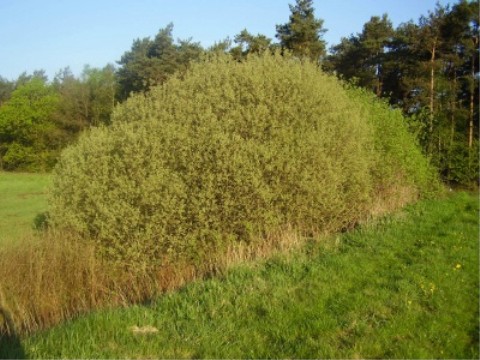
Indian willow (Salix tetrasperma Roxb.) is a medium-sized flowering tree in the family Salicaceae. It grows in wet and swampy places and occurs in India, Pakistan, Bangladesh, Nepal, Laos, and Thailand. It has silky young shoots and leaves, and produces sweet-scented male catkins on leafy branchlets.
Written 26 November 2026 from the sources listed below. Each statement was checked against the passage it cites; statements that could not be supported were removed.
Appearance
Indian willow is a medium-sized tree with rough bark marked by deep vertical fissures. Its young shoots and leaves are silky.[1][2][3]
The leaves are 8–15 cm long and lance-like or ovate-lance-like, with minutely and regularly toothed margins.[4][5]
The male catkins are 5–10 cm long, sweet-scented, and grow on leafy branchlets. The female catkins are 8–12 cm long.[6][7][8]
Habitat
Indian willow grows in wet and swampy places.[9]
Diet
The newly produced flowers of Indian willow are eaten in Manipur, northeastern India, where they are considered delicious.[10][11]
Behaviour
Indian willow sheds its leaves at the end of the monsoon season.[12]
Reproduction and life cycle
Indian willow flowers after producing leaves. Its capsules occur in groups of three to four.[13][14]
Uses
The newly produced flowers are eaten in Manipur, northeastern India, and are considered delicious there.[10][11]
An aqueous extract of Indian willow bark exhibits diuretic and laxative effects in a dose-dependent manner.[15][16]
Classification of the Indian Willow
| Kingdom | Plantae |
|---|---|
| Subkingdom | Pteridobiotina |
| Phylum | Tracheophyta |
| Class | Magnoliopsida |
| Order | Malpighiales |
| Family | Salicaceae (Willow Family) |
| Tribe | Saliceae |
| Genus | Salix (Willow) |
| Species | Salix tetrasperma Roxb. |
Where the Indian Willow is found
Checklists and occurrence records place Salix tetrasperma in 17 countries across Africa and Asia. GBIF holds 1,086 georeferenced records of it.
Countries
- Bangladesh 4
- Bhutan 6
- Cambodia 2
- China 449
- Egypt 23
- India 276
- Indonesia 94
- Laos 7
- Malaysia 11
- Myanmar 24
- Nepal 15
- Pakistan 23
- Palestinian Territory 3
- Philippines 25
- Saudi Arabia
- Thailand 112
- Vietnam 12
Regions and cities with the most records
- Yunnan, China 287
- Maharashtra, India 54
- Khadki, India 50
- Kharakvasla, India 50
- Pune, India 50
- Pimpri, India 49
- Pimpri-Chinchwad, India 49
- Alandi, India 48
- Dehu Road, India 46
- Mengla, China 41
- Yunjinghong, China 34
- Chiang Mai, Thailand 28
- Mangshi, China 25
- Longling County, China 24
- Menghuan, China 24
- Longshan, China 22
- Puchuan, China 22
- Tuantian, China 22
- Vagholi, India 22
- Sichuan, China 21
- Chiang Mai, Thailand 16
- Hang Dong, Thailand 15
- Dali, China 13
- Dali Old Town, China 13
- Fengyi, China 13
- Haidong Zhen, China 13
- Yongjian, China 13
- Guangxi, China 12
- Pu'er, China 12
- Tamil Nadu, India 12
- Lincang, China 11
- Khyber Pakhtunkhwa, Pakistan 10
- Mengzi, China 10
- Huangshan, China 9
- Lijiang, China 9
- Rajasthan, India 9
Range as the checklists state it
S-Egypt; Saudi Arabia (Hejaz, C-Saudi Arabia, Nejd Desert); China (Guangdong, Hainan, Yunnan); Tibet; Pakistan (Baluchistan, Quetta, Kurram, Gilgit, Punjab, Lahore); Nepal; N-India (Arunachal Pradesh, Assam, Bihar, Chhattisgarh, Himachal Pradesh, Karnataka, Kerala, Madhya Pradesh, Maharashtra, Manipur, Meghalaya, Mizoram, Nagaland, Orissa, Punjab, Rajasthan, Tamil Nadu, Uttarakhand, Uttar Pradesh, West Bengal); Bangladesh; Andaman Isl.; Myanmar (Bago, Kachin, Mandalay, Sagaing); Thailand; Laos; Cambodia; Vietnam; peninsular Malaysia (Perak, Pahang, Selangor); Sumatera; Borneo; Philippines (Luzon, Bohol, Mindanao); Jawa; Lesser Sunda Isl. (Lombok, Sumbawa, Sumba, Flores)
A number beside a place is its count of GBIF occurrence records. A place without a number comes from a checklist alone. Records show where a species has been observed or collected, which can include escapes and vagrants.
Common names
English
- Indian Willow
Names in 5 other languages
- Chinese
- 四子柳, 四子柳(四籽柳), 四籽柳, 紫柳
- Japanese
- テンジクヤナギ
- Marathi
- वाळुंज
- Thai
- สนุ่น
- jav
- Leri
Synonyms
32 other scientific names have been used for this species and are now treated as synonyms of Salix tetrasperma.
- Pleiarina boseensis (N.Chao) N.Chao & G.T.Gong
- Pleiarina populifolia N.Chao & J.Liu
- Pleiarina tetrasperma (Roxb.) N.Chao & G.T.Gong
- Ripsoctis indica Raf.
- Salix apiculata Andersson
- Salix araeostachya C.K.Schneid.
- Salix azaolana Blanco
- Salix boseensis N.Chao
- Salix calophylla Wall. ex Andersson
- Salix cuspidata D.Don
- Salix densa Wall.
- Salix densa Wall. ex Andersson
- Salix horsfieldiana Miq.
- Salix hugelii Wimm. ex Andersson
- Salix indica Roth
- Salix javanica Andersson
- Salix junghuhniana Andersson ex Miq.
- Salix myurus Wimm. ex Andersson
- Salix nilagirica Miq.
- Salix nobilis Fr.
- Salix suaveolens Andersson
- Salix sumatrana Miq.
- Salix tetrasperma var. harmandii Dode
- Salix tetrasperma var. nilagirica (Miq.) Andersson
- Salix tetrasperma var. suaveolens (Andersson) Andersson
- Salix tetrasperma var. urophylla (Lindl. ex Andersson) Andersson
- Salix urophylla Lindl.
- Salix urophylla Lindl. ex Andersson
- Salix wallichii Wimm. ex Andersson
- Salix zollingeri Miq.
- Salix zollingeriana Miq.
- Salix populifolia Andersson ambiguous synonym
Subspecies and varieties
- Salix tetrasperma var. ichnostachya variety
- Salix tetrasperma var. pyrina variety
Related species
-
 Weeping WillowSalix babylonica
-
 European WillowSalix alba
-
 Goat WillowSalix caprea
-
 Black WillowSalix nigra
-
 Arctic WillowSalix arctica
-
 Common OsierSalix viminalis
-
 Snowbed WillowSalix herbacea
-
 Common SallowSalix cinerea
Compare
Questions and answers
What is the scientific name of the Indian Willow?
The scientific name of the Indian Willow is Salix tetrasperma. Written with its author, the full name is Salix tetrasperma Roxb..
Which family does the Indian Willow belong to?
Salix tetrasperma belongs to the family Salicaceae, in the order Malpighiales and the class Magnoliopsida.
Where is the Indian Willow found?
Checklists and occurrence records place Salix tetrasperma in 17 countries, including China, India, Thailand, Indonesia, Philippines and Myanmar.
What is the conservation status of the Indian Willow?
The IUCN Red List category recorded for Salix tetrasperma is Least Concern (LC).
What habitat do willow trees live in?
Indian willow grows in wet and swampy places.[9]
What family does Salix tetrasperma belong to?
Indian willow belongs to the family Salicaceae.[17]
Sources
Passages the profile rests on
- Salix tetrasperma is a medium-sized tree. Source passage: “Salix tetrasperma, commonly called Indian willow, is a medium-sized tree” — English Wikipedia
- The bark of Salix tetrasperma is rough and has deep vertical fissures. Source passage: “The bark is rough, with deep, vertical fissures” — English Wikipedia
- The young shoots and leaves of Salix tetrasperma are silky. Source passage: “the young shoots leaves are silky.” — English Wikipedia
- The leaves of Salix tetrasperma measure 8–15 cm in length. Source passage: “The leaves are lance-like, or ovate-lancelike, 8–15 cm long” — English Wikipedia
- The leaves of Salix tetrasperma are lance-like or ovate-lance-like, with minutely and regularly toothed margins. Source passage: “The leaves are lance-like, or ovate-lancelike, 8–15 cm long, with minutely and regularly toothed margins.” — English Wikipedia
- The male catkins of Salix tetrasperma measure 5–10 cm in length. Source passage: “The male sweet scented catkins are 5–10 cm long” — English Wikipedia
- The male catkins of Salix tetrasperma are sweet-scented and grow on leafy branchlets. Source passage: “The male sweet scented catkins are 5–10 cm long, and are borne on leafy branchlets.” — English Wikipedia
- The female catkins of Salix tetrasperma measure 8–12 cm in length. Source passage: “The female catkins are 8–12 cm long.” — English Wikipedia
- Salix tetrasperma grows in wet and swampy places. Source passage: “a medium-sized tree of wet and swampy places” — English Wikipedia
- The newly produced flowers of Salix tetrasperma are eaten in Manipur, northeastern India. Source passage: “In Manipur, in NE India, the new flowers of Indian willow, locally known as ঊযুম (ooyum) are eaten” — English Wikipedia
- The newly produced flowers of Salix tetrasperma are considered delicious in Manipur, northeastern India. Source passage: “are eaten, and are considered delicious.” — English Wikipedia
- Salix tetrasperma sheds its leaves at the end of the monsoon season. Source passage: “shedding its leaves at the end of monsoon season.” — English Wikipedia
- Salix tetrasperma flowers after producing leaves. Source passage: “It flowers after leafing.” — English Wikipedia
- The capsules of Salix tetrasperma occur in groups of three to four. Source passage: “The capsules are long, stipulate, in groups of 3 to 4.” — English Wikipedia
- An aqueous extract of Salix tetrasperma bark exhibits diuretic effects in a dose-dependent manner. Source passage: “Aqueous extract of Salix tetrasperma shows significant diuretic and laxative effects in a dose-dependent manner.” — academia.edu
- An aqueous extract of Salix tetrasperma bark exhibits laxative effects in a dose-dependent manner. Source passage: “Aqueous extract of Salix tetrasperma shows significant diuretic and laxative effects in a dose-dependent manner.” — academia.edu
- Salix tetrasperma Roxb. is listed as an accepted species. Source passage: “Species Accepted Salix tetrasperma Roxb.” — gbif.org
Data
- Catalogue of Life, 2026-10-16 XR cc by
- Global Biodiversity Information Facility CC BY 4.0
- Wikidata CC0
- GeoNames CC BY 4.0
- Wikimedia Commons per image; credit shown with each image
- Within the Catalogue of Life, this name comes from Synonymic Checklists of the Vascular Plants of the World cc by
References
- Roxb. (1795). Pl. Coromandel 1: 66, t. 97 (1795). where the name was published
This species in other databases
- Catalogue of Life 6XDK5
- Wikidata Q3595468
- iNaturalist 426588
- World Flora Online wfo-0001133625
- GRIN 32775
Page built on 27 November 2026. See how the catalog is made and all sources and licences.
Cite this page
ScientificNames.org. (2026). Salix tetrasperma (Indian Willow). Retrieved November 27, 2026, from https://scientificnames.org/species/salix-tetrasperma
“Salix tetrasperma (Indian Willow).” ScientificNames.org, 2026, scientificnames.org/species/salix-tetrasperma. Accessed 27 Nov. 2026.
ScientificNames.org. “Salix tetrasperma (Indian Willow).” Accessed November 27, 2026. https://scientificnames.org/species/salix-tetrasperma.
@misc{scientificnames_salix_tetrasperma_indian_willow,
  author = {{ScientificNames.org}},
  title = {Salix tetrasperma (Indian Willow)},
  year = {2026},
  url = {https://scientificnames.org/species/salix-tetrasperma},
  note = {Accessed 2026-11-27}
}