Species · Flowering plants
Chinese Elder Sambucus javanica
The scientific name of the Chinese Elder is Sambucus javanica. It is a species of flowering plant in the family Viburnaceae (elder family), order Dipsacales.
- Scientific name
- Sambucus javanica Reinw. ex Blume
- Common name
- Chinese Elder
- Genus
- Sambucus
- Family
- Viburnaceae (Elder Family)
- Order
- Dipsacales
- Class
- Magnoliopsida
- Red List category
- LC Least Concern
- Recorded in
- 18 countries
- Name status
- accepted in the Catalogue of Life

Overview
The species is native to subtropical and tropical Asia, including Bhutan, Burma, Cambodia, China except the northern region, India, Indonesia, Taiwan, Japan, Laos, Malaysia (Sabah), the Philippines, southern Thailand, and Vietnam. The plant is used in traditional medicinal practices, including as an analgesic and a bowel and bladder stimulant.
Written 26 November 2026 from the sources listed below. Each statement was checked against the passage it cites; statements that could not be supported were removed.
Appearance
Chinese elder grows as a perennial herb or a small shrub. It reaches a height of 1–2 metres.[1][2]
Habitat
Chinese elder is native to subtropical and tropical Asia. Its native range includes Bhutan, Burma, Cambodia, China except the northern region, India, Indonesia, Taiwan, Japan, Laos, Malaysia (Sabah), the Philippines, southern Thailand, and Vietnam.[3][4]
Uses
Parts of Chinese elder are used as analgesics and bowel and bladder stimulants. The plant is believed to help address numbness, rheumatism, spasms, swelling, and trauma.[5][6][7]
The plant is believed to support general bone and circulatory health.[8]
Classification of the Chinese Elder
| Kingdom | Plantae |
|---|---|
| Subkingdom | Pteridobiotina |
| Phylum | Tracheophyta |
| Class | Magnoliopsida |
| Order | Dipsacales |
| Family | Viburnaceae (Elder Family) |
| Subfamily | Adoxoideae |
| Tribe | Sambuceae |
| Genus | Sambucus (Elder) |
| Species | Sambucus javanica Reinw. ex Blume |
Where the Chinese Elder is found
Checklists and occurrence records place Sambucus javanica in 18 countries across Asia and Oceania. GBIF holds 9,296 georeferenced records of it.
Countries where it is native or its origin is not stated
- Bangladesh
- Bhutan 6
- Cambodia 4
- China 3,620
- Hong Kong 31
- India 48
- Indonesia 204
- Japan 977
- Laos 23
- Malaysia 30
- Myanmar 19
- Nepal 19
- Philippines 270
- Sri Lanka 5
- Taiwan 3,879
- Thailand 108
- Vietnam 49
Countries where it has been introduced
Regions and cities with the most records
- Taiwan, Taiwan 2,269
- Neihu, Taiwan 842
- Taipei, Taiwan 840
- New Taipei City, Taiwan 815
- Banqiao, Taiwan 807
- Xizhi, Taiwan 751
- Chongqing, China 556
- Danshui, Taiwan 554
- Shulin, Taiwan 519
- Sanzhi, Taiwan 470
- Taipei, Taiwan 422
- Sanxia, Taiwan 363
- Zhushan, Taiwan 351
- Sichuan, China 335
- Zhudong, Taiwan 321
- Yingge, Taiwan 320
- Linnei, Taiwan 319
- Keelung, Taiwan 305
- Hubei, China 293
- Yunnan, China 290
- Douliu, Taiwan 266
- Gecheng, China 266
- Lugu, Taiwan 250
- Miaoli, Taiwan 250
- Guangxi, China 219
- Jiangxi, China 204
- Toufen, Taiwan 196
- Chiayi City, Taiwan 192
- Bade, Taiwan 190
- Taoyuan, Taiwan 181
- Daxi, Taiwan 171
- Neili, Taiwan 166
- Hsinchu, Taiwan 153
- Zhubei, Taiwan 152
- Guizhou, China 151
- Zhejiang, China 140
4 more countries have a few records outside this range
These countries hold a few records of Sambucus javanica but lie outside the range the checklists give for it. Such records are often zoo or garden specimens, museum material or vagrants, so the species is not counted as occurring there.
A number beside a place is its count of GBIF occurrence records. A place without a number comes from a checklist alone. Records show where a species has been observed or collected, which can include escapes and vagrants.
Common names
English
- Chinese Elder
- Sweet Elder
Names in 3 other languages
- Chinese
- jie gu cao, 七葉蓮, 冇骨消, 台灣蒴藋, 接骨草 走馬箭, 蒴藋, 陸英
- Japanese
- ソクズ
- jav
- Sangitan
Synonyms
2 other scientific names have been used for this species and are now treated as synonyms of Sambucus javanica.
- Sambucus chinensis var. chinensis
- Sambucus formosana var. arborescens Kaneh. & Sasaki
Subspecies and varieties
- Sambucus javanica subsp. chinensis subspecies
- Sambucus javanica subsp. javanica subspecies
Related species
-
 ElderSambucus nigra
-
 American ElderberrySambucus canadensis
-
 Red ElderberrySambucus racemosa
-
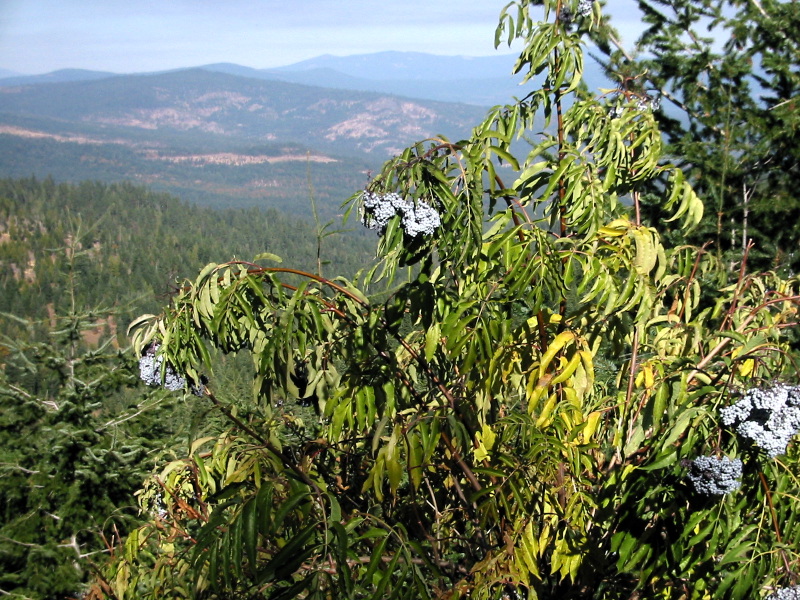 Blue ElderberrySambucus cerulea
-
 Dwarf ElderSambucus ebulus
-
 Blue ElderberrySambucus mexicana
-
 Native ElderSambucus australasica
-
 White ElderberrySambucus gaudichaudiana
Compare
Questions and answers
What is the scientific name of the Chinese Elder?
The scientific name of the Chinese Elder is Sambucus javanica. Written with its author, the full name is Sambucus javanica Reinw. ex Blume.
Which family does the Chinese Elder belong to?
Sambucus javanica belongs to the family Viburnaceae, in the order Dipsacales and the class Magnoliopsida.
Where is the Chinese Elder found?
Checklists and occurrence records place Sambucus javanica in 18 countries, including Taiwan, China, Japan, Philippines, Indonesia and Thailand.
What is the conservation status of the Chinese Elder?
The IUCN Red List category recorded for Sambucus javanica is Least Concern (LC).
What other names does the Chinese Elder have?
Sambucus javanica is also known in English as Sweet Elder.
Sources
Passages the profile rests on
- The species grows as a perennial herb or a small shrub. Source passage: “It is a perennial herb or a small shrub 1–2 m (3 ft 3 in – 6 ft 7 in) tall.” — English Wikipedia
- The plant reaches a height of 1–2 metres. Source passage: “1–2 m (3 ft 3 in – 6 ft 7 in) tall.” — English Wikipedia
- The species is native to subtropical and tropical Asia. Source passage: “native to subtropical and tropical Asia.” — English Wikipedia
- Its native range includes Bhutan, Burma, Cambodia, China except the northern region, India, Indonesia, Taiwan, Japan, Laos, Malaysia (Sabah), the Philippines, southern Thailand, and Vietnam. Source passage: “It is native to Bhutan, Burma, Cambodia, China (except in the north), India, Indonesia, Taiwan, Japan, Laos, Malaysia (in Sabah), the Philippines, southern Thailand, and Vietnam.” — English Wikipedia
- Parts of the plant are used as analgesics. Source passage: “Parts of the plant are used as analgesics” — English Wikipedia
- Parts of the plant are used as bowel and bladder stimulants. Source passage: “bowel and bladder stimulants” — English Wikipedia
- The plant is believed to help address numbness, rheumatism, spasms, swelling, and trauma. Source passage: “It is also believed to be an aid against numbness, rheumatism, spasms, swelling, and trauma” — English Wikipedia
- The plant is believed to support general bone and circulatory health. Source passage: “as well as for general bone and circulatory health.” — English Wikipedia
Data
- Catalogue of Life, 2026-10-16 XR cc by
- Global Biodiversity Information Facility CC BY 4.0
- Wikidata CC0
- GeoNames CC BY 4.0
- Wikimedia Commons per image; credit shown with each image
- Within the Catalogue of Life, this name comes from Synonymic Checklists of the Vascular Plants of the World cc by
References
- Reinw. ex Blume. where the name was published
This species in other databases
- Catalogue of Life 79HYP
- Wikidata Q4117827
- iNaturalist 474166
- World Flora Online wfo-0001241267
- GRIN 32990
Page built on 29 November 2026. See how the catalog is made and all sources and licences.
Cite this page
ScientificNames.org. (2026). Sambucus javanica (Chinese Elder). Retrieved November 29, 2026, from https://scientificnames.org/species/sambucus-javanica
“Sambucus javanica (Chinese Elder).” ScientificNames.org, 2026, scientificnames.org/species/sambucus-javanica. Accessed 29 Nov. 2026.
ScientificNames.org. “Sambucus javanica (Chinese Elder).” Accessed November 29, 2026. https://scientificnames.org/species/sambucus-javanica.
@misc{scientificnames_sambucus_javanica_chinese_elder,
  author = {{ScientificNames.org}},
  title = {Sambucus javanica (Chinese Elder)},
  year = {2026},
  url = {https://scientificnames.org/species/sambucus-javanica},
  note = {Accessed 2026-11-29}
}