Species · Mammals
Golden-bellied Capuchin Sapajus xanthosternos
The scientific name of the Golden-bellied Capuchin is Sapajus xanthosternos. It is a species of mammal in the family Cebidae (new world monkeys), order Primates. The name dates from 1826.

Overview
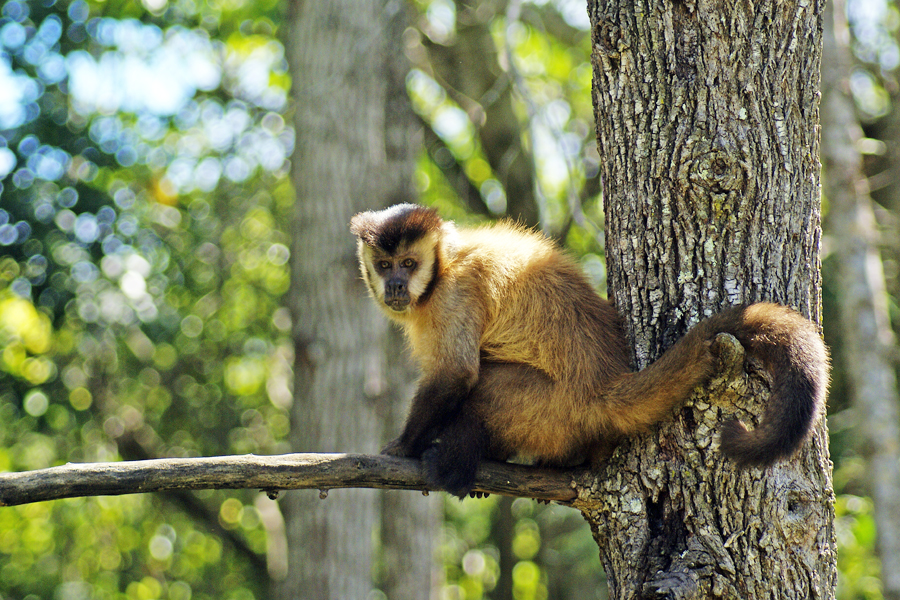
Sapajus xanthosternos is restricted to the Atlantic forest of southeastern Bahia, Brazil. It has a yellow to golden-red chest, belly, and upper arms, a light brown face, and darkly coloured limbs and tail.
Written 26 November 2026 from the sources listed below. Each statement was checked against the passage it cites; statements that could not be supported were removed.
Appearance
The Golden-bellied Capuchin has a yellow to golden-red chest, belly, and upper arms. Its face is light brown, and its cap can be dark brown, black, or light brown.[1][2][3]
Its limbs and tail are darkly coloured. Its facial tufts are inconspicuous and point toward the rear of the skull, while a band of short, speckled hair surrounds the upper part of its face.[4][5][6]
Adult males stand approximately 40 cm tall and weigh an average of approximately 4 kg. Adult females stand approximately 37 cm tall and weigh approximately 2.5 kg.[7][8][9][10]
Its prehensile tail is approximately as long as its body.[11]
Habitat
The Golden-bellied Capuchin inhabits the Atlantic forest of Brazil and uses agroforests known as cabrucas as habitat.[12][13]
It uses forest areas with greater cover and predator protection, even when food availability is lower. It also occupies secondary forests, where individuals remain lower in the canopy and closer together.[14][15]
Its remaining Atlantic forest habitat is highly fragmented, with most forest fragments smaller than 50 hectares. Forest fragments larger than approximately 400–700 hectares are considered ideal for sustaining populations, depending on local conditions.[16][17]
Diet
The Golden-bellied Capuchin is omnivorous and consumes both plant and animal foods. Its plant diet includes fruits, seeds, flowers, nuts, leaves, stems, and nectar.[18][19]
Its animal diet includes insects, bird eggs, frogs, small reptiles, birds, bats, and other small mammals. Individuals living near marine areas also consume oysters, crabs, and other shellfish.[20][21]
The species hunts and eats small lizards. It uses stones as hammers and anvil surfaces to crack hard-shelled fruits and nuts.[22][23]
Behaviour
The Golden-bellied Capuchin is arboreal and lives mainly in trees. Individuals live in groups of approximately 3–30 members.[24][25]
Group members have a social hierarchy that includes an alpha male and an alpha female. The alpha male defends the group's territory against approaching groups.[26][27]
Group members groom one another as a form of social interaction. The species marks territory by covering its body with its own urine.[28][29]
Individuals communicate using short, frequent yipping whines. When threatened, they produce a two-toned clunking sound.[30][31]
The species uses chemical signals to communicate territorial boundaries and during mating rituals. Individuals alert other group members to predators using alarm calls.[32][33]
Larger groups have a lower likelihood of becoming prey because more individuals can remain vigilant. The species uses stones as tools in areas with harsher and longer dry seasons.[34][35]
Reproduction and life cycle
The Golden-bellied Capuchin can mate throughout the year and has a polygynandrous mating system. Females give birth approximately once every two years.[36][37][38]
The gestation period lasts approximately 150–180 days. Females typically give birth to one infant.[39][40]
Females reach sexual maturity at approximately four to five years of age. Males reach maturity and fertility at approximately six to eight years of age.[41][42]
Newborns depend entirely on their mothers during their first year.[43]
Conservation
The Golden-bellied Capuchin is classified as critically endangered by the International Union for Conservation of Nature. Its population has declined by more than 50% over the preceding 50 years.[44][45]
Deforestation for agriculture and logging threatens its rainforest habitat. Hunting is a major threat to the long-term survival of populations in forest fragments.[46][47]
Individuals are captured for sale in the illegal pet trade. The Brazilian National Action Plan for the Conservation of the Northeastern Primates includes efforts to protect this species.[48][49]
The Una Biological Reserve in Bahia contains an estimated population of 185 individuals.[50]
Uses
As of 2004, 85 individuals were held in zoos and breeding facilities in Europe and Brazil.[51]
Classification of the Golden-bellied Capuchin
| Kingdom | Animalia |
|---|---|
| Phylum | Chordata |
| Subphylum | Vertebrata |
| Infraphylum | Gnathostomata |
| Parvphylum | Osteichthyes |
| Megaclass | Tetrapoda |
| Class | Mammalia (Mammal) |
| Subclass | Theria |
| Infraclass | Eutheria |
| Order | Primates (Primate) |
| Suborder | Haplorrhini |
| Infraorder | Simiiformes |
| Family | Cebidae (New World Monkeys) |
| Subfamily | Cebinae (Capuchin Monkeys) |
| Genus | Sapajus (Robust Capuchin Monkey) |
| Species | Sapajus xanthosternos (Wied-Neuwied, 1826) |
Where the Golden-bellied Capuchin is found
Checklists and occurrence records place Sapajus xanthosternos in 1 country across South America. GBIF holds 144 georeferenced records of it.
Countries
Regions and cities with the most records
- Bahia, Brazil 74
- Una, Brazil 21
- Minas Gerais, Brazil 18
- Montes Claros, Brazil 16
- Sergipe, Brazil 16
- Itaporanga d'Ajuda, Brazil 13
- São Cristóvão, Brazil 12
- Salgado, Brazil 7
- Belmonte, Brazil 6
- Ilhéus, Brazil 6
- Mato Grosso, Brazil 6
- Estância, Brazil 4
- Itiúba, Brazil 4
- Carinhanha, Brazil 3
- Malhada, Brazil 3
- Rio de Janeiro, Brazil 3
- Salvador, Brazil 3
- São Paulo, Brazil 3
- Vera Cruz, Brazil 3
Range as the checklists state it
South America
A number beside a place is its count of GBIF occurrence records. A place without a number comes from a checklist alone. Records show where a species has been observed or collected, which can include escapes and vagrants.
Common names
English
- Golden-bellied Capuchin
- Buff-headed Capuchin
- Yellow-breasted Capuchin
Names in 10 other languages
- Arabic
- كبوشي ذهبي البطن
- Czech
- malpa zlatobřichá
- Dutch
- Geelborstkapucijnaap
- French
- Sapajou à poitrine jaune
- German
- Gelbbrust-Kapuzineraffe, Gelbbrustkapuziner
- Japanese
- アゴヒゲオマキザル, キムネオマキザル
- Norwegian Bokmål
- Gulbrystet Kapusiner
- Polish
- kapucynka złotobrzucha
- Portuguese
- Macaco-prego, Macaco-prego-de-peito-amarelo, Macaco-prego-do-peito-amarelo
- Spanish
- Capuchino de pecho amarillo
Synonyms
2 other scientific names have been used for this species and are now treated as synonyms of Sapajus xanthosternos.
- Cebus apella xanthosternos Wied-Neuwied, 1826
- Cebus xanthosternos Wied-Neuwied, 1826
Related species
-
 Tufted CapuchinSapajus apella
-
 Black-striped CapuchinSapajus libidinosus
-
 Black CapuchinSapajus nigritus
-
 Blond CapuchinSapajus flavius
-
 Crested CapuchinSapajus robustus
-
 Azaras's CapuchinSapajus cay
- Sapajus cucullatus
-
 Panamanian White-faced CapuchinCebus imitator
Compare
Questions and answers
What is the scientific name of the Golden-bellied Capuchin?
The scientific name of the Golden-bellied Capuchin is Sapajus xanthosternos. Written with its author, the full name is Sapajus xanthosternos (Wied-Neuwied, 1826).
Which family does the Golden-bellied Capuchin belong to?
Sapajus xanthosternos belongs to the family Cebidae, in the order Primates and the class Mammalia.
Where is the Golden-bellied Capuchin found?
Checklists and occurrence records place Sapajus xanthosternos in 1 country: Brazil.
What is the conservation status of the Golden-bellied Capuchin?
The IUCN Red List category recorded for Sapajus xanthosternos is Critically Endangered (CR).
What other names does the Golden-bellied Capuchin have?
Sapajus xanthosternos is also known in English as Buff-headed Capuchin and Yellow-breasted Capuchin.
What is the diet of a capuchin monkey?
The Golden-bellied Capuchin is omnivorous. It eats fruits, seeds, flowers, nuts, leaves, stems, nectar, insects, bird eggs, frogs, small reptiles, birds, bats, and other small mammals. Individuals living near marine areas also consume oysters, crabs, and other shellfish.[18][19][20][21]
Sources
Passages the profile rests on
- The species has a yellow to golden-red chest, belly, and upper arms. Source passage: “S. xanthosternos is described as having a distinctive yellow to golden red chest, belly and upper arms.” — English Wikipedia
- Its face is light brown. Source passage: “Its face is a light brown” — English Wikipedia
- Its cap can be dark brown, black, or light brown. Source passage: “its cap for which the capuchins were first named is a dark brown/black or light brown.” — English Wikipedia
- Its limbs and tail are darkly coloured. Source passage: “The limbs and tail are also darkly coloured.” — English Wikipedia
- Its facial tufts are inconspicuous and point toward the rear of the skull. Source passage: “S. xanthosternos does not have very evident tufts, as they are oriented towards the rear of the skull and are hardly noticeable.” — English Wikipedia
- A band of short, speckled hair surrounds the upper part of its face. Source passage: “A band of short hair around the upper part of the face with speckled colouring contrasts with the darker surrounding areas.” — English Wikipedia
- Adult males stand approximately 40 cm tall. Source passage: “Capuchins males stand around 40 cm (16 in) tall” — English Wikipedia
- Adult males weigh an average of approximately 4 kg. Source passage: “weighing an average of 4 kg (8.8 lb).” — English Wikipedia
- Adult females stand approximately 37 cm tall. Source passage: “Females are 37 cm (15 in) tall” — English Wikipedia
- Adult females weigh approximately 2.5 kg. Source passage: “at round 2.5 kg (5.5 lb).” — English Wikipedia
- Its prehensile tail is approximately as long as its body. Source passage: “Their prehensile tails are about the same length as their bodies” — English Wikipedia
- The species inhabits the Atlantic forest of Brazil. Source passage: “Golden-bellied capuchin normal home range is in the Atlantic forest of Brazil” — English Wikipedia
- The species uses agroforests known as cabrucas as habitat. Source passage: “Some of the remaining forests are maintained due to the presence of agroforests called cabrucas. The presence of these agroforests provide a habitat for local flora and fauna including S. xanthosternos.” — English Wikipedia
- The species uses forest areas with greater cover and predator protection, even when food availability is lower. Source passage: “S. xanthosternos will use forest areas with more cover and protection from predators, even if it means avoiding areas of high food availability.” — English Wikipedia
- The species occupies secondary forests and remains lower in the canopy and closer together in these forests. Source passage: “while staying lower in the canopy and closer together in secondary forests.” — English Wikipedia
- The species' remaining Atlantic forest habitat is highly fragmented, with most forest fragments smaller than 50 hectares. Source passage: “the majority of remaining forest fragment smaller than 50 hectares.” — English Wikipedia
- Forest fragments larger than approximately 400–700 hectares are considered ideal for sustaining populations, depending on local conditions. Source passage: “The ideal size of a forest fragment in order to properly sustain a population of S. xanthosternos is deemed to be larger than a range of approximately 400 to 700 hectares depending on local conditions” — English Wikipedia
- The species is omnivorous and consumes both plant and animal foods. Source passage: “Golden-bellied capuchins feed on both plant and animal origins making them omnivores.” — English Wikipedia
- Its plant diet includes fruits, seeds, flowers, nuts, leaves, stems, and nectar. Source passage: “They mostly feed on plants such as fruits, seeds, flowers, nuts, leaves and stems, and nectar.” — English Wikipedia
- Its animal diet includes insects, bird eggs, frogs, small reptiles, birds, bats, and other small mammals. Source passage: “They also eat insects, bird eggs, frogs, small reptiles, birds, bats, or other small mammals.” — English Wikipedia
- Individuals living near marine areas consume oysters, crabs, and other shellfish. Source passage: “Capuchins residing near marine areas will feed on oysters, crabs or other shellfish.” — English Wikipedia
- The species hunts and eats small lizards. Source passage: “Sapajus xanthosternos has been known to hunt and eat various small lizards” — English Wikipedia
- The species uses stones as hammers and anvil surfaces to crack hard-shelled fruits and nuts. Source passage: “these capuchins select stones as hammers and use anvil surfaces to crack open hard-shelled fruits and nuts” — English Wikipedia
- The species is arboreal and lives mainly in trees. Source passage: “Capuchins are arboreal, living mainly in trees.” — English Wikipedia
- Individuals live in groups of approximately 3–30 members. Source passage: “Capuchins live in groups consisting of about 3-30 individuals” — English Wikipedia
- Group members have a social hierarchy that includes an alpha male and an alpha female. Source passage: “There is usually an equal number of males to females living together with a male and female alpha.” — English Wikipedia
- The alpha male defends the group's territory against approaching groups. Source passage: “The alpha male will defend his territory if approached by another group.” — English Wikipedia
- Group members groom one another as a form of social interaction. Source passage: “Capuchins spend much of their time grooming each other as a means of socialization” — English Wikipedia
- The species marks territory by covering its body with its own urine. Source passage: “They often participate in "urine washing" by covering themselves in their own urine to mark their territory.” — English Wikipedia
- Individuals communicate using short, frequent yipping whines. Source passage: “Capuchins communicate making short and frequent yipping whines similar to a newborn pup.” — English Wikipedia
- When threatened, individuals produce a two-toned clunking sound. Source passage: “When in danger, they emit a two-toned clunking noise.” — English Wikipedia
- The species uses chemical signals to communicate territorial boundaries and during mating rituals. Source passage: “They also communicate through chemical signals to express territory boundaries as well as during mating rituals.” — English Wikipedia
- Individuals alert other group members to predators using alarm calls. Source passage: “If a predator is spotted, the Capuchin will alert the others using their alarm call.” — English Wikipedia
- Larger groups have a lower likelihood of becoming prey because more individuals can remain vigilant. Source passage: “The larger the group, the less chance they have of becoming prey due to a higher number of vigilant individuals.” — English Wikipedia
- The species uses stones as tools in areas with harsher and longer dry seasons. Source passage: “Such tool use occurs in areas of harsher and longer dry seasons” — English Wikipedia
- The species can mate throughout the year. Source passage: “Capuchins can mate year-round” — English Wikipedia
- Females give birth approximately once every two years. Source passage: “females will give birth every two years.” — English Wikipedia
- The species has a polygynandrous mating system. Source passage: “Capuchins mate with more than one partner making them polygynandrous.” — English Wikipedia
- The gestation period lasts approximately 150–180 days. Source passage: “A female's gestation period is 150–180 days” — English Wikipedia
- Females typically give birth to one infant. Source passage: “and give birth to one infant.” — English Wikipedia
- Females reach sexual maturity at approximately four to five years of age. Source passage: “Female Capuchins reach maturity around 4–5 years old” — English Wikipedia
- Males reach maturity and fertility at approximately six to eight years of age. Source passage: “Males reach maturity and are fertile around 6–8 years.” — English Wikipedia
- Newborns depend entirely on their mothers during their first year. Source passage: “Newborns are 100% reliant on their mothers for their first year of life” — English Wikipedia
- The species is classified as critically endangered by the International Union for Conservation of Nature. Source passage: “The Capuchin is listed by the International Union for Conservation of Nature as critically endangered.” — English Wikipedia
- The population has declined by more than 50% over the preceding 50 years. Source passage: “The population of the Capuchin within the last 50 years has declined over 50%.” — English Wikipedia
- Deforestation for agriculture and logging threatens the species' rainforest habitat. Source passage: “Capuchins are endemic to Brazil's rainforests which are in danger of deforestation for agriculture and logging.” — English Wikipedia
- Hunting is a major threat to the long-term survival of populations in forest fragments. Source passage: “Hunting is a major threat to S. xanthosternos and its ability to have populations survive long-term in forest fragments.” — English Wikipedia
- Individuals are captured for sale in the illegal pet trade. Source passage: “Capuchins are regularly captured in order to be sold in the illegal pet trade.” — English Wikipedia
- The Brazilian National Action Plan for the Conservation of the Northeastern Primates includes efforts to protect this species. Source passage: “There is an effort in place by the Brazilian National Action Plan for the Conservation of the Northeastern Primates to protect a number of endangered primate species including S. xanthosternos.” — English Wikipedia
- The Una Biological Reserve in Bahia contains an estimated population of 185 individuals. Source passage: “The largest continuous area of forest in its known range, the Una Biological Reserve in Bahia, is estimated to contain a population of 185 individuals.” — English Wikipedia
- As of 2004, 85 individuals were held in zoos and breeding facilities in Europe and Brazil. Source passage: “As of 2004, there were 85 individuals in zoos and breeding facilities in Europe and Brazil.” — English Wikipedia
Data
- Catalogue of Life, 2026-10-16 XR cc by
- Global Biodiversity Information Facility CC BY 4.0
- Wikidata CC0
- GeoNames CC BY 4.0
- Wikimedia Commons per image; credit shown with each image
- Within the Catalogue of Life, this name comes from The Integrated Taxonomic Information System cc0
References
- Mittermeier, Rusell A., Anthony B. Rylands, and Don E. Wilson, eds. (2013). Handbook of the Mammals of the World. Volume 3. Primates.
- Lima, Marcela G. M., José de Sousa E. Silva-Júnior, David Cerny, Janet C. Buckner, et al. (2018). A phylogenomic perspective on the robust capuchin monkey (Sapajus) radiation: First evidence for extensive population admixture across South America. Molecular Phylogenetics and Evolution, Vol. 124.
This species in other databases
Page built on 27 November 2026. See how the catalog is made and all sources and licences.
Cite this page
ScientificNames.org. (2026). Sapajus xanthosternos (Golden-bellied Capuchin). Retrieved November 27, 2026, from https://scientificnames.org/species/sapajus-xanthosternos
“Sapajus xanthosternos (Golden-bellied Capuchin).” ScientificNames.org, 2026, scientificnames.org/species/sapajus-xanthosternos. Accessed 27 Nov. 2026.
ScientificNames.org. “Sapajus xanthosternos (Golden-bellied Capuchin).” Accessed November 27, 2026. https://scientificnames.org/species/sapajus-xanthosternos.
@misc{scientificnames_sapajus_xanthosternos_golden_bellied_capuchin,
  author = {{ScientificNames.org}},
  title = {Sapajus xanthosternos (Golden-bellied Capuchin)},
  year = {2026},
  url = {https://scientificnames.org/species/sapajus-xanthosternos},
  note = {Accessed 2026-11-27}
}