Species · Fishes
Chameleon Parrotfish Scarus chameleon
The scientific name of the Chameleon Parrotfish is Scarus chameleon. It is a species of fish in the family Labridae (wrasse), order Perciformes. The name dates from 1986.
- Scientific name
- Scarus chameleon Choat & Randall, 1986
- Common name
- Chameleon Parrotfish
- Genus
- Scarus
- Family
- Labridae (Wrasse)
- Order
- Perciformes
- Class
- Teleostei
- Red List category
- LC Least Concern
- Environment
- marine
- Recorded in
- 18 countries
- Name status
- accepted in the Catalogue of Life
Overview
Scarus chameleon changes colour phase as it grows and can rapidly change its colouration.
Written 27 November 2026 from the sources listed below. Each statement was checked against the passage it cites; statements that could not be supported were removed.
Habitat
The type locality is Sumilon Island in the Philippines.[1]
Appearance
The species changes colour phase as it grows. Juvenile, initial-phase and terminal-phase individuals exhibit highly variable colouration.[2][3]
The initial colour phase includes females and primary males. Terminal-phase secondary males are more visually distinct than initial-phase individuals.[4][5]
Reproduction and life cycle
Females may reach sexual maturity at a standard length of 115 mm.[6]
Females as small as 149.5 mm standard length may transition into terminal-phase males.[7]
Similar species
Scarus festivus is the closest relative of the Chameleon Parrotfish, and the two species overlap in distribution.[8]
Initial-phase individuals may closely resemble northern and inshore populations of Scarus rivulatus.[9]
Uses
The reported nutritional composition includes 18.6% protein by wet weight.[10]
The reported calcium content is 49.1 mg per 100 g wet weight, and the iron content is 0.846 mg per 100 g wet weight.[11][12]
The reported omega-3 content is 0.0933 g per 100 g wet weight, and the selenium content is 19.2 micrograms per 100 g wet weight.[13][14]
The reported vitamin A content is 48.9 micrograms per 100 g wet weight, and the zinc content is 2.44 mg per 100 g wet weight.[15][16]
Classification of the Chameleon Parrotfish
| Kingdom | Animalia |
|---|---|
| Phylum | Chordata |
| Subphylum | Vertebrata |
| Infraphylum | Gnathostomata |
| Parvphylum | Osteichthyes |
| Gigaclass | Actinopterygii |
| Superclass | Actinopteri |
| Class | Teleostei (Teleost) |
| Order | Perciformes |
| Family | Labridae (Wrasse) |
| Subfamily | Scarinae |
| Tribe | Scarini |
| Genus | Scarus (Parrotfishes) |
| Species | Scarus chameleon Choat & Randall, 1986 |
Where the Chameleon Parrotfish is found
Checklists and occurrence records place Scarus chameleon in 18 countries. GBIF holds 4,529 georeferenced records of it.
Countries
- American Samoa 4
- Australia 3,595
- Fiji 107
- French Polynesia 24
- Kiribati 10
- Marshall Islands 8
- Micronesia 3
- New Caledonia 242
- Niue 13
- Norfolk Island 8
- Palau 21
- Papua New Guinea 27
- Samoa 7
- Solomon Islands 18
- Tonga 386
- Tuvalu 4
- Vanuatu 45
- Wallis and Futuna 7
Regions and cities with the most records
- Nuku‘alofa, Tonga 82
- Queensland, Australia 31
- Alofi, Niue 13
- Lami, Fiji 13
- Suva, Fiji 13
- Nasinu, Fiji 12
- New South Wales, Australia 10
- Kingston, Norfolk Island 8
- Labasa, Fiji 8
- Nouméa, New Caledonia 6
- Coffs Harbour, Australia 4
- Mata-Utu, Wallis and Futuna 4
- Pago Pago, American Samoa 4
- Vavau, Tonga 3
6 more countries have a few records outside this range
These countries hold a few records of Scarus chameleon but lie outside the range the checklists give for it. Such records are often zoo or garden specimens, museum material or vagrants, so the species is not counted as occurring there.
A number beside a place is its count of GBIF occurrence records. A place without a number comes from a checklist alone. Records show where a species has been observed or collected, which can include escapes and vagrants.
Common names
English
- Chameleon Parrotfish
Names in 9 other languages
- Catalan
- Peix lloro camaleó
- Cebuano
- Aliyakyak
- Chinese
- 蓝臀鹦嘴鱼, 藍臀鸚哥魚, 藍臀鸚嘴魚, 蠔魚(雌), 青衫(雄), 鸚哥
- Czech
- ploskozubec měnivý
- French
- Perroquet caméléon
- Italian
- Pesce pappagallo camaleonte
- Japanese
- カメレオンブダイ
- Portuguese
- Peixe-papagaio-camaleão
- Spanish
- Loro camaleón
Synonyms
One other scientific name has been used for this species and is now treated as a synonym of Scarus chameleon.
- Scarus chaemeleon Choat & Randall, 1986
Related species
-
 Blue ParrotfishScarus coeruleus
- Black ParrotfishScarus niger
-
 Rainbow ParrotfishScarus guacamaia
-
 Queen ParrotfishScarus vetula
-
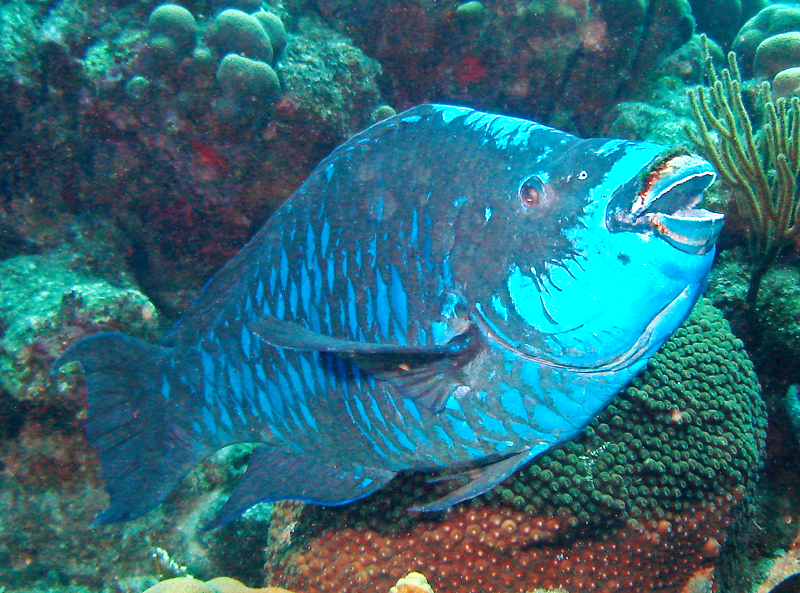 Midnight ParrotfishScarus coelestinus
-
 Blue-barred ParrotfishScarus ghobban
-
 Princess ParrotfishScarus taeniopterus
-
 Common ParrotfishScarus psittacus
Compare
Questions and answers
What is the scientific name of the Chameleon Parrotfish?
The scientific name of the Chameleon Parrotfish is Scarus chameleon. Written with its author, the full name is Scarus chameleon Choat & Randall, 1986.
Which family does the Chameleon Parrotfish belong to?
Scarus chameleon belongs to the family Labridae, in the order Perciformes and the class Teleostei.
Where is the Chameleon Parrotfish found?
Checklists and occurrence records place Scarus chameleon in 18 countries, including Australia, Tonga, New Caledonia, Fiji, Vanuatu and Papua New Guinea.
What is the conservation status of the Chameleon Parrotfish?
The IUCN Red List category recorded for Scarus chameleon is Least Concern (LC).
Sources
Passages the profile rests on
- The type locality of Scarus chameleon is Sumilon Island in the Philippines. Source passage: “The type locality is Sumilon Island in the Philippines.” — English Wikipedia
- Scarus chameleon changes colour phase as it grows. Source passage: “Like most parrotfish, S. chameleon changes colour phase as it grows.” — English Wikipedia
- Juvenile, initial-phase and terminal-phase individuals exhibit highly variable colouration. Source passage: “The young juveniles, initial phase, and terminal phases of S. chameleon are all highly variable in colouration” — English Wikipedia
- The initial colour phase includes females and primary males. Source passage: “The initial phase includes females and primary males” — English Wikipedia
- Terminal-phase secondary males are more visually distinct than initial-phase individuals. Source passage: “The secondary males of the terminal phase are more distinct” — English Wikipedia
- Females may reach sexual maturity at a standard length of 115 mm. Source passage: “Females may be sexually mature by the time they reach 115 mm (4.5 in) SL.” — English Wikipedia
- Females as small as 149.5 mm standard length may transition into terminal-phase males. Source passage: “Females may be as small as 149.5 mm (5.89 in) SL before transitioning into terminal phase males” — English Wikipedia
- Scarus festivus is the closest relative of S. chameleon, and the two species overlap in distribution. Source passage: “It is similar in appearance to S. festivus, which is its closest relative and overlaps with it in distribution.” — English Wikipedia
- Initial-phase individuals may closely resemble northern and inshore populations of Scarus rivulatus. Source passage: “may appear very similar to northern and inshore populations of the closely related and more common S. rivulatus.” — English Wikipedia
- The reported nutritional composition includes 18.6% protein by wet weight. Source passage: “Protein = 18.6 [16.5, 20.3] %;” — fishbase.se
- The reported calcium content is 49.1 mg per 100 g wet weight. Source passage: “Calcium = 49.1 [32.1, 83.3] mg/100g;” — fishbase.se
- The reported iron content is 0.846 mg per 100 g wet weight. Source passage: “Iron = 0.846 [0.595, 1.285] mg/100g;” — fishbase.se
- The reported omega-3 content is 0.0933 g per 100 g wet weight. Source passage: “Omega3 = 0.0933 [, ] g/100g;” — fishbase.se
- The reported selenium content is 19.2 micrograms per 100 g wet weight. Source passage: “Selenium = 19.2 [12.0, 29.8] μg/100g;” — fishbase.se
- The reported vitamin A content is 48.9 micrograms per 100 g wet weight. Source passage: “VitaminA = 48.9 [15.3, 159.1] μg/100g;” — fishbase.se
- The reported zinc content is 2.44 mg per 100 g wet weight. Source passage: “Zinc = 2.44 [1.86, 3.16] mg/100g (wet weight);” — fishbase.se
Data
- Catalogue of Life, 2026-10-16 XR cc by
- Global Biodiversity Information Facility CC BY 4.0
- Wikidata CC0
- GeoNames CC BY 4.0
- Within the Catalogue of Life, this name comes from World Register of Marine Species cc by
References
- Choat, J. H., & Randall, J. E. (1986). A review of the parrotfishes (family Scaridae) of the Great Barrier Reef of Australia with description of a new species. Records of the Australian Museum, 38 (4): 175–228, Pls. 1–11. [Date on cover erroneously as 1 Dec. 1985.]. https://doi.org/10.3853/j.0067-1975.38.1986.181 Link where the name was published
This species in other databases
- Catalogue of Life 4V3GY
- Wikidata Q2570964
- iNaturalist 112133
- WoRMS urn:lsid:marinespecies.org:taxname:276040
- ITIS 614679
Page built on 27 November 2026. See how the catalog is made and all sources and licences.
Cite this page
ScientificNames.org. (2026). Scarus chameleon (Chameleon Parrotfish). Retrieved November 27, 2026, from https://scientificnames.org/species/scarus-chameleon
“Scarus chameleon (Chameleon Parrotfish).” ScientificNames.org, 2026, scientificnames.org/species/scarus-chameleon. Accessed 27 Nov. 2026.
ScientificNames.org. “Scarus chameleon (Chameleon Parrotfish).” Accessed November 27, 2026. https://scientificnames.org/species/scarus-chameleon.
@misc{scientificnames_scarus_chameleon_chameleon_parrotfish,
  author = {{ScientificNames.org}},
  title = {Scarus chameleon (Chameleon Parrotfish)},
  year = {2026},
  url = {https://scientificnames.org/species/scarus-chameleon},
  note = {Accessed 2026-11-27}
}