Species · Fishes
Ember Parrotfish Scarus rubroviolaceus
The scientific name of the Ember Parrotfish is Scarus rubroviolaceus. It is a species of fish in the family Labridae (wrasse), order Perciformes. The name dates from 1847.
- Scientific name
- Scarus rubroviolaceus Bleeker, 1847
- Common name
- Ember Parrotfish
- Genus
- Scarus
- Family
- Labridae (Wrasse)
- Order
- Perciformes
- Class
- Teleostei
- Red List category
- LC Least Concern
- Environment
- marine
- Recorded in
- 45 countries
- Name status
- accepted in the Catalogue of Life

Overview
Scarus rubroviolaceus occurs across the tropical Indo-Pacific, with a range extending from East Africa to the Americas. It has an elongated, laterally compressed body and beak-like teeth formed by joined dental plates.
Written 26 November 2026 from the sources listed below. Each statement was checked against the passage it cites; statements that could not be supported were removed.
Appearance
The body is elongated, oval-shaped and laterally compressed. The species exhibits sexual dimorphism, with males having bright greenish-blue coloration and females having duller brown coloration.[1][2]
Large males have a steep, blunt snout profile, and terminal males have a strongly concave tail fin. The teeth form a beak consisting of two broad, joined plates on each jaw, with smooth outer surfaces lacking lip coverage.[3][4][5][6]
The upper jaw has one or two canines on its rear side. The cheek has large, smooth scales arranged in three rows, with two scales in the lowest row.[7][8][9]
Six scales occur along the center of the nape before the dorsal fin. The lateral line is divided into two sections.[10][11]
Initial-phase individuals are grey on the anterior half and whitish on the posterior half, with small black spots, dark lateral lines and red fins. Terminal-phase individuals are predominantly green to bluish green, sometimes with a purplish anterior half, blue bands on the chin and a blue-green beak.[12][13][14]
Juveniles smaller than approximately 15 mm have whitish bodies with three thin, dashed brown stripes. The lowest stripe is widest and has pale dots.[15]
Juveniles measuring 15–25 mm have three brown to olive stripes, a large white blotch at the base of the tail fin and a dark bar extending downward from the bases of dorsal-fin spines three to eight.[16][17]
In juveniles larger than 25 mm, the three stripes become well developed, the dark bar fades and the scales develop dark edges. These juveniles also have scattered white spots and a white blotch at the base of the tail fin.[18][19]
Habitat
The Ember Parrotfish inhabits shallow reefs and their surrounding fringes.[20]
Diet
The Ember Parrotfish feeds on aquatic plants and benthic algae. It scrapes algae from rocks using its beak.[21][22]
Benthic microalgae and detritus are also listed among its ecological food-related associations.[23]
Behaviour
The Ember Parrotfish undergoes sequential hermaphroditism, changing sex during its lifetime.[24]
Reproduction and life cycle
Juvenile individuals have undifferentiated sex. Individuals mature into reddish-brown females at approximately 32 cm body length and 2.6 years of age.[25][26]
Females can change into males at approximately 37 cm body length and 13 years of age. Some individuals remain female throughout their lives.[27][28]
Conservation
FishBase reports low to moderate vulnerability for the species, with a vulnerability score of 30 out of 100.[29]
Uses
The Ember Parrotfish is commercially fished and can be kept in saltwater aquariums.[30][31]
Classification of the Ember Parrotfish
| Kingdom | Animalia |
|---|---|
| Phylum | Chordata |
| Subphylum | Vertebrata |
| Infraphylum | Gnathostomata |
| Parvphylum | Osteichthyes |
| Gigaclass | Actinopterygii |
| Superclass | Actinopteri |
| Class | Teleostei (Teleost) |
| Order | Perciformes |
| Family | Labridae (Wrasse) |
| Subfamily | Scarinae |
| Tribe | Scarini |
| Genus | Scarus (Parrotfishes) |
| Species | Scarus rubroviolaceus Bleeker, 1847 |
Where the Ember Parrotfish is found
Checklists and occurrence records place Scarus rubroviolaceus in 45 countries. GBIF holds 13,772 georeferenced records of it.
Countries
- American Samoa 855
- Australia 1,581
- British Indian Ocean Territory 5
- China 33
- Christmas Island 47
- Cocos Islands 4
- Colombia 226
- Costa Rica 259
- Cuba 5
- Ecuador 752
- Fiji 49
- French Polynesia 333
- Guam 92
- Honduras 6
- India 72
- Indonesia 224
- Israel 4
- Japan 262
- Jordan 3
- Kiribati 52
- Malaysia 27
- Maldives 254
- Marshall Islands 53
- Mexico 417
- Micronesia 200
- Nauru 62
- New Caledonia 71
- Niue 47
- Northern Mariana Islands 1,985
- Palau 26
- Panama 416
- Papua New Guinea 26
- Philippines 75
- Samoa 11
- Solomon Islands 64
- Sri Lanka 11
- Taiwan 99
- Thailand 144
- Tonga 51
- Tuvalu 42
- United States 2,909
- United States Minor Outlying Islands 1,696
- Vanuatu 55
- Wallis and Futuna 157
- Yemen 10
Regions and cities with the most records
- Hawaii, United States 522
- Pago Pago, American Samoa 424
- Kaneohe, United States 323
- Makiki / Lower Punchbowl / Tantalus, United States 318
- Manoa, United States 318
- Kailua, United States 317
- Kalihi Valley, United States 317
- Kuliouou - Kalani Iki, United States 315
- Waikīkī, United States 315
- Diamond Head / Kapahulu / Saint Louis Heights, United States 314
- East Honolulu, United States 313
- Niu Valley, United States 313
- Honolulu, United States 305
- Northern Islands, Northern Mariana Islands 278
- Kīhei, United States 214
- Wailuku, United States 128
- Jarvis Island, United States Minor Outlying Islands 123
- Colima, Mexico 100
- Kahului, United States 98
- Puntarenas Province, Costa Rica 88
- Saipan, Northern Mariana Islands 77
- Dededo Village, Guam 73
- Yigo Village, Guam 73
- Faaa, French Polynesia 64
- Hilo, United States 64
- Yaren, Nauru 62
- Schofield Barracks, United States 56
- Amlapura, Indonesia 52
- Amlapura city, Indonesia 52
- Bedugul, Indonesia 52
- Cabo San Lucas, Mexico 50
- Colonia del Sol, Mexico 50
- Koolauloa, United States 49
- Alofi, Niue 47
- Flying Fish Cove, Christmas Island 47
- Schofield-Wheeler, United States 42
9 more countries have a few records outside this range
These countries hold a few records of Scarus rubroviolaceus but lie outside the range the checklists give for it. Such records are often zoo or garden specimens, museum material or vagrants, so the species is not counted as occurring there.
A number beside a place is its count of GBIF occurrence records. A place without a number comes from a checklist alone. Records show where a species has been observed or collected, which can include escapes and vagrants.
Common names
English
- Ember Parrotfish
- Black-veined Parrotfish
- Black-veined Red Parrotfish
- Blackvein Parrotfish
- Half & Half Parrotfish
- Redlip Parrotfish
- Bicolor Parrotfish
Names in 18 other languages
- Catalan
- Peix lloro brasa
- Cebuano
- Aliyakyak, Bungalog, Buyos
- Chinese
- 紅海蜇(雌), 紅紫鸚哥魚, 紅紫鸚哥魚(鈍頭鸚哥魚), 紅衣, 紅鸚哥, 紅黑落(雌), 鈍頭鸚嘴魚, 钝头鹦嘴鱼
- Czech
- ploskozubec červenofialový
- Danish
- Rødlæbet papegøjefisk
- Fijian
- soqo
- French
- Perroque Lie-de-vin, Perroquet Prairie, Perroquet Rouge-Violet, Perroquet Violet, Perroquet braisé
- German
- Nasenhöcker-Papageifisch
- Italian
- Pesce pappagallo labbra rosse
- Japanese
- Naga-budai, ナガブダイ
- Malay
- Kalat, Ketarap, Perencong
- Portuguese
- Papagaio de Brasa, Peixe-papagaio-brasa
- Russian
- Маргаритодон
- Spanish
- Loro, Loro Violáceo, loro bicolor
- Tagalog
- Isdang loro, Luro, Lutiin, Yapot
- Thai
- ปลานกแก้วหางยาว
- bik
- Bunog na angol
- div
- Landaa
Synonyms
16 other scientific names have been used for this species and are now treated as synonyms of Scarus rubroviolaceus.
- Callyodon africanus Smith, 1955
- Callyodon jordani (Jenkins, 1901)
- Callyodon ruberrimus Jordan & Seale, 1906
- Callyodon rubrovidaceus (Bleeker, 1847)
- Callyodon rubroviolaceus (Bleeker, 1847)
- Margaritodon africanus (Smith, 1955)
- Pseudoscarus frontalis Macleay, 1883
- Pseudoscarus heliotropinus Bryan, 1906
- Pseudoscarus jordani Jenkins, 1901
- Pseudoscarus rostratus Günther, 1909
- Scarops jordani (Jenkins, 1901)
- Scarops rubroviolaceus (Bleeker, 1847)
- Scarus calus Fowler, 1904
- Scarus jordani (Jenkins, 1901)
- Scarus paluca Jenkins, 1901
- Scarus ruber Bleeker, 1862
Related species
-
 Blue ParrotfishScarus coeruleus
- Black ParrotfishScarus niger
-
 Rainbow ParrotfishScarus guacamaia
-
 Queen ParrotfishScarus vetula
-
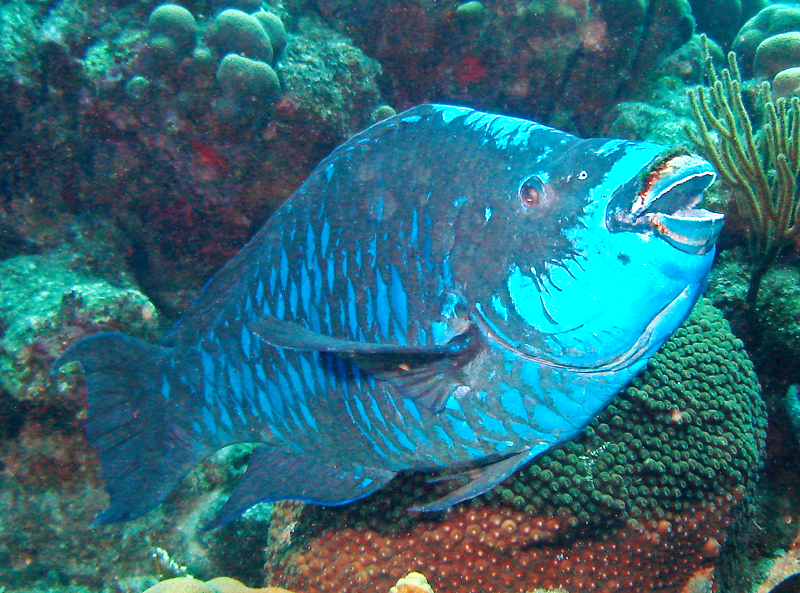 Midnight ParrotfishScarus coelestinus
-
 Blue-barred ParrotfishScarus ghobban
-
 Princess ParrotfishScarus taeniopterus
-
 Common ParrotfishScarus psittacus
Compare
Questions and answers
What is the scientific name of the Ember Parrotfish?
The scientific name of the Ember Parrotfish is Scarus rubroviolaceus. Written with its author, the full name is Scarus rubroviolaceus Bleeker, 1847.
Which family does the Ember Parrotfish belong to?
Scarus rubroviolaceus belongs to the family Labridae, in the order Perciformes and the class Teleostei.
Where is the Ember Parrotfish found?
Checklists and occurrence records place Scarus rubroviolaceus in 45 countries, including United States, Northern Mariana Islands, United States Minor Outlying Islands, Australia, American Samoa and Ecuador.
What is the conservation status of the Ember Parrotfish?
The IUCN Red List category recorded for Scarus rubroviolaceus is Least Concern (LC).
What other names does the Ember Parrotfish have?
Scarus rubroviolaceus is also known in English as Black-veined Parrotfish, Black-veined Red Parrotfish, Blackvein Parrotfish, Half & Half Parrotfish, Redlip Parrotfish and Bicolor Parrotfish.
Where can I find ember parrot fish?
The Ember Parrotfish is native to the Indian and Pacific Oceans. Its geographic range extends from eastern Africa to Japan and the Hawaiian Islands, and its Eastern Pacific distribution extends from the central Gulf of California to Colombia, including several offshore islands.[32][33][34]
What is the diet of a parrotfish?
The Ember Parrotfish feeds on aquatic plants and benthic algae. It scrapes algae from rocks using its beak; benthic microalgae and detritus are also listed among its ecological food-related associations.[21][22][23]
What is the habitat of a parrotfish?
The Ember Parrotfish inhabits shallow reefs and their surrounding fringes.[20]
Is a parrotfish an herbivore, carnivore, or omnivore?
The Ember Parrotfish feeds on aquatic plants and benthic algae.[21]
Sources
Passages the profile rests on
- The species exhibits sexual dimorphism, with males having bright greenish-blue coloration and females having duller brown coloration. Source passage: “The species is sexually dimorphic, with the males possessing a bright, greenish-blue color while the females are a duller brown.” — English Wikipedia
- The body is elongated, oval-shaped and laterally compressed. Source passage: “Body an elongate oval, compressed;” — biogeodb.stri.si.edu
- Large males have a steep, blunt snout profile. Source passage: “snout profile steep and blunt, especially in large males;” — biogeodb.stri.si.edu
- Its teeth form a beak consisting of two broad, joined plates on each jaw. Source passage: “teeth fused into a beak with two broad joined plates on each jaw,” — biogeodb.stri.si.edu
- The outer surfaces of its dental plates are smooth and lack lip coverage. Source passage: “outer surface of plates smooth, not covered by lips;” — biogeodb.stri.si.edu
- The tail fin of terminal males is strongly concave. Source passage: “that of terminal males strongly so;” — biogeodb.stri.si.edu
- The upper jaw has one or two canines on its rear side. Source passage: “1-2 canines on rear side of top jaw;” — biogeodb.stri.si.edu
- The species has large, smooth scales arranged in three rows on the cheek. Source passage: “scales large, smooth, 3 rows on cheek,” — biogeodb.stri.si.edu
- The lowest cheek-scale row contains two scales. Source passage: “2 scales in lowest row;” — biogeodb.stri.si.edu
- Six scales occur along the center of the nape before the dorsal fin. Source passage: “6 scales on center of nape before dorsal fin;” — biogeodb.stri.si.edu
- The lateral line is divided into two sections. Source passage: “lateral line in 2 sections.” — biogeodb.stri.si.edu
- Initial-phase individuals are grey on the anterior half and whitish on the posterior half, with small black spots, dark lateral lines and red fins. Source passage: “IP: grey on anterior half and whitish posteriorly with small black spots and dark lines on sides and red fins;” — biogeodb.stri.si.edu
- Terminal-phase individuals are predominantly green to bluish green, sometimes with a purplish anterior half. Source passage: “TP: mainly green to bluish green, sometimes purplish on anterior half giving strong bicolor effect;” — biogeodb.stri.si.edu
- Terminal-phase individuals have blue bands on the chin and a blue-green beak. Source passage: “a pair of blue bands on chin and beak blue green.” — biogeodb.stri.si.edu
- Juveniles smaller than approximately 15 mm have whitish bodies with three thin, dashed brown stripes, of which the lowest is widest and has pale dots. Source passage: “less than ~ 15 mm - body whitish, with 3 dashed thin brown stripes, lowermost line widest and has pale dots along its length,” — biogeodb.stri.si.edu
- Juveniles measuring 15–25 mm have three brown to olive stripes and a large white blotch at the base of the tail fin. Source passage: “larger individuals (15-25 mm)- body whitish with 3 brown to olive stripes (lower one widest) with white spots, a large white blotch on base of tail fin;” — biogeodb.stri.si.edu
- Juveniles measuring 15–25 mm have a dark bar extending downward from the bases of dorsal-fin spines three to eight. Source passage: “a dark bar extending down from base of spines 3-8 of dorsal fin;” — biogeodb.stri.si.edu
- In juveniles larger than 25 mm, the three stripes become well developed, the dark bar fades and the scales develop dark edges. Source passage: “above 25 mm - 3 stripes well developed, dark bar fades, scales develop dark edges,” — biogeodb.stri.si.edu
- Juveniles larger than 25 mm have scattered white spots and a white blotch at the base of the tail fin. Source passage: “body with scattered white spots, white blotch on tail fin base.” — biogeodb.stri.si.edu
- The species inhabits shallow reefs and their surrounding fringes. Source passage: “Habitat: it occurs on shallow reefs and around their fringes.” — biogeodb.stri.si.edu
- The species feeds on aquatic plants and benthic algae. Source passage: “Diet includes aquatic plants and benthic algae,” — English Wikipedia
- The species scrapes algae from rocks using its beak. Source passage: “which scrape off rocks using their beak.” — English Wikipedia
- Benthic microalgae and detritus are listed among the species' ecological food-related associations. Source passage: “Benthic microalgae Data Detritus Hard corals” — biogeodb.stri.si.edu
- The species undergoes sequential hermaphroditism, changing sex during its lifetime. Source passage: “Ember Parrotfish shows sequential hermaphroditism meaning it changes its sex at some point in its life.” — English Wikipedia
- Juvenile individuals have undifferentiated sex. Source passage: “Juvenile Ember Parrotfish has undifferentiated sex.” — English Wikipedia
- Individuals mature into reddish-brown females at approximately 32 cm body length and 2.6 years of age. Source passage: “at a body length of about 32 cm at about 2.6 years old, it matures into a female who is reddish brown.” — English Wikipedia
- Females can change into males at approximately 37 cm body length and 13 years of age. Source passage: “at a body length of 37cm it is about 13 years old, it changes its sex into a male.” — English Wikipedia
- Some individuals remain female throughout their lives. Source passage: “However, some remain female throughout their lives.” — English Wikipedia
- FishBase reports low to moderate vulnerability for the species, with a vulnerability score of 30 out of 100. Source passage: “Low to moderate vulnerability (30 of 100).” — fishbase.se
- The species is commercially fished. Source passage: “The ember parrotfish is commercially fished,” — English Wikipedia
- The species can be kept in saltwater aquariums. Source passage: “and can be kept in saltwater aquariums.” — English Wikipedia
- The ember parrotfish is native to the Indian and Pacific Oceans. Source passage: “It is native to the Indian and Pacific Oceans.” — English Wikipedia
- Its geographic range extends from eastern Africa to Japan and the Hawaiian Islands. Source passage: “It has been found in the Indian and Pacific Oceans, with its range including Japan, eastern Africa, and the Hawaiian islands.” — English Wikipedia
- Its Eastern Pacific distribution extends from the central Gulf of California to Colombia and includes several offshore islands. Source passage: “the central Gulf of California to Colombia, as well as the Revillagigedos, Clipperton, Cocos, Malpelo and the Galapagos.” — biogeodb.stri.si.edu
Data
- Catalogue of Life, 2026-10-16 XR cc by
- Global Biodiversity Information Facility CC BY 4.0
- Wikidata CC0
- GeoNames CC BY 4.0
- Wikimedia Commons per image; credit shown with each image
- Within the Catalogue of Life, this name comes from World Register of Marine Species cc by
References
- Bleeker, P. (1847). Pharyngognathorum Siluroideorumque species novae Javanenses. Natuur-En Geneeskundig Archief Voor Neȇrlandsch Indië, v. 4 (no. 2): 155–169. where the name was published
This species in other databases
- Catalogue of Life 4V3N6
- Wikidata Q1853893
- iNaturalist 83297
- WoRMS urn:lsid:marinespecies.org:taxname:219124
- ITIS 170880
Page built on 26 November 2026. See how the catalog is made and all sources and licences.
Cite this page
ScientificNames.org. (2026). Scarus rubroviolaceus (Ember Parrotfish). Retrieved November 26, 2026, from https://scientificnames.org/species/scarus-rubroviolaceus
“Scarus rubroviolaceus (Ember Parrotfish).” ScientificNames.org, 2026, scientificnames.org/species/scarus-rubroviolaceus. Accessed 26 Nov. 2026.
ScientificNames.org. “Scarus rubroviolaceus (Ember Parrotfish).” Accessed November 26, 2026. https://scientificnames.org/species/scarus-rubroviolaceus.
@misc{scientificnames_scarus_rubroviolaceus_ember_parrotfish,
  author = {{ScientificNames.org}},
  title = {Scarus rubroviolaceus (Ember Parrotfish)},
  year = {2026},
  url = {https://scientificnames.org/species/scarus-rubroviolaceus},
  note = {Accessed 2026-11-26}
}