Species · Fishes
Three-colour Parrotfish Scarus tricolor
The scientific name of the Three-colour Parrotfish is Scarus tricolor. It is a species of fish in the family Labridae (wrasse), order Perciformes. The name dates from 1847.
- Scientific name
- Scarus tricolor Bleeker, 1847
- Common name
- Three-colour Parrotfish
- Genus
- Scarus
- Family
- Labridae (Wrasse)
- Order
- Perciformes
- Class
- Teleostei
- Red List category
- LC Least Concern
- Environment
- marine
- Recorded in
- 29 countries
- Name status
- accepted in the Catalogue of Life
Overview
Scarus tricolor occurs from East Africa south to KwaZulu-Natal in South Africa, eastward through Madagascar and other tropical Indian Ocean archipelagos, and through the eastern Indian Ocean into the western Pacific as far as French Polynesia and Pitcairn. It has a purplish band just inside the margin of each caudal-fin lobe, and terminal-phase males have a yellow inner pectoral axil.
Written 27 November 2026 from the sources listed below. Each statement was checked against the passage it cites; statements that could not be supported were removed.
Appearance
Females are dark grey to almost black, shading to blue or bluish-green on their lower flanks. They have black-edged scales, a red tail fin, an orange anal fin and sooty yellowish to orange pelvic fins.[1][2]
Terminal-phase males have a yellow inner pectoral axil, distinguishing them from similar Scarus forsteni. Both caudal-fin lobes have a purplish band just inside their margins.[3][4]
Habitat
The species is usually found in areas with dense coral growth. It normally inhabits seaward reefs but also occurs within lagoons, at depths of up to 30 metres.[5][6][7]
Diet
The species feeds on benthic algae.[8]
Behaviour
The species is usually encountered individually, although groups are sometimes recorded.[9]
Reproduction and life cycle
The species is oviparous and forms distinct pairs for spawning.[10][11]
Similar species
Terminal-phase males resemble those of Scarus forsteni. The species is largely replaced by Scarus forsteni in the western Pacific, although their distributions overlap in the Philippines.[12][13]
Conservation
The species has a moderate vulnerability score of 44 out of 100 in FishBase. Its estimated minimum population doubling time is between 1.4 and 4.4 years.[14][15]
Classification of the Three-colour Parrotfish
| Kingdom | Animalia |
|---|---|
| Phylum | Chordata |
| Subphylum | Vertebrata |
| Infraphylum | Gnathostomata |
| Parvphylum | Osteichthyes |
| Gigaclass | Actinopterygii |
| Superclass | Actinopteri |
| Class | Teleostei (Teleost) |
| Order | Perciformes |
| Family | Labridae (Wrasse) |
| Subfamily | Scarinae |
| Tribe | Scarini |
| Genus | Scarus (Parrotfishes) |
| Species | Scarus tricolor Bleeker, 1847 |
Where the Three-colour Parrotfish is found
Checklists and occurrence records place Scarus tricolor in 29 countries. GBIF holds 2,394 georeferenced records of it.
Countries
- American Samoa 28
- Australia 12
- French Polynesia 4
- India 31
- Indonesia 200
- Kenya 18
- Kiribati 26
- Madagascar 8
- Malaysia 8
- Maldives 57
- Mauritius 6
- Mayotte 595
- Micronesia 11
- Mozambique 12
- Nauru 36
- Palau 5
- Papua New Guinea 5
- Philippines 176
- Reunion 9
- Samoa 3
- Seychelles 78
- Solomon Islands 15
- South Africa 6
- Tanzania 5
- Thailand 11
- Timor Leste 9
- Tonga 43
- Tuvalu 37
- United States Minor Outlying Islands 940
Regions and cities with the most records
- Koungou, Mayotte 197
- Mamoudzou, Mayotte 179
- Kaouéni, Mayotte 170
- Dzaoudzi, Mayotte 159
- Labattoir, Mayotte 136
- Jarvis Island, United States Minor Outlying Islands 102
- Amlapura, Indonesia 40
- Amlapura city, Indonesia 40
- Bedugul, Indonesia 40
- Yaren, Nauru 36
- Bauan, Philippines 31
- San Pascual, Philippines 27
- Batangas, Philippines 22
- Pago Pago, American Samoa 22
- Taal, Philippines 16
- Bali, Indonesia 10
- Male, Maldives 10
- Dumaguete, Philippines 9
- Manado, Indonesia 9
- Sibulan, Philippines 9
- Guihulñgan, Philippines 8
- Victoria, Seychelles 8
- Calapan, Philippines 7
- Rosario, Philippines 7
- Bitung, Indonesia 6
- Klungkung, Indonesia 5
- Mahébourg, Mauritius 5
- Bambous, Mauritius 4
- Beau Bassin-Rose Hill, Mauritius 4
- Bel Air Rivière Sèche, Mauritius 4
- Bignay Uno, Philippines 4
- Centre de Flacq, Mauritius 4
- Concepcion Ibaba, Philippines 4
- Curepipe, Mauritius 4
- Funafuti, Tuvalu 4
- Jagna, Philippines 4
1 more country has a few records outside this range
These countries hold a few records of Scarus tricolor but lie outside the range the checklists give for it. Such records are often zoo or garden specimens, museum material or vagrants, so the species is not counted as occurring there.
A number beside a place is its count of GBIF occurrence records. A place without a number comes from a checklist alone. Records show where a species has been observed or collected, which can include escapes and vagrants.
Common names
English
- Three-colour Parrotfish
- Tricolor Parrotfish
- Tricolour Parrotfish
Names in 15 other languages
- Catalan
- Peix lloro arc de Sant Martí de l'Indopacífic
- Cebuano
- Aliyakyak, Bungalog, Buyos
- Chinese
- 三色鸚哥魚
- Czech
- ploskozubec tříbarvý
- Danish
- Trefarvet papegøjefisk
- Fijian
- soqo
- French
- Perroquet tricolore, Poisson-perroquet Tricolore
- Italian
- Pesce pappagallo tricolore
- Japanese
- Ichimonji-budai
- Malay
- Kalat, Ketarap, Perencong
- Portuguese
- Papagaio Tricolor, Peixe-papagaio-tricolor
- Spanish
- Loro Tricolor, Loro de tres colores
- Tagalog
- Isdang loro, Luro, Lutiin
- Thai
- ปลานกแก้วสามสี
- bik
- Bunog na angol
Synonyms
10 other scientific names have been used for this species and are now treated as synonyms of Scarus tricolor.
- Callyodon cyanognathus (Bleeker, 1847)
- Callyodon elerae Jordan & Seale, 1907
- Callyodon latifasciatus Seale & Bean, 1907
- Callyodon mus Smith, 1956
- Callyodon tricolor (Bleeker, 1847)
- Callyodon urbanus Smith, 1959
- Callyodon viridibusius Fowler & Bean, 1928
- Scarus cyanognathos Bleeker, 1847
- Scarus cyanognathus Bleeker, 1847
- Scarus visayanus Herre, 1933
Related species
-
 Blue ParrotfishScarus coeruleus
- Black ParrotfishScarus niger
-
 Rainbow ParrotfishScarus guacamaia
-
 Queen ParrotfishScarus vetula
-
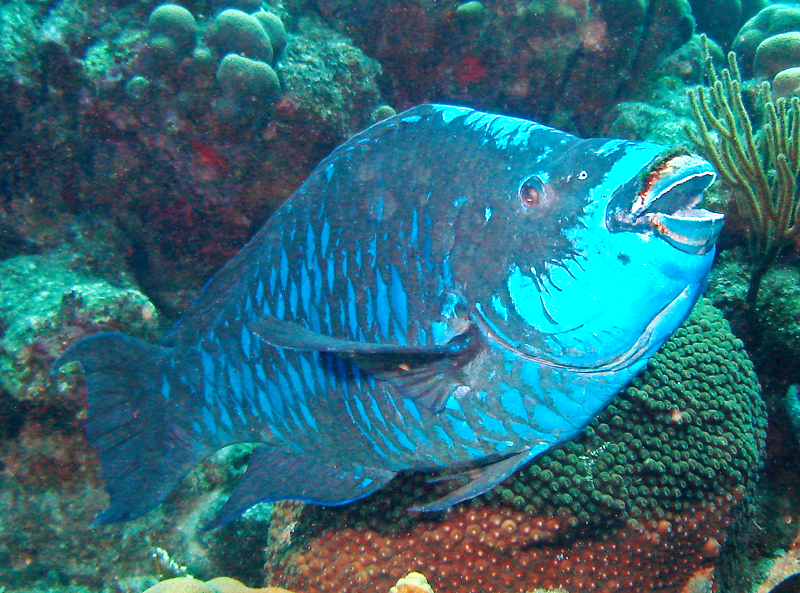 Midnight ParrotfishScarus coelestinus
-
 Blue-barred ParrotfishScarus ghobban
-
 Princess ParrotfishScarus taeniopterus
-
 Common ParrotfishScarus psittacus
Compare
Questions and answers
What is the scientific name of the Three-colour Parrotfish?
The scientific name of the Three-colour Parrotfish is Scarus tricolor. Written with its author, the full name is Scarus tricolor Bleeker, 1847.
Which family does the Three-colour Parrotfish belong to?
Scarus tricolor belongs to the family Labridae, in the order Perciformes and the class Teleostei.
Where is the Three-colour Parrotfish found?
Checklists and occurrence records place Scarus tricolor in 29 countries, including United States Minor Outlying Islands, Mayotte, Indonesia, Philippines, Seychelles and Maldives.
What is the conservation status of the Three-colour Parrotfish?
The IUCN Red List category recorded for Scarus tricolor is Least Concern (LC).
What other names does the Three-colour Parrotfish have?
Scarus tricolor is also known in English as Tricolor Parrotfish and Tricolour Parrotfish.
What is the diet of a parrotfish?
The Three-colour Parrotfish feeds on benthic algae.[8]
Sources
Passages the profile rests on
- Females are dark grey to almost black, shading to blue or bluish-green on their lower flanks. Source passage: “The females are dark grey to almost black shading to blue to bluish-green on the lower flanks” — English Wikipedia
- Females have black-edged scales, a red tail fin, an orange anal fin and sooty yellowish to orange pelvic fins. Source passage: “with black edging to the scales, a red tail fin, an orange anal fin and sooty yellowish to orange pelvic fins.” — English Wikipedia
- The species has a purplish band just inside the margin of each caudal-fin lobe. Source passage: “a purplish band just inside the margin of each lobe of the caudal fin.” — English Wikipedia
- Terminal-phase males have a yellow inner pectoral axil, distinguishing them from similar Scarus forsteni. Source passage: “the most notable difference being that S. tricolor has a yellow inner pectoral axil.” — English Wikipedia
- The species is usually found in areas with dense coral growth. Source passage: “in area where there is a dense growth of coral” — English Wikipedia
- The species normally inhabits seaward reefs but also occurs within lagoons. Source passage: “normally on seaward reefs but also within lagoons.” — English Wikipedia
- The species occurs at depths of up to 30 metres. Source passage: “It occurs to depths of 30 metres (98 ft)” — English Wikipedia
- The species feeds on benthic algae. Source passage: “and it feeds on benthic algae.” — English Wikipedia
- The species is usually encountered individually, although groups are sometimes recorded. Source passage: “Scarus tricolor can be usually be found as individuals, although groups are sometimes recorded” — English Wikipedia
- The species is oviparous. Source passage: “It is an oviparous species” — English Wikipedia
- The species forms distinct pairs for spawning. Source passage: “which forms distinct pairs for spawning.” — English Wikipedia
- The species is largely replaced by Scarus forsteni in the western Pacific, although their distributions overlap in the Philippines. Source passage: “It is largely replaced by S. forsteni in the western Pacific although there is some overlap in the Philippines.” — English Wikipedia
- Terminal-phase males of this species resemble those of Scarus forsteni. Source passage: “The terminal phase males are similar to those of Scarus forsteni” — English Wikipedia
- The species has a moderate vulnerability score of 44 out of 100 in FishBase. Source passage: “Moderate vulnerability (44 of 100).” — fishbase.se
- The estimated minimum population doubling time is between 1.4 and 4.4 years. Source passage: “Medium, minimum population doubling time 1.4 - 4.4 years” — fishbase.se
Data
- Catalogue of Life, 2026-10-16 XR cc by
- Global Biodiversity Information Facility CC BY 4.0
- Wikidata CC0
- GeoNames CC BY 4.0
- Within the Catalogue of Life, this name comes from World Register of Marine Species cc by
References
- Bleeker, P. (1847). Pharyngognathorum Siluroideorumque species novae Javanenses. Natuur-En Geneeskundig Archief Voor Neȇrlandsch Indië, v. 4 (no. 2): 155–169. where the name was published
This species in other databases
- Catalogue of Life 4V3P2
- Wikidata Q2329408
- iNaturalist 112167
- WoRMS urn:lsid:marinespecies.org:taxname:219098
- ITIS 170843
Page built on 27 November 2026. See how the catalog is made and all sources and licences.
Cite this page
ScientificNames.org. (2026). Scarus tricolor (Three-colour Parrotfish). Retrieved November 27, 2026, from https://scientificnames.org/species/scarus-tricolor
“Scarus tricolor (Three-colour Parrotfish).” ScientificNames.org, 2026, scientificnames.org/species/scarus-tricolor. Accessed 27 Nov. 2026.
ScientificNames.org. “Scarus tricolor (Three-colour Parrotfish).” Accessed November 27, 2026. https://scientificnames.org/species/scarus-tricolor.
@misc{scientificnames_scarus_tricolor_three_colour_parrotfish,
  author = {{ScientificNames.org}},
  title = {Scarus tricolor (Three-colour Parrotfish)},
  year = {2026},
  url = {https://scientificnames.org/species/scarus-tricolor},
  note = {Accessed 2026-11-27}
}