Species · Birds
Silvered Antbird Sclateria naevia
The scientific name of the Silvered Antbird is Sclateria naevia. It is a species of bird in the family Thamnophilidae (antbird), order Passeriformes. The name dates from 1788.
- Scientific name
- Sclateria naevia (J. F. Gmelin, 1788)
- Common name
- Silvered Antbird
- Genus
- Sclateria
- Family
- Thamnophilidae (Antbird)
- Order
- Passeriformes
- Class
- Aves
- Red List category
- LC Least Concern
- Recorded in
- 10 countries
- Name status
- accepted in the Catalogue of Life

Overview
The Silvered Antbird (Sclateria naevia) is a bird in the family Thamnophilidae, order Passeriformes, and class Aves. It inhabits tropical evergreen forests in Trinidad and every mainland South American country except Argentina, Chile, Paraguay, and Uruguay. It measures 14–16 cm in length and 21–27 g in weight.
Written 27 November 2026 from the sources listed below. Each statement was checked against the passage it cites; statements that could not be supported were removed.
Appearance
Adult males of the nominate subspecies have dark gray crowns, napes, and upperparts, with mostly white underparts marked by gray scalloping. Adult females have a similar plumage pattern but are grayish brown rather than gray.[1][2][3]
Subadult males resemble adult females in plumage. Males of subspecies argentata have almost entirely white underparts with faint gray mottling on the breast and flanks.[4][5]
Subspecies toddi has plumage characteristics intermediate between those of the nominate subspecies and argentata. Males of subspecies diaphora have small white dots on their wing coverts and mostly gray underparts.[6][7]
Habitat
The Silvered Antbird inhabits the forest floor and understory of tropical evergreen forests. Its principal forest habitats include várzea and igapó, and it also occurs along streams, in terra firme forest, and in swampy forest areas.[8][9][10]
It favors habitats with vine tangles, branches, and vegetation overhanging the water's edge. It also inhabits mangrove swamps in Trinidad and Suriname.[11][12]
In Ecuador and Peru, it occurs in Mauritia flexuosa palm swamps. Its recorded elevational range reaches 500 m in Venezuela and Colombia, 450 m in Ecuador, and 600 m in Peru.[13][14]
Diet
The Silvered Antbird feeds primarily on insects and spiders.[15]
Behaviour
The Silvered Antbird is believed to remain resident throughout its range throughout the year. It forages individually, in pairs, and in small family groups.[16][17]
It usually forages within approximately one metre of the ground, hopping along the ground and among low branches. It obtains prey mainly by picking it from leaf litter and reaching toward leaves and twigs.[18][19][20]
It also picks prey from the water surface while perched above it. It rarely joins mixed-species feeding flocks or attends army ant swarms.[21][22][23]
Reproduction and life cycle
The Silvered Antbird is a resident breeder. Its breeding season varies geographically and includes August in Suriname and northern Brazil; in Peru, it extends from at least October through November.[24][25][26]
It builds an open-cup nest from thick rootlets and moss, incorporating fern fragments and lining it with thinner rootlets. The nest is typically woven onto low branches overhanging water.[27][28]
The usual clutch consists of two bluish-white eggs marked with red-brown spots and blotches.[29]
Conservation
The IUCN classifies the Silvered Antbird as Least Concern. It has a very large geographic range that does not approach the Vulnerable threshold under the range-size criterion.[30][31][32]
Its population size is unknown and its population is believed to be stable. No immediate threats have been identified.[33][34]
The species is considered fairly common across most of its range and common in Colombia. It was most recently assessed for the IUCN Red List in 2018.[35][36]
Classification of the Silvered Antbird
| Kingdom | Animalia |
|---|---|
| Phylum | Chordata |
| Subphylum | Vertebrata |
| Infraphylum | Gnathostomata |
| Parvphylum | Osteichthyes |
| Megaclass | Tetrapoda |
| Class | Aves (Bird) |
| Order | Passeriformes (Passerine) |
| Family | Thamnophilidae (Antbird) |
| Genus | Sclateria |
| Species | Sclateria naevia (J. F. Gmelin, 1788) |
Where the Silvered Antbird is found
Checklists and occurrence records place Sclateria naevia in 10 countries across North America and South America. GBIF holds 12,149 georeferenced records of it.
Countries
- Bolivia 155
- Brazil 3,059
- Colombia 1,133
- Ecuador 2,698
- French Guiana 415
- Guyana 486
- Peru 2,887
- Suriname 550
- Trinidad and Tobago 580
- Venezuela 186
Regions and cities with the most records
- Madre de Dios, Peru 1,979
- Sucumbíos, Ecuador 1,628
- Mato Grosso, Brazil 1,062
- Orellana Province, Ecuador 902
- Pará, Brazil 753
- Loreto, Peru 698
- Puerto Maldonado, Peru 423
- Amazonas, Brazil 347
- Tambopata, Peru 275
- Guaviare Department, Colombia 228
- Rondônia, Brazil 223
- Rio Claro, Trinidad and Tobago 205
- Mayaro, Trinidad and Tobago 202
- Sipaliwini District, Suriname 197
- Meta Department, Colombia 194
- Putumayo Department, Colombia 192
- Demerara-Mahaica, Guyana 186
- Paramaribo, Suriname 180
- Commewijne District, Suriname 175
- Arima, Trinidad and Tobago 169
- Lelydorp, Suriname 165
- Amazonas Department, Colombia 163
- Paradise, Trinidad and Tobago 162
- Marituba, Brazil 156
- Tunapuna, Trinidad and Tobago 147
- San José del Guaviare, Colombia 146
- Puerto Asís, Colombia 141
- Tunapuna/Piarco, Trinidad and Tobago 133
- Guainía Department, Colombia 131
- Vaupés, Colombia 118
- Ananindeua, Brazil 116
- Matoury, French Guiana 116
- Benevides, Brazil 106
- Amapá, Brazil 103
- San Martín Department, Peru 101
- Mitú, Colombia 96
Range as the checklists state it
South America
Caribbean
A number beside a place is its count of GBIF occurrence records. A place without a number comes from a checklist alone. Records show where a species has been observed or collected, which can include escapes and vagrants.
Common names
English
- Silvered Antbird
Names in 24 other languages
- Catalan
- formiguera de Gmelin
- Chinese
- 銀色蟻鳥, 银色蚁鸟
- Croatian
- srebrnastoprsa mravarica
- Czech
- mravenčík bažinný
- Danish
- Sølvmyrefugl
- Dutch
- Mangrovemiervogel
- Esperanto
- arĝenta formikulo
- Finnish
- hopeakylkimuura
- French
- Alapi paludicole, Batara paludicole
- German
- Mangroven-Ameisenvogel, Silberameisenschnäpper, Silbergrauer Ameisenschnäpper
- Italian
- Formichiere argentato
- Japanese
- ギンムネアリドリ
- Lithuanian
- mangrovinė skruzdinukė
- Norwegian
- sølvmaurfugl
- Polish
- potoczak
- Portuguese
- Formigueiro-do-igarapé, formigueiro-prateado, papa-formiga-do-igarapé
- Russian
- Серебристая муравьеловка, Склатерия
- Serbian
- Srebrna mravarka
- Slovak
- mravcovka bahenná
- Spanish
- Hormiguero plateado
- Swedish
- silvermyrfågel
- Turkish
- Gümüşi Karıncakuşu
- Ukrainian
- аляпі сріблястий
- Welsh
- aderyn morgrug Sclater
Synonyms
4 other scientific names have been used for this species and are now treated as synonyms of Sclateria naevia.
- Holocnemis flammata Strickland, 1844
- Myrmeciza dubia Snethlage, HMMEE, 1925
- Sclateria naevia dubia Snethlage, HMMEE, 1925
- Sitta naevia J. F. Gmelin, 1788
Subspecies and varieties
- Sclateria naevia argentata (Western Silvered Antbird) subspecies
- Sclateria naevia diaphora subspecies
- Sclateria naevia naevia (Silvered Antbird) subspecies
- Sclateria naevia toddi subspecies
Related species
-
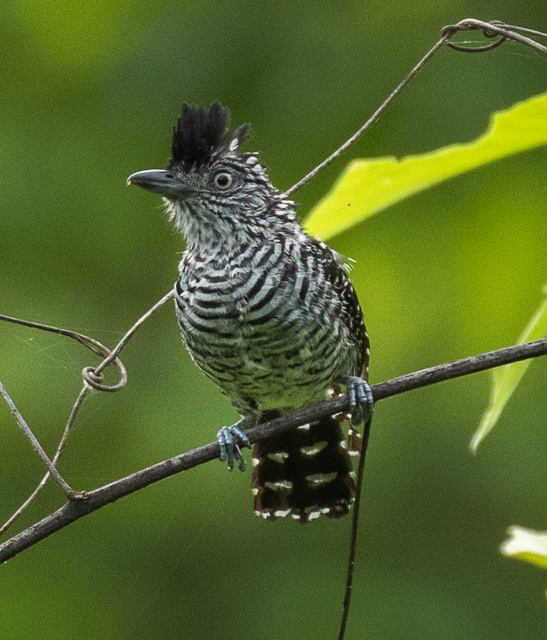 Barred AntshrikeThamnophilus doliatus
-
 Great AntshrikeTaraba major
-
 Black-crowned AntshrikeThamnophilus atrinucha
-
 Ocellated AntbirdPhaenostictus mcleannani
-
 Bicolored AntbirdGymnopithys bicolor
-
 Fasciated AntshrikeCymbilaimus lineatus
-
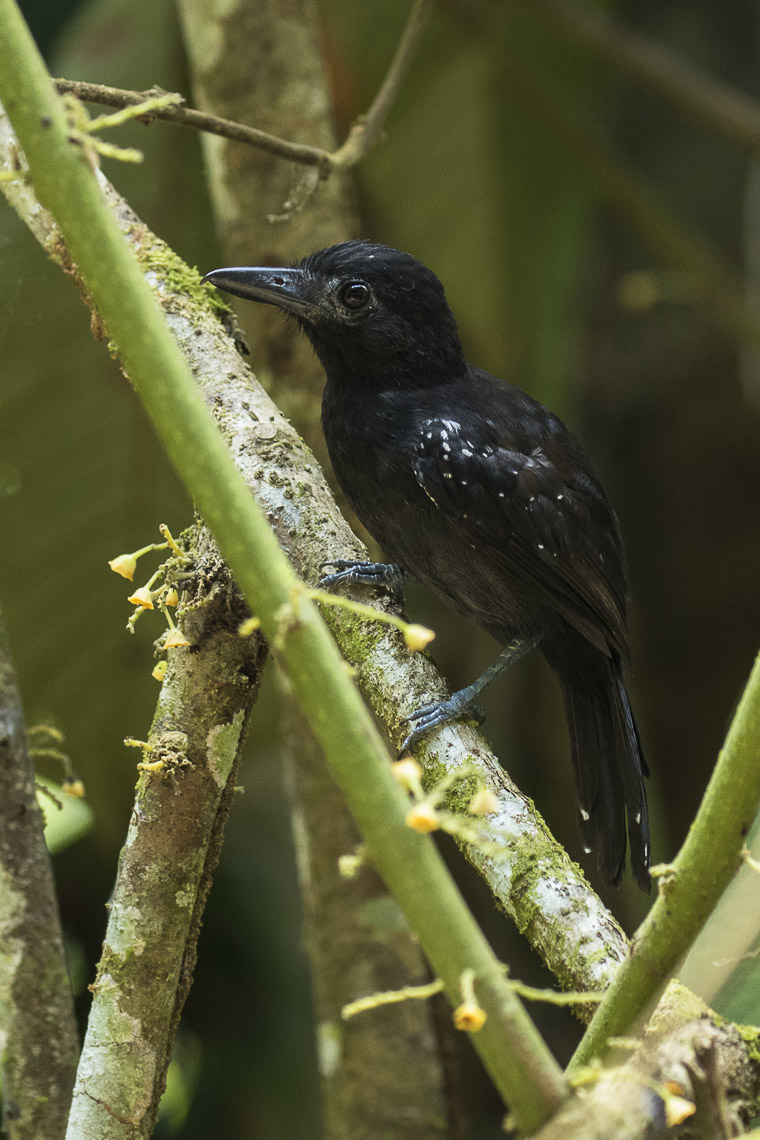 Black-hooded AntshrikeThamnophilus bridgesi
-
 Black-crested AntshrikeSakesphorus canadensis
Compare
Questions and answers
What is the scientific name of the Silvered Antbird?
The scientific name of the Silvered Antbird is Sclateria naevia. Written with its author, the full name is Sclateria naevia (J. F. Gmelin, 1788).
Which family does the Silvered Antbird belong to?
Sclateria naevia belongs to the family Thamnophilidae, in the order Passeriformes and the class Aves.
Where is the Silvered Antbird found?
Checklists and occurrence records place Sclateria naevia in 10 countries, including Brazil, Peru, Ecuador, Colombia, Trinidad and Tobago and Suriname.
What is the conservation status of the Silvered Antbird?
The IUCN Red List category recorded for Sclateria naevia is Least Concern (LC).
Where does the Silvered Antbird occur?
It occurs in Trinidad and every mainland South American country except Argentina, Chile, Paraguay, and Uruguay.[37]
What is the length and weight of the Silvered Antbird?
What does the Silvered Antbird eat?
It feeds primarily on insects and spiders.[15]
How does the Silvered Antbird forage?
It usually forages within approximately one metre of the ground, picking prey from leaf litter, leaves, and twigs. It also picks prey from the water surface while perched above it.[18][20][21]
What type of nest does the Silvered Antbird build?
It builds an open-cup nest from thick rootlets and moss, incorporating fern fragments and lining it with thinner rootlets. The nest is typically woven onto low branches overhanging water.[27][28]
How many eggs does the Silvered Antbird usually lay?
The usual clutch consists of two bluish-white eggs marked with red-brown spots and blotches.[29]
Sources
Passages the profile rests on
- Adult males of the nominate subspecies have dark gray crowns, napes, and upperparts. Source passage: “Adult males of the nominate subspecies S. n. naevia have a dark gray crown, nape, and upperparts.” — English Wikipedia
- Adult males of the nominate subspecies have mostly white underparts with gray scalloping. Source passage: “Their underparts are mostly white with gray scalloping that is lightest on the throat.” — English Wikipedia
- Adult females have a similar plumage pattern to males but are grayish brown rather than gray. Source passage: “Adult females have the same pattern as males, but are grayish brown” — English Wikipedia
- Subadult males resemble adult females in plumage. Source passage: “Subadult males look like adult females.” — English Wikipedia
- Males of subspecies argentata have almost entirely white underparts with faint gray mottling on the breast and flanks. Source passage: “Males of subspecies S. n. argentata have almost white underparts with faint light gray mottling on the breast and flanks” — English Wikipedia
- Subspecies toddi has plumage characteristics intermediate between those of the nominate subspecies and argentata. Source passage: “S. n. toddi is intermediate between the nominate and argentata.” — English Wikipedia
- Males of subspecies diaphora have small white dots on their wing coverts and mostly gray underparts. Source passage: “S. n. diaphora males have small white dots, rather than white tips, on their wing coverts, and mostly gray underparts” — English Wikipedia
- The species inhabits the forest floor and understory of tropical evergreen forests. Source passage: “The silvered antbird inhabits the floor and understorey of tropical evergreen forest” — English Wikipedia
- Its principal forest habitats include várzea and igapó. Source passage: “primarily várzea and igapó” — English Wikipedia
- The species occurs along streams, in terra firme forest, and in swampy forest areas. Source passage: “along streams, terra firme and in swampy areas within the forest.” — English Wikipedia
- The species favors habitats with vine tangles, branches, and vegetation overhanging the water's edge. Source passage: “It favors areas with vine tangles, branches, and vegetation that overhang the water's edge.” — English Wikipedia
- The species also inhabits mangrove swamps in Trinidad and Suriname. Source passage: “In Trinidad and Suriname, it also occurs in mangrove swamps” — English Wikipedia
- In Ecuador and Peru, the species occurs in Mauritia flexuosa palm swamps. Source passage: “Ecuador and Peru, found in Mauritia flexuosa palm swamps.” — English Wikipedia
- Its recorded elevational range reaches 500 m in Venezuela and Colombia, 450 m in Ecuador, and 600 m in Peru. Source passage: “it reaches 500 m (1,600 ft) in Venezuela and Colombia, 450 m (1,500 ft) in Ecuador, and 600 m (2,000 ft) in Peru.” — English Wikipedia
- The species feeds primarily on insects and spiders. Source passage: “The silvered antbird feeds primarily on a variety of insects and spiders.” — English Wikipedia
- The species is believed to remain resident throughout its range throughout the year. Source passage: “The silvered antbird is believed to be a year-round resident throughout its range.” — English Wikipedia
- The species forages individually, in pairs, and in small family groups. Source passage: “It forages as individuals, pairs, and small family groups” — English Wikipedia
- The species usually forages within approximately one metre of the ground. Source passage: “mostly within about 1 m (3 ft) of the ground” — English Wikipedia
- The species hops along the ground and among low branches while foraging. Source passage: “They hop along the ground and among low branches” — English Wikipedia
- The species obtains prey mainly by picking it from leaf litter and reaching toward leaves and twigs. Source passage: “take prey mostly by picking from leaf litter and reaching up to leaves and twigs.” — English Wikipedia
- The species also picks prey from the water surface while perched above it. Source passage: “They also pick prey from the water's surface while perched above it.” — English Wikipedia
- The species rarely joins mixed-species feeding flocks. Source passage: “seldom with mixed-species feeding flocks.” — English Wikipedia
- The species rarely attends army ant swarms. Source passage: “They rarely attend army ant swarms” — English Wikipedia
- The species' breeding season varies geographically and includes August in Suriname and northern Brazil. Source passage: “It includes August in Suriname and northern Brazil” — English Wikipedia
- In Peru, the breeding season extends from at least October through November. Source passage: “spans at least October to November in Peru.” — English Wikipedia
- The species is described as a resident breeder. Source passage: “It is a resident breeder in” — inaturalist.org
- The species builds an open-cup nest from thick rootlets and moss, incorporating fern fragments and lining it with thinner rootlets. Source passage: “Its nest is an open cup of thick rootlets and moss with bits of fern and lined with thinner rootlets.” — English Wikipedia
- The nest is typically woven onto low branches overhanging water. Source passage: “It is typically woven to low branches overhanging water.” — English Wikipedia
- The usual clutch consists of two bluish-white eggs marked with red-brown spots and blotches. Source passage: “The clutch is usually two bluish white eggs with red-brown spots and blotches.” — English Wikipedia
- The IUCN classifies the species as Least Concern. Source passage: “The IUCN has assessed the silvered antbird as being of Least Concern.” — English Wikipedia
- The species has a very large geographic range. Source passage: “It has a very large range” — English Wikipedia
- The species has an extremely large range that does not approach the Vulnerable threshold under the range-size criterion. Source passage: “This species has an extremely large range, and hence does not approach the thresholds for Vulnerable under the range size criterion” — datazone.birdlife.org
- The species' population size is unknown and its population is believed to be stable. Source passage: “its population size is unknown and is believed to be stable.” — English Wikipedia
- No immediate threats to the species have been identified. Source passage: “No immediate threats have been identified.” — English Wikipedia
- The species is considered fairly common across most of its range and common in Colombia. Source passage: “It is considered fairly common in most of its range and common in Colombia.” — English Wikipedia
- The species was most recently assessed for the IUCN Red List in 2018. Source passage: “has most recently been assessed for The IUCN Red List of Threatened Species in 2018.” — iucnredlist.org
- The species occurs in Trinidad and every mainland South American country except Argentina, Chile, Paraguay, and Uruguay. Source passage: “It is found in Trinidad and every mainland South American country except Argentina, Chile, Paraguay, and Uruguay.” — English Wikipedia
- The species measures 14–16 cm in length. Source passage: “The silvered antbird is 14 to 16 cm (5.5 to 6.3 in) long” — English Wikipedia
- The species weighs 21–27 g. Source passage: “weighs 21 to 27 g (0.74 to 0.95 oz).” — English Wikipedia
- The species was formally described in 1788 by Johann Friedrich Gmelin. Source passage: “The silvered antbird was formally described in 1788 by the German naturalist Johann Friedrich Gmelin” — English Wikipedia
- Its original scientific name was Sitta naevia. Source passage: “He placed it with the nuthatches in the genus Sitta and coined the binomial name Sitta naevia.” — English Wikipedia
Data
- Catalogue of Life, 2026-10-16 XR cc by
- Global Biodiversity Information Facility CC BY 4.0
- Wikidata CC0
- GeoNames CC BY 4.0
- Wikimedia Commons per image; credit shown with each image
- Within the Catalogue of Life, this name comes from The Integrated Taxonomic Information System cc0
References
- Gill, Frank, & and Minturn Wright. (2006). Birds of the World: Recommended English Names.
This species in other databases
Page built on 29 November 2026. See how the catalog is made and all sources and licences.
Cite this page
ScientificNames.org. (2026). Sclateria naevia (Silvered Antbird). Retrieved November 29, 2026, from https://scientificnames.org/species/sclateria-naevia
“Sclateria naevia (Silvered Antbird).” ScientificNames.org, 2026, scientificnames.org/species/sclateria-naevia. Accessed 29 Nov. 2026.
ScientificNames.org. “Sclateria naevia (Silvered Antbird).” Accessed November 29, 2026. https://scientificnames.org/species/sclateria-naevia.
@misc{scientificnames_sclateria_naevia_silvered_antbird,
  author = {{ScientificNames.org}},
  title = {Sclateria naevia (Silvered Antbird)},
  year = {2026},
  url = {https://scientificnames.org/species/sclateria-naevia},
  note = {Accessed 2026-11-29}
}