Species · Reptiles
Coastal Burrowing Snake Simoselaps littoralis
The scientific name of the Coastal Burrowing Snake is Simoselaps littoralis. It is a species of reptile in the family Elapidae (cobras), order Squamata. The name dates from 1968.
- Scientific name
- Simoselaps littoralis (Storr, 1968)
- Common name
- Coastal Burrowing Snake
- Genus
- Simoselaps
- Family
- Elapidae (Cobras)
- Order
- Squamata
- Class
- Reptilia
- Red List category
- LC Least Concern
- Recorded in
- 1 country
- Name status
- accepted in the Catalogue of Life
Overview
The Coastal Burrowing Snake is a mildly venomous burrowing snake in the family Elapidae. It inhabits coastal dune and heath environments along the western coast of Western Australia south of Exmouth, including coastal islands. It reaches an average length of approximately 39 cm and reproduces by laying eggs.
Written 27 November 2026 from the sources listed below. Each statement was checked against the passage it cites; statements that could not be supported were removed.
Appearance
The Coastal Burrowing Snake is mildly venomous and reaches an average length of approximately 39 cm.[1][2]
Habitat
The species inhabits coastal dune and heath environments. It occurs along the western coast of Western Australia south of Exmouth, including coastal islands.[3][4]
Reproduction and life cycle
The Coastal Burrowing Snake reproduces by laying eggs. Its average clutch size is four eggs.[5][6]
Classification of the Coastal Burrowing Snake
| Kingdom | Animalia |
|---|---|
| Phylum | Chordata |
| Subphylum | Vertebrata |
| Infraphylum | Gnathostomata |
| Parvphylum | Osteichthyes |
| Megaclass | Tetrapoda |
| Class | Reptilia (Reptile) |
| Order | Squamata (Snakes) |
| Suborder | Serpentes (Snakes) |
| Infraorder | Alethinophidia |
| Family | Elapidae (Cobras) |
| Subfamily | Hydrophiinae |
| Genus | Simoselaps (Australian Coral Snakes) |
| Species | Simoselaps littoralis (Storr, 1968) |
Where the Coastal Burrowing Snake is found
Checklists and occurrence records place Simoselaps littoralis in 1 country across Oceania. GBIF holds 337 georeferenced records of it.
Countries
Regions and cities with the most records
Range as the checklists state it
Australia (Western Australia)
A number beside a place is its count of GBIF occurrence records. A place without a number comes from a checklist alone. Records show where a species has been observed or collected, which can include escapes and vagrants.
Common names
English
- Coastal Burrowing Snake
- West Coast Banded Snake
- West-Coast Banded Snake
Names in 2 other languages
- Italian
- Serpente a bande costiero, Serpente a bande dei litorali occidentali, Serpente a bande delle coste occidentali, Serpente fasciato costiero, Serpente fasciato dei litorali, Serpente fasciato dei litorali occidentali, Serpente fasciato delle coste occidentali
- Spanish
- coral bandeada de la costa oeste
Synonyms
One other scientific name has been used for this species and is now treated as a synonym of Simoselaps littoralis.
- Vermicella bertholdi littoralis Storr, 1968
Related species
-
 Southern Desert Banded SnakeSimoselaps bertholdi
- Northern Desert Banded SnakeSimoselaps anomalus
- Dampierland Burrowing SnakeSimoselaps minimus
-
 King CobraOphiophagus hannah
-
 Inland TaipanOxyuranus microlepidotus
-
 Black MambaDendroaspis polylepis
-
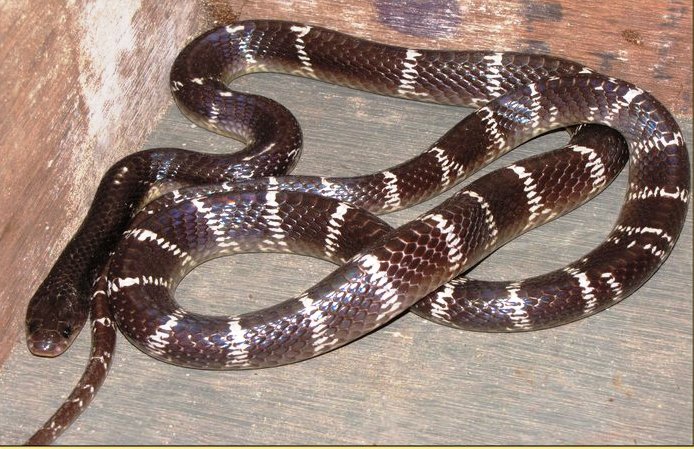 Common KraitBungarus caeruleus
-
 Eastern Brown SnakePseudonaja textilis
Compare
Questions and answers
What is the scientific name of the Coastal Burrowing Snake?
The scientific name of the Coastal Burrowing Snake is Simoselaps littoralis. Written with its author, the full name is Simoselaps littoralis (Storr, 1968).
Which family does the Coastal Burrowing Snake belong to?
Simoselaps littoralis belongs to the family Elapidae, in the order Squamata and the class Reptilia.
Where is the Coastal Burrowing Snake found?
Checklists and occurrence records place Simoselaps littoralis in 1 country: Australia.
What is the conservation status of the Coastal Burrowing Snake?
The IUCN Red List category recorded for Simoselaps littoralis is Least Concern (LC).
What other names does the Coastal Burrowing Snake have?
Simoselaps littoralis is also known in English as West Coast Banded Snake and West-Coast Banded Snake.
What kind of snakes burrow in the ground?
The Coastal Burrowing Snake is a burrowing snake.[1]
Do any snakes live on beaches?
The Coastal Burrowing Snake inhabits coastal dune environments.[3]
Sources
Passages the profile rests on
- The species is a mildly venomous burrowing snake. Source passage: “is a species of mildly venomous burrowing snake” — English Wikipedia
- The species reaches an average length of approximately 39 cm. Source passage: “The species grows to an average of about 39 cm in length.” — English Wikipedia
- The species inhabits coastal dune and heath environments. Source passage: “The species occurs in coastal dune and heath habitats” — English Wikipedia
- The species occurs along the western coast of Western Australia south of Exmouth, including coastal islands. Source passage: “along the west coast of Western Australia south of Exmouth, including coastal islands.” — English Wikipedia
- The species reproduces by laying eggs. Source passage: “The species is oviparous” — English Wikipedia
- The species has an average clutch size of four eggs. Source passage: “with an average clutch size of four.” — English Wikipedia
Data
- Catalogue of Life, 2026-10-16 XR cc by
- Global Biodiversity Information Facility CC BY 4.0
- Wikidata CC0
- GeoNames CC BY 4.0
- Within the Catalogue of Life, this name comes from The Reptile Database cc by
References
- Storr, G. M. (1968). The genus Vermicella (Serpentes : Elapidae) in Western Australia and the Northern Territory. J. Royal Soc. Western Australia. 50: 80-92.
- Storr G M. (1978). Taxonomic notes on the reptiles of the Shark Bay region, Western Australia. Rec. West. Aust. Mus. 6 (3): 303-318.
- Storr, G. M. (1979). Revisionary notes on the genus Vermicella (Serpentes: Elapidae). Rec. West. Aust. Mus. 8 (1): 75-79.
- Mengden, Gregory A. (1983). The taxonomy of Australian elapid snakes: A review. Rec. Austral. Mus. 35 (5): 195-222. Link
- Cogger, H. G. (2000). Reptiles and Amphibians of Australia, 6th ed. Ralph Curtis Publishing, Sanibel Island, 808 Pp.
- Wilson, S., & Swan, G. (2010). A complete guide to reptiles of Australia, 3rd ed. Chatswood: New Holland, 558 Pp.
- Gower, D.; Garrett, K. & Stafford, P. (2012). Snakes. Firefly Books, Buffalo, NY,144 P..
- Cogger, H. G. (2014). Reptiles and Amphibians of Australia, 7th ed. CSIRO Publishing, Xxx + 1033 Pp.
- Wallach, Van; Kenneth L. Williams, Jeff Boundy. (2014). Snakes of the World: A Catalogue of Living and Extinct Species. [type catalogue]. Taylor and Francis, CRC Press, 1237 Pp.
- How, RA, Cowan, MA, Teale, RJ, Schmitt, LH. (2020). Environmental correlates of reptile variation on the Houtman Abrolhos archipelago, eastern Indian Ocean. J Biogeogr. 47: 2017– 2028.
- Eipper T, & Eipper S. (2024). SNAKES OF AUSTRALIA. Princeton University Press, Princeton and Oxford, 368 Pp.
- Maryan, B., Gaikhorst, G., & Parkhurst, B. (2024). The terrestrial herpetofauna of the Zuytdorp coast and hinterland of Western Australia: Exceptional richness in a global biodiversity hotspot. Western Australian Naturalist, 33, 3.
This species in other databases
Page built on 29 November 2026. See how the catalog is made and all sources and licences.
Cite this page
ScientificNames.org. (2026). Simoselaps littoralis (Coastal Burrowing Snake). Retrieved November 29, 2026, from https://scientificnames.org/species/simoselaps-littoralis
“Simoselaps littoralis (Coastal Burrowing Snake).” ScientificNames.org, 2026, scientificnames.org/species/simoselaps-littoralis. Accessed 29 Nov. 2026.
ScientificNames.org. “Simoselaps littoralis (Coastal Burrowing Snake).” Accessed November 29, 2026. https://scientificnames.org/species/simoselaps-littoralis.
@misc{scientificnames_simoselaps_littoralis_coastal_burrowing_snake,
  author = {{ScientificNames.org}},
  title = {Simoselaps littoralis (Coastal Burrowing Snake)},
  year = {2026},
  url = {https://scientificnames.org/species/simoselaps-littoralis},
  note = {Accessed 2026-11-29}
}