Species · Flowering plants
Chinaroot Smilax china
The scientific name of the Chinaroot is Smilax china. It is a species of flowering plant in the family Smilacaceae (greenbriars), order Liliales.
- Scientific name
- Smilax china L.
- Common name
- Chinaroot
- Genus
- Smilax
- Family
- Smilacaceae (Greenbriars)
- Order
- Liliales
- Class
- Liliopsida
- Recorded in
- 12 countries
- Name status
- accepted in the Catalogue of Life

Overview
Smilax china is native to China, Korea, Taiwan, Japan, the Philippines, Vietnam, Thailand, Myanmar, and India. It has woody stems with sparse prickles, elliptic to orbicular leaves, and red, spherical berries.
Written 26 November 2026 from the sources listed below. Each statement was checked against the passage it cites; statements that could not be supported were removed.
Appearance
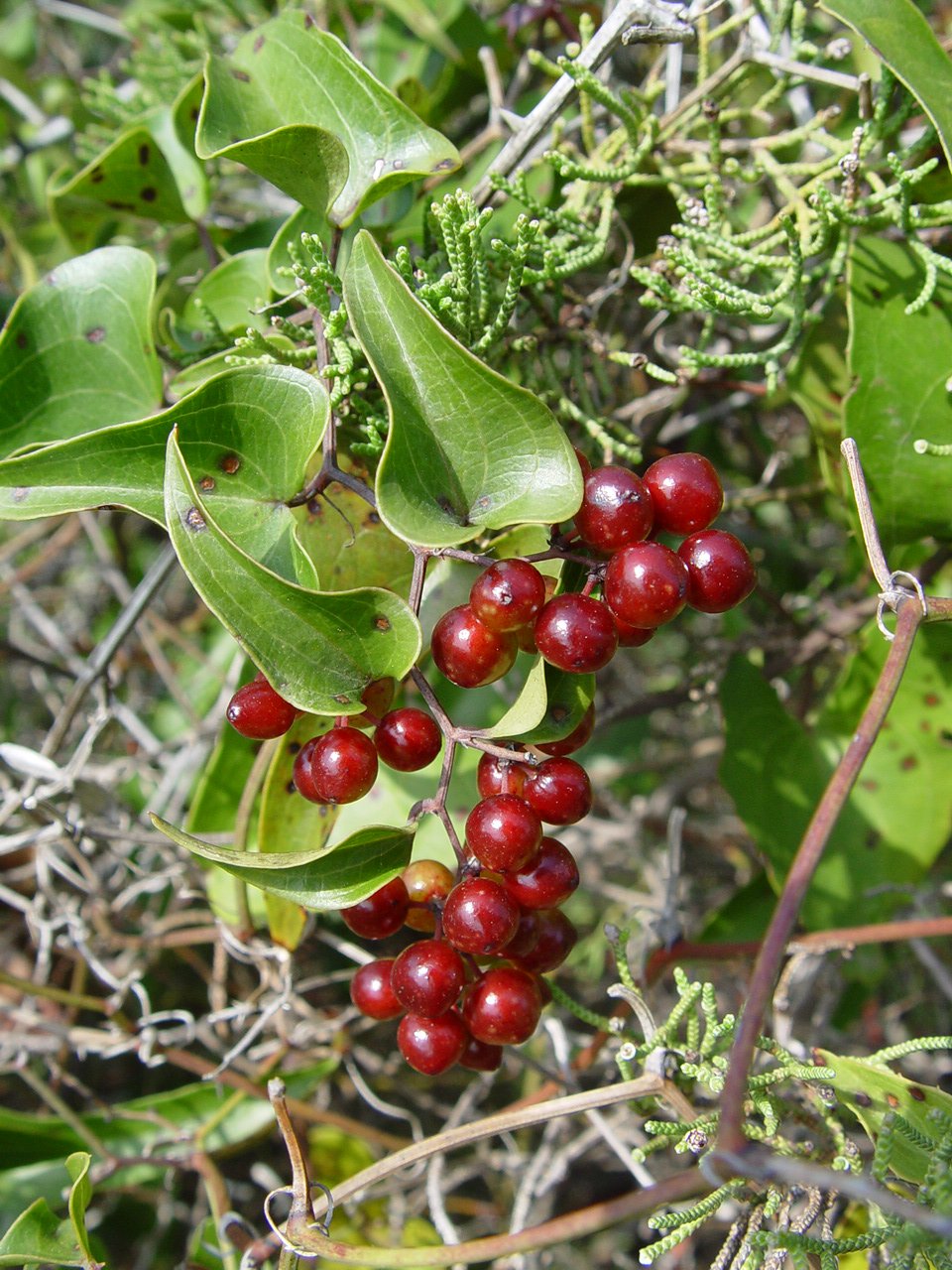
Chinaroot has woody stems with sparse prickles. Its leaves have elliptic to orbicular blades, and its berries are red and spherical.[1][2][3]
The woody stems measure 1–5 m in length. The petioles measure 0.5–1.5 cm, and the leaf blades measure 3–10 cm long and 1.5–6 cm wide, sometimes exceeding that width.[4][5][6]
The berries measure 0.6–1.5 cm in diameter.[7]
Habitat
In China, Chinaroot grows in forests and thickets and occurs on hillsides and grassy slopes.[8][9]
It also grows in shaded places along valleys or streams in China, at elevations ranging from near sea level to 2,000 m.[10][11]
Uses
In Korea, the leaves and roots of Chinaroot are used as herbs.[12][13]
Classification of the Chinaroot
| Kingdom | Plantae |
|---|---|
| Subkingdom | Pteridobiotina |
| Phylum | Tracheophyta |
| Class | Liliopsida |
| Order | Liliales |
| Family | Smilacaceae (Greenbriars) |
| Genus | Smilax (Greenbriar) |
| Species | Smilax china L. |
Where the Chinaroot is found
Checklists and occurrence records place Smilax china in 12 countries across Asia. GBIF holds 16,889 georeferenced records of it.
Countries
- Cambodia 4
- China 3,339
- Hong Kong 111
- India 13
- Japan 5,550
- Myanmar 7
- North Korea 27
- Philippines 73
- South Korea 6,175
- Taiwan 1,579
- Thailand 6
- Vietnam 5
Regions and cities with the most records
- Jeollanam-do, South Korea 680
- Taiwan, Taiwan 598
- Azamino, Japan 545
- Inagi, Japan 524
- Tokyo, Japan 521
- Noborito, Japan 513
- Komae, Japan 503
- Xizhi, Taiwan 501
- Neihu, Taiwan 498
- Fuchū, Japan 496
- Chōfu, Japan 494
- Taipei, Taiwan 493
- Chungcheongnam-do, South Korea 491
- Kokubunji, Japan 487
- Koganei, Japan 486
- New Taipei City, Taiwan 485
- Musashino, Japan 478
- Kodaira, Japan 472
- Nishi-Tokyo-shi, Japan 470
- Sekimachi-minami, Japan 467
- Higashikurume, Japan 460
- Gyeonggi-do, South Korea 459
- Den’enchōfu, Japan 458
- Banqiao, Taiwan 452
- Gyeongsangnam-do, South Korea 451
- Kamiigusa, Japan 445
- Asagaya-minami, Japan 434
- Shimoigusa, Japan 432
- Kiyose, Japan 422
- Ōta, Japan 416
- Kawasaki, Japan 413
- Ōizumi-gakuenchō, Japan 413
- Guangdong, China 411
- Jeollabuk-do, South Korea 410
- Ōizumimachi, Japan 407
- Danshui, Taiwan 404
4 more countries have a few records outside this range
These countries hold a few records of Smilax china but lie outside the range the checklists give for it. Such records are often zoo or garden specimens, museum material or vagrants, so the species is not counted as occurring there.
A number beside a place is its count of GBIF occurrence records. A place without a number comes from a checklist alone. Records show where a species has been observed or collected, which can include escapes and vagrants.
Common names
English
- Chinaroot
- Chinese Smilax
Names in 4 other languages
- French
- racine de Chine
- German
- Chinawurzel
- Spanish
- zarzaparilla de China
- Swedish
- kinarot
Synonyms
2 other scientific names have been used for this species and are now treated as synonyms of Smilax china.
- Smilax china f. china
- Smilax china f. obtusa H.Lév.
Subspecies and varieties
- Smilax china var. china variety
- Smilax china var. kuru variety
Related species
-
 Common GreenbrierSmilax rotundifolia
-
 Common SmilaxSmilax aspera
-
 CatbrierSmilax bona-nox
-
 Carrion-flowerSmilax herbacea
-
 Cat GreenbrierSmilax glauca
-
 Chinese SmilaxSmilax glabra
-
 Bristly GreenbrierSmilax tamnoides
-
 Sweet SarsaparillaSmilax glyciphylla
Compare
Questions and answers
What is the scientific name of the Chinaroot?
The scientific name of the Chinaroot is Smilax china. Written with its author, the full name is Smilax china L..
Which family does the Chinaroot belong to?
Smilax china belongs to the family Smilacaceae, in the order Liliales and the class Liliopsida.
Where is the Chinaroot found?
Checklists and occurrence records place Smilax china in 12 countries, including South Korea, Japan, China, Taiwan, Hong Kong and Philippines.
What other names does the Chinaroot have?
Smilax china is also known in English as Chinese Smilax.
Sources
Passages the profile rests on
- Smilax china has woody stems with sparse prickles. Source passage: “The stem is woody, sparsely prickly” — English Wikipedia
- The leaves of Smilax china have elliptic to orbicular blades. Source passage: “leaf blade is elliptic to orbicular” — English Wikipedia
- The berries of Smilax china are red and spherical. Source passage: “Berries are red, globose” — English Wikipedia
- The woody stems of Smilax china measure 1–5 m in length. Source passage: “1–5 m (3 ft 3 in – 16 ft 5 in) long.” — English Wikipedia
- The petioles of Smilax china measure 0.5–1.5 cm in length. Source passage: “Petiole is 0.5–1.5 cm (0.20–0.59 in) long” — English Wikipedia
- The leaf blades of Smilax china measure 3–10 cm long and 1.5–6 cm wide, sometimes exceeding that width. Source passage: “3–10 cm (1.2–3.9 in) long and 1.5–6 cm (0.59–2.36 in) wide, sometimes wider.” — English Wikipedia
- The berries of Smilax china measure 0.6–1.5 cm in diameter. Source passage: “0.6–1.5 cm (0.24–0.59 in) in diameter.” — English Wikipedia
- In China, Smilax china grows in forests and thickets. Source passage: “In China, S. china occurs in forests, thickets” — English Wikipedia
- In China, Smilax china occurs on hillsides and grassy slopes. Source passage: “hillsides, grassy slopes” — English Wikipedia
- In China, Smilax china grows in shaded places along valleys or streams. Source passage: “shaded places along valleys or streams.” — English Wikipedia
- In China, Smilax china occurs at elevations ranging from near sea level to 2,000 m. Source passage: “It is found from near sea level to 2,000 m (6,600 ft).” — English Wikipedia
- The leaves of Smilax china are used as herbs in Korea. Source passage: “In Korea, its leaves and roots are used as herbs.” — English Wikipedia
- The roots of Smilax china are used as herbs in Korea. Source passage: “In Korea, its leaves and roots are used as herbs.” — English Wikipedia
Data
- Catalogue of Life, 2026-10-16 XR cc by
- Global Biodiversity Information Facility CC BY 4.0
- Wikidata CC0
- GeoNames CC BY 4.0
- Wikimedia Commons per image; credit shown with each image
- Within the Catalogue of Life, this name comes from The World Checklist of Vascular Plants (WCVP) cc by
References
- Sp. Pl.: 1029 (1753) where the name was published
This species in other databases
Page built on 28 November 2026. See how the catalog is made and all sources and licences.
Cite this page
ScientificNames.org. (2026). Smilax china (Chinaroot). Retrieved November 28, 2026, from https://scientificnames.org/species/smilax-china
“Smilax china (Chinaroot).” ScientificNames.org, 2026, scientificnames.org/species/smilax-china. Accessed 28 Nov. 2026.
ScientificNames.org. “Smilax china (Chinaroot).” Accessed November 28, 2026. https://scientificnames.org/species/smilax-china.
@misc{scientificnames_smilax_china_chinaroot,
  author = {{ScientificNames.org}},
  title = {Smilax china (Chinaroot)},
  year = {2026},
  url = {https://scientificnames.org/species/smilax-china},
  note = {Accessed 2026-11-28}
}