Species · Flowering plants
Carrion-flower Smilax herbacea
The scientific name of the Carrion-flower is Smilax herbacea. It is a species of flowering plant in the family Smilacaceae (greenbriars), order Liliales.
- Scientific name
- Smilax herbacea L.
- Common name
- Carrion-flower
- Genus
- Smilax
- Family
- Smilacaceae (Greenbriars)
- Order
- Liliales
- Class
- Liliopsida
- Recorded in
- 2 countries
- Name status
- accepted in the Catalogue of Life

Overview
The species is native to eastern North America. The carrion-flower produces clusters of small green to yellow-green flowers with a carrion-like odor that attracts flies and beetles.
Written 26 November 2026 from the sources listed below. Each statement was checked against the passage it cites; statements that could not be supported were removed.
Appearance
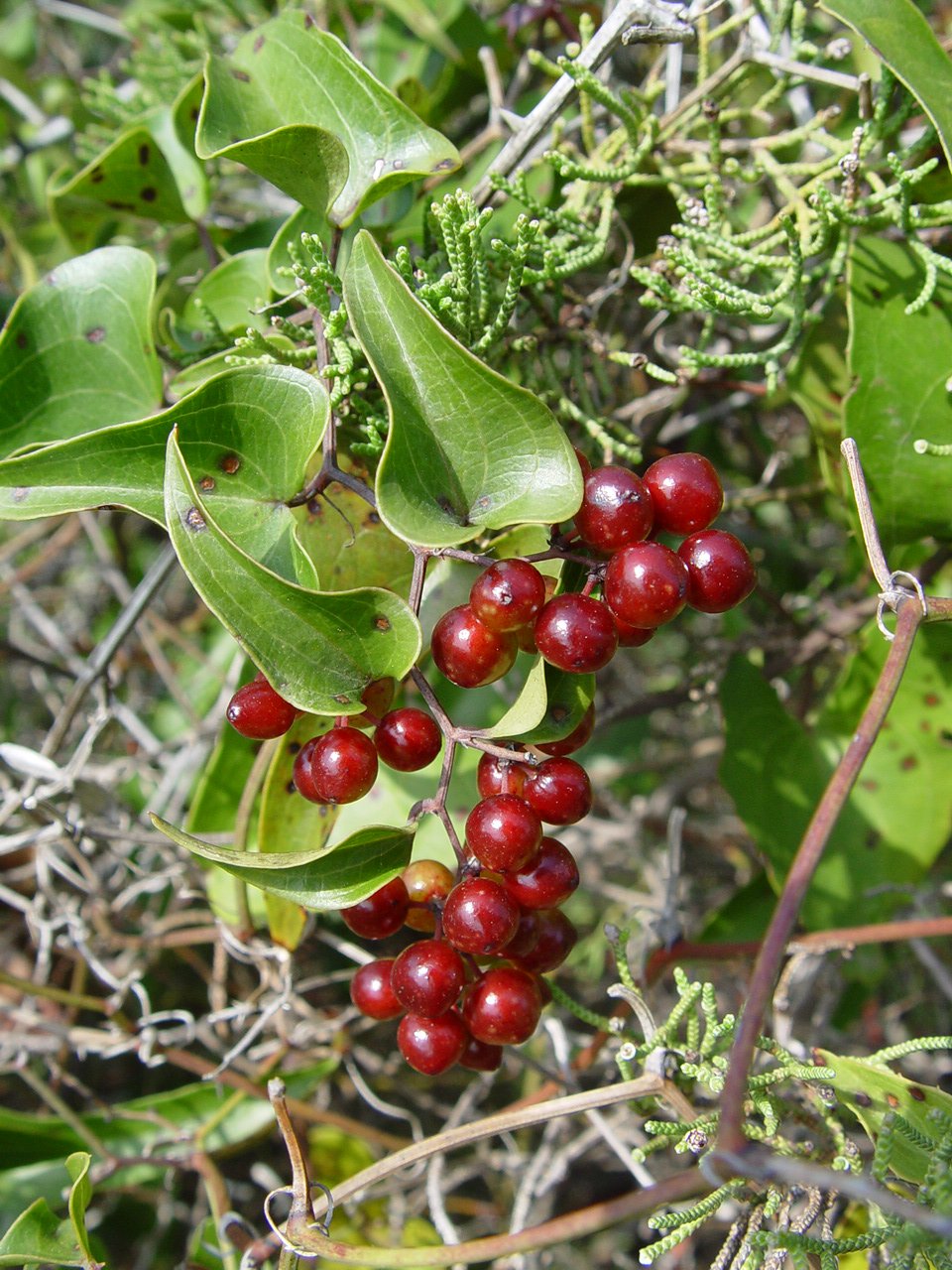
The carrion-flower produces smooth green shoots that emerge from a perennial rhizome each spring. Its stems are generally smooth, although some populations have scattered small thorns.[1][2]
Its leaves are alternately arranged and heart-shaped, with three to seven prominent veins. The upper surfaces are dark green and smooth, while the undersides are pale green and hairless.[3][4]
The leaf petioles bear short tendrils that help the vine attach to vegetation or structures. Its climbing stems can reach six to nine feet in height when support is available, and its leaves measure five to fifteen centimeters in length.[5][6][7]
The flowers are small, green to yellow-green, and arranged in large clusters. The peduncles can reach ten centimeters in length, and the ripe berries are dark blue to black.[8][9][10]
Habitat
The carrion-flower grows in moist deciduous forests, riparian thickets, moist meadows, lowlands, and open or partially open savannas.[11]
It can grow in clay, loam, and sandy soils when sufficient moisture is present. The plant tolerates shade but prefers full or partial sunlight and can tolerate fluctuations in moisture and sunlight.[12][13][14]
Behaviour
The carrion-flower climbs when support is available but spreads along the ground when support is absent.[15]
Its flowers produce a carrion-like odor that attracts flies and beetles.[16]
Reproduction and life cycle
The carrion-flower is dioecious, with male and female flowers occurring on separate plants. Its flowers are arranged in spherical umbels on elongated stalks, and individual flowers generally remain alive for approximately four days.[17][18][19]
Both male and female flowers possess nectar glands at their bases. Carrion flies and beetles are attracted to the flowers by their strong odor.[20][21]
Flowering occurs primarily during May and June. Only female plants produce fruit, and each berry typically contains multiple seeds.[22][23][24]
The berries generally mature in late summer and may continue developing into winter if uneaten.[25]
Uses
Young shoots and leaves are edible both raw and cooked. Their flavor and texture are commonly compared to asparagus.[26][27]
Ripe berries can be eaten fresh or processed into jelly. The roots can be dried and powdered for use as thickening flour or as a starchy food ingredient.[28][29]
Indigenous groups, including the Cherokee, have traditionally used the carrion-flower medicinally. Traditional applications include treatments for rheumatism and arthritis, and poultices for burns, sores, and skin eruptions.[30][31][32]
Traditional medicinal preparations include decoctions for cramps, lung conditions, and back pain.[33]
Similar species
Smilax hirtellicaulis is identified as a closely related Asian species.[34]
Classification of the Carrion-flower
| Kingdom | Plantae |
|---|---|
| Subkingdom | Pteridobiotina |
| Phylum | Tracheophyta |
| Class | Liliopsida |
| Order | Liliales |
| Family | Smilacaceae (Greenbriars) |
| Genus | Smilax (Greenbriar) |
| Species | Smilax herbacea L. |
Where the Carrion-flower is found
Checklists and occurrence records place Smilax herbacea in 2 countries across North America. GBIF holds 6,951 georeferenced records of it.
Countries
Regions and cities with the most records
- Ontario, Canada 728
- Pennsylvania, United States 588
- Quebec, Canada 548
- Massachusetts, United States 506
- New York, United States 339
- North Carolina, United States 338
- Virginia, United States 195
- Connecticut, United States 170
- Vermont, United States 137
- Maine, United States 135
- Fallingbrook, Canada 122
- Ottawa, Canada 122
- Ottawa South, Canada 122
- Vanier, Canada 120
- Gatineau, Canada 119
- Orléans, Canada 118
- Clarence-Rockland, Canada 117
- New Hampshire, United States 116
- Buckingham, Canada 107
- New Jersey, United States 107
- L'Ancienne-Lorette, Canada 106
- Maryland, United States 103
- Neufchâtel-Est–Lebourgneuf, Canada 103
- Rosemont–La Petite-Patrie, Canada 100
- Mont-Royal, Canada 99
- Saint-Augustin-de-Desmaures, Canada 97
- Le Plateau-Mont-Royal, Canada 95
- Québec, Canada 95
- Villeray–Saint-Michel–Parc-Extension, Canada 94
- Longueuil, Canada 93
- Gloucester, Canada 92
- Côte-Saint-Luc, Canada 91
- Laflèche, Canada 91
- Greenfield Park, Canada 90
- Montréal, Canada 90
- Ville-Marie, Canada 88
2 more countries have a few records outside this range
These countries hold a few records of Smilax herbacea but lie outside the range the checklists give for it. Such records are often zoo or garden specimens, museum material or vagrants, so the species is not counted as occurring there.
A number beside a place is its count of GBIF occurrence records. A place without a number comes from a checklist alone. Records show where a species has been observed or collected, which can include escapes and vagrants.
Common names
English
- Carrion-flower
- Jacob's-ladder
- Carrionflower
- Herbaceous Carrionflower
- Smooth Carrionflower
Names in 1 other language
- French
- raisin de couleuvre, smilace herbacée, smilax herbacé
Synonyms
16 other scientific names have been used for this species and are now treated as synonyms of Smilax herbacea.
- Coprosmanthus consanguineus Kunth
- Coprosmanthus herbaceus (L.) Kunth
- Coprosmanthus peduncularis (Muhl. ex Willd.) Kunth
- Nemexia cerulea Raf.
- Nemexia herbacea (L.) Small
- Nemexia nigra Raf.
- Smilax herbacea subsp. crispifolia Pennell
- Smilax herbacea var. herbacea
- Smilax herbacea var. humilis Farw.
- Smilax herbacea var. latifolia House
- Smilax herbacea var. peduncularis (Muhl. ex Willd.) A.DC.
- Smilax herbacea var. simsii A.DC.
- Smilax peduncularia Muhlenberg ex Willdenow
- Smilax watsonii Sweet
- Smilax longifolia P.Watson ambiguous synonym
- Smilax peduncularis Muhl. ex Willd. ambiguous synonym
Related species
-
 Common GreenbrierSmilax rotundifolia
-
 Common SmilaxSmilax aspera
-
 CatbrierSmilax bona-nox
-
 ChinarootSmilax china
-
 Cat GreenbrierSmilax glauca
-
 Chinese SmilaxSmilax glabra
-
 Bristly GreenbrierSmilax tamnoides
-
 Sweet SarsaparillaSmilax glyciphylla
Compare
Questions and answers
What is the scientific name of the Carrion-flower?
The scientific name of the Carrion-flower is Smilax herbacea. Written with its author, the full name is Smilax herbacea L..
Which family does the Carrion-flower belong to?
Smilax herbacea belongs to the family Smilacaceae, in the order Liliales and the class Liliopsida.
Where is the Carrion-flower found?
Checklists and occurrence records place Smilax herbacea in 2 countries: United States and Canada.
What other names does the Carrion-flower have?
Smilax herbacea is also known in English as Jacob's-ladder, Carrionflower, Herbaceous Carrionflower and Smooth Carrionflower.
Why is it called a carrion flower?
Its flowers produce a carrion-like odor that attracts flies and beetles.[16][21]
What does the carrion flower smell like?
Its flowers produce a carrion-like odor.[16]
Can you eat berries of a carrion flower?
Yes. Ripe berries can be eaten fresh or processed into jelly.[28]
What is Smilax used for?
Young shoots and leaves are eaten raw or cooked, ripe berries are eaten fresh or made into jelly, and dried powdered roots are used as thickening flour or as a starchy food ingredient. Indigenous groups, including the Cherokee, have traditionally used the species medicinally for rheumatism, arthritis, burns, sores, skin eruptions, cramps, lung conditions, and back pain.[26][28][29][30][31][32][33]
Sources
Passages the profile rests on
- Smilax herbacea produces smooth green shoots that emerge from a perennial rhizome each spring. Source passage: “Smilax herbacea grows as a smooth, green shoot from a perennial rhizome each spring.” — English Wikipedia
- The plant generally has smooth stems, although some populations have scattered small thorns. Source passage: “The stems of this plant are usually very smooth, although some plants may have scattered small thorns depending on the population.” — English Wikipedia
- Its leaves are alternately arranged and heart-shaped, with three to seven prominent veins. Source passage: “Leaves are arranged alternately and appear heart-shaped, growing five to fifteen centimeters long with three to seven prominent veins in them.” — English Wikipedia
- The upper leaf surfaces are dark green and smooth, while the undersides are pale green and hairless. Source passage: “The upper leaf surfaces are smooth and dark green, while the undersides are pale green and hairless.” — English Wikipedia
- The leaf petioles bear short tendrils that help the vine attach to vegetation or structures. Source passage: “The leaf petioles have short tendrils that allow the vine to attach to other vegetation or structures.” — English Wikipedia
- The climbing stems can reach six to nine feet in height when support is available. Source passage: “As the plant grows, the shoot becomes a climbing vine, which can reach six to nine feet in height if support is available” — English Wikipedia
- Its leaves measure five to fifteen centimeters in length. Source passage: “Leaves are arranged alternately and appear heart-shaped, growing five to fifteen centimeters long with three to seven prominent veins in them.” — English Wikipedia
- Its peduncles can reach ten centimeters in length. Source passage: “The plant also has long peduncles, which can reach up to ten centimeters in length.” — English Wikipedia
- The flowers are small, green to yellow-green, and arranged in large clusters. Source passage: “The plant produces numerous small green to yellow-green flowers arranged in large clusters, which is the source of its characteristic odor.” — English Wikipedia
- Its ripe berries are dark blue to black. Source passage: “These flowers then develop into berries that are dark blue to black when they are ripe.” — English Wikipedia
- The species grows in moist deciduous forests, riparian thickets, moist meadows, lowlands, and open or partially open savannas. Source passage: “This plant usually grows in moist, nutrient-rich environments such as deciduous forests, riparian thickets, moist meadows and lowlands, open or partially open savannas, and some forests.” — English Wikipedia
- The species can grow in clay, loam, and sandy soils when sufficient moisture is present. Source passage: “In terms of soil, it can grow in clay, loam, or sandy soils, as long as there is enough moisture present.” — English Wikipedia
- The plant tolerates shade but prefers full or partial sunlight. Source passage: “It can grow in shade but prefers areas with full or partial sun.” — English Wikipedia
- The species can tolerate fluctuations in moisture and sunlight. Source passage: “This plant is also highly adaptable and can grow in habitats that experience fluctuations in moisture and sunlight.” — English Wikipedia
- The plant climbs when support is available but spreads along the ground when support is absent. Source passage: “As the plant grows, the shoot becomes a climbing vine, which can reach six to nine feet in height if support is available, but without support, the stems will spread out on the ground.” — English Wikipedia
- Its flowers produce a carrion-like odor that attracts flies and beetles. Source passage: “The flowers emit a strong carrion odor, which is used in order to attract carrion flies and beetles.” — English Wikipedia
- Smilax herbacea is dioecious, with male and female flowers occurring on separate plants. Source passage: “Smilax herbacea is dioecious, meaning male and female flowers occur on separate plants.” — English Wikipedia
- Its flowers are arranged in spherical umbels on elongated stalks. Source passage: “The flowers are arranged in spherical umbels on elongated stalks and are green to yellow-green in color.” — English Wikipedia
- Individual flowers generally remain alive for approximately four days. Source passage: “Individual flowers can usually stay alive for about four days.” — English Wikipedia
- Both male and female flowers possess nectar glands at their bases. Source passage: “Both male and female flowers in this plant have nectar glands at their bases, which is how they attract a variety of pollinators.” — English Wikipedia
- Carrion flies and beetles are attracted to the flowers by their strong odor. Source passage: “The flowers emit a strong carrion odor, which is used in order to attract carrion flies and beetles.” — English Wikipedia
- Flowering occurs primarily during May and June. Source passage: “For Smilax herbacea, flowering occurs mostly in May and June.” — English Wikipedia
- Only female plants produce fruit. Source passage: “In this flower, only female vines are able to produce fruit.” — English Wikipedia
- Each berry typically contains multiple seeds. Source passage: “Each berry typically contains multiple seeds, and the fruits are arranged in tight clusters.” — English Wikipedia
- The berries generally mature in late summer and may continue developing into winter if uneaten. Source passage: “They usually mature in late summer and sometimes continue to grow into the winter if they are not consumed.” — English Wikipedia
- Young shoots and leaves are edible both raw and cooked. Source passage: “The young shoots and leaves of Smilax herbacea are edible and can be eaten raw or cooked.” — English Wikipedia
- The flavor and texture of its young shoots and leaves are commonly compared to asparagus. Source passage: “They are usually compared to asparagus in flavor and texture.” — English Wikipedia
- Ripe berries can be eaten fresh or processed into jelly. Source passage: “The ripe berries can also be consumed fresh or used to produce jelly.” — English Wikipedia
- The roots can be dried and powdered for use as thickening flour or as a starchy food ingredient. Source passage: “The roots can also be dried, powdered, and used as a thickening flour or as a starchy component for many of the traditional foods of indigenous people.” — English Wikipedia
- Indigenous groups, including the Cherokee, have traditionally used the species medicinally. Source passage: “Indigenous groups, including the Cherokee, traditionally have been the ones to use this plant medicinally.” — English Wikipedia
- Traditional medicinal applications include treatments for rheumatism and arthritis. Source passage: “It has been used for treatments of rheumatism and arthritis, remedies for kidney and urinary issues” — English Wikipedia
- Traditional applications include poultices for burns, sores, and skin eruptions. Source passage: “poultices for burns, sores, and skin eruptions” — English Wikipedia
- Traditional medicinal preparations include decoctions for cramps, lung conditions, and back pain. Source passage: “and decoctions for cramps, lung conditions, and back pain.” — English Wikipedia
- Smilax hirtellicaulis is identified as a closely related Asian species. Source passage: “comparative morphological and molecular research have identified closely related species to this plant in Asia, including Smilax hirtellicaulis.” — English Wikipedia
Data
- Catalogue of Life, 2026-10-16 XR cc by
- Global Biodiversity Information Facility CC BY 4.0
- Wikidata CC0
- GeoNames CC BY 4.0
- Wikimedia Commons per image; credit shown with each image
- Within the Catalogue of Life, this name comes from The World Checklist of Vascular Plants (WCVP) cc by
References
- Sp. Pl.: 1030 (1753) where the name was published
This species in other databases
Page built on 27 November 2026. See how the catalog is made and all sources and licences.
Cite this page
ScientificNames.org. (2026). Smilax herbacea (Carrion-flower). Retrieved November 27, 2026, from https://scientificnames.org/species/smilax-herbacea
“Smilax herbacea (Carrion-flower).” ScientificNames.org, 2026, scientificnames.org/species/smilax-herbacea. Accessed 27 Nov. 2026.
ScientificNames.org. “Smilax herbacea (Carrion-flower).” Accessed November 27, 2026. https://scientificnames.org/species/smilax-herbacea.
@misc{scientificnames_smilax_herbacea_carrion_flower,
  author = {{ScientificNames.org}},
  title = {Smilax herbacea (Carrion-flower)},
  year = {2026},
  url = {https://scientificnames.org/species/smilax-herbacea},
  note = {Accessed 2026-11-27}
}