Species · Flowering plants
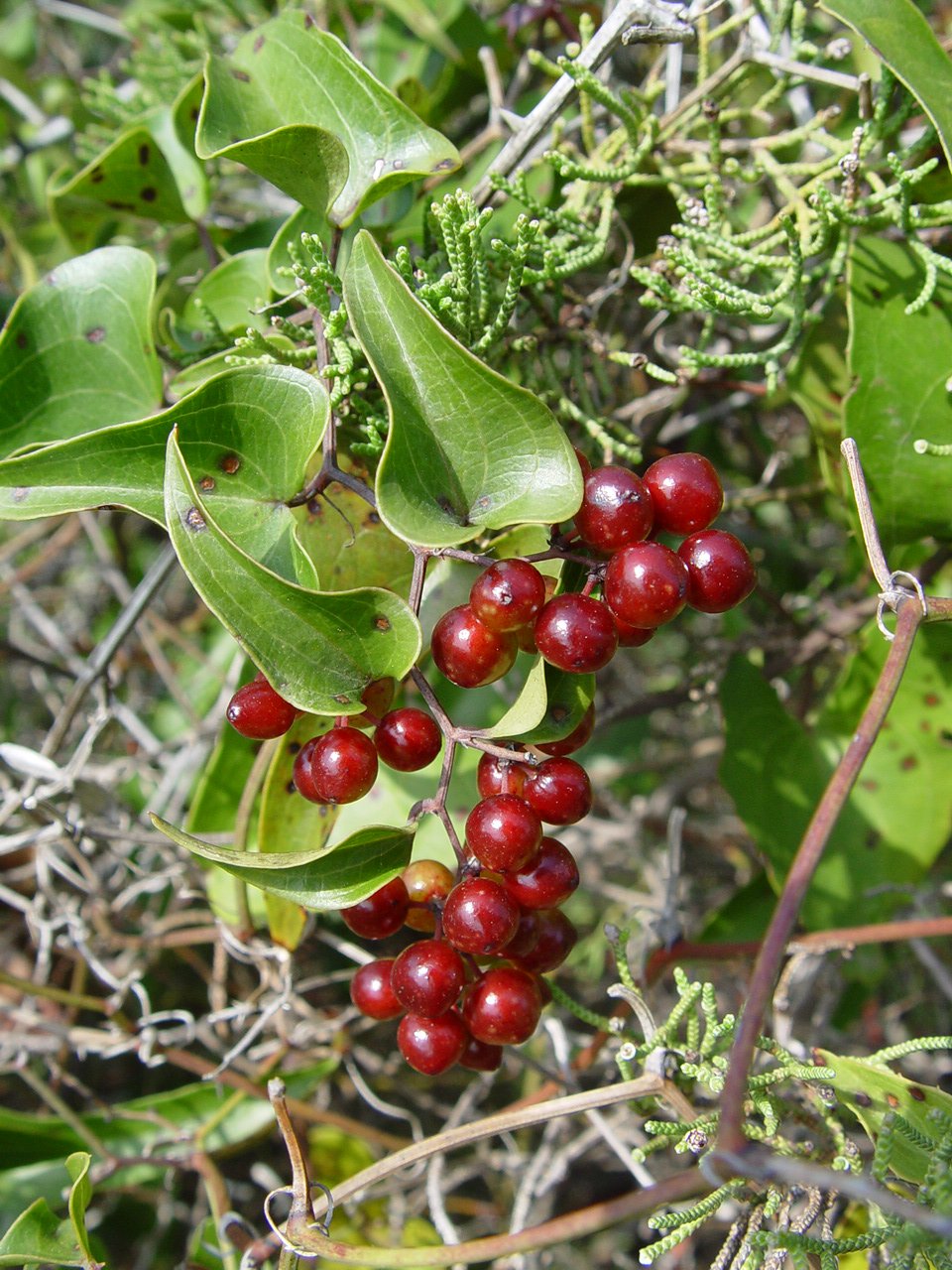
Chinese Smilax Smilax glabra
The scientific name of the Chinese Smilax is Smilax glabra. It is a species of flowering plant in the family Smilacaceae (greenbriars), order Liliales.
- Scientific name
- Smilax glabra Roxb.
- Common name
- Chinese Smilax
- Genus
- Smilax
- Family
- Smilacaceae (Greenbriars)
- Order
- Liliales
- Class
- Liliopsida
- Recorded in
- 11 countries
- Name status
- accepted in the Catalogue of Life

Overview
Chinese smilax is an herbal vine. It is native to China, the Himalayas, and Indochina. It is used as a traditional medicinal plant in Chinese herbal medicine.
Written 26 November 2026 from the sources listed below. Each statement was checked against the passage it cites; statements that could not be supported were removed.
Appearance
Chinese smilax is an herbal vine.[1]
Habitat
Chinese smilax is native to China, the Himalayas, and Indochina.[2]
It is widely distributed in China, India, Vietnam, Myanmar, and Thailand.[3]
Uses
Chinese smilax is used as a traditional medicinal plant in Chinese herbal medicine. Its root is traditionally used to treat dysentery, joint pain, and colds.[4][5]
The plant's rhizome is collected and dried throughout the year for medicinal use. The dried root is prepared by mixing it with water and taking it orally.[6][7]
The dried rhizome is recorded in the Chinese Pharmacopoeia as a traditional medicine used to treat syphilis, furunculosis, eczema, dermatitis, nephritis, cystitis, and mercury poisoning.[8]
The species is traditionally believed to help treat syphilis and remove dampness and toxicity associated with yin disease.[9]
The dried rhizome is used in traditional Chinese medicine and functional foods. It is the main ingredient of Gui Ling Gao, a functional food popular in southern China, and is also used in the Chinese medicinal dessert guilinggao.[10][11][12]
Classification of the Chinese Smilax
| Kingdom | Plantae |
|---|---|
| Subkingdom | Pteridobiotina |
| Phylum | Tracheophyta |
| Class | Liliopsida |
| Order | Liliales |
| Family | Smilacaceae (Greenbriars) |
| Genus | Smilax (Greenbriar) |
| Species | Smilax glabra Roxb. |
Where the Chinese Smilax is found
Checklists and occurrence records place Smilax glabra in 11 countries across Asia. GBIF holds 2,649 georeferenced records of it.
Countries
- Bangladesh 1
- Cambodia 5
- China 2,320
- Hong Kong 60
- India 10
- Laos 3
- Macao 11
- Myanmar 1
- Taiwan 180
- Thailand 19
- Vietnam 39
Regions and cities with the most records
- Guangdong, China 330
- Yunnan, China 203
- Sichuan, China 186
- Jiangxi, China 171
- Guangxi, China 142
- Hubei, China 138
- Zhejiang, China 135
- Guizhou, China 102
- Hunan, China 97
- Taiwan, Taiwan 86
- Chongqing, China 83
- Fujian, China 78
- Hainan, China 48
- Anlong, China 35
- Discovery Park, Hong Kong 33
- Tsuen Wan, Hong Kong 33
- Fairview Park, Hong Kong 31
- Pat Heung, Hong Kong 31
- Puli, Taiwan 31
- Sham Tseng, Hong Kong 31
- Tai Po, Hong Kong 31
- Ting Kau, Hong Kong 31
- Kam Tin, Hong Kong 30
- Fanling, Hong Kong 29
- Hong Lok Yuen, Hong Kong 29
- San Tin, Hong Kong 29
- Sheung Shui, Hong Kong 29
- Shuen Wan, Hong Kong 29
- Yuen Long Kau Hui, Hong Kong 29
- Gecheng, China 28
- Yuen Long, Hong Kong 28
- Gangxia, China 27
- Ping Shan, Hong Kong 27
- Shap Pat Heung, Hong Kong 27
- Shawei, China 27
- Shenzhen, China 27
1 more country has a few records outside this range
These countries hold a few records of Smilax glabra but lie outside the range the checklists give for it. Such records are often zoo or garden specimens, museum material or vagrants, so the species is not counted as occurring there.
A number beside a place is its count of GBIF occurrence records. A place without a number comes from a checklist alone. Records show where a species has been observed or collected, which can include escapes and vagrants.
Common names
English
- Chinese Smilax
- Glabrous Greenbrier
Names in 4 other languages
- Chinese
- 光葉菝葜 (土茯苓), 禹餘糧
- Japanese
- ドブクリョウ
- Russian
- Смилакс голый
- Thai
- ข้าวเย็นใต้
Synonyms
8 other scientific names have been used for this species and are now treated as synonyms of Smilax glabra.
- Smilax blinii H.Lév.
- Smilax calophylla var. concolor C.H.Wright
- Smilax dunniana H.Lév.
- Smilax glabra var. maculata H.Lév.
- Smilax hookeri Kunth
- Smilax mengmaensis R.H.Miao
- Smilax trigona Warb.
- Smilax lanceolata Burm.f. ambiguous synonym
Related species
-
 Common GreenbrierSmilax rotundifolia
-
 Common SmilaxSmilax aspera
-
 CatbrierSmilax bona-nox
-
 Carrion-flowerSmilax herbacea
-
 ChinarootSmilax china
-
 Cat GreenbrierSmilax glauca
-
 Bristly GreenbrierSmilax tamnoides
-
 Sweet SarsaparillaSmilax glyciphylla
Compare
Questions and answers
What is the scientific name of the Chinese Smilax?
The scientific name of the Chinese Smilax is Smilax glabra. Written with its author, the full name is Smilax glabra Roxb..
Which family does the Chinese Smilax belong to?
Smilax glabra belongs to the family Smilacaceae, in the order Liliales and the class Liliopsida.
Where is the Chinese Smilax found?
Checklists and occurrence records place Smilax glabra in 11 countries, including China, Taiwan, Hong Kong, Vietnam, Thailand and Macao.
What other names does the Chinese Smilax have?
Smilax glabra is also known in English as Glabrous Greenbrier.
What is Chinese Smilax used for?
Chinese smilax is used in traditional Chinese medicine. Its root is traditionally used to treat dysentery, joint pain, and colds, while its dried rhizome is recorded as a traditional medicine for syphilis, furunculosis, eczema, dermatitis, nephritis, cystitis, and mercury poisoning. Its rhizome is also used in functional foods and as the main ingredient of Gui Ling Gao.[4][10][5][11][8][12]
Sources
Passages the profile rests on
- Smilax glabra is an herbal vine. Source passage: “Smilax glabra Roxb. is an herbal vine widely distributed in China” — pmc.ncbi.nlm.nih.gov
- Smilax glabra is native to China, the Himalayas, and Indochina. Source passage: “It is native to China, the Himalayas, and Indochina.” — English Wikipedia
- Smilax glabra is widely distributed in China, India, Vietnam, Myanmar, and Thailand. Source passage: “Smilax glabra Roxb. (Smilacaceae) is an herbal vine that is widely distributed in China, India, Vietnam, Myanmar and Thailand” — pmc.ncbi.nlm.nih.gov
- The species is used as a traditional medicinal plant in Chinese herbal medicine. Source passage: “S. glabra is a traditional medicine in Chinese herbology” — English Wikipedia
- The root is traditionally used in Chinese medicine to treat dysentery, joint pain, and colds. Source passage: “The root of S. glabra is used in traditional Chinese medicine (TCM) to treat dysentery, joint pain and colds.” — English Wikipedia
- The plant's rhizome is collected and dried throughout the year for medicinal use. Source passage: “The rhizome of the plant is collected and dried during all seasons for herbal use.” — English Wikipedia
- The dried root is prepared by mixing it with water and taking it orally. Source passage: “The dried root is mixed with water and taken orally.” — English Wikipedia
- The dried rhizome is recorded in the Chinese Pharmacopoeia as a traditional medicine used to treat syphilis, furunculosis, eczema, dermatitis, nephritis, cystitis, and mercury poisoning. Source passage: “SGR is recorded in the Chinese Pharmacopoeia and is used to treat syphilis, furunculosis, eczema, dermatitis, nephritis, cystitis, and mercury poisoning” — pmc.ncbi.nlm.nih.gov
- The species is traditionally believed to help treat syphilis and remove dampness and toxicity associated with yin disease. Source passage: “It is believed to cure Syphilis and restore balance in the body in response to yin disease by removing dampness and toxicity.” — English Wikipedia
- The rhizome of Smilax glabra is used as an ingredient in the Chinese medicinal dessert guilinggao. Source passage: “Chinaroot is a key ingredient in the Chinese medical dessert guilinggao” — English Wikipedia
- The dried rhizome is used in traditional Chinese medicine and functional foods. Source passage: “its dried rhizome (Smilacis Glabrae Rhizoma, SGR) is often used in traditional medicines and functional foods.” — pmc.ncbi.nlm.nih.gov
- The dried rhizome is the main ingredient of Gui Ling Gao, a functional food popular in southern China. Source passage: “SGR is also the main ingredient of “Gui Ling Gao” (turtle jelly), a well-known functional food popular in southern China” — pmc.ncbi.nlm.nih.gov
Data
- Catalogue of Life, 2026-10-16 XR cc by
- Global Biodiversity Information Facility CC BY 4.0
- Wikidata CC0
- GeoNames CC BY 4.0
- Wikimedia Commons per image; credit shown with each image
- Within the Catalogue of Life, this name comes from The World Checklist of Vascular Plants (WCVP) cc by
References
- Fl. Ind., ed. 1832. 3: 792 (1832) where the name was published
This species in other databases
- Catalogue of Life 4XWGT
- Wikidata Q3658986
- iNaturalist 556188
- World Flora Online wfo-0000742694
- GRIN 423547
Page built on 28 November 2026. See how the catalog is made and all sources and licences.
Cite this page
ScientificNames.org. (2026). Smilax glabra (Chinese Smilax). Retrieved November 28, 2026, from https://scientificnames.org/species/smilax-glabra
“Smilax glabra (Chinese Smilax).” ScientificNames.org, 2026, scientificnames.org/species/smilax-glabra. Accessed 28 Nov. 2026.
ScientificNames.org. “Smilax glabra (Chinese Smilax).” Accessed November 28, 2026. https://scientificnames.org/species/smilax-glabra.
@misc{scientificnames_smilax_glabra_chinese_smilax,
  author = {{ScientificNames.org}},
  title = {Smilax glabra (Chinese Smilax)},
  year = {2026},
  url = {https://scientificnames.org/species/smilax-glabra},
  note = {Accessed 2026-11-28}
}