Species · Birds
Australasian Figbird Sphecotheres vieilloti
The scientific name of the Australasian Figbird is Sphecotheres vieilloti. It is a species of bird in the family Oriolidae (old world oriole), order Passeriformes. The name dates from 1827.
- Scientific name
- Sphecotheres vieilloti Vigors & Horsfield, 1827
- Common name
- Australasian Figbird
- Genus
- Sphecotheres
- Family
- Oriolidae (Old World Oriole)
- Order
- Passeriformes
- Class
- Aves
- Red List category
- LC Least Concern
- Recorded in
- 3 countries
- Name status
- accepted in the Catalogue of Life

Overview
Sphecotheres vieilloti is native to northern and eastern Australia, southern New Guinea and the Kai Islands. It is sexually dimorphic, with males and females having distinct plumage.
Written 26 November 2026 from the sources listed below. Each statement was checked against the passage it cites; statements that could not be supported were removed.
Appearance
The Australasian Figbird is a medium-sized passerine with a stout bill and bare skin surrounding its eyes. Its total body length is 27.0–29.5 cm, and its body mass is approximately 111–130 g.[1][2][3][4]
Males have a black tail with broad white tips on the outer tail feathers, blackish primary feathers, a black head, bright red facial skin, a black bill with a red base, and pinkish legs. Males of the nominate subspecies have predominantly olive-green bodies and grey throats, necks and chests.[5][6]
Females have dull brownish upperparts and white underparts marked with strong dark streaks. They have greyish facial skin and a greyish-black bill.[7][8]
Juveniles resemble adult females but generally have less pronounced streaking on their underparts. Adult Australasian figbirds are sexually dimorphic, with racial plumage differences occurring almost entirely in males.[9][10]
Habitat
The Australasian Figbird occupies a wide range of wooded habitats. It is commonly encountered in city parks containing fig trees.[11][12]
Diet
The Australasian Figbird feeds predominantly on fruit. It also consumes small insects, nectar and small seeds.[13][14]
Behaviour
The species is largely resident, although its southern population may migrate. It also exhibits nomadic movements in response to food availability.[15][16]
Australasian figbirds are gregarious and commonly form flocks of 20–40 birds outside the breeding season. They can also breed in small, loose colonies.[17][18]
Australasian figbirds produce numerous different short calls and can mimic the vocalizations of parrots and other oriole species. Their song consists of a series of simple whistles.[19][20][21]
Reproduction and life cycle
Australasian figbirds construct flimsy, saucer-shaped nests from plant material, usually placing them relatively high in a tree. The typical clutch contains two to four eggs.[22][23][24]
Both sexes incubate the eggs, which typically hatch after 16–17 days of incubation.[25][26]
The species has been recorded nesting near spangled drongos and helmeted friarbirds. Its nests sometimes experience parasitism by Pacific koels.[27][28]
Conservation
The Australasian Figbird is common across large parts of its geographical range and occurs in numerous protected areas. BirdLife International and the IUCN classify the species as Least Concern.[29][30][31]
Similar species
The brown oriole and olive-backed oriole are superficially similar to the Australasian Figbird. Adult brown and olive-backed orioles differ by having entirely red bills.[32][33]
Classification of the Australasian Figbird
| Kingdom | Animalia |
|---|---|
| Phylum | Chordata |
| Subphylum | Vertebrata |
| Infraphylum | Gnathostomata |
| Parvphylum | Osteichthyes |
| Megaclass | Tetrapoda |
| Class | Aves (Bird) |
| Order | Passeriformes (Passerine) |
| Family | Oriolidae (Old World Oriole) |
| Genus | Sphecotheres (Figbird) |
| Species | Sphecotheres vieilloti Vigors & Horsfield, 1827 |
Where the Australasian Figbird is found
Checklists and occurrence records place Sphecotheres vieilloti in 3 countries. GBIF holds 450,612 georeferenced records of it.
Countries
Regions and cities with the most records
- Queensland, Australia 286,142
- New South Wales, Australia 117,332
- Brisbane, Australia 68,722
- Logan City, Australia 34,084
- Capalaba, Australia 31,271
- Northern Territory, Australia 27,625
- Cairns, Australia 27,202
- Narangba, Australia 24,451
- Palmerston, Australia 21,470
- Darwin, Australia 20,948
- Sydney, Australia 17,849
- Townsville, Australia 12,711
- Sunshine Coast, Australia 11,250
- Parramatta, Australia 10,459
- Port Macquarie, Australia 7,648
- Bundaberg, Australia 6,938
- Gold Coast, Australia 6,455
- Liverpool, Australia 5,830
- Hornsby, Australia 5,465
- Caloundra, Australia 5,384
- Newcastle, Australia 5,273
- Central Coast, Australia 5,000
- Toowoomba, Australia 4,930
- Wollongong, Australia 4,881
- Maitland, Australia 3,407
- Coffs Harbour, Australia 2,924
- Mackay, Australia 2,745
- Hervey Bay, Australia 2,483
- Taree, Australia 2,090
- Grafton, Australia 1,727
- Gladstone, Australia 1,544
- Rockhampton, Australia 1,535
- Gympie, Australia 1,215
- Maryborough, Australia 1,044
- Victoria, Australia 786
- Port Moresby, Papua New Guinea 630
1 more country has a few records outside this range
These countries hold a few records of Sphecotheres vieilloti but lie outside the range the checklists give for it. Such records are often zoo or garden specimens, museum material or vagrants, so the species is not counted as occurring there.
A number beside a place is its count of GBIF occurrence records. A place without a number comes from a checklist alone. Records show where a species has been observed or collected, which can include escapes and vagrants.
Common names
English
- Australasian Figbird
- Australian Figbird
Names in 24 other languages
- Catalan
- figuer de Vieillot
- Chinese
- 南方裸眼鸝, 澳大利亞裸眼鸝(南方裸眼鸝), 澳裸眼鹂
- Croatian
- crvenolica vuga
- Danish
- Grønbuget Figenfugl
- Dutch
- Grijskraagvijgvogel
- Esperanto
- aŭstralia figoriolo
- Estonian
- austraalia viigipeoleo
- Finnish
- australianviikunansyöjä
- French
- Sphécothère de Vieillot
- German
- Australischer Feigenpirol, Feigenpirol, Nördlicher Feigenpirol, Vieillotfeigenpirol
- Indonesian
- Burung-ara hijau
- Italian
- Mangiafico australiano
- Japanese
- メガネコウライウグイス
- Lithuanian
- australazijinė figinė volungė
- Norwegian
- australfikenfugl
- Polish
- figojad zielony
- Portuguese
- papa-figos-australasiático, papa-figos-de-vieillot
- Russian
- Белогорлая фиговая иволга, Зелёная инжирница
- Serbian
- Australazijska smokvarica
- Slovak
- figárka zelená
- Spanish
- Papafigos de Vieillot, oropéndola de Vieillot
- Swedish
- australisk fikonfågel
- Turkish
- Viellot İnciryiyeni
- Ukrainian
- телюга австралійська
Synonyms
2 other scientific names have been used for this species and are now treated as synonyms of Sphecotheres vieilloti.
- Oriolus viridis vieilloti Horsfield, T; Vigors, NA, 1827
- Sphecotheres viridis vieilloti Horsfield, T; Vigors, NA, 1827
Subspecies and varieties
- Sphecotheres vieilloti ashbyi (Northwestern Figbird) subspecies
- Sphecotheres vieilloti cucullatus (Kai Figbird) subspecies
- Sphecotheres vieilloti flaviventris (Yellow Figbird) subspecies
- Sphecotheres vieilloti salvadorii (Papuan Figbird) subspecies
- Sphecotheres vieilloti vieilloti (Green Figbird) subspecies
Related species
-
 Green FigbirdSphecotheres viridis
-
 Wetar FigbirdSphecotheres hypoleucus
- Sphecotheres flaviventris
-
 Hooded PitohuiPitohui dichrous
-
 Eurasian Golden OrioleOriolus oriolus
-
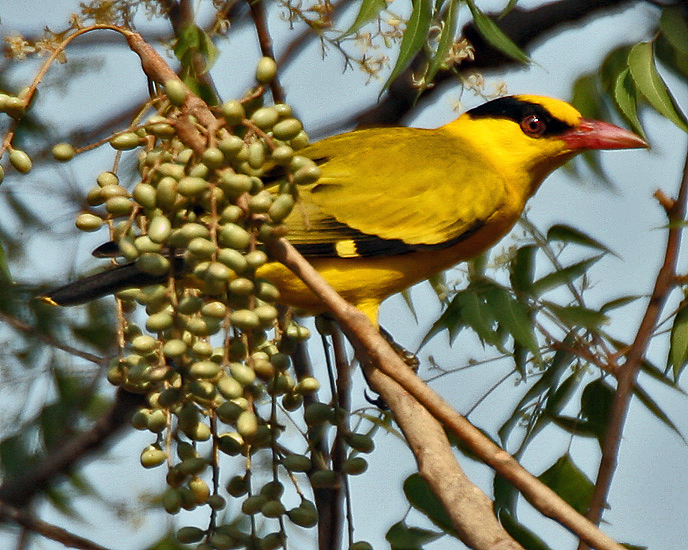 Black-naped OrioleOriolus chinensis
-
 Black-hooded OrioleOriolus xanthornus
-
 Indian Golden OrioleOriolus kundoo
Compare
Questions and answers
What is the scientific name of the Australasian Figbird?
The scientific name of the Australasian Figbird is Sphecotheres vieilloti. Written with its author, the full name is Sphecotheres vieilloti Vigors & Horsfield, 1827.
Which family does the Australasian Figbird belong to?
Sphecotheres vieilloti belongs to the family Oriolidae, in the order Passeriformes and the class Aves.
Where is the Australasian Figbird found?
Checklists and occurrence records place Sphecotheres vieilloti in 3 countries: Australia, Papua New Guinea and Timor Leste.
What is the conservation status of the Australasian Figbird?
The IUCN Red List category recorded for Sphecotheres vieilloti is Least Concern (LC).
What other names does the Australasian Figbird have?
Sphecotheres vieilloti is also known in English as Australian Figbird.
Do figbirds eat figs?
The Australasian Figbird feeds predominantly on fruit and is commonly encountered in city parks containing fig trees.[12][13]
What kind of sound does the Australasian figbird make?
It produces numerous different short calls and a song consisting of a series of simple whistles. It can also mimic the vocalizations of parrots and other oriole species.[19][20][21]
What do australasian fig birds eat?
They feed predominantly on fruit and also consume small insects, nectar and small seeds.[13][14]
Sources
Passages the profile rests on
- The species is a medium-sized passerine bird. Source passage: “The Australasian figbird (Sphecotheres vieilloti), also known as the green figbird (not to be confused with the Timor figbird), is a conspicuous, medium-sized passerine bird” — English Wikipedia
- The species has a stout bill and bare skin surrounding its eyes. Source passage: “Medium-sized songbird with stout bill and bare skin around eyes.” — ebird.org
- The species has a total body length of 27.0–29.5 cm. Source passage: “The Australasian figbird has a total length of 27.0–29.5 cm (10.6–11.6 in)” — English Wikipedia
- The species has a body mass of approximately 111–130 g. Source passage: “With a body mass of around 111 to 130 g (3.9 to 4.6 oz)” — English Wikipedia
- Males of the species have a black tail with broad white tips on the outer tail feathers, blackish primary feathers, a black head, bright red facial skin, a black bill with a red base, and pinkish legs. Source passage: “Males of all subspecies have a black tail with broad white tips to the outer rectrices, white crissum (the undertail coverts surrounding the cloaca), blackish primaries, a black head, distinct bright red facial skin, a black bill with a red base, and pinkish legs.” — English Wikipedia
- Males of the nominate subspecies have predominantly olive-green bodies and grey throats, necks and chests. Source passage: “In the nominate subspecies, the body is largely olive-green, and the throat, neck and chest are grey.” — English Wikipedia
- Females have dull brownish upperparts and white underparts marked with strong dark streaks. Source passage: “Females are drab-coloured, being dull brownish above, and white below with strong dark streaking.” — English Wikipedia
- Females have greyish facial skin and a greyish-black bill. Source passage: “They have greyish facial skin, and a greyish-black bill.” — English Wikipedia
- Juveniles resemble adult females but generally have less pronounced streaking on their underparts. Source passage: “Juveniles resemble females, but the streaking below is typically not as strong.” — English Wikipedia
- Adult Australasian figbirds are sexually dimorphic, with racial plumage differences occurring almost entirely in males. Source passage: “It is sexually dimorphic, and the racial differences are almost entirely limited to the male.” — English Wikipedia
- The species occupies a wide range of wooded habitats. Source passage: “native to a wide range of wooded habitats” — English Wikipedia
- The species is commonly encountered in city parks containing fig trees. Source passage: “Commonly encountered in city parks that contain fig trees” — australian.museum
- The species feeds predominantly on fruit. Source passage: “As suggested by their name, Australasian figbirds are largely frugivorous” — English Wikipedia
- The species also consumes small insects, nectar and small seeds. Source passage: “but also take small insects, nectar and small seeds.” — English Wikipedia
- The species is largely resident, although its southern population may migrate. Source passage: “While largely a resident species (although the southern population may be migratory)” — English Wikipedia
- The species exhibits nomadic movements in response to food availability. Source passage: “it is nomadic in response to the availability of food.” — English Wikipedia
- Australasian figbirds are gregarious and commonly form flocks of 20–40 birds outside the breeding season. Source passage: “Australasian figbirds are gregarious, often forming flocks of 20 to 40 birds during the nonbreeding season” — English Wikipedia
- The species can breed in small, loose colonies. Source passage: “and even breeding in small, loose colonies.” — English Wikipedia
- Australasian figbirds produce numerous different short calls. Source passage: “Australasian figbirds make a large number of different short calls” — English Wikipedia
- The species can mimic the vocalizations of parrots and other oriole species. Source passage: “and are also able to mimic the voices of other birds, for example parrots and other species of orioles.” — English Wikipedia
- The species produces a song consisting of a series of simple whistles. Source passage: “The song consists of a series of simple whistles.” — English Wikipedia
- Australasian figbirds construct flimsy, saucer-shaped nests from plant material. Source passage: “The flimsy, saucer-shaped nest is made from plant material” — English Wikipedia
- The species usually places its nest relatively high in a tree. Source passage: “and usually placed relatively high in a tree.” — English Wikipedia
- The typical clutch contains two to four eggs. Source passage: “The clutch of two to four eggs” — English Wikipedia
- Both sexes incubate the eggs. Source passage: “is incubated by both sexes” — English Wikipedia
- The eggs typically hatch after 16–17 days of incubation. Source passage: “and typically hatches after 16–17 days.” — English Wikipedia
- The species has been recorded nesting near spangled drongos and helmeted friarbirds. Source passage: “It has been recorded nesting near the aggressive spangled drongo and helmeted friarbird” — English Wikipedia
- Australasian figbird nests sometimes experience parasitism by Pacific koels. Source passage: “Australasian figbirds sometimes fall victim to nest parasitism by Pacific koels.” — English Wikipedia
- The Australasian figbird is common across large parts of its geographical range. Source passage: “It is common in large parts of its range” — English Wikipedia
- The species occurs in numerous protected areas. Source passage: “and occurs in numerous protected areas.” — English Wikipedia
- BirdLife International and the IUCN classify the Australasian figbird as Least Concern. Source passage: “Consequently, it is rated as least concern by BirdLife International and the IUCN.” — English Wikipedia
- The brown oriole and olive-backed oriole are superficially similar to the Australasian figbird. Source passage: “The other orioles in its range, the brown and olive-backed orioles, are superficially similar” — English Wikipedia
- Adult brown and olive-backed orioles differ from Australasian figbirds by having entirely red bills. Source passage: “but have entirely red bills when adult.” — English Wikipedia
- The species is native to northern and eastern Australia, southern New Guinea and the Kai Islands. Source passage: “native to a wide range of wooded habitats in northern and eastern Australia, southern New Guinea, and the Kai Islands.” — English Wikipedia
Data
- Catalogue of Life, 2026-10-16 XR cc by
- Global Biodiversity Information Facility CC BY 4.0
- Wikidata CC0
- GeoNames CC BY 4.0
- Wikimedia Commons per image; credit shown with each image
- Within the Catalogue of Life, this name comes from The Integrated Taxonomic Information System cc0
This species in other databases
Page built on 27 November 2026. See how the catalog is made and all sources and licences.
Cite this page
ScientificNames.org. (2026). Sphecotheres vieilloti (Australasian Figbird). Retrieved November 27, 2026, from https://scientificnames.org/species/sphecotheres-vieilloti
“Sphecotheres vieilloti (Australasian Figbird).” ScientificNames.org, 2026, scientificnames.org/species/sphecotheres-vieilloti. Accessed 27 Nov. 2026.
ScientificNames.org. “Sphecotheres vieilloti (Australasian Figbird).” Accessed November 27, 2026. https://scientificnames.org/species/sphecotheres-vieilloti.
@misc{scientificnames_sphecotheres_vieilloti_australasian_figbird,
  author = {{ScientificNames.org}},
  title = {Sphecotheres vieilloti (Australasian Figbird)},
  year = {2026},
  url = {https://scientificnames.org/species/sphecotheres-vieilloti},
  note = {Accessed 2026-11-27}
}