Species · Birds
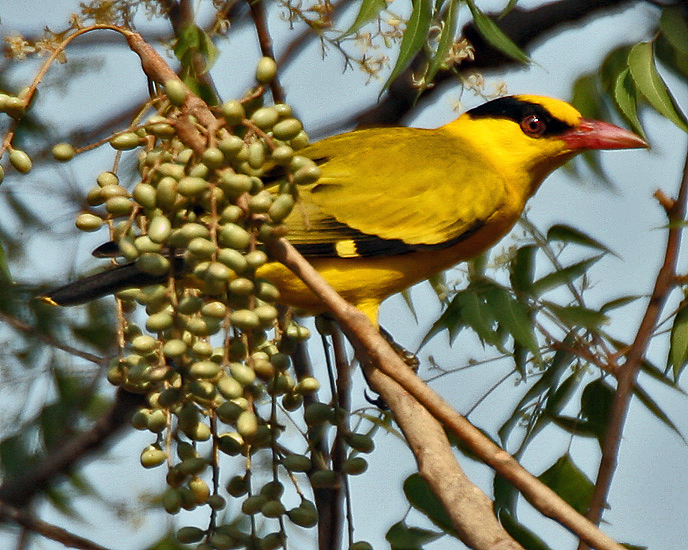
Black-hooded Oriole Oriolus xanthornus
The scientific name of the Black-hooded Oriole is Oriolus xanthornus. It is a species of bird in the family Oriolidae (old world oriole), order Passeriformes. The name dates from 1758.
- Scientific name
- Oriolus xanthornus (Linnaeus, 1758)
- Common name
- Black-hooded Oriole
- Genus
- Oriolus
- Family
- Oriolidae (Old World Oriole)
- Order
- Passeriformes
- Class
- Aves
- Red List category
- LC Least Concern
- Environment
- terrestrial
- Recorded in
- 13 countries
- Name status
- accepted in the Catalogue of Life

Overview
Oriolus xanthornus is a resident breeder across tropical southern Asia, ranging from India and Sri Lanka eastward to Indonesia. It is distinguished by its yellow plumage and solid black hood.
Written 26 November 2026 from the sources listed below. Each statement was checked against the passage it cites; statements that could not be supported were removed.
Appearance
The Black-hooded Oriole is a distinctive medium-sized yellow bird with a black head and breast. Adult males have predominantly yellow plumage, a solid black hood, and black markings on the wings and central tail.[1][2]
Females have greenish underparts and a black hood, with less vivid overall coloration than males. Juveniles resemble females but have dark streaks on their underparts and an incompletely black hood, particularly on the throat.[3][4]
Habitat
The Black-hooded Oriole inhabits open woodland and cultivated areas.[5]
In India, it occurs in both rural and urban environments, where it regularly encounters humans.[6]
Diet
The Black-hooded Oriole feeds on insects and fruit, with figs being a particularly important food.[7]
Reproduction and life cycle
The Black-hooded Oriole builds its nest in trees and lays two eggs.[8]
Behaviour
Individuals spend much of their time in tree canopies. The species can be shy and difficult to observe even when an individual is male.[9][10]
Its flight is strong and direct, with shallow dips over longer distances. It forages using foliage-gleaning, wood-gleaning, and sallying techniques.[11][12]
Similar species
The Black-hooded Oriole can be distinguished from the Indian golden oriole by its black head.[13]
Classification of the Black-hooded Oriole
| Kingdom | Animalia |
|---|---|
| Phylum | Chordata |
| Subphylum | Vertebrata |
| Infraphylum | Gnathostomata |
| Parvphylum | Osteichthyes |
| Megaclass | Tetrapoda |
| Class | Aves (Bird) |
| Order | Passeriformes (Passerine) |
| Family | Oriolidae (Old World Oriole) |
| Genus | Oriolus (Oriole) |
| Species | Oriolus xanthornus (Linnaeus, 1758) |
Where the Black-hooded Oriole is found
Checklists and occurrence records place Oriolus xanthornus in 13 countries. GBIF holds 322,514 georeferenced records of it.
Countries
- Bangladesh 9,588
- Bhutan 559
- Cambodia 2,922
- China 285
- India 253,723
- Indonesia 21
- Laos 69
- Malaysia 63
- Myanmar 688
- Nepal 7,465
- Sri Lanka 38,416
- Thailand 6,248
- Vietnam 2,467
Regions and cities with the most records
- Kerala, India 70,377
- Madhya Pradesh, India 35,577
- West Bengal, India 30,335
- Assam, India 21,608
- Baihar, India 18,936
- Malajkhand, India 17,897
- Maharashtra, India 17,607
- Karnataka, India 14,753
- Kolkata, India 13,947
- Mulleriyawa, Sri Lanka 13,568
- Kotikawatta, Sri Lanka 13,483
- Battaramulla South, Sri Lanka 13,449
- Kolonnawa, Sri Lanka 13,439
- Pita Kotte, Sri Lanka 13,399
- Sri Jayewardenepura Kotte, Sri Lanka 13,213
- Kelaniya, Sri Lanka 13,192
- Chakapara, India 13,136
- Bāli, India 13,054
- Peliyagoda, Sri Lanka 13,034
- Howrah, India 12,977
- Maharagama, Sri Lanka 12,762
- Wattala, Sri Lanka 12,591
- Colombo, Sri Lanka 12,588
- Hendala, Sri Lanka 12,471
- Rajpur Sonarpur, India 11,971
- Dehiwala-Mount Lavinia, Sri Lanka 11,860
- Uttarakhand, India 11,714
- Dam Dam, India 11,630
- Bankra, India 11,558
- Kāmārhāti, India 11,359
- Odisha, India 11,144
- Welisara, Sri Lanka 10,582
- Vadakāncheri, India 10,316
- Homagama, Sri Lanka 9,934
- Maheshtala, India 9,893
- Puthūr, India 9,684
A number beside a place is its count of GBIF occurrence records. A place without a number comes from a checklist alone. Records show where a species has been observed or collected, which can include escapes and vagrants.
Common names
English
- Black-hooded Oriole
Names in 33 other languages
- Bengali
- বেনেবউ
- Breton
- Glazaour kabell du
- Catalan
- oriol capnegre asiàtic
- Chinese
- 黑头黄鹂, 黑頭黃鸝
- Croatian
- crnokrila vuga
- Czech
- žluva černokápá
- Danish
- Orientalsk Hættepirol
- Dutch
- Zwartkopwielewaal
- Esperanto
- Nigrakapuĉa oriolo, kapuĉa oriolo
- Estonian
- karbuspeoleo
- Finnish
- huppukuhankeittäjä
- French
- Loriot à capuchon noir
- German
- Bengalenpirol, Schwarzkopfpirol
- Indonesian
- Kepodang Kerudung-hitam, Kepudang kerudung-hitam
- Italian
- Oriolo monaco, Rigogolo testanera asiatico
- Japanese
- ズグロコウライウグイス
- Lithuanian
- geltonnugarė juodagalvė volungė
- Malayalam
- മഞ്ഞക്കറുപ്പൻ
- Marathi
- काळटोप हळद्या
- Norwegian
- orientpirol
- Polish
- wilga złotogrzbieta
- Portuguese
- papa-figos-de-capuz
- Russian
- Черноголовая иволга
- Serbian
- Crnoglava vuga
- Sinhala
- කහ කුරුල්ලා
- Slovak
- vlha kapucňová
- Spanish
- Oropéndola encapuchada
- Swedish
- orientgylling
- Thai
- นกขมิ้นหัวดำใหญ่
- Turkish
- Çinhindi Kara Başlı Sarıasması
- Ukrainian
- вивільга східна
- Welsh
- euryn penddu Asia
- asm
- সখিয়তী
Synonyms
5 other scientific names have been used for this species and are now treated as synonyms of Oriolus xanthornus.
- Coracias xanthornus Linnaeus, 1758
- Oriolus naevius Pennant, T, 1781
- Oriolus xanthorus Latham, J, 1790
- Sturnus luteolus Linnaeus, C, 1758
- Turdus bengalensis Pennant, T, 1781
Subspecies and varieties
- Oriolus xanthornus ceylonensis subspecies
- Oriolus xanthornus maderaspatanus subspecies
- Oriolus xanthornus reubeni subspecies
- Oriolus xanthornus tanakae subspecies
- Oriolus xanthornus xanthornus subspecies
Related species
-
 Eurasian Golden OrioleOriolus oriolus
-
 Black-naped OrioleOriolus chinensis
-
 Indian Golden OrioleOriolus kundoo
-
 Black-headed OrioleOriolus larvatus
-
 Maroon OrioleOriolus traillii
-
 Green OrioleOriolus flavocinctus
-
 African Golden OrioleOriolus auratus
-
 Isabela OrioleOriolus isabellae
Compare
Questions and answers
What is the scientific name of the Black-hooded Oriole?
The scientific name of the Black-hooded Oriole is Oriolus xanthornus. Written with its author, the full name is Oriolus xanthornus (Linnaeus, 1758).
Which family does the Black-hooded Oriole belong to?
Oriolus xanthornus belongs to the family Oriolidae, in the order Passeriformes and the class Aves.
Where is the Black-hooded Oriole found?
Checklists and occurrence records place Oriolus xanthornus in 13 countries, including India, Sri Lanka, Bangladesh, Nepal, Thailand and Cambodia.
What is the conservation status of the Black-hooded Oriole?
The IUCN Red List category recorded for Oriolus xanthornus is Least Concern (LC).
What does the black hooded oriole eat?
The Black-hooded Oriole feeds on insects and fruit, with figs being a particularly important food.[7]
Where do Hooded Orioles live?
The Black-hooded Oriole is a resident breeder across tropical southern Asia, ranging from India and Sri Lanka eastward to Indonesia. It inhabits open woodland and cultivated areas.[14][5]
What does the oriole bird eat?
The Black-hooded Oriole feeds on insects and fruit, with figs being a particularly important food.[7]
Sources
Passages the profile rests on
- The black-hooded oriole is described as a distinctive medium-sized yellow bird with a black head and breast. Source passage: “A distinctive medium-sized yellow bird with a black head and breast, Black-hooded Oriole Oriolus xanthornus.” — ebird.org
- Adult males have predominantly yellow plumage, a solid black hood, and black markings on the wings and central tail. Source passage: “The plumage is predominantly yellow, with a solid black hood, and black also in the wings and tail centre.” — English Wikipedia
- Females have greenish underparts and a black hood, with less vivid overall coloration than males. Source passage: “The female black-hooded oriole is a drabber bird with greenish underparts, but still has the black hood.” — English Wikipedia
- Juveniles resemble females but have dark streaks on their underparts and an incompletely black hood, particularly on the throat. Source passage: “Young birds are like the female, but have dark streaking on the underparts, and their hood is not solidly black, especially on the throat.” — English Wikipedia
- The species inhabits open woodland and cultivated areas. Source passage: “It is a bird of open woodland and cultivation.” — English Wikipedia
- The species occurs in both rural and urban environments in India where it regularly encounters humans. Source passage: “The black-hooded oriole lives in common contact with humans in rural and urban India.” — English Wikipedia
- The species feeds on insects and fruit, with figs being a particularly important food. Source passage: “Its food is insects and fruit, especially figs” — English Wikipedia
- The species builds its nest in trees and lays two eggs. Source passage: “The nest is built in a tree, and contains two eggs.” — English Wikipedia
- Individuals spend much of their time in tree canopies. Source passage: “found in the tree canopies where they spend much of their time.” — English Wikipedia
- The species can be shy and difficult to observe even when an individual is male. Source passage: “Orioles can be shy, and even the male may be difficult to see” — English Wikipedia
- Its flight is strong and direct, with shallow dips over longer distances. Source passage: “strong and direct with some shallow dips over longer distances.” — English Wikipedia
- The species forages using foliage-gleaning, wood-gleaning, and sallying techniques. Source passage: “While foraging the species uses foliage-gleening, wood-gleening, or sallying methods.” — English Wikipedia
- The species can be distinguished from the Indian golden oriole by its black head. Source passage: “The black head of this species is an obvious distinction from the Indian golden oriole” — English Wikipedia
- The species is a resident breeder across tropical southern Asia, ranging from India and Sri Lanka eastward to Indonesia. Source passage: “is a resident breeder in tropical southern Asia from India and Sri Lanka east to Indonesia.” — English Wikipedia
Data
- Catalogue of Life, 2026-10-16 XR cc by
- Global Biodiversity Information Facility CC BY 4.0
- Wikidata CC0
- GeoNames CC BY 4.0
- Wikimedia Commons per image; credit shown with each image
- Within the Catalogue of Life, this name comes from The Integrated Taxonomic Information System cc0
References
- Gill, Frank, & and Minturn Wright. (2006). Birds of the World: Recommended English Names.
This species in other databases
- Catalogue of Life 757FY
- Wikidata Q653246
- iNaturalist 7875
- WoRMS urn:lsid:marinespecies.org:taxname:1649243
- Avibase blhori1
Page built on 27 November 2026. See how the catalog is made and all sources and licences.
Cite this page
ScientificNames.org. (2026). Oriolus xanthornus (Black-hooded Oriole). Retrieved November 27, 2026, from https://scientificnames.org/species/oriolus-xanthornus
“Oriolus xanthornus (Black-hooded Oriole).” ScientificNames.org, 2026, scientificnames.org/species/oriolus-xanthornus. Accessed 27 Nov. 2026.
ScientificNames.org. “Oriolus xanthornus (Black-hooded Oriole).” Accessed November 27, 2026. https://scientificnames.org/species/oriolus-xanthornus.
@misc{scientificnames_oriolus_xanthornus_black_hooded_oriole,
  author = {{ScientificNames.org}},
  title = {Oriolus xanthornus (Black-hooded Oriole)},
  year = {2026},
  url = {https://scientificnames.org/species/oriolus-xanthornus},
  note = {Accessed 2026-11-27}
}