Species · Birds
Indian Golden Oriole Oriolus kundoo
The scientific name of the Indian Golden Oriole is Oriolus kundoo. It is a species of bird in the family Oriolidae (old world oriole), order Passeriformes. The name dates from 1832.
- Scientific name
- Oriolus kundoo Sykes, 1832
- Common name
- Indian Golden Oriole
- Genus
- Oriolus
- Family
- Oriolidae (Old World Oriole)
- Order
- Passeriformes
- Class
- Aves
- Red List category
- LC Least Concern
- Recorded in
- 15 countries
- Name status
- accepted in the Catalogue of Life

Overview
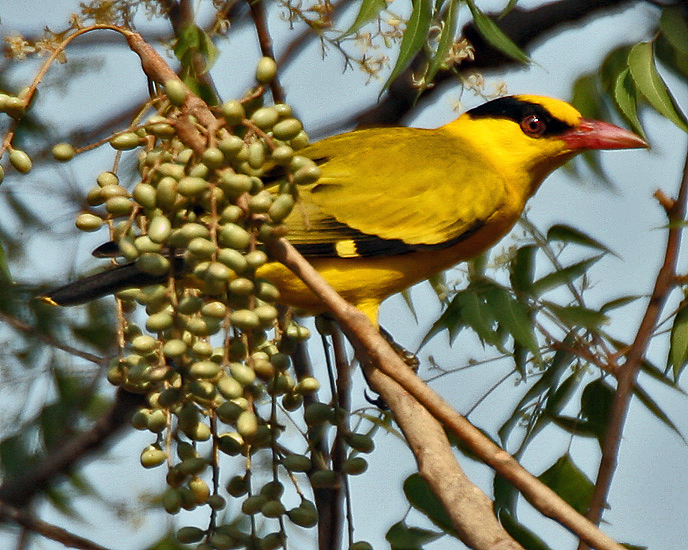
Oriolus kundoo breeds from Baluchistan and Afghanistan along the Himalayas to Nepal, with some populations breeding locally in the Indian peninsula. Adults have a black eye stripe extending behind the eye, and the species has more yellow in its tail than the Eurasian Golden Oriole.
Written 26 November 2026 from the sources listed below. Each statement was checked against the passage it cites; statements that could not be supported were removed.
Appearance
Adult Indian Golden Orioles have a black eye stripe that extends behind the eye. Compared with the Eurasian Golden Oriole, they have more yellow in the tail and paler red coloration in the iris and bill.[1][2]
Habitat
The Indian Golden Oriole inhabits open deciduous forests, semi-evergreen forests, and open and semi-open broadleaf woodlands. It also occurs in woodland and along forest edges.[3][4][5]
The species occurs in open country with scattered trees, as well as in parks, gardens, orchards, and plantations.[6][7]
Diet
The Indian Golden Oriole feeds on fruits, nectar, and insects. It can also prey on southern flying lizards.[8][9]
The species consumes fruits and can disperse seeds from berry-bearing plants. It has also been recorded dispersing seeds of the invasive plant Lantana camara.[10][11]
Behaviour
The Indian Golden Oriole has a strong, dipping flight. Its recorded flight speed can reach approximately 40 km/h.[12][13]
Individuals may forage in tree canopies alone or in pairs. The species sometimes bathes by repeatedly flying into a small pool of water.[14][15]
Reproduction and life cycle
The Indian Golden Oriole is a partial migrant, with Indian populations largely resident and other populations migratory. Northern populations winter in southern India, and some individuals winter in Sri Lanka.[16][17]
The breeding season extends from April through August. The species builds small cup-shaped nests in forks near the ends of branches, often near the nests of Black Drongos.[18][19][20]
A typical clutch contains two or three white eggs with reddish, brown, and black speckling. Both parents participate in nest and brood care.[21][22]
Parents defend their nests against intruding birds, including shikras and crows.[23]
Similar species
The Indian Golden Oriole was formerly treated as a subspecies of the Eurasian Golden Oriole. It was recognized as a separate species by ornithologists Pamela Rasmussen and John Anderton in 2005, and a molecular phylogenetic study published in 2010 supported this recognition.[24][25][26]
The species is considered monotypic.[27]
Classification of the Indian Golden Oriole
| Kingdom | Animalia |
|---|---|
| Phylum | Chordata |
| Subphylum | Vertebrata |
| Infraphylum | Gnathostomata |
| Parvphylum | Osteichthyes |
| Megaclass | Tetrapoda |
| Class | Aves (Bird) |
| Order | Passeriformes (Passerine) |
| Family | Oriolidae (Old World Oriole) |
| Genus | Oriolus (Oriole) |
| Species | Oriolus kundoo Sykes, 1832 |
Where the Indian Golden Oriole is found
Checklists and occurrence records place Oriolus kundoo in 15 countries. GBIF holds 229,182 georeferenced records of it.
Countries
- Afghanistan 26
- Bangladesh 692
- Bhutan 24
- China 127
- India 221,744
- Iran 15
- Kazakhstan 342
- Kyrgyzstan 455
- Nepal 4,324
- Pakistan 663
- Sri Lanka 178
- Tajikistan 284
- Thailand 31
- Turkmenistan 6
- Uzbekistan 271
Regions and cities with the most records
- Karnataka, India 43,085
- Kerala, India 40,099
- Maharashtra, India 37,452
- Tamil Nadu, India 24,766
- Bengaluru, India 14,131
- Airoli, India 12,029
- Thāne, India 11,153
- Electronic City Phase I, India 10,947
- koppana Agrahara, India 10,903
- Powai, India 10,669
- Hebbagodi, India 10,393
- Bommasandra Industrial Area, India 10,198
- Madhya Pradesh, India 10,120
- Goa, India 9,866
- Mumbai, India 9,461
- Yelahanka, India 9,028
- Gujarat, India 8,924
- Borivli, India 8,918
- Jigani, India 8,892
- Kalher, India 8,667
- Kharghar, India 7,974
- Telangana, India 6,901
- Gorai, India 6,806
- Bhayandar, India 6,102
- Chimbel, India 5,972
- Taleigao, India 5,957
- Rajasthan, India 5,845
- Dombivali, India 5,801
- Penha de França, India 5,772
- Panjim, India 5,757
- Andhra Pradesh, India 5,362
- West Bengal, India 5,271
- Vasco da Gama, India 4,956
- Curti, India 4,930
- Ponda, India 4,922
- Mormugao, India 4,850
A number beside a place is its count of GBIF occurrence records. A place without a number comes from a checklist alone. Records show where a species has been observed or collected, which can include escapes and vagrants.
Common names
English
- Indian Golden Oriole
Names in 37 other languages
- Asturian
- Filomena india
- Breton
- Glazaour India
- Catalan
- oriol de l'Índia
- Chinese
- 印度金黄鹂, 印度黃鸝
- Czech
- žluva asijská
- Danish
- Indisk Pirol
- Dutch
- Indiase Wielewaal
- Esperanto
- Hinda oriolo, hindia oriolo
- Estonian
- mangopeoleo
- Finnish
- intiankuhankeittäjä
- French
- Loriot indien
- German
- Indienpirol, Indischer Pirol
- Italian
- Rigogolo indiano
- Japanese
- インドコウライウグイス
- Kannada
- ಅರಿಶಿನ-ಬುರುಡೆ
- Kazakh
- Үнді мысықторғайы
- Lithuanian
- indinė volungė
- Malayalam
- ഇന്ത്യൻ മഞ്ഞക്കിളി, മഞ്ഞകിളി
- Marathi
- हळद्या
- Nepali
- गाजले सुनचरी
- Norwegian
- indiapirol
- Persian
- پریشاهرخ طلایی هندی
- Polish
- wilga złotoplama
- Portuguese
- papa-figos-indiano
- Punjabi
- ਭਾਰਤੀ ਸੁਨਿਹਰੀ ਪੀਲਕ
- Russian
- Индийская иволга
- Serbian
- Indijska vuga
- Slovak
- vlha mangová
- Spanish
- Oropéndola india
- Swedish
- indisk sommargylling
- Tamil
- மாங்குயில்
- Thai
- นกขมิ้นหัวปีกดำ
- Turkish
- Hint Sarıasması
- Ukrainian
- вивільга індійська
- div
- ހިންދު ރަންވަންދޫނި
- kas
- پوشہِ نوٗل
- pnb
- پاکستانی بسنتی پنچھی
Synonyms
5 other scientific names have been used for this species and are now treated as synonyms of Oriolus kundoo.
- Oriolus fulvus Pennant, T, 1781
- Oriolus kundoo turkestanica Kudashev, A; Zarudny, NA, 1918
- Oriolus oriolus baltistanicus Koelz, WN, 1939
- Oriolus oriolus kundoo Sykes, WH, 1832
- Oriolus yarkandensis Scully, J, 1876
Related species
-
 Eurasian Golden OrioleOriolus oriolus
-
 Black-naped OrioleOriolus chinensis
-
 Black-hooded OrioleOriolus xanthornus
-
 Black-headed OrioleOriolus larvatus
-
 Maroon OrioleOriolus traillii
-
 Green OrioleOriolus flavocinctus
-
 African Golden OrioleOriolus auratus
-
 Isabela OrioleOriolus isabellae
Compare
Questions and answers
What is the scientific name of the Indian Golden Oriole?
The scientific name of the Indian Golden Oriole is Oriolus kundoo. Written with its author, the full name is Oriolus kundoo Sykes, 1832.
Which family does the Indian Golden Oriole belong to?
Oriolus kundoo belongs to the family Oriolidae, in the order Passeriformes and the class Aves.
Where is the Indian Golden Oriole found?
Checklists and occurrence records place Oriolus kundoo in 15 countries, including India, Nepal, Bangladesh, Pakistan, Kyrgyzstan and Kazakhstan.
What is the conservation status of the Indian Golden Oriole?
The IUCN Red List category recorded for Oriolus kundoo is Least Concern (LC).
Sources
Passages the profile rests on
- Adult Indian Golden Orioles have a black eye stripe that extends behind the eye. Source passage: “Adults can be told apart from the Eurasian golden oriole by the black of the eye stripe extending behind the eye.” — English Wikipedia
- The species has more yellow in its tail and paler red coloration in its iris and bill than the Eurasian Golden Oriole. Source passage: “has more yellow in the tail and has a paler shade of red in the iris and bill.” — English Wikipedia
- The species inhabits open deciduous forests and semi-evergreen forests. Source passage: “including open deciduous forests, semi-evergreen forests” — English Wikipedia
- The species occurs in woodland and along forest edges. Source passage: “woodland, forest edge” — English Wikipedia
- The species uses open and semi-open broadleaf woodlands. Source passage: “Open and semi-open broadleaf woodlands” — datazone.birdlife.org
- The species inhabits open country with scattered trees. Source passage: “open country with scattered trees” — English Wikipedia
- The species also occurs in parks, gardens, orchards, and plantations. Source passage: “parks, gardens, orchards, and plantations.” — English Wikipedia
- The species feeds on fruits, nectar, and insects. Source passage: “Orioles feed on fruits, nectar, and insects.” — English Wikipedia
- The species can prey on southern flying lizards. Source passage: “An oriole has been recorded preying on southern flying lizards.” — English Wikipedia
- The species consumes fruits and can disperse seeds from berry-bearing plants. Source passage: “They are capable of dispersing the seeds of many berry-bearing plants” — English Wikipedia
- The species has been recorded dispersing seeds of the invasive plant Lantana camara. Source passage: “including the invasive Lantana camara.” — English Wikipedia
- The Indian Golden Oriole has a strong, dipping flight. Source passage: “The Indian golden oriole's flight is dipping but strong” — English Wikipedia
- Its recorded flight speed can reach approximately 40 km/h. Source passage: “has been recorded to reach about 40 km/h (25 mph).” — English Wikipedia
- The species sometimes bathes by repeatedly flying into a small pool of water. Source passage: “It sometimes bathes by repeatedly flying into a small pool of water.” — English Wikipedia
- Individuals may forage in tree canopies either alone or in pairs. Source passage: “feeding in tree canopies either singly or in pairs.” — ebird.org
- The species is a partial migrant, with Indian populations largely resident and other populations migratory. Source passage: “The Indian populations are largely resident while the other populations are migratory.” — English Wikipedia
- Northern populations winter in southern India, and some individuals winter in Sri Lanka. Source passage: “The northern populations winter in southern India, with some birds wintering in Sri Lanka.” — English Wikipedia
- The breeding season extends from April through August. Source passage: “The breeding season is April to August” — English Wikipedia
- The species builds small cup-shaped nests in forks near the ends of branches. Source passage: “the nest being a small cup placed in a fork near the end of a branch.” — English Wikipedia
- Nests are often constructed near the nests of Black Drongos. Source passage: “Nests are often built in the vicinity of the nest of a black drongo.” — English Wikipedia
- A typical clutch contains two or three white eggs with reddish, brown, and black speckling. Source passage: “Two or three white eggs with reddish, brown, and black speckling form the typical clutch.” — English Wikipedia
- Both parents participate in nest and brood care. Source passage: “Both parents take part in nest and brood care” — English Wikipedia
- Parents defend their nests against intruding birds, including shikras and crows. Source passage: “defending the nest against intruding birds such as shikras and crows.” — English Wikipedia
- The Indian Golden Oriole was formerly treated as a subspecies of the Eurasian Golden Oriole. Source passage: “The Indian golden oriole was usually treated as a subspecies of the Eurasian golden oriole.” — English Wikipedia
- The Indian Golden Oriole was recognized as a separate species by ornithologists Pamela Rasmussen and John Anderton in 2005. Source passage: “In 2005, the ornithologists Pamela Rasmussen and John Anderton in their Birds of South Asia decided to treat the two varieties as separate species” — English Wikipedia
- A molecular phylogenetic study published in 2010 supported the recognition of the Indian Golden Oriole as a separate species. Source passage: “Support for this split was provided by a molecular phylogenetic study published in 2010” — English Wikipedia
- The Indian Golden Oriole is considered monotypic. Source passage: “the Indian golden oriole is considered to be monotypic.” — English Wikipedia
Data
- Catalogue of Life, 2026-10-16 XR cc by
- Global Biodiversity Information Facility CC BY 4.0
- Wikidata CC0
- GeoNames CC BY 4.0
- Wikimedia Commons per image; credit shown with each image
- Within the Catalogue of Life, this name comes from The Integrated Taxonomic Information System cc0
This species in other databases
Page built on 26 November 2026. See how the catalog is made and all sources and licences.
Cite this page
ScientificNames.org. (2026). Oriolus kundoo (Indian Golden Oriole). Retrieved November 26, 2026, from https://scientificnames.org/species/oriolus-kundoo
“Oriolus kundoo (Indian Golden Oriole).” ScientificNames.org, 2026, scientificnames.org/species/oriolus-kundoo. Accessed 26 Nov. 2026.
ScientificNames.org. “Oriolus kundoo (Indian Golden Oriole).” Accessed November 26, 2026. https://scientificnames.org/species/oriolus-kundoo.
@misc{scientificnames_oriolus_kundoo_indian_golden_oriole,
  author = {{ScientificNames.org}},
  title = {Oriolus kundoo (Indian Golden Oriole)},
  year = {2026},
  url = {https://scientificnames.org/species/oriolus-kundoo},
  note = {Accessed 2026-11-26}
}