Species · Flowering plants
Coddled Hedgenettle Stachys lamarckii
The scientific name of the Coddled Hedgenettle is Stachys lamarckii. It is a species of flowering plant in the family Lamiaceae (mint family), order Lamiales.
- Scientific name
- Stachys lamarckii Benth.
- Common name
- Coddled Hedgenettle
- Genus
- Stachys
- Family
- Lamiaceae (Mint Family)
- Order
- Lamiales
- Class
- Magnoliopsida
- Recorded in
- 2 countries
- Name status
- accepted in the Catalogue of Life

Overview
Stachys lamarckii grows among rocks in mountainous areas of the south-western Great Karoo, Namaqualand and Richtersveld, at elevations of 600–1,500 metres. It is distinguished by its densely woolly young branches, wrinkled leaves and yellow flowers arranged in dense whorls.
Written 28 November 2026 from the sources listed below. Each statement was checked against the passage it cites; statements that could not be supported were removed.
Appearance
Coddled Hedgenettle grows as a shrub reaching 0.2–1 metre in height. Its ascending branches are densely white and woolly when young, becoming smooth and brownish-purple with age.[1][2]
Its leaves are elliptic to ovate-elliptic, fairly thick and wrinkled, with blades measuring 20–50 mm in length. The upper surfaces have sparse to fairly dense stellate-tomentose covering, while the lower surfaces are more densely woolly.[3][4][5]
The leaf margins are crenate, with rounded to blunt tips and obtuse to wedge-shaped bases.[6]
The flowers occur in several dense whorls, each containing at least six flowers, with the whorls becoming more crowded towards the inflorescence apex. The calyx is densely covered in white to cream-coloured woolly hairs and measures 8–11 mm long.[7][8]
The yellow corolla has a short tube, an ascending upper lip and a spreading lower lip.[9]
Habitat
Coddled Hedgenettle grows among rocks in mountainous areas of the south-western Great Karoo, Namaqualand and Richtersveld. It occurs at elevations of 600–1,500 metres.[10][11]
The species occurs in South Africa and Namibia, with records also existing from far-southern Namibia.[12][13]
Reproduction and life cycle
Coddled Hedgenettle flowers from August through October.[14]
Classification of the Coddled Hedgenettle
| Kingdom | Plantae |
|---|---|
| Subkingdom | Pteridobiotina |
| Phylum | Tracheophyta |
| Class | Magnoliopsida |
| Order | Lamiales |
| Family | Lamiaceae (Mint Family) |
| Subfamily | Lamioideae |
| Tribe | Stachydeae |
| Genus | Stachys (Woundwort) |
| Species | Stachys lamarckii Benth. |
Where the Coddled Hedgenettle is found
Checklists and occurrence records place Stachys lamarckii in 2 countries across Africa. GBIF holds 74 georeferenced records of it.
Countries
Regions and cities with the most records
Range as the checklists state it
Namibia; South Africa (N-Cape Prov.)
A number beside a place is its count of GBIF occurrence records. A place without a number comes from a checklist alone. Records show where a species has been observed or collected, which can include escapes and vagrants.
Common names
English
- Coddled Hedgenettle
Synonyms
3 other scientific names have been used for this species and are now treated as synonyms of Stachys lamarckii.
- Stachys nutans Benth.
- Sideritis decumbens Thunb. ambiguous synonym
- Stachys rugosa Lam. ambiguous synonym
Related species
-
 Lamb's EarStachys byzantina
-
 Chinese-artichokeStachys affinis
-
 Hedge WoundwortStachys sylvatica
-
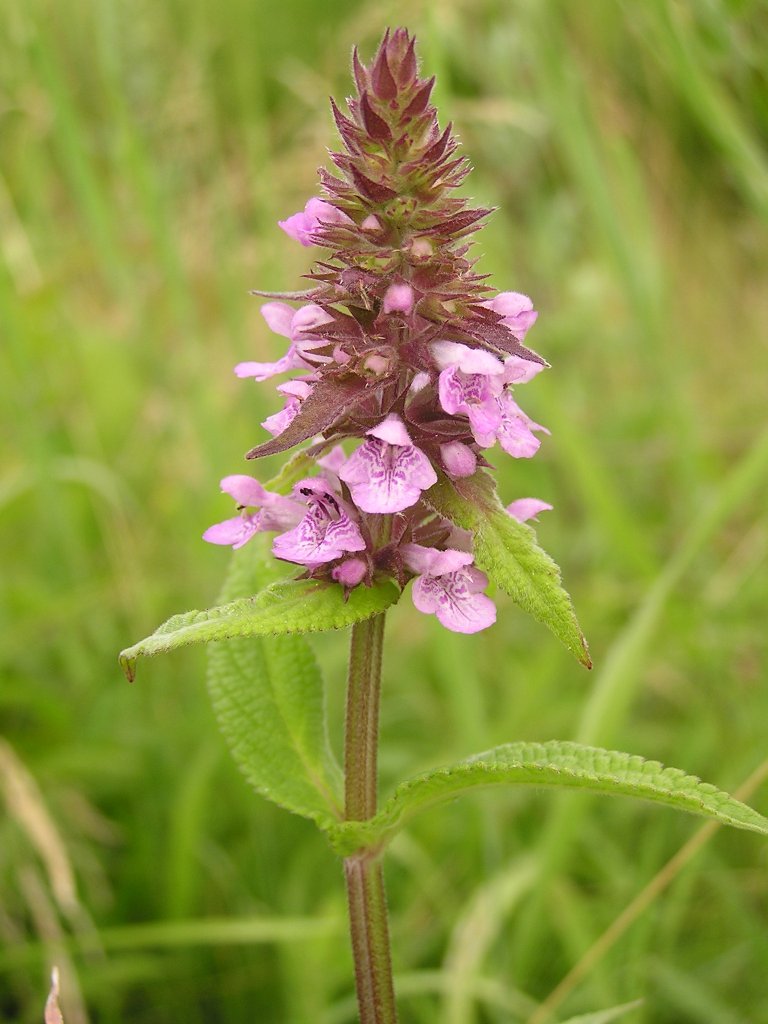 Marsh WoundwortStachys palustris
-
 Field WoundwortStachys arvensis
-
 Florida BetonyStachys floridana
-
 Perennial Yellow-WoundwortStachys recta
-
 Annual Yellow WoundwortStachys annua
Compare
Questions and answers
What is the scientific name of the Coddled Hedgenettle?
The scientific name of the Coddled Hedgenettle is Stachys lamarckii. Written with its author, the full name is Stachys lamarckii Benth..
Which family does the Coddled Hedgenettle belong to?
Stachys lamarckii belongs to the family Lamiaceae, in the order Lamiales and the class Magnoliopsida.
Where is the Coddled Hedgenettle found?
Checklists and occurrence records place Stachys lamarckii in 2 countries: South Africa and Namibia.
Sources
Passages the profile rests on
- The species grows as a shrub with ascending branches that are densely white and woolly when young, becoming smooth and brownish-purple with age. Source passage: “with ascending branches that are densely white and woolly on younger growth, becoming glabrous and brownish-purple with age.” — English Wikipedia
- The shrub reaches a height of 0.2–1 metre. Source passage: “This species is a shrub 0.2–1 m (7.9 in – 3 ft 3.4 in) tall” — English Wikipedia
- Its leaves are elliptic to ovate-elliptic, fairly thick, and have wrinkled blades. Source passage: “with fairly thick, rugose blades that are elliptic to ovate-elliptic” — English Wikipedia
- Its leaf blades measure 20–50 mm in length. Source passage: “20–50 mm (0.79–1.97 in) long.” — English Wikipedia
- The upper surfaces of its leaves have sparse to fairly dense stellate-tomentose covering, while their lower surfaces are more densely woolly. Source passage: “The upper surface is sparsely to fairly densely stellate-tomentose, while the lower surface is more densely woolly.” — English Wikipedia
- Its leaf margins are crenate, with rounded to blunt tips and obtuse to wedge-shaped bases. Source passage: “The leaf margins are crenate, with rounded to blunt tips and obtuse to wedge-shaped bases.” — English Wikipedia
- Its flowers occur in several dense whorls, each containing at least six flowers, with the whorls becoming more crowded towards the inflorescence apex. Source passage: “The flowers are arranged in few to several dense whorls, each bearing six or more flowers, becoming more crowded towards the apex of the inflorescence.” — English Wikipedia
- Its calyx is densely covered in white to cream-coloured woolly hairs and measures 8–11 mm long. Source passage: “The calyx is very densely white to cream-coloured and woolly, 8–11 mm (0.31–0.43 in) long.” — English Wikipedia
- Its yellow corolla has a short tube, an ascending upper lip and a spreading lower lip. Source passage: “The corolla is yellow, with a short tube, an ascending upper lip, and a spreading lower lip.” — English Wikipedia
- The species grows among rocks in mountainous areas of the south-western Great Karoo, Namaqualand and Richtersveld. Source passage: “found among rocks in the mountains of the south-western Great Karoo through the Namaqualand to the Richtersveld” — English Wikipedia
- It occurs at elevations of 600–1,500 metres. Source passage: “at altitudes of 600–1,500 m (2,000–4,900 ft).” — English Wikipedia
- The species occurs in South Africa and Namibia. Source passage: “is a species of hedgenettle found in South Africa and Namibia.” — English Wikipedia
- Records of the species also exist from far-southern Namibia. Source passage: “There are records from far-southern Namibia too.” — English Wikipedia
- The species flowers from August through October. Source passage: “Stachys lamarckii flowers from August to October.” — English Wikipedia
Data
- Catalogue of Life, 2026-10-16 XR cc by
- Global Biodiversity Information Facility CC BY 4.0
- Wikidata CC0
- GeoNames CC BY 4.0
- Wikimedia Commons per image; credit shown with each image
- Within the Catalogue of Life, this name comes from Synonymic Checklists of the Vascular Plants of the World cc by
References
- Benth. Labiat. Gen. Spec. [Bentham] 562 (1833). where the name was published
This species in other databases
Page built on 29 November 2026. See how the catalog is made and all sources and licences.
Cite this page
ScientificNames.org. (2026). Stachys lamarckii (Coddled Hedgenettle). Retrieved November 29, 2026, from https://scientificnames.org/species/stachys-lamarckii
“Stachys lamarckii (Coddled Hedgenettle).” ScientificNames.org, 2026, scientificnames.org/species/stachys-lamarckii. Accessed 29 Nov. 2026.
ScientificNames.org. “Stachys lamarckii (Coddled Hedgenettle).” Accessed November 29, 2026. https://scientificnames.org/species/stachys-lamarckii.
@misc{scientificnames_stachys_lamarckii_coddled_hedgenettle,
  author = {{ScientificNames.org}},
  title = {Stachys lamarckii (Coddled Hedgenettle)},
  year = {2026},
  url = {https://scientificnames.org/species/stachys-lamarckii},
  note = {Accessed 2026-11-29}
}