Species · Flowering plants
Hairy Woundwort Stachys ocymastrum
The scientific name of the Hairy Woundwort is Stachys ocymastrum. It is a species of flowering plant in the family Lamiaceae (mint family), order Lamiales.
- Scientific name
- Stachys ocymastrum (L.) Briq.
- Common name
- Hairy Woundwort
- Genus
- Stachys
- Family
- Lamiaceae (Mint Family)
- Order
- Lamiales
- Class
- Magnoliopsida
- Recorded in
- 15 countries
- Name status
- accepted in the Catalogue of Life

Overview
Hairy Woundwort is an annual herb. The plant has ascending stems, ovate, toothed leaves and a hairy appearance.
Written 27 November 2026 from the sources listed below. Each statement was checked against the passage it cites; statements that could not be supported were removed.
Appearance
Hairy Woundwort has ascending stems and ovate, toothed leaves. Its lower leaves have stalks, and the plant has a hairy appearance.[1][2][3][4]
Individual plants can reach a height of 0.4 metres.[5]
Habitat
The species has a self-supporting growth form.[6]
Diet
The Green-striped White butterfly visits the flowers of Hairy Woundwort.[7]
Classification of the Hairy Woundwort
| Kingdom | Plantae |
|---|---|
| Subkingdom | Pteridobiotina |
| Phylum | Tracheophyta |
| Class | Magnoliopsida |
| Order | Lamiales |
| Family | Lamiaceae (Mint Family) |
| Subfamily | Lamioideae |
| Tribe | Stachydeae |
| Genus | Stachys (Woundwort) |
| Species | Stachys ocymastrum (L.) Briq. |
Where the Hairy Woundwort is found
Checklists and occurrence records place Stachys ocymastrum in 15 countries across Africa, Asia, Europe and North America. GBIF holds 6,889 georeferenced records of it.
Countries where it is native or its origin is not stated
- Albania 3
- Algeria 227
- France 313
- Gibraltar 9
- Greece 29
- Italy 179
- Lebanon
- Libya 1
- Malta 4
- Morocco 217
- Portugal 1,818
- Spain 4,044
- Tunisia 36
- Turkey 4
Countries where it has been introduced
Regions and cities with the most records
- Valencia, Spain 958
- Catalonia, Spain 811
- Lisbon, Portugal 458
- Belas, Portugal 430
- Olival, Portugal 428
- Queluz, Portugal 428
- Cacém, Portugal 425
- Massamá, Portugal 423
- Falagueira, Portugal 420
- Alfornelos, Portugal 418
- Rio de Mouro, Portugal 418
- Amadora, Portugal 417
- Damaia, Portugal 415
- Pontinha, Portugal 415
- Benfica, Portugal 413
- Alfragide, Portugal 412
- Carnaxide, Portugal 412
- Carnide, Portugal 411
- Balearic Islands, Spain 408
- Buraca, Portugal 407
- Algueirão, Portugal 398
- Odivelas, Portugal 393
- Campo Grande, Portugal 392
- Ramada, Portugal 389
- Alvalade, Portugal 386
- Lumiar, Portugal 385
- Linda-a-Velha, Portugal 384
- Loures, Portugal 384
- Algés, Portugal 380
- Sete Rios, Portugal 378
- Paço de Arcos, Portugal 372
- Oeiras, Portugal 367
- Areeiro, Portugal 366
- Carcavelos, Portugal 365
- São Domingos de Rana, Portugal 363
- Lisbon, Portugal 359
Range as the checklists state it
Portugal; Spain; Gibraltar; Baleares; France; Corsica; Sardinia; Italy; Sicily; Greece (very rare Kerkyra, SW-Peloponnisos); NW-Crete; Morocco; Algeria; Tunisia; Libya; Madeira (Madeira Isl., Porto Santo Isl.); Canary Isl. (Lanzarote, Fuerteventura, Gran Canaria, Tenerife, La Gomera, Hierro, La Palma); Lebanon (coastal W-Lebanon); USA [I] (New Jersey [I])
A number beside a place is its count of GBIF occurrence records. A place without a number comes from a checklist alone. Records show where a species has been observed or collected, which can include escapes and vagrants.
Common names
English
- Hairy Woundwort
- Italian Woundwort
Names in 7 other languages
- Catalan
- Alfabregueta, Alfàbrega borda
- Finnish
- valkopähkämö
- French
- Épiaire faux basilic, Épiaire hérissée
- German
- Basilikum-Ziest
- Portuguese
- Betónica-hirta, Rabo-de-raposa
- Russian
- Чистец базиликовый
- Spanish
- alfabraca, rabo de zorra
Synonyms
22 other scientific names have been used for this species and are now treated as synonyms of Stachys ocymastrum.
- Galeopsis hirsuta L.
- Galeopsis hispanica Mill.
- Sideritis ocymastrum L.
- Stachys divaricata Viv.
- Stachys foucauldiana Sennen
- Stachys hirta var. hirtula (Pomel) Batt.
- Stachys hirta var. lagascae (Caball.) Sennen & Mauricio
- Stachys hirta var. virgata Batt.
- Stachys hirtula Pomel
- Stachys inscripta Rchb.
- Stachys lagascae Caball.
- Stachys marrubiastrum Briq.
- Stachys ocymastrum f. bicolor Faure & Maire
- Stachys ocymastrum f. lagascae (Caball.) Guarr.
- Stachys ocymastrum subsp. bicolor (Faure & Maire) C.E.Blanco
- Stachys ocymastrum var. bicolor (Faure & Maire) Maire
- Stachys ocymastrum var. rifana (Font-Quer & Maire) Guarr.
- Stachys ocymastrum var. violascens Faure & Maire
- Stachys rifana Font Quer & Maire
- Stachys rifana var. foucauldiana (Sennen) Font Quer & Sennen
- Tetrahitum hirtum Hoffmanns. & Link
- Stachys hirta L. ambiguous synonym
Related species
-
 Lamb's EarStachys byzantina
-
 Chinese-artichokeStachys affinis
-
 Hedge WoundwortStachys sylvatica
-
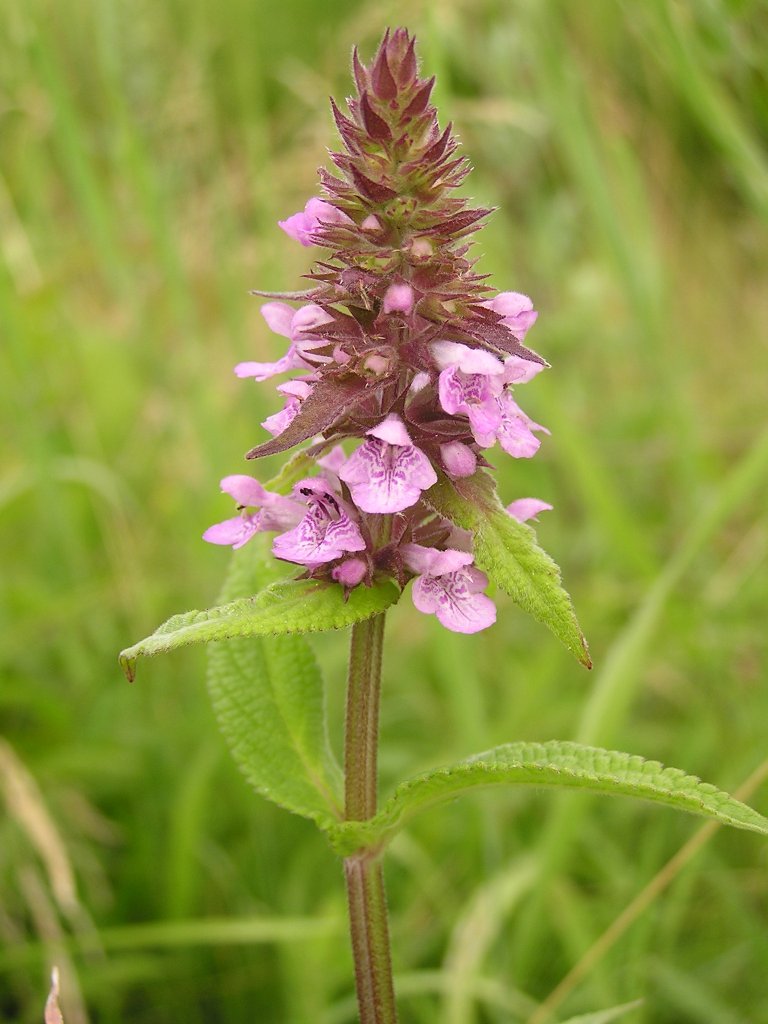 Marsh WoundwortStachys palustris
-
 Field WoundwortStachys arvensis
-
 Florida BetonyStachys floridana
-
 Perennial Yellow-WoundwortStachys recta
-
 Annual Yellow WoundwortStachys annua
Compare
Questions and answers
What is the scientific name of the Hairy Woundwort?
The scientific name of the Hairy Woundwort is Stachys ocymastrum. Written with its author, the full name is Stachys ocymastrum (L.) Briq..
Which family does the Hairy Woundwort belong to?
Stachys ocymastrum belongs to the family Lamiaceae, in the order Lamiales and the class Magnoliopsida.
Where is the Hairy Woundwort found?
Checklists and occurrence records place Stachys ocymastrum in 15 countries, including Spain, Portugal, France, Algeria, Morocco and Italy.
What other names does the Hairy Woundwort have?
Stachys ocymastrum is also known in English as Italian Woundwort.
Sources
Passages the profile rests on
- The plant has ascending stems. Source passage: “A hairy annual with ascending stems and ovate toothed leaves, lower ones stalked.” — academia.edu
- The plant has ovate, toothed leaves. Source passage: “A hairy annual with ascending stems and ovate toothed leaves, lower ones stalked.” — academia.edu
- The lower leaves have stalks. Source passage: “A hairy annual with ascending stems and ovate toothed leaves, lower ones stalked.” — academia.edu
- The plant has a hairy appearance. Source passage: “A hairy annual with ascending stems and ovate toothed leaves, lower ones stalked.” — academia.edu
- Individual plants can reach a height of 0.4 metres. Source passage: “Individuals can grow to 0.4 m.” — English Wikipedia
- The species has a self-supporting growth form. Source passage: “They have a self-supporting growth form.” — English Wikipedia
- The species' flowers are visited by the Green-striped White butterfly. Source passage: “Flowers are visited by Green-striped White.” — English Wikipedia
Data
- Catalogue of Life, 2026-10-16 XR cc by
- Global Biodiversity Information Facility CC BY 4.0
- Wikidata CC0
- GeoNames CC BY 4.0
- Wikimedia Commons per image; credit shown with each image
- Within the Catalogue of Life, this name comes from Synonymic Checklists of the Vascular Plants of the World cc by
References
- Briq. Lab. Alp. Mar. 252 (1893). where the name was published
This species in other databases
- Catalogue of Life 4ZFSW
- Wikidata Q6133608
- iNaturalist 82914
- World Flora Online wfo-0000314327
- GRIN 407644
Page built on 27 November 2026. See how the catalog is made and all sources and licences.
Cite this page
ScientificNames.org. (2026). Stachys ocymastrum (Hairy Woundwort). Retrieved November 27, 2026, from https://scientificnames.org/species/stachys-ocymastrum
“Stachys ocymastrum (Hairy Woundwort).” ScientificNames.org, 2026, scientificnames.org/species/stachys-ocymastrum. Accessed 27 Nov. 2026.
ScientificNames.org. “Stachys ocymastrum (Hairy Woundwort).” Accessed November 27, 2026. https://scientificnames.org/species/stachys-ocymastrum.
@misc{scientificnames_stachys_ocymastrum_hairy_woundwort,
  author = {{ScientificNames.org}},
  title = {Stachys ocymastrum (Hairy Woundwort)},
  year = {2026},
  url = {https://scientificnames.org/species/stachys-ocymastrum},
  note = {Accessed 2026-11-27}
}