Species · Fishes
Oceania Fantail Ray Taeniura lessoni
The scientific name of the Oceania Fantail Ray is Taeniura lessoni. It is a species of fish in the family Dasyatidae (whiptail stingray), order Myliobatiformes. The name dates from 2016.
- Scientific name
- Taeniura lessoni Last, White & Naylor, 2016
- Common name
- Oceania Fantail Ray
- Genus
- Taeniura
- Family
- Dasyatidae (Whiptail Stingray)
- Order
- Myliobatiformes
- Class
- Elasmobranchii
- Red List category
- DD Data Deficient
- Environment
- marine
- Recorded in
- 4 countries
- Name status
- accepted in the Catalogue of Life

Overview
Taeniura lessoni occurs in Papua New Guinea, Solomon Islands, Vanuatu and Fiji, usually inhabiting inshore waters, particularly coral reef habitats.
Written 27 November 2026 from the sources listed below. Each statement was checked against the passage it cites; statements that could not be supported were removed.
Appearance
The species lacks a pair of bluish longitudinal stripes along the sides of its tail. It has no dorsal fold but has a firm ridge along the upper margin of its tail.[1][2]
The species has a relatively short post-orbital disc and a uniformly pale ventral fold.[3][4]
It can reach a maximum disc width of approximately 21–22 cm.[5]
Habitat
The species is usually found in inshore waters, particularly in coral reef habitats. It inhabits waters at depths of approximately 18 metres.[6][7]
Conservation
The species may be susceptible to habitat-level threats. Coral bleaching resulting from climate change is identified as a possible threat.[8][9]
Classification of the Oceania Fantail Ray
| Kingdom | Animalia |
|---|---|
| Phylum | Chordata |
| Subphylum | Vertebrata |
| Infraphylum | Gnathostomata |
| Parvphylum | Chondrichthyes |
| Class | Elasmobranchii |
| Subclass | Neoselachii |
| Infraclass | Batoidea |
| Order | Myliobatiformes |
| Family | Dasyatidae (Whiptail Stingray) |
| Genus | Taeniura (Ribbontail Stingrays) |
| Species | Taeniura lessoni Last, White & Naylor, 2016 |
Origin of the name. Etymology. Epithet in recognition of the work of the 19 th C French scientist, Rene Lesson, who once worked on members of this genus in Melanesia. Vernacular: Oceania Fantail Ray. FIGURE 13. Original illustration of Trygon halgani from Lesson (1831) clearly showing the paired blue stripes on the tail. FIGURE 14. Dorsal view of one of the syntypes (MNHN A 7994) of Trygon halgani Lesson (preserved). Comparisons. Taeniura lessoni is immediately distinguishable from T. lymma in the field by the absence of a pair of blue stripes along the sides of the tail, and the ventral fold is uniformly pale in T. lessoni (fold margin darker than its base in T. lymma with the tail tip usually white). Closer inspection of the tail of T. lymma reveals that its upper post-sting margin in raised slight to form an angular, fleshy ridge that becomes a distinct low fold near the tail tip in juveniles. In the T. lessoni types the margin appears as a firm ridge, not forming a fold and its edge is less acute than in T. lymma. A comparison of the T. lessoni types with 4 similar-sized specimens of T. lymma (QM I 17668, QM I 31356, QM I 8328 and QM I 6666) indicated that these species might differ subtly in some morphometrics details: length from rear of orbit to pectoral-fin insertion 63.4 - 65.2 % vs. 65.6 - 74.1 % DW in T. lymma; horizontal snout length 20.0 - 21.2 % vs. 17.1 - 19.4 % DW; prenasal length 14.3 - 15.6 % vs. 12.2 - 14.7 % DW, 1.46 - 1.94 vs. 1.36 - 1.39 times internasal width; and pelvic-fin length 28.8 - 30.8 % vs. 32.3 - 34.3 % DW. However, no doubt these species are very similar morphologically and more data is needed to determine the extent of interspecific variability. Taeniura lymma may also attain a slightly larger size than T. lessoni (35 cm rather than 22 cm DW, Last et al., in press). The distributions of these two similar species do not appear to overlap. Both occur off Papua New Guinea, based on underwater images, but they do not appear to be sympatric. Lesson (1831) described Trygon halgani based on material from Waigeo (Indonesia) and Port Praslin (New Ireland). His illustrated syntype (Fig. 13) is clearly referable to T. lymma due to the presence of the longitudinal blue stripes on the tail. The two syntypes attributed to this species are listed as being from Port Praslin. Seret & McEachran (1986) compared the two available New Ireland specimens (MNHN A 7994, Fig. 14) to Lesson's drawing, and found some similarities in the pattern of spots between the " larger " specimen and the drawing (mainly on the interorbital space and inner left pectoral fin). However, because of uncertainty as to which of these two specimens Lesson used as the type, they decided to consider both specimens as syntypes and also treated Trygon halgani as a junior synonym of Taeniura lymma. Lesson also unequivocally mentioned the existence of ' two soft blue lines extending along the entire length of the tail' and these markings are evident in his colour painting of the type (Fig. 13) - a key diagnostic feature of T. lymma but absent in T. lessoni. However, while the two syntypes of T. halgani are in good condition, and the blue spots remain distinctive, the blue stripes on the tail are not clearly evident based on images of these specimens. According to B. Seret (pers. comm.), the blue tail stripes mentioned by Lesson were still visible in the preserved specimens as darker bands (most evident on the " larger " specimen) when examined in the 1980 s. The confirmed presence of T. lessoni (and possible absence of T. lymma) from New Ireland confounds this issue. However, given that Lesson's illustrated ' type' clearly depicts T. lymma, T. halgani must be considered a synonym of that species. Additional collections of these rays are needed from New Ireland, and the surrounding island groups of Papua New Guinea, to determine the local range of T. lessoni in this area and whether the two species co-occur. From information gathered to date, T. lymma has been confirmed from Milne Bay (KRFS unregistered specimens), Madang (NTUM 10296), Trobriand Islands (e. g. BMNH 1974.5. 25.1, USNM 206313), Port Moresby (FMNH 120119) and Daru (e. g. USNM 222553) in Papua New Guinea. Furthermore, Miklouho-Maclay & Macleay (1886) described Discobatis marginipinnis from the Admiralty Islands of PNG. While no type specimens were retained, the illustration and description clearly highlight that the possession of blue lines on the tail diagnostic of T. lymma. In comparison, T. lessoni has been confirmed from Rabaul (East New Britain) and Kavieng (New Ireland) based on underwater images. Thus, T. lymma appears to be common around mainland Papua New Guinea, but T. lessoni may be confined to New Ireland and eastern New Britain.
Where the Oceania Fantail Ray is found
Checklists and occurrence records place Taeniura lessoni in 4 countries. GBIF holds 131 georeferenced records of it.
Countries
Regions and cities with the most records
- Western, Fiji 16
- Port-Vila, Vanuatu 9
- Lautoka, Fiji 5
- Nadi, Fiji 3
- Northern, Fiji 3
- Shefa, Vanuatu 3
A number beside a place is its count of GBIF occurrence records. A place without a number comes from a checklist alone. Records show where a species has been observed or collected, which can include escapes and vagrants.
Common names
English
- Oceania Fantail Ray
- Oceanic Fantail Ray
Names in 2 other languages
- Italian
- Pastinaca a macchie blu delle Figi, Pastinaca a macchie blu di Lesson, Pastinaca a macchie blu oceanica, Pastinaca a macchie blu orientale, Trigone a macchie blu delle Figi, Trigone a macchie blu di Lesson, Trigone a macchie blu oceanico, Trigone a macchie blu orientale
- Portuguese
- Raia-de-laguna
Related species
-
 Bluespotted Ribbontail RayTaeniura lymma
-
 Common StingrayDasyatis pastinaca
-
 Pelagic StingrayPteroplatytrygon violacea
-
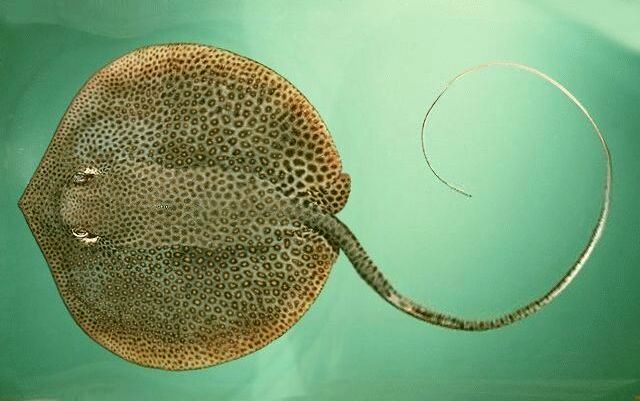 Reticulate WhiprayHimantura uarnak
-
 Leopard WhiprayHimantura leoparda
-
 Cowtail StingrayPastinachus sephen
-
 Porcupine RayUrogymnus asperrimus
-
 Kuhl's MaskrayNeotrygon kuhlii
Compare
Questions and answers
What is the scientific name of the Oceania Fantail Ray?
The scientific name of the Oceania Fantail Ray is Taeniura lessoni. Written with its author, the full name is Taeniura lessoni Last, White & Naylor, 2016.
Which family does the Oceania Fantail Ray belong to?
Taeniura lessoni belongs to the family Dasyatidae, in the order Myliobatiformes and the class Elasmobranchii.
Where is the Oceania Fantail Ray found?
Checklists and occurrence records place Taeniura lessoni in 4 countries: Fiji, Solomon Islands, Vanuatu and Wallis and Futuna.
What is the conservation status of the Oceania Fantail Ray?
The IUCN Red List category recorded for Taeniura lessoni is Data Deficient (DD).
What other names does the Oceania Fantail Ray have?
Taeniura lessoni is also known in English as Oceanic Fantail Ray.
Where is the Oceania Fantail Ray found?
It has been recorded in Papua New Guinea, Solomon Islands, Vanuatu and Fiji. It occurs in Melanesia, including the Solomon Islands and Vanuatu.[10][11]
What is the maximum size of the Oceania Fantail Ray?
It can reach a maximum disc width of approximately 21–22 cm.[5]
What habitat does the Oceania Fantail Ray inhabit?
It is usually found in inshore waters, particularly in coral reef habitats, at depths of approximately 18 metres.[6][7]
Sources
Passages the profile rests on
- The species lacks a pair of bluish longitudinal stripes along the sides of its tail. Source passage: “the absence of a pair of blue-ish longitudinal stripes along the tail's sides” — English Wikipedia
- The species lacks a dorsal fold but has a firm ridge along the upper margin of its tail. Source passage: “absence of dorsal fold but upper margin of tail with a firm ridge” — English Wikipedia
- The species has a relatively short post-orbital disc. Source passage: “relatively short post-orbital disc” — English Wikipedia
- The species has a uniformly pale ventral fold. Source passage: “uniformly pale ventral fold” — English Wikipedia
- The species can reach a maximum disc width of approximately 21–22 cm. Source passage: “It can reach a maximum size of around 21 or 22 cm (8.3 or 8.7 in) disc width.” — English Wikipedia
- The species is usually found in inshore waters, particularly in coral reef habitats. Source passage: “This species is usually found inshore, especially coral reefs habitat” — English Wikipedia
- The species inhabits waters at depths of approximately 18 metres. Source passage: “in the depth of around 18 metres (60 ft).” — English Wikipedia
- The species may be susceptible to habitat-level threats. Source passage: “possibly susceptible to habitat-level threats which targeted its habitat.” — English Wikipedia
- Coral bleaching resulting from climate change is identified as a possible threat to the species. Source passage: “such as coral bleaching resulted by climate change.” — English Wikipedia
- The species has been recorded in Papua New Guinea, Solomon Islands, Vanuatu and Fiji. Source passage: “These rays have been found in Papua New Guinea, Solomon Islands, Vanuatu, and Fiji” — English Wikipedia
- The species occurs in Melanesia, including the Solomon Islands and Vanuatu. Source passage: “found in Melanesia, including Solomon Islands and Vanuatu.” — inaturalist.org
- The species name honours French surgeon-naturalist René Lesson (1794–1849). Source passage: “The fish is named in honor of René Lesson (1794–1849), a French surgeon-naturalist” — English Wikipedia
- René Lesson previously worked on members of the genus in Melanesia. Source passage: “who once worked on the members of this genus in Melanesia” — English Wikipedia
Data
- Catalogue of Life, 2026-10-16 XR cc by
- Global Biodiversity Information Facility CC BY 4.0
- Wikidata CC0
- GeoNames CC BY 4.0
- Wikimedia Commons per image; credit shown with each image
- Within the Catalogue of Life, this name comes from World Register of Marine Species cc by
References
- Last, P. R., White, W. T., & Naylor, G. (2016). Three new stingrays (Myliobatiformes: Dasyatidae) from the Indo–West Pacific. Zootaxa, 4147. https://doi.org/10.11646/zootaxa.4147.4.2 Link where the name was published
This species in other databases
- Catalogue of Life 54JCY
- Wikidata Q26260487
- iNaturalist 519608
- WoRMS urn:lsid:marinespecies.org:taxname:1043629
Page built on 28 November 2026. See how the catalog is made and all sources and licences.
Cite this page
ScientificNames.org. (2026). Taeniura lessoni (Oceania Fantail Ray). Retrieved November 28, 2026, from https://scientificnames.org/species/taeniura-lessoni
“Taeniura lessoni (Oceania Fantail Ray).” ScientificNames.org, 2026, scientificnames.org/species/taeniura-lessoni. Accessed 28 Nov. 2026.
ScientificNames.org. “Taeniura lessoni (Oceania Fantail Ray).” Accessed November 28, 2026. https://scientificnames.org/species/taeniura-lessoni.
@misc{scientificnames_taeniura_lessoni_oceania_fantail_ray,
  author = {{ScientificNames.org}},
  title = {Taeniura lessoni (Oceania Fantail Ray)},
  year = {2026},
  url = {https://scientificnames.org/species/taeniura-lessoni},
  note = {Accessed 2026-11-28}
}