Species · Birds
Bannerman's Turaco Tauraco bannermani
The scientific name of the Bannerman's Turaco is Tauraco bannermani. It is a species of bird in the family Musophagidae (turaco), order Musophagiformes. The name dates from 1923.
- Scientific name
- Tauraco bannermani (G. L. Bates, 1923)
- Common name
- Bannerman's Turaco
- Genus
- Tauraco
- Family
- Musophagidae (Turaco)
- Order
- Musophagiformes
- Class
- Aves
- Red List category
- NT Near Threatened
- Recorded in
- 2 countries
- Name status
- accepted in the Catalogue of Life

Overview
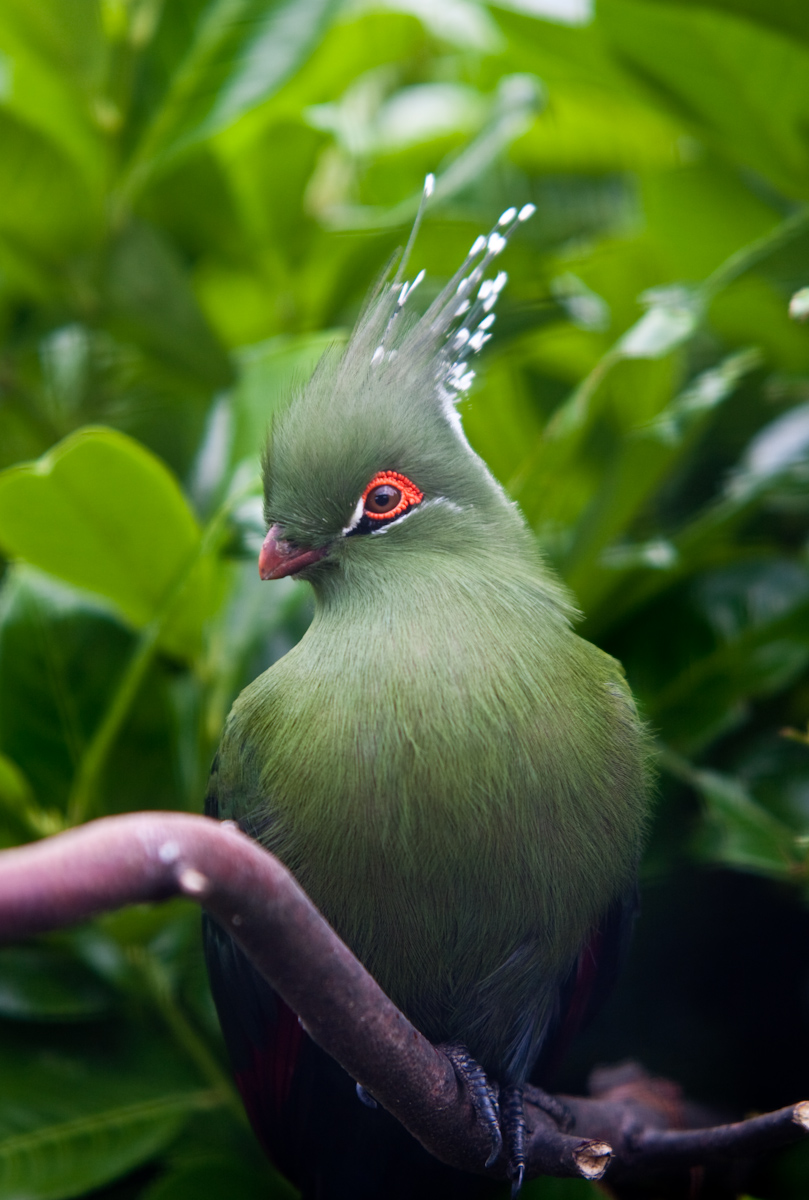
Bannerman's Turaco is a bird in the family Musophagidae and order Musophagiformes. It is endemic to Cameroon, with its principal population in the Bamenda Highlands of western Cameroon. It has a grey head, an orange-red crown, crest and nape, dark green upperparts, paler green underparts and a blue tail.
Written 26 November 2026 from the sources listed below. Each statement was checked against the passage it cites; statements that could not be supported were removed.
Appearance
Adults reach a body length of 43 cm. The species has a grey head, orange-red crown, crest and nape, dark green upperparts, paler green underparts and a blue tail.[1][2]
Red patches beneath the wings are visible when the bird flies.[3]
Habitat
Bannerman's Turaco inhabits subtropical or tropical moist montane forests at altitudes of 2,200–2,600 metres. It occupies both primary montane forests and secondary forests that retain plenty of tall trees.[4][5][6]
Its principal population occurs in the Bamenda Highlands of western Cameroon. Some individuals occur in the Massif du Mbam in Cameroon, and the species has also been recorded in forest remnants in the Bamenda Highlands of the Western High Plateau.[7][8][9]
Historical climatic changes contributed to declining forest cover in the region inhabited by the species. It became restricted to montane habitats where forest cover remained.[10][11]
Behaviour
Bannerman's Turaco is shy and is seldom observed. It is reluctant to cross cleared areas.[12][13]
Its distinctive call consists of a series of raucous notes. Its vocalizations can be heard from a distance of one kilometre.[14][15]
Uses
Local villagers hunt the species for its feathers, which are used in ceremonies.[16]
Similar species
Genetic studies indicate that Bannerman's Turaco is closely related to the red-crested turaco (Tauraco erthrolophus) and the white-crested turaco (Tauraco leucolophus). It diverged from these two closely related turaco species in the late Pliocene.[17][18][19]
Conservation
The IUCN estimated the population at 4,800–14,000 mature individuals. The species occurs in fragmented populations, and its population trend is decreasing.[20][21][22]
Habitat loss is the principal cause of the population decline. Wildfires are a major source of habitat loss, while agricultural land clearance, grazing, timber extraction and firewood collection also contribute.[23][24][25][26]
The species tends not to survive in forest fragments.[27]
Classification of the Bannerman's Turaco
| Kingdom | Animalia |
|---|---|
| Phylum | Chordata |
| Subphylum | Vertebrata |
| Infraphylum | Gnathostomata |
| Parvphylum | Osteichthyes |
| Megaclass | Tetrapoda |
| Class | Aves (Bird) |
| Order | Musophagiformes (Turaco) |
| Family | Musophagidae (Turaco) |
| Genus | Tauraco (Turacos) |
| Species | Tauraco bannermani (G. L. Bates, 1923) |
Where the Bannerman's Turaco is found
Checklists and occurrence records place Tauraco bannermani in 2 countries across Africa. GBIF holds 164 georeferenced records of it.
Countries
Regions and cities with the most records
- North-West, Cameroon 139
- Bamenda, Cameroon 95
- Oku, Cameroon 34
- Bali, Cameroon 24
- Ndop, Cameroon 18
- Bafut, Cameroon 17
- Kumbo, Cameroon 16
- Taraba State, Nigeria 10
- Fundong, Cameroon 8
Range as the checklists state it
Africa
A number beside a place is its count of GBIF occurrence records. A place without a number comes from a checklist alone. Records show where a species has been observed or collected, which can include escapes and vagrants.
Common names
English
- Bannerman's Turaco
- BATU
Names in 30 other languages
- Arabic
- توراكو بانرمان, توراكو بانرماني
- Breton
- Tourako Bannerman
- Bulgarian
- Банерманово турако
- Catalan
- turac de Bannerman
- Chinese
- 喀麥隆冠蕉鵑, 班氏蕉鹃
- Czech
- turako Bannermanův, turako kamerunský
- Danish
- Cameroonturako, Camerounturako
- Dutch
- Bannermans Toerako
- Esperanto
- kamerunia turako
- Estonian
- kameruni turako
- Finnish
- kameruninturako
- French
- Touraco de Bannerman, Touraco doré
- German
- Bannerman-Turako, Bannermanturako
- Hungarian
- Bannerman-turákó
- Italian
- Turaco di Bannerman
- Japanese
- ニシアカガシラエボシドリ
- Lithuanian
- Banermano turakas
- Norwegian
- kamerunturako
- Persian
- وزخوار بنرمن
- Polish
- turak kameruński
- Portuguese
- turaco-de-bamenda, turaco-de-bannerman
- Russian
- Камерунский турако, Турако Баннермана
- Serbian
- Kamerunski turako
- Slovak
- turako zlatistý
- Spanish
- Turaco de Bannerman
- Swedish
- bamendaturako
- Turkish
- Bannerman Turakosu
- Ukrainian
- турако камерунський
- Welsh
- twraco Bannerman
- mrj
- Баннерман турако
Synonyms
One other scientific name has been used for this species and is now treated as a synonym of Tauraco bannermani.
- Proturacus bannermani G. L. Bates, 1923
Related species
-
 Red-crested TuracoTauraco erythrolophus
-
 Knysna TuracoTauraco corythaix
-
 Guinea TuracoTauraco persa
-
 Livingstone's TuracoTauraco livingstonii
-
 Schalow's TuracoTauraco schalowi
-
 Fischer's TuracoTauraco fischeri
-
 Hartlaub's TuracoTauraco hartlaubi
-
 White-crested TuracoTauraco leucolophus
Compare
Questions and answers
What is the scientific name of the Bannerman's Turaco?
The scientific name of the Bannerman's Turaco is Tauraco bannermani. Written with its author, the full name is Tauraco bannermani (G. L. Bates, 1923).
Which family does the Bannerman's Turaco belong to?
Tauraco bannermani belongs to the family Musophagidae, in the order Musophagiformes and the class Aves.
Where is the Bannerman's Turaco found?
Checklists and occurrence records place Tauraco bannermani in 2 countries: Cameroon and Nigeria.
What is the conservation status of the Bannerman's Turaco?
The IUCN Red List category recorded for Tauraco bannermani is Near Threatened (NT).
What other names does the Bannerman's Turaco have?
Tauraco bannermani is also known in English as BATU.
Sources
Passages the profile rests on
- The species has a grey head, orange-red crown, crest and nape, dark green upperparts, paler green underparts and a blue tail. Source passage: “It has a grey head, orange-red crown, crest and nape, dark green upper parts, paler green underparts and a blue tail.” — English Wikipedia
- Adults reach a body length of 43 cm. Source passage: “Bannerman's turaco grows to a length of 43 cm (17 in).” — English Wikipedia
- Red patches beneath the wings are visible when the bird flies. Source passage: “Red under-wing patches are visible in flight” — English Wikipedia
- The species inhabits subtropical or tropical moist montane forests. Source passage: “Its natural habitat is subtropical or tropical moist montane forests.” — English Wikipedia
- The species occupies both primary montane forests and secondary forests that retain plenty of tall trees. Source passage: “It inhabits montane forest, either primary forests or secondary forests where plenty of tall trees are allowed to remain” — English Wikipedia
- Its recorded altitudinal range is 2,200–2,600 metres. Source passage: “Its altitudinal range is between 2,200 and 2,600 m (7,200 and 8,500 ft).” — English Wikipedia
- Its principal population occurs in the Bamenda Highlands of western Cameroon. Source passage: “Its main population is in the Bamenda Highlands in western Cameroon” — English Wikipedia
- Some individuals occur in the Massif du Mbam in Cameroon. Source passage: “with some birds being present in the Massif du Mbam.” — English Wikipedia
- The species has also been recorded in forest remnants in the Bamenda Highlands of the Western High Plateau. Source passage: “It has also been recorded from forested remnants in the Bamenda Highlands in the Western High Plateau.” — English Wikipedia
- Historical climatic changes contributed to declining forest cover in the region inhabited by the species. Source passage: “climatic changes occurred which subsequently led to increasingly arid conditions, a decrease in forest cover and an increase in wooded savannah.” — English Wikipedia
- The species became restricted to montane habitats where forest cover remained. Source passage: “Bannerman's turaco became restricted to montane habitats where the forest cover remained.” — English Wikipedia
- The species is shy and is seldom observed. Source passage: “it is a shy bird and seldom seen.” — English Wikipedia
- The species is reluctant to cross cleared areas. Source passage: “being reluctant to cross cleared areas.” — English Wikipedia
- Its distinctive call consists of a series of raucous notes. Source passage: “Its voice is distinctive however, being a raucous series of "kow-kow-kow" notes” — English Wikipedia
- Its vocalizations can be heard from a distance of one kilometre. Source passage: “that can be heard a kilometre away.” — English Wikipedia
- Local villagers hunt the species for its feathers, which are used in ceremonies. Source passage: “The birds are also hunted for their feathers which are used in ceremonies by the local villagers.” — English Wikipedia
- Genetic studies indicate that Bannerman's turaco is closely related to the red-crested turaco (Tauraco erthrolophus). Source passage: “this species is closely related to the red-crested turaco (Tauraco erthrolophus)” — English Wikipedia
- Genetic studies indicate that Bannerman's turaco is closely related to the white-crested turaco (Tauraco leucolophus). Source passage: “and white-crested turaco (Tauraco leucolophus)” — English Wikipedia
- Bannerman's turaco diverged from its two closely related turaco species in the late Pliocene. Source passage: “having diverged from them in the late Pliocene.” — English Wikipedia
- The IUCN estimated the population at 4,800–14,000 mature individuals. Source passage: “there are between 4,800 and 14,000 mature individuals” — English Wikipedia
- The species occurs in fragmented populations. Source passage: “scattered among fragmented populations” — English Wikipedia
- The population trend is decreasing. Source passage: “and that the number of birds is decreasing.” — English Wikipedia
- Habitat loss is the principal cause of the species' population decline. Source passage: “The chief cause of the declining population is habitat loss” — English Wikipedia
- Wildfires are a major source of habitat loss affecting the species. Source passage: “mostly from wildfires” — English Wikipedia
- Agricultural land clearance and grazing contribute to habitat loss affecting the species. Source passage: “but also from land clearance for agriculture and grazing” — English Wikipedia
- Timber extraction and firewood collection also contribute to habitat loss. Source passage: “and from timber extraction and the collection of firewood.” — English Wikipedia
- The species tends not to survive in forest fragments. Source passage: “It tends not to survive in forest fragments” — English Wikipedia
- Bannerman's turaco is endemic to Cameroon. Source passage: “It is endemic to Cameroon.” — English Wikipedia
Data
- Catalogue of Life, 2026-10-16 XR cc by
- Global Biodiversity Information Facility CC BY 4.0
- Wikidata CC0
- GeoNames CC BY 4.0
- Wikimedia Commons per image; credit shown with each image
- Within the Catalogue of Life, this name comes from The Integrated Taxonomic Information System cc0
References
- Dickinson, Edward C., ed. (2003). The Howard and Moore Complete Checklist of the Birds of the World, 3rd Edition.
- Gill, Frank, & and Minturn Wright. (2006). Birds of the World: Recommended English Names.
- Dickinson, E. C., and J. V. Remsen Jr., eds. (2013). The Howard and Moore Complete Checklist of the Birds of the World, 4th Edition, Vol. 1 Non-Passerines.
This species in other databases
Page built on 28 November 2026. See how the catalog is made and all sources and licences.
Cite this page
ScientificNames.org. (2026). Tauraco bannermani (Bannerman's Turaco). Retrieved November 28, 2026, from https://scientificnames.org/species/tauraco-bannermani
“Tauraco bannermani (Bannerman's Turaco).” ScientificNames.org, 2026, scientificnames.org/species/tauraco-bannermani. Accessed 28 Nov. 2026.
ScientificNames.org. “Tauraco bannermani (Bannerman's Turaco).” Accessed November 28, 2026. https://scientificnames.org/species/tauraco-bannermani.
@misc{scientificnames_tauraco_bannermani_bannermans_turaco,
  author = {{ScientificNames.org}},
  title = {Tauraco bannermani (Bannerman's Turaco)},
  year = {2026},
  url = {https://scientificnames.org/species/tauraco-bannermani},
  note = {Accessed 2026-11-28}
}