Species · Birds
White-crested Turaco Tauraco leucolophus
The scientific name of the White-crested Turaco is Tauraco leucolophus. It is a species of bird in the family Musophagidae (turaco), order Musophagiformes. The name dates from 1855.
- Scientific name
- Tauraco leucolophus (Heuglin, 1855)
- Common name
- White-crested Turaco
- Genus
- Tauraco
- Family
- Musophagidae (Turaco)
- Order
- Musophagiformes
- Class
- Aves
- Red List category
- LC Least Concern
- Recorded in
- 9 countries
- Name status
- accepted in the Catalogue of Life

Overview
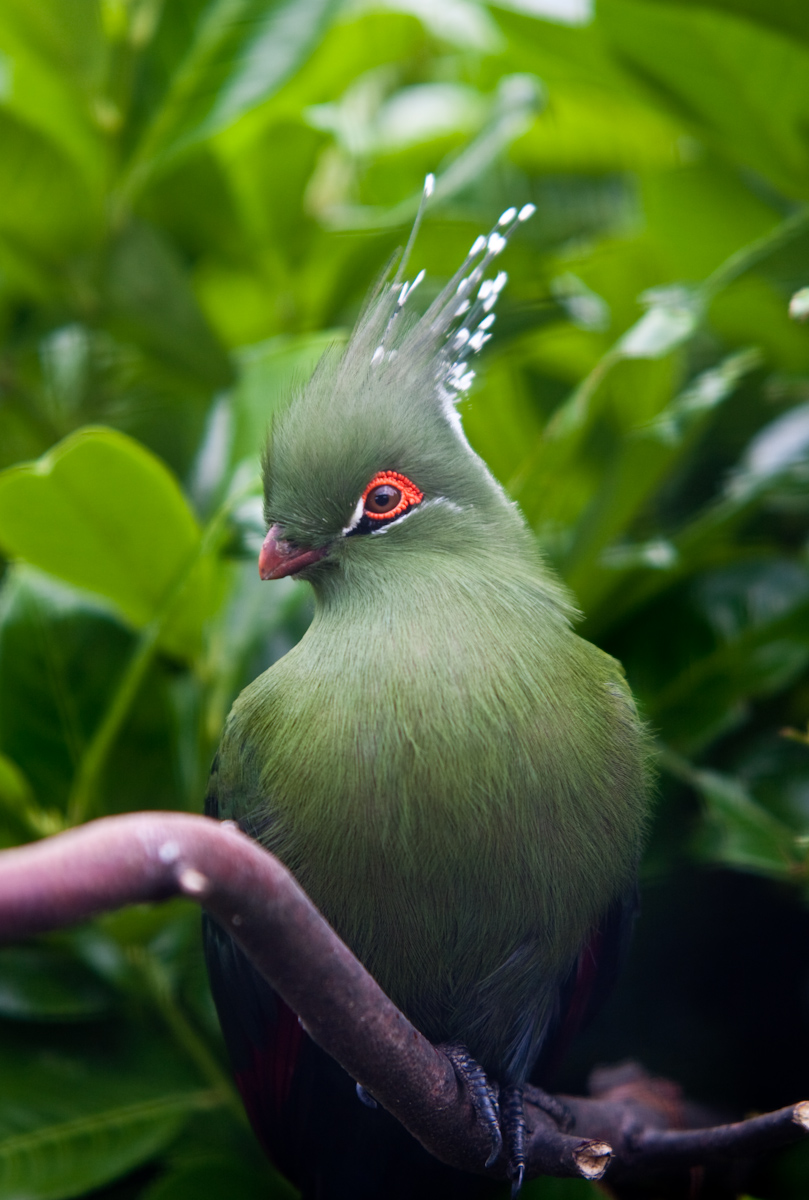
Tauraco leucolophus inhabits riverine forests, lowland forests, woodland, and savannah. It has glossy bluish-black upperparts, a white crest, cheeks, neck, and throat, and violet wing coverts and tail feathers.
Written 26 November 2026 from the sources listed below. Each statement was checked against the passage it cites; statements that could not be supported were removed.
Appearance
The White-crested Turaco has glossy bluish-black upperparts contrasting with a white crest, cheeks, neck, and throat. Its shoulders have a green mantle, while its wing coverts and tail feathers are violet.[1][2]
It also has a mostly white head with a black mark above the eye. Its wings and tail are dark blue, and its back and underparts are green.[3]
Habitat
The White-crested Turaco inhabits riverine forests, lowland forests, woodland, and savannah. It typically occurs in forests alongside rivers and wooded savannahs, especially in areas with tangled masses of creepers.[4][5][6]
It occurs in hilly habitats at elevations of up to approximately 2,200 metres.[7]
Its native range extends across Nigeria, Cameroon, Chad, the Central African Republic, the Democratic Republic of Congo, Sudan, South Sudan, Kenya, and Uganda. The range forms a belt from eastern Nigeria to western Kenya.[8][9]
Diet
The White-crested Turaco primarily eats berries and fruits. It also consumes flowers and invertebrates, including snails.[10][11]
Reproduction and life cycle
The breeding season occurs in April in the Congo and August in Uganda. The species builds a relatively insubstantial, saucer-shaped nest.[12][13]
Similar species
Genetic studies identify the red-crested turaco (Tauraco erthrolophus) and Bannerman's turaco (Tauraco bannermanii) as close relatives of the White-crested Turaco. The species diverged from these two relatives during the late Pliocene.[14][15]
Conservation
The White-crested Turaco is assessed as being of Least Concern by the International Union for Conservation of Nature. Its population appears to be steady, and no specific threats have been identified.[16][17]
The species was most recently assessed for the IUCN Red List in 2024.[18]
Classification of the White-crested Turaco
| Kingdom | Animalia |
|---|---|
| Phylum | Chordata |
| Subphylum | Vertebrata |
| Infraphylum | Gnathostomata |
| Parvphylum | Osteichthyes |
| Megaclass | Tetrapoda |
| Class | Aves (Bird) |
| Order | Musophagiformes (Turaco) |
| Family | Musophagidae (Turaco) |
| Genus | Tauraco (Turacos) |
| Species | Tauraco leucolophus (Heuglin, 1855) |
Where the White-crested Turaco is found
Checklists and occurrence records place Tauraco leucolophus in 9 countries across Africa. GBIF holds 2,672 georeferenced records of it.
Countries
- Cameroon 174
- Central African Republic 49
- Chad 4
- Democratic Republic of the Congo 97
- Kenya 699
- Nigeria 186
- South Sudan 45
- Sudan 15
- Uganda 1,403
Regions and cities with the most records
- Kabarnet, Kenya 266
- Baringo, Kenya 214
- West Pokot County, Kenya 214
- Pakwach, Uganda 187
- Makutano, Kenya 166
- Taraba State, Nigeria 166
- Kapenguria, Kenya 130
- Adamaoua, Cameroon 93
- Iten, Kenya 70
- Haut-Uele, Democratic Republic of the Congo 63
- Moroto, Uganda 61
- North, Cameroon 58
- Trans Nzoia, Kenya 54
- Masindi, Uganda 51
- Kitale, Kenya 40
- Ouaka, Central African Republic 19
- Mbomou, Central African Republic 14
- Adamawa, Nigeria 12
- Busia County, Kenya 11
- Kapchorwa, Uganda 10
- Kiminini, Kenya 10
- Lugulu, Kenya 10
- Luwero, Uganda 10
- Kasanje, Uganda 8
- Lugazi, Uganda 7
- Mumias, Kenya 7
- Entebbe, Uganda 6
- Katabi, Uganda 6
- Mukono, Uganda 6
- Ngaoundéré, Cameroon 6
- Rwiimi, Uganda 6
- Ituri, Democratic Republic of the Congo 5
- Moi‘s Bridge, Kenya 5
- Moyo, Uganda 5
- Aru, Democratic Republic of the Congo 4
- Fort Portal, Uganda 4
1 more country has a few records outside this range
These countries hold a few records of Tauraco leucolophus but lie outside the range the checklists give for it. Such records are often zoo or garden specimens, museum material or vagrants, so the species is not counted as occurring there.
Range as the checklists state it
Africa
A number beside a place is its count of GBIF occurrence records. A place without a number comes from a checklist alone. Records show where a species has been observed or collected, which can include escapes and vagrants.
Common names
English
- White-crested Turaco
- WCTU
Names in 27 other languages
- Arabic
- توراكو ذو العرف الأبيض
- Catalan
- turac de cresta blanca
- Chinese
- 白冠蕉鵑, 白冠蕉鹃
- Croatian
- bjelokresti turako
- Czech
- turako bělochocholatý, turako bělokorunkatý
- Danish
- Hvidtoppet Turako
- Dutch
- Witkuiftoerako
- Esperanto
- blankakresta turako
- Estonian
- valgetutt-turako
- Finnish
- valkoharjaturako
- French
- Touraco à huppe blanche
- German
- Weißhaubenturako
- Hungarian
- fehérbóbitás turákó
- Italian
- Turaco crestabianca
- Japanese
- シロガシラエボシドリ
- Lithuanian
- baltakuodis turakas
- Norwegian
- hvithodeturako
- Polish
- turak białoczuby
- Portuguese
- turaco-de-crista-branca, turaco-de-poupa-branca
- Russian
- Белохохлый турако
- Serbian
- Beloćubi turako
- Slovak
- turako bielochochlatý
- Spanish
- Turaco crestiblanco
- Swedish
- vitkronad turako
- Turkish
- Ak Tepeli Turako, Beyaz İbikli Turako
- Ukrainian
- турако білочубий
- Welsh
- twraco cribwyn
Synonyms
2 other scientific names have been used for this species and are now treated as synonyms of Tauraco leucolophus.
- Corythaix leucolophus Heuglin, 1855
- Proturacus leucolophus Heuglin, MT, 1855
Related species
-
 Red-crested TuracoTauraco erythrolophus
-
 Knysna TuracoTauraco corythaix
-
 Guinea TuracoTauraco persa
-
 Livingstone's TuracoTauraco livingstonii
-
 Schalow's TuracoTauraco schalowi
-
 Fischer's TuracoTauraco fischeri
-
 Hartlaub's TuracoTauraco hartlaubi
-
 Bannerman's TuracoTauraco bannermani
Compare
Questions and answers
What is the scientific name of the White-crested Turaco?
The scientific name of the White-crested Turaco is Tauraco leucolophus. Written with its author, the full name is Tauraco leucolophus (Heuglin, 1855).
Which family does the White-crested Turaco belong to?
Tauraco leucolophus belongs to the family Musophagidae, in the order Musophagiformes and the class Aves.
Where is the White-crested Turaco found?
Checklists and occurrence records place Tauraco leucolophus in 9 countries, including Uganda, Kenya, Nigeria, Cameroon, Democratic Republic of the Congo and Central African Republic.
What is the conservation status of the White-crested Turaco?
The IUCN Red List category recorded for Tauraco leucolophus is Least Concern (LC).
What other names does the White-crested Turaco have?
Tauraco leucolophus is also known in English as WCTU.
What are some interesting facts about turacos?
The White-crested Turaco was first described in 1855 by German explorer and ornithologist Theodor von Heuglin. It diverged from its two identified close relatives during the late Pliocene.[19][15]
Sources
Passages the profile rests on
- The species has glossy bluish-black upperparts contrasting with a white crest, cheeks, neck, and throat. Source passage: “This distinctive bird has glossy, bluish-black upperparts which contrast markedly with its white crest, cheeks, neck and throat.” — English Wikipedia
- The species has a green mantle around its shoulders and violet wing coverts and tail feathers. Source passage: “It possesses a green mantle around the shoulders and violet wing coverts and rectrices.” — English Wikipedia
- The species has a mostly white head, a black mark above the eye, dark blue wings and tail, and a green back and underparts. Source passage: “Beautiful turaco with a mostly white head, a black mark above the eye, dark blue wings and tail, and a green back and underparts.” — ebird.org
- The species inhabits riverine forests and woodland. Source passage: “The white-crested turaco is native to riverine forest and woodland in a belt between eastern Nigeria and western Kenya.” — English Wikipedia
- The species occurs in lowland forests, woodland, and savannah. Source passage: “It occurs in lowland forests, woodland and savannah, and in hilly habitats up to an altitude of about 2,200 m (7,200 ft).” — English Wikipedia
- The species typically inhabits forests alongside rivers and wooded savannahs, especially areas with tangled masses of creepers. Source passage: “The white-crested turaco typically inhabits forests alongside rivers and wooded savannahs, particularly where there are tangled masses of creepers.” — English Wikipedia
- The species occurs in hilly habitats at elevations of up to approximately 2,200 metres. Source passage: “in hilly habitats up to an altitude of about 2,200 m (7,200 ft).” — English Wikipedia
- The species is native to Nigeria, Cameroon, Chad, the Central African Republic, the Democratic Republic of Congo, Sudan, South Sudan, Kenya, and Uganda. Source passage: “The white-crested turaco is native to Nigeria, Cameroon, Chad, Central African Republic, the Democratic Republic of Congo, Sudan, South Sudan, Kenya and Uganda.” — English Wikipedia
- The species' native range extends in a belt from eastern Nigeria to western Kenya. Source passage: “The white-crested turaco is native to riverine forest and woodland in a belt between eastern Nigeria and western Kenya.” — English Wikipedia
- The species primarily eats berries and fruits. Source passage: “It mostly eats berries and fruits” — English Wikipedia
- The species also consumes flowers and invertebrates, including snails. Source passage: “but also consumes flowers and invertebrates such as snails.” — English Wikipedia
- The breeding season occurs in April in the Congo and August in Uganda. Source passage: “The breeding season varies across the range, being April in the Congo and August in Uganda.” — English Wikipedia
- The species builds a relatively insubstantial, saucer-shaped nest. Source passage: “The nest is a rather insubstantial, saucer-shaped structure.” — English Wikipedia
- Genetic studies identify the red-crested turaco (Tauraco erthrolophus) and Bannerman's turaco (Tauraco bannermanii) as close relatives of this species. Source passage: “Genetic studies show that this species is closely related to the red-crested turaco (Tauraco erthrolophus) and Bannerman's turaco (Tauraco bannermanii)” — English Wikipedia
- The species diverged from its two identified close relatives during the late Pliocene. Source passage: “having diverged from them in the late Pliocene.” — English Wikipedia
- The species is assessed as being of Least Concern by the International Union for Conservation of Nature. Source passage: “the International Union for Conservation of Nature has assessed its conservation status as being of "least concern".” — English Wikipedia
- The species' population appears to be steady, and no specific threats have been identified. Source passage: “The population of white-crested turacos appears to be steady and no particular threats have been identified.” — English Wikipedia
- The species was most recently assessed for the IUCN Red List in 2024. Source passage: “White-crested Turaco Tauraco leucolophus has most recently been assessed for The IUCN Red List of Threatened Species in 2024.” — iucnredlist.org
- The species was first described in 1855 by German explorer and ornithologist Theodor von Heuglin. Source passage: “The white-crested turaco was first described in 1855 by the German explorer and ornithologist Theodor von Heuglin.” — English Wikipedia
Data
- Catalogue of Life, 2026-10-16 XR cc by
- Global Biodiversity Information Facility CC BY 4.0
- Wikidata CC0
- GeoNames CC BY 4.0
- Wikimedia Commons per image; credit shown with each image
- Within the Catalogue of Life, this name comes from The Integrated Taxonomic Information System cc0
References
- Dickinson, Edward C., ed. (2003). The Howard and Moore Complete Checklist of the Birds of the World, 3rd Edition.
- Gill, Frank, & and Minturn Wright. (2006). Birds of the World: Recommended English Names.
- Dickinson, E. C., and J. V. Remsen Jr., eds. (2013). The Howard and Moore Complete Checklist of the Birds of the World, 4th Edition, Vol. 1 Non-Passerines.
This species in other databases
Page built on 28 November 2026. See how the catalog is made and all sources and licences.
Cite this page
ScientificNames.org. (2026). Tauraco leucolophus (White-crested Turaco). Retrieved November 28, 2026, from https://scientificnames.org/species/tauraco-leucolophus
“Tauraco leucolophus (White-crested Turaco).” ScientificNames.org, 2026, scientificnames.org/species/tauraco-leucolophus. Accessed 28 Nov. 2026.
ScientificNames.org. “Tauraco leucolophus (White-crested Turaco).” Accessed November 28, 2026. https://scientificnames.org/species/tauraco-leucolophus.
@misc{scientificnames_tauraco_leucolophus_white_crested_turaco,
  author = {{ScientificNames.org}},
  title = {Tauraco leucolophus (White-crested Turaco)},
  year = {2026},
  url = {https://scientificnames.org/species/tauraco-leucolophus},
  note = {Accessed 2026-11-28}
}